
Articles 19 – 22: Right to Freedom under Part III of the Constitution of India
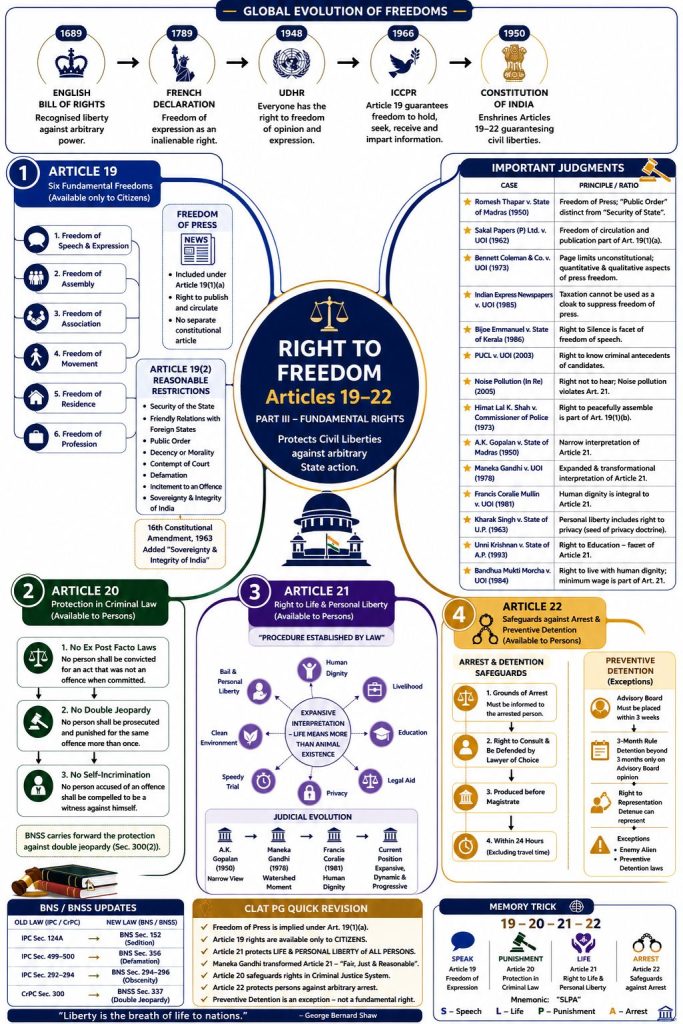
CLAT paper may throw up questions on Articles 19 to 22, and most aspirants mug up “reasonable restrictions” without knowing where the idea even came from. So let’s start there.
England’s Bill of Rights, 1689, was one of the first documents to treat free speech as a citizen’s entitlement, not a king’s favour. That idea still runs through English law today.
The French took it further. Their 1789 Declaration said people could speak, write and publish freely, but had to answer for misusing it. By 1948, the UDHR made this a global promise, and the ICCPR’s Article 19 gave it real teeth.
When the Press Fought Back and Freedom of Press
Romesh Thapar v. State of Madras (1950) kicked things off. Madras banned Thapar’s journal Cross Roads, calling it a “public safety” issue. The Court disagreed, since Article 19(2) only allows curbs for “security of the State,” a far narrower idea. The ban fell.
Sakal Papers v. Union of India (1962) was sneakier. The government tied newspaper prices to page count, forcing publishers to either raise prices or cut content. The Court struck it down, holding press freedom is baked into Article 19(1)(a).
Parliament responded with the 16th Amendment, 1963, adding “sovereignty and integrity of India” as a new restriction ground.
Bennett Coleman v. Union of India (1973) struck down page limits on newspapers. Press freedom, the Court said, has both a quantity side (how much) and a quality side (what is said).
By 1985, in Indian Express Newspapers, the issue was import duty pushing up prices. The duty survived, but the Court warned that taxing the press can never become a backdoor way to restrict speech.
Flags, Silence, and the Right to Not Sing
Union of India v. Naveen Jindal isn’t really about patriotism. It’s the Court reading flag-flying as free expression, something citizens shouldn’t need special permission for.
Bijoe Emanuel v. State of Kerala (1987) is quietly powerful. Three Jehovah’s Witness kids were expelled for not singing the anthem. No law actually compelled it, and silent, respectful standing disturbed no one. Expulsion overturned.
What Voters Deserve to Know: Rights of Voters
PUCL v. Union of India gave voters something we now take for granted: the right to know a candidate’s criminal record and assets. You can’t vote meaningfully in the dark. Disclosing educational qualifications, however, still isn’t compulsory.
Noise as a Constitutional Problem
Free speech has a limit built around silence too. In re: Noise Pollution (2005), the Court held that Article 21’s right to life includes freedom from noise. Your right to make noise ends where someone else’s peace begins.
Choosing How You Learn
Associated Management Schools v. Karnataka (2014) held that choosing a child’s medium of instruction is itself free expression under Article 19(1)(a). The State can’t override that choice.
The Grounds That Keep Speech in Check
Article 19(2) lists specific restriction grounds, not vague ones. Security of the State covers only serious threats, not everyday law and order issues. Friendly relations with foreign States (1951) stop hostile propaganda from wrecking diplomacy.
Public order (1951) is broader; it looks at whether society at large is disturbed. Decency or morality now sits under BNS Sections 294-296 (old IPC 292–294). Contempt of court restricts speech scandalising judicial authority.
Defamation has moved to BNS Section 356, replacing IPC 499 and 500. Incitement to an offence (1951) stops speech encouraging crime. Sovereignty and integrity of India came via the 16th Amendment, 1963.
Sedition isn’t even directly listed in Article 19(2). BNS Section 152 has replaced IPC 124-A, and courts confine it strictly to speech that actually incites violence, not mere criticism.
The Right to Assemble, and Its Limits
Article 19(1)(b) allows peaceful, unarmed assembly, subject to Article 19(3) restrictions. Notably, this right doesn’t stretch far enough to cover strikes.
In Himat Lal Shah v. Commissioner of Police (1973), police rules demanded prior permission for meetings but gave no clarity on refusal. That unchecked discretion couldn’t survive, and the rule was struck down.
Protection Against Conviction, Article 20
Clause (1) stops conviction under a law that didn’t exist when the act happened.
Clause (2) protects against double jeopardy, now backed by BNSS Section 337.
Clause (3) protects against self-incrimination.
Here’s a twist students miss: India’s double jeopardy rule is narrower than America’s Fifth Amendment. In the US, protection kicks in once charged. In India, you must have actually been punished earlier.
Article 21, the Right That Kept Growing
It started narrow. A.K. Gopalan (1950) read personal liberty as just freedom from bodily restraint. That didn’t last, Kharak Singh (1963) called it a broad umbrella covering every facet of individual freedom.
Maneka Gandhi (1978) blew the doors open, adding the right to consult a lawyer and stay in touch with family. Francis Coralie (1981) said living with dignity means food, shelter, and the freedom to express yourself.
The Court kept building. Bandhua Mukti Morcha (1984) tied minimum wage denial to Article 21. DTC v. Mazdoor Congress (1991) folded in the right to livelihood. Unni Krishnan (1993) read in the right to education, before Parliament formally added Article 21A via the 86th Amendment, 2002.
Article 22: Protection in Cases of Arrest and Detention
Clause (1) gives the right to know grounds of arrest and consult a lawyer.
Clause (2) requires production before a magistrate within 24 hours.
Clause (3) exempts preventive detention and enemy aliens from these protections.
Detention beyond three months needs an advisory board review, clause (4). The detainee must be told the grounds and get a chance to respond, clause (5). The authority can withhold facts against public interest, clause (6), and Parliament can specify longer detention categories by law, clause (7).
From a 1689 English statute to a 2023 BNS provision, that’s the full arc. These aren’t just case names to mug up, each one is the Court quietly redrawing the line between what the State controls and what a citizen keeps for themselves.
Subscribe for updates
Join 10,000+ subscribers.
HA
Hanspal Bakul
Contributing author
Have a doubt about this?Ask Doubts
