
Bailment and Pledge Under the Indian Contract Act, 1872
Contract law often deals with situations where goods change hands without a change in ownership. Bailment and pledge are two such concepts. Both fall under Chapter IX of the Indian Contract Act, 1872, spanning Sections 148 to 181. Understanding these terms helps clear up a lot of confusion around possession, ownership, and security transactions.
What Exactly Is Bailment?
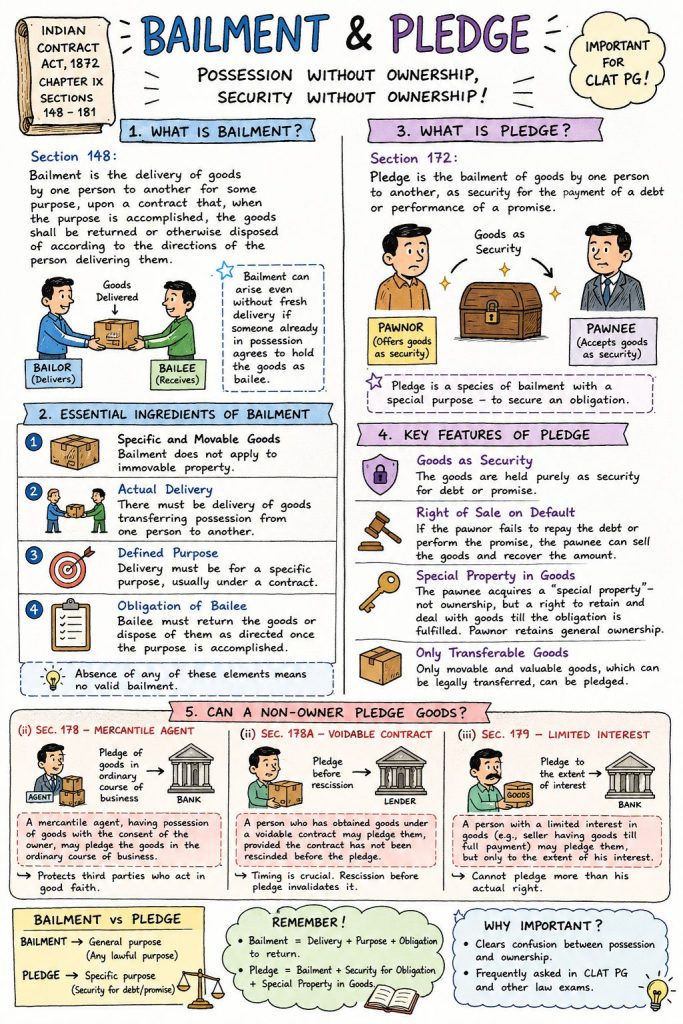
Section 148 explains bailment as the act of handing over goods from one person to another for a particular purpose. Once that purpose is fulfilled, the goods must be returned or dealt with as instructed by the person who gave them. The one handing over the goods is called the bailor, while the one receiving them is the bailee.
Interestingly, bailment doesn’t always begin with a fresh handover. If someone already holding another person’s goods agrees to hold them as a bailee, the relationship still counts as bailment. In such cases, the original delivery doesn’t need to have happened for the bailor-bailee bond to exist.
Key Ingredients That Make a Bailment
For a transaction to qualify as bailment, a few conditions need to be met. First, the property involved must be specific and movable, since bailment doesn’t apply to immovable assets. Second, there has to be an actual delivery that shifts possession from one party to another.
Additionally, this delivery must serve a defined purpose, typically backed by a contract. Finally, the bailee is bound by an obligation to return the goods or dispose of them exactly as directed once the purpose is achieved. Skipping any of these elements means the transaction won’t hold up as a valid bailment.
Moving on to Pledge
Pledge is essentially a specific type of bailment. Section 172 defines it as the bailment of goods by one person to another, used as security for repaying a debt or fulfilling a promise. The person offering the goods as security is the pawnor, and the person accepting them is the pawnee.
Since pledge is rooted in bailment, it naturally involves a transfer of possession. However, the purpose here is narrower and more specific, that is, securing an obligation rather than achieving a general task.
Core Features of a Valid Pledge
The goods pledged act purely as security. If the pawnor fails to repay the debt or honour the promise, the pawnee gets the right to sell the goods and recover what’s owed. This security-based purpose is what separates pledge from ordinary bailment.
Moreover, the pawnee gains what’s known as a “special property” in the pledged goods. This doesn’t mean ownership shifts. The pawnor still holds general ownership, but the pawnee earns a special right to retain and deal with the goods until the obligation is cleared.
It’s also worth noting that only transferable goods, meaning movable and economically valuable items, qualify for a pledge. Anything that can’t legally change hands doesn’t fit this category.
Can Someone Who Isn’t the Owner Pledge Goods?
Surprisingly, yes, in certain situations. Section 178 allows a mercantile agent, who holds goods with the owner’s consent, to pledge them as part of regular business dealings. This provision protects third parties who deal with such agents in good faith.
Similarly, Section 178A permits a person who obtained goods under a voidable contract to pledge them, provided the contract hasn’t been cancelled before the pledge takes place. Timing matters a lot here, since rescission before the pledge would invalidate the transaction.
Lastly, Section 179 covers people with a limited interest in goods, such as a seller still holding goods pending full payment. Such individuals can pledge the goods, but only to the extent of their actual interest, not beyond it.
Bailment and pledge might sound like technical jargon, but they show up constantly in everyday transactions, from leaving your car at a repair shop to pawning jewellery for a loan. Grasping these basics makes it much easier to understand broader contract law concepts and how possession-based obligations actually work in practice as well as the questions on the same in CLAT PG 2027.
Subscribe for updates
Join 10,000+ subscribers.
HA
Hanspal Bakul
Contributing author
Have a doubt about this?Ask Doubts
