Basic Introduction to the Transfer of Property Act, 1882
Introduction - Why was the law needed?
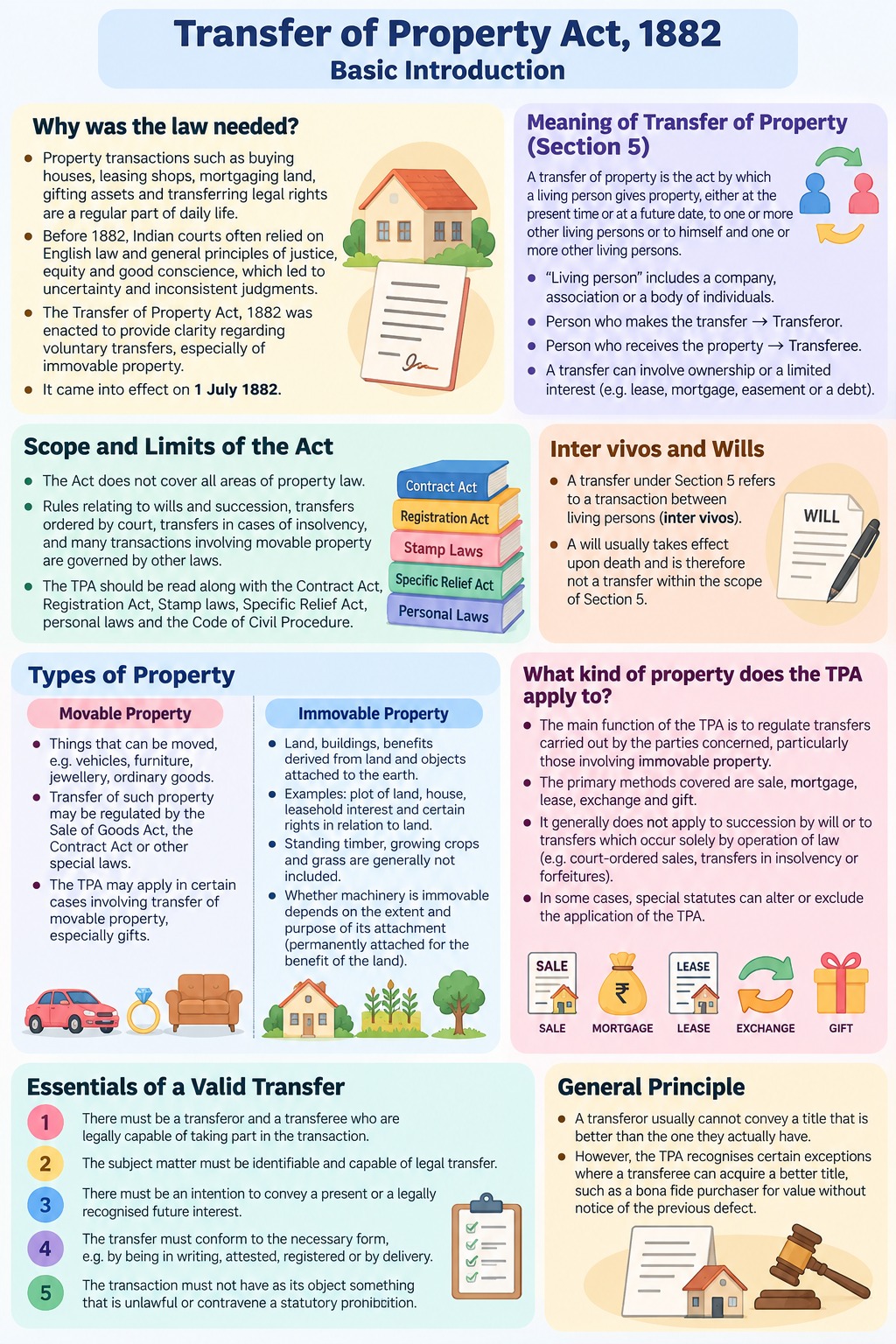
Property transactions are a regular part of daily life, with people buying houses, leasing shops, mortgaging land, gifting assets and transferring legal rights. Prior to the passage of the Transfer of Property Act, 1882 (TPA), the Indian courts frequently turned to English law and the general principles of justice, equity and good conscience. This approach on occasions led to a lack of certainty and to inconsistent judgments.
The TPA was introduced in order to provide clarity regarding voluntary transfers, especially in the case of immovable property, and it came into effect on 1 July 1882.
The Act does not constitute a full set of rules covering all areas of property law; rules relating to wills and succession, transfers ordered by court, transfers in cases of insolvency, and a number of transactions involving movable property are determined by other laws. The TPA has to be read in conjunction with the Contract Act, the Registration Act, the Stamp laws, the Specific Relief Act, the personal laws and the Code of Civil Procedure.
Meaning of Transfer of Property : Section 5
Section 5 describes the transfer of property as being the act by which a living person gives property, either at the present time or at a future date, to one or more other living persons or to himself and one or more other living persons. A 'living person' is taken to include a company, an association or a body of individuals. The person who makes the transfer is known as the transferor and the person who receives it is the transferee.
A transfer can involve ownership or a limited interest, for example a lease, a mortgage, an easement or a debt. The phrase 'inter vivos' refers to a transaction between living people. A will usually comes into effect upon death and is therefore not considered to be a transfer within the scope of Section 5. In the case of Suraj Lamp & Industries (P) Ltd. v. State of Haryana (2012), the Supreme Court made it clear that a general power of attorney, an agreement to sell and a will transaction do not in themselves convey title to immovable property, a legally recognised conveyance is necessary.
Types of Property : Movable and Immovable
Generally, movable property refers to things that can be moved, for example vehicles, furniture, jewellery and ordinary goods. The transfer of such property may be regulated by the Sale of Goods Act, the Contract Act or other special laws, and the TPA may apply in certain cases involving the transfer of movable property, especially in the case of gifts, but the main focus of the TPA is on immovable property.
Land, buildings, the benefits derived from land and objects attached to the earth are generally considered to be Immovable property. Examples of such property include a plot of land, a house, a leasehold interest and certain rights in relation to land. However, standing timber and growing crops and grass are usually not included in the definition of "immovable property" under the General Clauses Act. It is the extent and purpose of the attachment that determines whether machinery is classed as immovable property.
In the case of Duncans Industries Ltd. v. State of U.P, the Supreme Court held that machinery which is intended to remain permanently attached in order that it may be enjoyed for the benefit of the land is regarded as immovable property.
What kind of property does the TPA apply to?
The main function of the TPA is to regulate transfers carried out by the parties concerned, particularly those involving immovable property. The primary methods covered by it are sale, mortgage, lease, exchange and gift. It generally does not apply to succession by will or to transfers which occur solely by operation of law, for example certain court-ordered sales, transfers in insolvency or forfeitures. In some cases special statutes can alter or exclude the application of the TPA.
Essentials of a Valid Transfer
- A valid transfer usually involves the following elements.
- there must be a transferor and a transferee who are legally capable of taking part in the transaction.
- The subject matter must be identifiable and capable of legal transfer.
- There must be an intention to convey a present or a legally recognised future interest.
- The transfer itself must conform to the necessary form, for example by being in writing, attested, registered or by delivery.
- The transaction must not have as its object something that is unlawful or contravene a statutory prohibition.
Usually a transferor cannot convey a title that is better than the one they actually have. But the TPA provides exceptions, such as that of ostensible ownership under Section 41 and feeding the grant by estoppel under Section 43.
What is the Procedure for making a Transfer?
The type of transfer determines the necessary procedure. In the case of the sale of immovable property, a written and registered conveyance is usually required if the law so provides. For a mortgage, the form specified in Section 59 is generally needed, with some recognised exceptions. If a lease is long-term or has certain terms it may need to be registered. A gift of immovable property calls for a registered document together with attestation and the donee's acceptance. Exchanges are normally carried out using the form appropriate to the property involved.
Section 8 states that, if no contrary intention is indicated, a transfer includes all the interest which the transferor is able to transfer together with its legal consequences. Section 9 permits an oral transfer only in cases where writing is not legally necessary; oral statements cannot take the place of a compulsory registered instrument.
What cannot be Transferred: Section 6
Section 6 states the general rule that property of any kind may be transferred unless it is prohibited by the TPA or some other law. The important exceptions are:
- Spes successionis: A mere chance of succeeding to an estate or receiving a legacy cannot be transferred. In the case of Mercara v. Kodimaniandra Deviah (1962) in Jumma Masjid, the Supreme Court examined the difference between an invalid transfer of a mere expectancy and a subsequent transaction which had a valid legal basis.
- The right of re-entry must not be separated from the property in question.
- An easement, for example a right of way, cannot be separated from the land for the benefit of which it exists.
- An interest which is entirely personal, the right to receive maintenance in the future, a public office together with its salary and various pensions cannot be transferred.
- It is not possible to sell a bare right to claim damages.
These rules make it impossible to regard personal hopes, public offices, and mere claims as ordinary marketable property.
Competency of Transferor : Section 7
A person is able to transfer property provided that they have the capacity to contract and are either entitled to the property or have been authorised to dispose of it. The person making the transfer should generally be a mature individual with a sound mind and one who is not legally disqualified.
They must also have title or valid authority, for example, the power held by an agent or a trustee. The transfer can be absolute or conditional and it may involve the entire property or only the transferor’s interest.
Restrictions on Transfer : Sections 10, 11 and 12
The restriction on alienation stated in Section 10 is entirely void. In the case where A gives a house to B on the condition that B shall never be able to sell it, the condition usually fails even if the transfer itself remains valid. The rule promotes the free circulation of property, with certain exceptions such as those relating to leases.
The section 11 on repugnant conditions states that if an absolute interest is established, a directive obliging the transferee to enjoy it in a particular way is usually invalid. Likewise, section 12 makes it void to end an interest simply because the transferee has become insolvent or makes an attempt to transfer it. Such rules serve to prevent the transferor from keeping too much control after having transferred the ownership.
Unborn persons and Future Interests: Sections 13 and 14
A direct present transfer cannot be made to an unborn child since at that time the child does not exist. However, under Section 13 it is possible to make a transfer to an unborn person if an earlier interest is first created in a living person and the unborn person then receives the entire remainder interest of the transferor. A limited interest followed by a further future interest is not enough.
The rule against perpetuity is set out in Section 14. A future interest has to vest within the lifetime of one or more people who are living at the time the transfer is made, together with the allowed minority period of the final beneficiary. This rule is intended to prevent property from being held back indefinitely. With regard to the limitations involving unborn beneficiaries and perpetuity, the Privy Council gave an explanation in Sopher v. Administrator-General of Bengal (1944) .
Vested Interest: Sections 19 and 20
A fixed legal right is what is meant by a vested interest, even if the actual possession or enjoyment is postponed. Unless the document indicates otherwise, Section 19 takes it to be a vested interest. Generally, the death of the person who holds it before possession does not cause the interest to vanish, instead it passes to their legal representatives.
Section 20 states that an interest created for a person who has not yet been born in the way provided in Section 13 usually becomes vested at the time of birth, although possession might be delayed. In the case of Rajes Kanta Roy v. Santi Debi (1957) the Supreme Court stressed that the fact that enjoyment is postponed by itself does not make an interest contingent.
Doctrine of Ostensible Ownership
The principle provided for in Section 41 is that a transfer made by an ostensible owner may be valid if the actual owner had allowed that appearance, the transfer was made in exchange for consideration, and the person who received the property took reasonable care and acted in good faith.This principle was established in the case of Ramcoomar Koondoo v. Macqueen (1872) .
Doctrine of Feeding the grant by Estoppel
The principle involved in section 43 is that of feeding the grant by estoppel. If someone falsely or wrongly claims that they have authority to transfer property and then acquires an interest in it, the person to whom the property has been transferred may choose to make a claim for it, provided that the statutory requirements are met. Jumma Masjid is also a leading authority on this doctrine.
Doctrine of Lis Pendens
Section 52 Contains lis pendens. Where a suit is ongoing and the rights in particular immovable property are directly at stake, a party is not allowed to transfer the property in order to defeat the rights awarded by the court. The transfer is not automatically invalid, but it remains subject to the outcome of the legal proceedings. The Supreme Court stated in Jayaram Mudaliar v. Ayyaswami (1972) that the principle is grounded in public policy.
Doctrine of Fraudulent Transfer and Part Performance
The provisions in section 53 relate to transfers which are made with the object of defeating or delaying creditors. Such a transfer is usually voidable at the discretion of the creditor who is affected by it.
Section 53A provides protection in cases of part performance. If there is a written contract and possession has been given or has been maintained as a result of part performance, the person to whom the property has been transferred has been acting in furtherance of the contract and is willing to carry out their own obligations, then the transferor may be stopped from enforcing rights which are inconsistent with the contract.
It acts as a shield and is not an independent title deed. The need for a written contract, for possession in the context of part performance and for a readiness and willingness to perform was explained by the Supreme Court in Nathulal v. Phoolchand (1970).
Conclusion
With regard to CLAT PG, the TPA can best be understood by referring to its various concepts. Sections 5 to 9 set out the basic structure of a transfer. Section 6 lists the important non-transferable interests. Sections 10 to 12 deal with unreasonable restraints. Sections 13, 14, 19 and 20 cover unborn persons, perpetuity and vesting. And Sections 41, 43, 52, 53 and 53A contain the important doctrines which are frequently tested in problem questions.
The main idea is that property can be transferred freely provided that this does not undermine the law, the rights of creditors, ongoing litigation, or the future ability to transfer the property.
Subscribe for updates
Join 10,000+ subscribers.
JU
Julie Nigam
Contributing author
Have a doubt about this?Ask Doubts