
Case Brief: State of Punjab & Ors. v. Davinder Singh & Ors. (2024)
The landmark judgment of the Supreme Court of India in State of Punjab & Ors. v. Davinder Singh (2024) is broken down below as follows:
Case Name: State of Punjab & Ors. v. Davinder Singh & Ors. (2024 SCC OnLine SC 1860)
Court & Bench: Supreme Court of India; 7-judge Constitution Bench headed by CJI D.Y. Chandrachud
Verdict Ratio: 6:1 Majority ruling
Date of Judgment: August 1, 2024
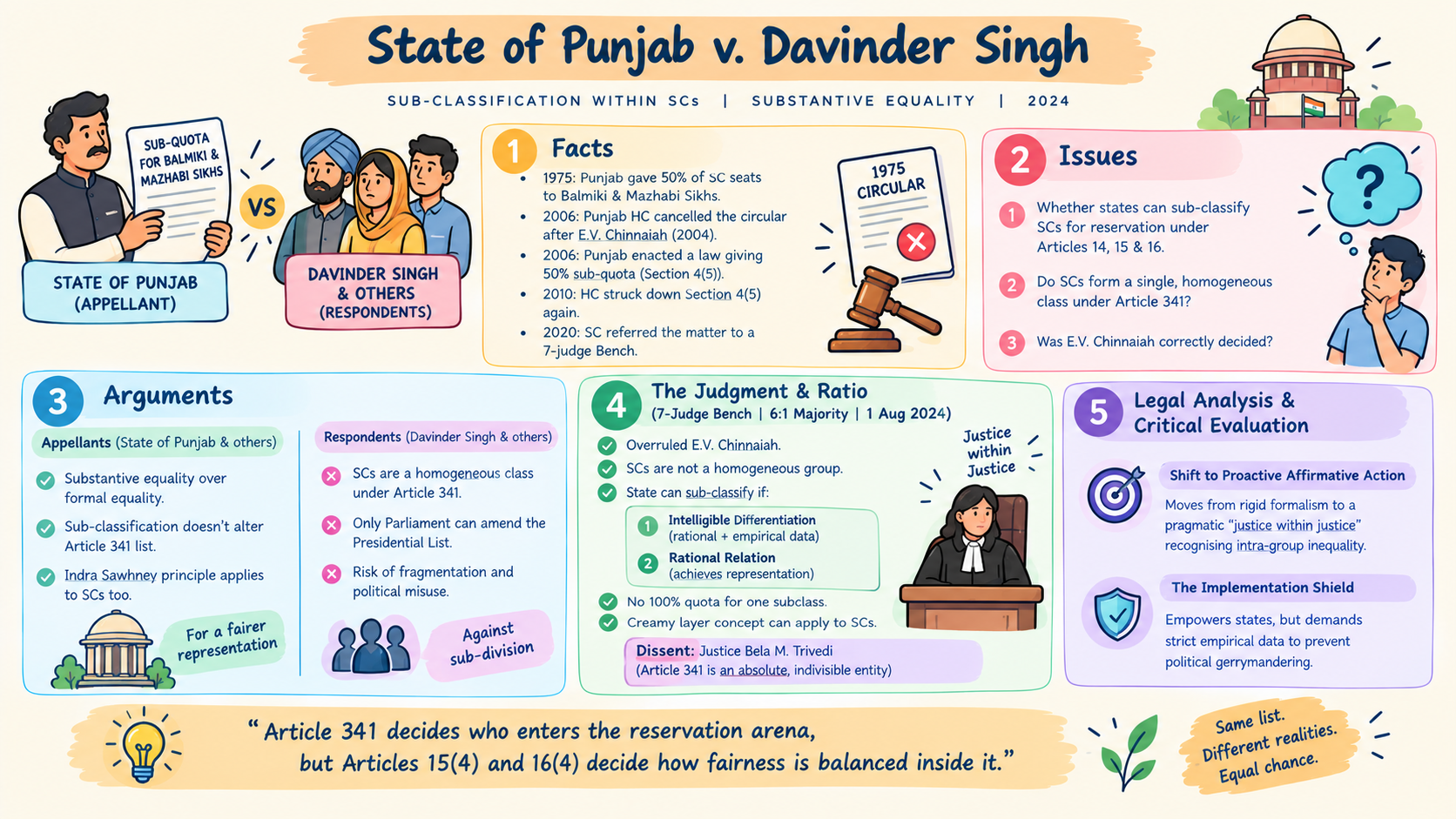
1. Facts
- The Original Policy (1975): The Punjab administration released a circular stating that from the overall number of the allocated seats for Scheduled Castes (SCs) in the province, half of the vacancies were to be allotted to the Balmiki and Mazhabi Sikh communities, which are ranked as the most inferior groups among SCs.
- The First Legal Challenge (2006): After a significant decision taken by the Supreme Court in E.V Chinnaiah v. State of Andhra Pradesh (2004), the Punjab and Haryana High Court cancelled the 1975 circular.
- Legal Codification (2006): In reply, the Punjab government passed the Act of Punjab Scheduled Castes and Backward Classes (Reservation in Services), 2006. Under Section 4(5) of the Act, it has recommended the “first preference” system and thus gave 50 percent sub-quota for the Balmiki and Mazhabi Sikhs.
- Again a High Court Verdict: Davinder Singh and the other representatives of Chamar Mahasabha challenged the constitutionality of Section 4(5). Following the earlier case of E.V Chinnaiah, the Punjab and Haryana High Court ruled this provision unconstitutional.
2. Issues
- Permissibility of Sub-Classification: Whether states are constitutionally empowered to create sub-classifications within the Scheduled Castes category for the distribution of reservation benefits under Articles 14, 15, and 16.
- The Homogeneity Question: Do the Scheduled Castes notified under Article 341 of the Constitution constitute a single, indivisible, and homogeneous class?
- The Validity of Precedent: Whether the 5-judge bench decision in E.V. Chinnaiah v. State of Andhra Pradesh was correctly decided.
3. Arguments of the Parties
Arguments for the Appellants (State of Punjab & Supporting States)
- Substantive equality vs. formal equality: According to the State, treating all Scheduled Castes just as one cohesive group disregards the existing significant differences in both education and social progress between the in-group members.
In the process, the sub-groups that have advanced the most are the ones that benefited the most from reservations, whereas the least privileged are left out.
- Keeping the Article 341 parameters: They argued that subclassification doesn’t bring about changes to the Presidential List as presented in Article 341; it does not take any caste away from the list or add anything to it, but merely redistributes the benefits between the eligible groups.
- Use of Indra Sawhney principle: They pointed that Indra Sawheny rule of distinction between backward and more backward classes can be applied not only to OBCs, but to the Scheduled Castes to comply with the objective of substantive equality as indicated in the Constitution.
Arguments for the Respondents (Davinder Singh & Contesting Groups)
- Homogeneity of Presidential Notification: It was claimed by respondents that the moment the president issues a notification under Article 341, the particular caste loses all individuality and becomes a new homogeneous legal category.
The legal category formed in this fashion cannot be split by the state legislature.
- Parliamentary Authority: Respondents argued that any division, grouping, or arrangement of SC list comes under amendments of the presidential order, which is legislation only by Parliament under Article 341 (2).
- Fragmentation and Political Exploitation: They contend that allowing the states to create sub-categories will ruin the unity of Dalits and open the doors for state governments to exploit reservation system for short-term electoral gain.
4. The Judgment & Ratio Decidendi
On August 1, 2024, the 7-judge Constitution Bench delivered a 6:1 majority verdict. The majority judgment was authored by Chief Justice D.Y. Chandrachud.
Ratio:
- Overruling of E.V. Chinnaiah: The Court explicitly overruled E.V. Chinnaiah, holding that its premise of absolute SC homogeneity was legally flawed.
- Existence of Diversity among SCs: The Supreme Court majority observed that Scheduled Castes do not form a homogeneous social or economic category. Historical and case law evidence makes it clear that deep-rooted structural inequalities still exist within the SC group.
- Conditions for Classification based on Data and Relation: It was pointed out by the Supreme Court that the State has the authority to classify communities if two requirements are met:
- No Complete Exclusion: The state cannot reserve 100% of the quota proceeds for one specific subclass and exclude other SC groups from participating in the competition.
- Clarification concerning the Creamy Layer: Different reasons were presented by the majority in favor of the idea that the creamy layer notion should be used to SCs in case of distinguishing those who obtain benefits.
The Dissent: Justice Bela M. Trivedi dissented, holding that the Presidential List under Article 341 is an absolute, indivisible entity. She observed that any modification by the state constitutes an unauthorized tinkering with the constitutional framework.
5. Legal Analysis & Critical Evaluation
Shift to Proactive Affirmative Action
The 2024 ruling represents a massive paradigm shift in Indian equality jurisprudence. For decades, the judiciary treated the Presidential List under Article 341 as a uniform shield.
By recognizing that systemic exclusion operates even within marginalized groups, the Court transitioned from structural formalism to a pragmatic model of "justice within justice."
It acknowledges that a blunt, uncalibrated reservation system can accidentally create an elite layer within vulnerable categories, stalling the vertical mobility of the most depressed classes.
The Implementation Shield
The judgment acts as a double-edged sword. While it empowers state governments to correct historic imbalances, the insistence on strict, verifiable empirical data protects the system from arbitrary political gerrymandering.
State legislatures can no longer split categories based on political convenience; any sub-quota must pass strict judicial scrutiny based on real-world numbers regarding backwardness and workplace representation.
State of Punjab v. Davinder Singh firmly establishes that the pursuit of substantive equality permits classification within a classification.
For your examination, remember that Article 341 controls who enters the reservation arena, but Articles 15(4) and 16(4) empower the states to decide how fairness is balanced inside that arena.
Get case-law updates weekly
Join 10,000+ subscribers.
HA
Hanspal Bakul
Contributing author
Have a doubt about this judgment?Ask Doubts