Top Judgments of February 2025
Introduction
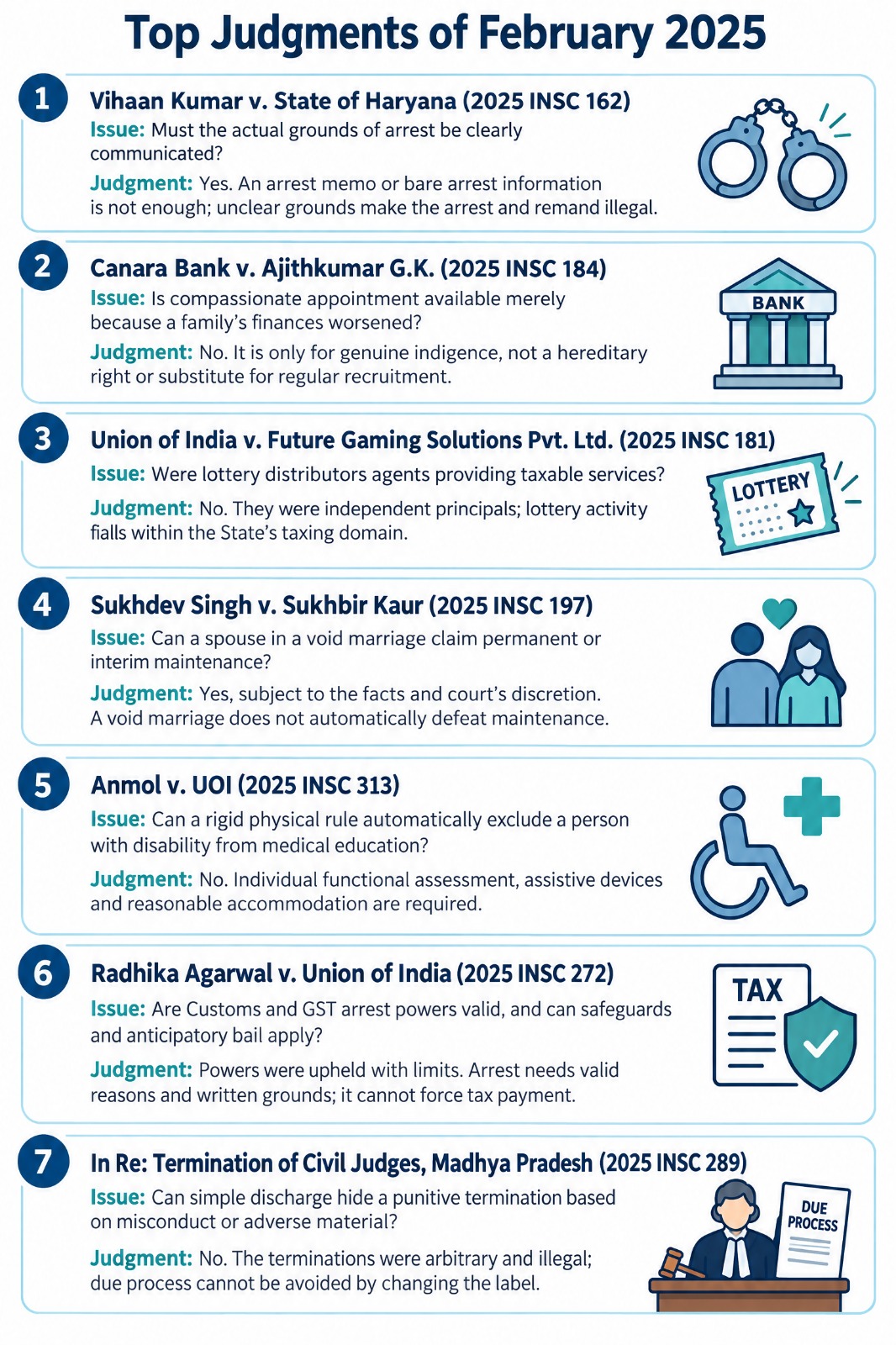
February 2025 brought important rulings on personal liberty, family law, taxation, disability rights and judicial administration. This article covers seven final decisions delivered that month, excluding interim-only orders. Each follows Fact, Issue and Judgment.
1. Vihaan Kumar v. State of Haryana (2025 INSC 162)
Fact
- Vihaan Kumar was arrested in a case involving cheating, forgery, criminal breach of trust and conspiracy.
- He argued that the police had not told him the actual grounds of arrest.
- He was also handcuffed and chained to a hospital bed after his arrest.
- The High Court treated the arrest information and arrest memo as sufficient.
Issue
Does failure to communicate the actual grounds of arrest violate Article 22(1) of the Constitution? If so, does it make the arrest and remand illegal?
Judgment
The Supreme Court allowed the appeal and ordered Kumar’s release. It held that telling a person only that they are under arrest, giving an arrest memo or informing a relative is not enough. The basic facts behind the arrest must be communicated clearly and in a language the person understands.
The arresting agency bears the burden of proving compliance. Non-communication violates Articles 22(1) and 21 and invalidates the arrest and remand, though it does not automatically destroy the investigation or trial. The Court also directed safeguards against handcuffing and required Magistrates to check Article 22 compliance at remand.
2. Canara Bank v. Ajithkumar G.K. (2025 INSC 184)
Fact
- Ajithkumar’s father, a Canara Bank employee, died shortly before retirement.
- Ajithkumar applied for compassionate appointment under the Bank’s scheme.
- The Bank rejected the claim because the family received a pension and was not found to be indigent.
- The High Court directed the Bank to appoint him and imposed costs.
Issue
When should compassionate appointments be granted? Can it be claimed merely because the family’s financial position has worsened after the death of its earning member?
Judgment
The Supreme Court set aside the High Court’s orders. It held that compassionate appointment is an exception to the normal recruitment process. It is not a hereditary right or a substitute for regular employment.
Such appointments are limited to genuine “hand-to-mouth” cases where basic needs cannot be met. A fall in living standards is insufficient. Indigence comes first, age relaxation and suitability follow. Although delay should not defeat a genuine claim, this family was not sufficiently indigent. The Court nevertheless directed Canara Bank to pay Rs. 2.5 lakh under Article 142.
3. Union of India v. Future Gaming Solutions Pvt. Ltd. (2025 INSC 181)
Fact
- The respondents distributed paper and online lottery tickets organised by the Government of Sikkim.
- Tax authorities treated the distributors as providers of taxable services to the State.
- The distributors argued that they purchased and resold tickets as independent principals.
- The Union appealed against the Sikkim High Court judgment setting aside the service-tax demands.
Issue
Were the lottery distributors agents providing taxable services, or independent purchasers dealing with the State on a principal-to-principal basis? Which government has the power to tax lottery-related activities?
Judgment
The Supreme Court dismissed the Union’s appeals. It held that the distributors purchased the tickets as principals, bore the commercial risk and resold them. They were not agents of the Sikkim Government and did not provide a taxable service to it.
The Court held that conducting a lottery is betting and gambling under Entries 34 and 62 of the State List. The Union could not impose service tax by labelling the transaction a business-support service. The case has implications for federalism, taxation and distinction between an actionable claim and lottery activity.
4. Sukhdev Singh v. Sukhbir Kaur (2025 INSC 197)
Fact
- The three judge bench examined conflicting views on maintenance under Hindu Marriage Act, 1955.
- The reference is in relation to a marriage declared void under section 11 of the Act.
- The Court had to interpret Sections 24 and 25, dealing with interim and permanent maintenance.
- The reference did not decide the parties’ final financial claims on their individual facts.
Issue
Can a spouse of a marriage declared void claim permanent maintenance under Section 25? Can interim maintenance be granted while a case concerning the validity of the marriage is pending?
Judgment
The Court answered both questions in the affirmative, subject to the facts and the court’s discretion. A decree declaring a marriage void is still a decree for the purpose of Section 25. Therefore, either spouse may seek permanent alimony or maintenance.
Relief is discretionary and depends on income, circumstances and conduct. Interim maintenance may also be granted when the marriage appears void or voidable, if Section 24 is satisfied. The case demonstrates that the legal invalidity of a marriage does not automatically deprive protection from financial hardship.
5. Anmol v. UOI (2025 INSC 313)
Fact.
- Anmol, who was disabled in movement and speech, passed NEET-UG 2024.
- A disability board said he was not eligible for MBBS as per a rule that both hands should be intact.
- The board did not give the proper detailed functional assessment and proper reasons.
- A medical expert found that Anmol could complete the course with assistive technology and reasonable accommodation.
Issue
Can a rigid physical requirement automatically exclude a person with a disability from medical education? Must eligibility be decided through an individual functional assessment?
Judgment
The Court rejected the rigid “both hands intact” rule. Disability assessment must examine actual functional ability, assistive devices and reasonable accommodation, with reasons. A disability percentage alone cannot decide eligibility. The guideline was in contravention of Article 41 and the Rights of Persons with Disabilities Act. The Court upheld Anmol’s admission, further strengthening inclusion over automatic exclusion.
6.Radhika Agarwal v. Union of India (2025 INSC 272)
Fact.
- The petitioners challenged the powers of arrest under the Customs Act and the Central Goods and Services Tax Act.
- They claimed tax officers were using threats of arrest to coerce taxpayers to pay.
- The case also raised questions about the application of normal safeguards of criminal procedure.
- The petitioners challenged the provisions for arrest and summons under the tax laws.
Issue
Are arrest powers under the Customs and GST laws constitutional? Do safeguards under criminal procedure apply to these arrests, and can anticipatory bail be sought before an FIR?
Judgment
The Supreme Court upheld the relevant arrest powers but placed important limits on their exercise. It held that Customs and GST officers are not police officers. However, criminal-procedure safeguards apply where the special laws do not exclude them.
Arrest cannot rest on mere suspicion. The authorised officer needs legally valid reasons to believe, supported by material showing a prima facie offence, and must communicate the grounds in writing. Arrest cannot be used to force tax payment. The Court also recognised anticipatory bail on a reasonable apprehension of arrest, even before an FIR where permitted.
7. In Re: Termination of Civil Judges, Madhya Pradesh (2025 INSC 289)
Fact
- Six women Civil Judges in Madhya Pradesh were terminated during probation on the basis of performance material, complaints and assessment records.
- Four officers were later reinstated, but Sarita Choudhary and Aditi Kumar Sharma were not.
- The records included adverse assessments that did not properly consider personal hardships, including illness, miscarriage and family medical emergencies.
- The Supreme Court examined whether the terminations were really based on unsuitability or were punitive in substance.
Issue
Can a probationer be terminated through a simple discharge order when the real basis is alleged misconduct or adverse material? Were the terminations arbitrary and contrary to natural justice?
Judgment
The Supreme Court held that the terminations were punitive, arbitrary, stigmatic and illegal. Although a probationer has no automatic right to confirmation, the State cannot avoid due process by giving a termination a simple label when the real reason is misconduct or adverse complaints.
The Court found no consistent poor performance, noted that adverse material was not properly communicated and held that personal hardships were ignored. It ordered reinstatement, continuity and seniority, but no back wages, the period would count notionally for pension. The ruling is important for Article 311(2), natural justice, probationers and the difference between simple discharge and punitive termination.
Conclusion
The February 2025 judgments show the Supreme Court applying constitutional rights to practical problems. It protected an accused who was not informed of the grounds of arrest, limited the use of compassionate appointment and prevented tax authorities from using arrest as a recovery tool. It also recognised maintenance rights in void marriages and rejected disability-based exclusion from medical education.
For CLAT PG, it is important to keep in mind Article 22 demands sufficient grounds of arrest, compassionate appointment demands bona fide poverty, lottery taxation is within the state domain, void marriage does not ipso facto defeat maintenance, disability demands functional assessment, and punitive termination cannot escape natural justice.
Get case-law updates weekly
Join 10,000+ subscribers.
JU
Julie Nigam
Contributing author
Have a doubt about this judgment?Ask Doubts