CLAT 2023 Counselling: What to expect?
Now that CLAT 2023 is over, what comes next?
The Counselling process for CLAT 2023 is expected to start in January, 2023, giving you time to understand the process, and make well-informed decisions.
After the results have been declared and the merit list has been released, the CLAT Consortium will start the counselling process. The counselling will happen online, through the CLAT Consortium website.
The Counselling process for CLAT 2023 is expected to start in January, 2023, giving you time to understand the process, and make well-informed decisions.
After the results have been declared and the merit list has been released, the CLAT Consortium will start the counselling process. The counselling will happen online, through the CLAT Consortium website.
The Common Law Admission Test (CLAT) counselling process is a system through which candidates gain admission to the undergraduate and postgraduate programs in a National Law University (NLU) . It is the official procedure of allocating a seat in an NLU based on the All India Rank (AIR), factored in with reservations, the preferences of colleges marked in the Admission Form.
1. Publication of invite list: The process begins with the publication of the counselling invite list, which can be checked by logging into your account on Consortium website. The consortium usually invites five times the number of seats in every category, to account for contingencies like candidates not registering for the process, or choosing a non-CLAT college.
2. Registration: All candidates invited have the option to register for the process, if they wish to. Upon doing so, they will be further allotted colleges in the subsequent allotment lists. The fee for registration is usually Rs. 30,000 for General Category students, and Rs. 20,000 for SC/ST/OBC/EWS/other reserved categories. This fee will be later adjusted into the candidate’s allotted college fees.
It is advised that candidates should register, if invited, no matter what the rank is, because its a win-win for them. Either they are allotted a college, or they will get a refund. The candidates will also have to fill their preferences for NLUs. Decide this preference list after careful deliberation, read, research, consult, and only then choose. While 5 is the minimum number of preferences, there is no maximum. So, fill as many colleges as you wish, do not restrain yourself to just 5.
3. 1st Provisional Allotment List: After registration, the first allotment list will be released, based on the number of seats, and the preference allotments of candidates better ranked than you. Candidates will have the option to either-
a) accept and lock the seat(by uploading documents and paying fees),
b) upgrade (uploading documents and paying fees for current NLU, thus locking it in case not upgraded) or,
c) exiting the process.
4. 2nd, 3rd, 4th, 5th (Final) list: The same process will be followed till the 5th or the final list. Here, candidates will not have the option to upgrade, but simply to accept or exit the process.
The fee paid to the NLU while upgrading to another will be adjusted in the upgraded NLU’s fees. After the closure of the counselling process, individual NLUs may open applications for vacant seats, which an individual can apply for directly through that NLU’s website.
2. Registration: All candidates invited have the option to register for the process, if they wish to. Upon doing so, they will be further allotted colleges in the subsequent allotment lists. The fee for registration is usually Rs. 30,000 for General Category students, and Rs. 20,000 for SC/ST/OBC/EWS/other reserved categories. This fee will be later adjusted into the candidate’s allotted college fees.
It is advised that candidates should register, if invited, no matter what the rank is, because its a win-win for them. Either they are allotted a college, or they will get a refund. The candidates will also have to fill their preferences for NLUs. Decide this preference list after careful deliberation, read, research, consult, and only then choose. While 5 is the minimum number of preferences, there is no maximum. So, fill as many colleges as you wish, do not restrain yourself to just 5.
3. 1st Provisional Allotment List: After registration, the first allotment list will be released, based on the number of seats, and the preference allotments of candidates better ranked than you. Candidates will have the option to either-
a) accept and lock the seat(by uploading documents and paying fees),
b) upgrade (uploading documents and paying fees for current NLU, thus locking it in case not upgraded) or,
c) exiting the process.
4. 2nd, 3rd, 4th, 5th (Final) list: The same process will be followed till the 5th or the final list. Here, candidates will not have the option to upgrade, but simply to accept or exit the process.
The fee paid to the NLU while upgrading to another will be adjusted in the upgraded NLU’s fees. After the closure of the counselling process, individual NLUs may open applications for vacant seats, which an individual can apply for directly through that NLU’s website.
CLAT Counselling at a glance
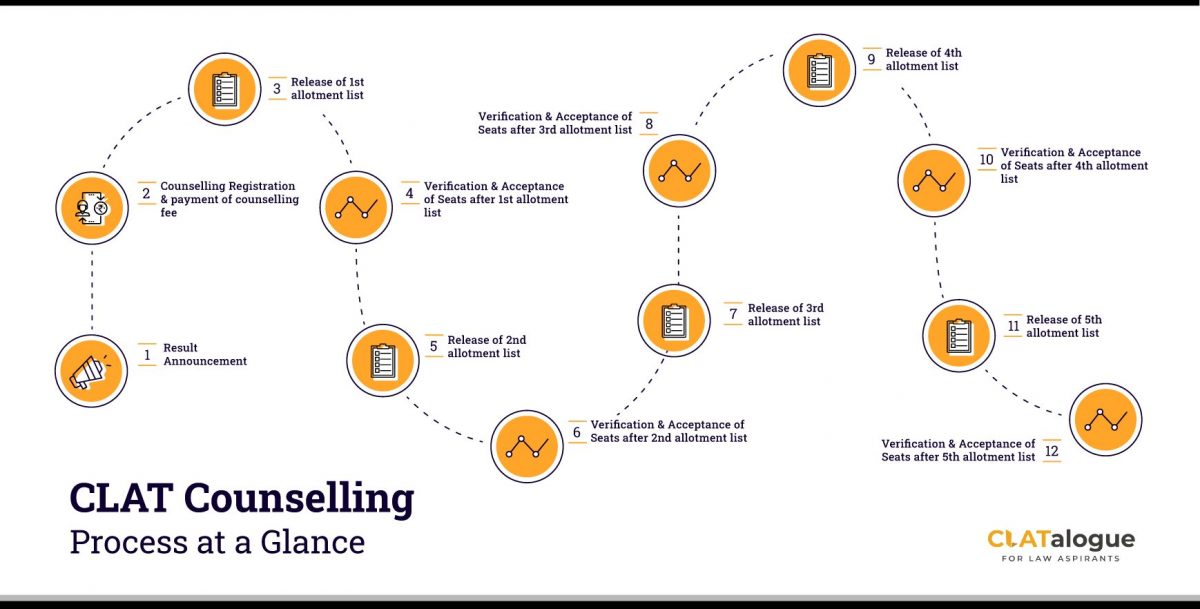
CLAT Counselling Process
What documents are required for the CLAT Counselling process?
- CLAT 2021 Admission Form
- CLAT Admit Card 2021
- CLAT 2021 Scorecard
- Class 10th Marks-sheet (Date of Birth proof)
- Class 12th Marks-sheet (Academic Qualification/ Eligibility Criteria)
- Caste Certificate (If applicable)
- Specially-Abled Certificate (If applicable)
What if a candidate does not pay the counselling fees?
In case a candidate fails to deposit the fee within a specified time frame, he/she will lose his/her right to consideration for admission under CLAT. Besides, their names will be dropped from the merit list.
Leave a comment if you have any doubts or queries.
All the best!
You can check our analysis of the CLAT 2023 UG and CLAT 2023 PG exams here.
Subscribe for updates
Join 10,000+ subscribers.
SA
Sanya Ambastha
Contributing author
Have a doubt about this?Ask Doubts

