
Culpable Homicide and Murder Under BNS, 2023: What Is the Real Difference?
Every year, thousands of criminal cases in India hinge on one question. Was it murder, or was it "only" culpable homicide?
These two offences sound similar. Both involve the death of a person. Both are punishable. Yet the law treats them very differently, and so does the punishment attached to them.
If you are a law student, a judiciary aspirant, or simply someone trying to understand Indian criminal law, this article breaks down the concept in plain language. We will look at the exact provisions under the Bharatiya Nyaya Sanhita, 2023 (BNS), along with illustrations to make the concept easy to remember.
What Is Culpable Homicide Under Section 100 BNS?
Section 100 defines culpable homicide as causing death by an act done with:
- The intention of causing death, or
- The intention of causing such bodily injury as is likely to cause death, or
- The knowledge that the act is likely to cause death.
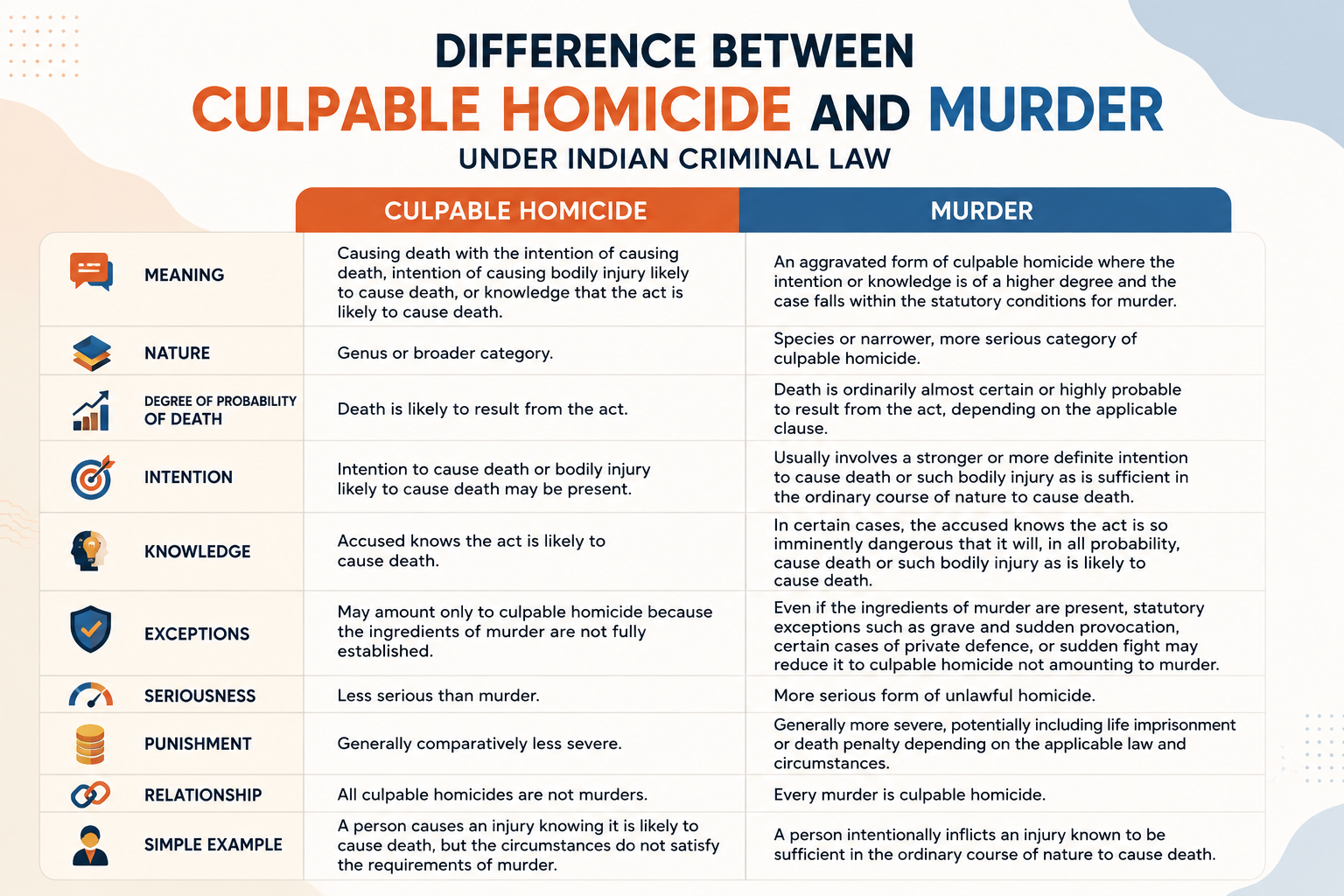
In simple words, culpable homicide is the wider, general category. It covers all unlawful killings where death was intended or was a known likely consequence.
Illustration: A lays sticks and turf over a pit, intending to cause death or knowing that death is likely to result. Z, believing the ground to be firm, steps on it, falls in, and dies. A has committed culpable homicide.
Section 100 also carries three explanations worth remembering. Causing death by aggravating an existing illness still counts as causing death. Death caused by an injury still counts as culpable homicide even if proper medical treatment could have saved the person. And causing the death of an unborn child in the womb is not homicide, though harming a child who has partly emerged during birth can be.
What Is Murder Under Section 101 BNS?
Here is where most students get confused. Murder is not a separate, unrelated offence. It is simply the gravest form of culpable homicide.
Think of it this way: every murder is culpable homicide, but not every culpable homicide is murder. Culpable homicide is the genus, and murder is its most serious species.
Section 101 says culpable homicide becomes murder in four situations:
Clause (a): The act is done with the intention of causing death.
Clause (b): The act is done with the intention of causing a bodily injury, and the offender knows that this particular injury is likely to cause the death of that specific person. This clause is personal to the victim. It applies even if the injury would not normally kill an ordinary person, so long as the offender knew of some special vulnerability of the victim.
Clause (c): The act is done with the intention of causing a bodily injury, and that injury is sufficient in the ordinary course of nature to cause death. Here, the offender's motive does not matter. What matters is whether the injury itself was objectively lethal.
Clause (d): The person knows the act is so imminently dangerous that it must, in all probability, cause death, and commits it without any excuse.
Illustration for Clause (c): A stabs Z with a knife in the chest, aiming directly at a vital organ. Even if A later claims he "only wanted to injure" Z, the wound is sufficient in the ordinary course of nature to cause death. This is murder.
Illustration for Clause (d): A fires a loaded gun into a crowded market without any reason, killing a bystander. A did not target anyone specific, but the act was so inherently dangerous that death was almost certain. This is murder.
The Fine Line Difference: Intention vs Knowledge
The real difference between culpable homicide and murder lies in the degree of probability of death, not merely the presence of intention.
If death is a "probable" consequence but not overwhelmingly certain, the offence usually stays as culpable homicide not amounting to murder. If death is the "most likely" or "almost certain" consequence, it graduates to murder.
Courts often describe this using the "degree of risk" test. A push during a scuffle that unexpectedly kills someone is very different, legally, from a calculated blow to the head with a heavy weapon.
The Five Exceptions Under Section 101
Even when the four clauses above are satisfied, the law says culpable homicide will not amount to murder if any of the following five exceptions apply.
Exception 1 - Grave and Sudden Provocation: If the offender, while deprived of self-control due to grave and sudden provocation, kills the person who provoked him (or accidentally kills someone else), it is not murder. The provocation cannot be something the offender invited himself, or an act by a public servant doing his duty, or an act of lawful private defence.
Exception 2 - Exceeding the Right of Private Defence: If death is caused in good faith while exceeding the right of private defence, without premeditation and without any intention to cause more harm than necessary, it is not murder.
Exception 3 - Public Servant Acting in Good Faith: If a public servant, acting in good faith for the advancement of public justice, exceeds the powers given to him by law and causes death without ill will, it is not murder.
Exception 4 - Sudden Fight: Death caused in a sudden fight, in the heat of passion, without premeditation, and without the offender taking undue advantage or acting cruelly, is not murder. It must genuinely be a spur of the moment fight, not a planned attack.
Exception 5 - Consent: If the deceased, being above eighteen years of age, suffers death or takes the risk of death with his own consent, it is not murder.
Illustration: Y gives grave and sudden provocation to A. A fires a pistol at Y but, without intending or knowing it, kills Z, who was standing nearby out of sight. Since the provocation came from Y and the killing was accidental in that heated moment, A has not committed murder, only culpable homicide.
Landmark Cases on Culpable Homicide and Murder
Reg v. Govinda (1876), ILR 1 Bom 342
This is the oldest and most cited case on this distinction. The accused struck his wife on the face and knelt on her chest during a quarrel, causing her death.
The Bombay High Court held there was no intention to cause death, and the injury was not of a kind that would ordinarily be fatal. The accused was convicted of culpable homicide, not murder. This case first laid down the practical test of comparing the nature of the injury against the outcome.
Virsa Singh v. State of Punjab (1958), AIR 1958 SC 465
The accused thrust a spear into the victim's abdomen, causing intestines to come out. He claimed he only meant to injure, not kill.
The Supreme Court, through Justice Vivian Bose, held this was murder. It laid down a four point test for what is now Clause (c) of Section 101 BNS: the injury must exist, it must be intentional, it must be objectively sufficient in the ordinary course of nature to cause death, and the offender need not separately intend death itself. This test is still applied by courts under the BNS today.
State of Andhra Pradesh v. Rayavarapu Punnayya (1976), 4 SCC 382
This case gave us the famous phrase that culpable homicide is genus, and murder is species. The Supreme Court explained that the difference between the two is one of degree, based on the intensity of intention and knowledge, not a difference in kind.
K.M. Nanavati v. State of Maharashtra (1962), AIR 1962 SC 605
A naval officer shot his wife's lover after learning of their affair. The defence argued grave and sudden provocation.
The Supreme Court held that enough time had passed between the discovery and the killing for the accused to regain self-control. Since the act was not truly sudden, Exception 1 did not apply, and the conviction was for murder. This case remains the go to authority on how courts test the "suddenness" of provocation.
Sukhbir Singh v. State of Haryana (2002), 3 SCC 327
Here, the killing arose from a sudden quarrel with no premeditation. The Supreme Court reduced the conviction from murder to culpable homicide not amounting to murder, applying the sudden fight exception.
Reading these five cases together gives you the complete judicial framework that courts still use while interpreting Sections 100 and 101 of the BNS.
Punishment Under the BNS for Culpable Homicide and Murder
Section 103(1) prescribes punishment for murder: death, or imprisonment for life, along with a fine.
Section 103(2) is a new addition under the BNS. It punishes murder committed by a group of five or more persons acting together, on grounds such as race, caste, community, sex, place of birth, language, or personal belief. This clause was introduced largely to address mob lynching. The punishment here is death, or imprisonment for life, or imprisonment of not less than seven years, along with a fine.
Section 105 deals with culpable homicide not amounting to murder. If the act is done with the intention of causing death, or of causing bodily injury likely to cause death, the punishment can extend to imprisonment for life, or imprisonment up to ten years, along with a fine. If the act is done only with the knowledge that it is likely to cause death, but without any such intention, the punishment is imprisonment up to ten years, or fine, or both.
Section 104 provides that if a person already undergoing a life sentence commits murder, he shall be punished with death or imprisonment for life, and shall also be liable to a fine.
A Simple Way to Remember It
Ask yourself three questions when analysing a fact pattern.
Did the accused intend to kill, or know death was likely? If no, it may not even be culpable homicide.
If yes, was the act so dangerous or the injury so severe that death was the highly probable, near certain outcome? If yes, look at murder under Section 101.
Do any of the five exceptions apply, such as sudden provocation or a sudden fight? If yes, it falls back to culpable homicide, not murder, even though the killing was intentional.
Conclusion
Culpable homicide and murder under the BNS, 2023 are not two separate crimes but two ends of the same spectrum. Section 100 sets the broad boundary of unlawful killing, while Section 101 narrows it down to the most severe cases, subject to five well-defined exceptions.
Understanding this distinction with the help of illustrations, rather than just memorising sections, is the best way to master this topic for both exams and practice.
Subscribe for updates
Join 10,000+ subscribers.
SH
Shruti chauhan
Contributing author
Have a doubt about this?Ask Doubts
