
Landmark Judgments on Tax Law - Part 1
Understanding landmark judgments on tax law is essential because these court decisions directly shape how we save, spend, and protect our money. Read these judgements to ace your CLAT PG examination.
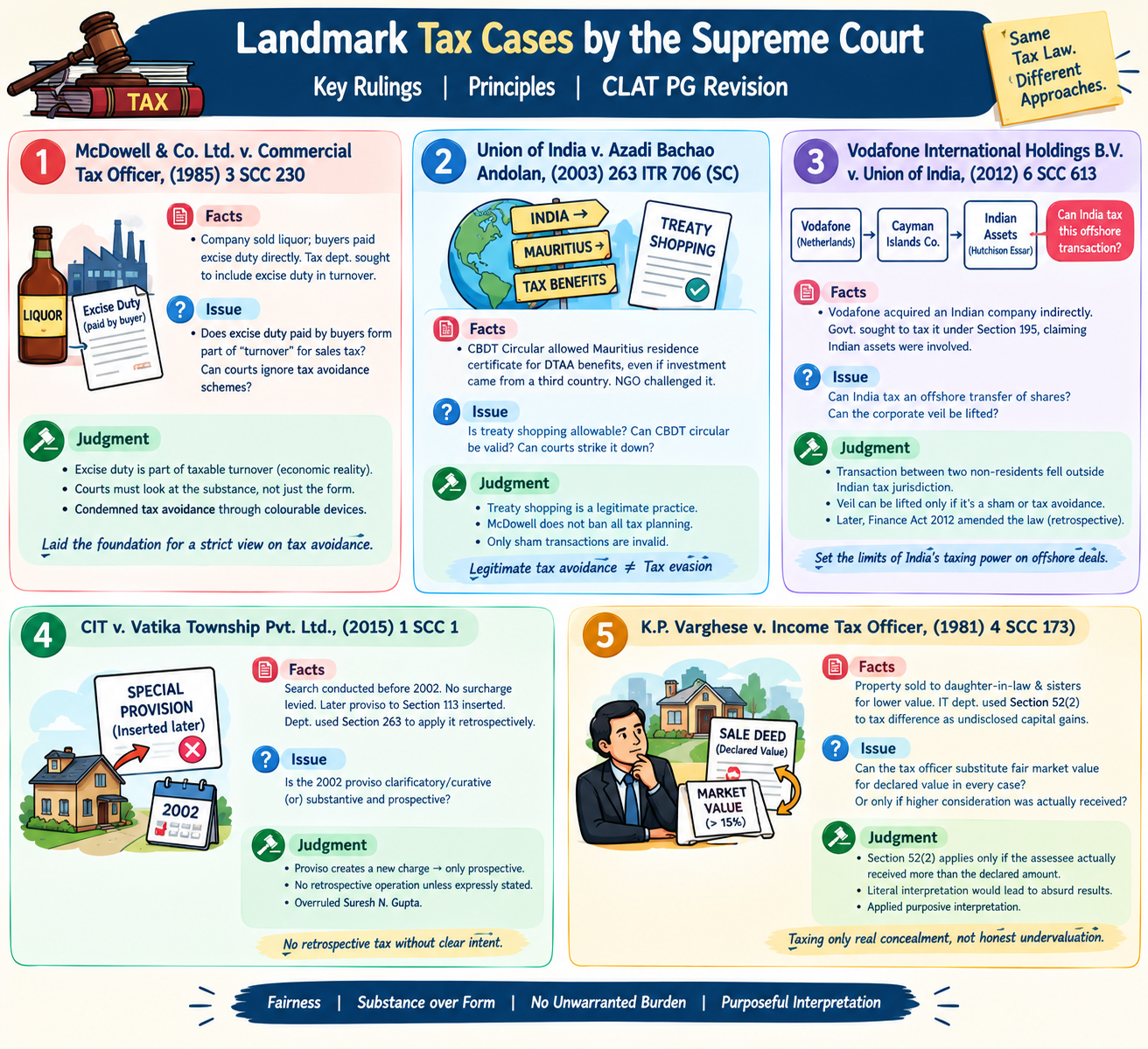
1. McDowell & Co. Ltd. v. Commercial Tax Officer, (1985) 3 SCC 230
Facts
McDowell & Co., a manufacturer of liquor, sold its products to buyers who were themselves responsible for paying excise duty directly to the excise authorities, rather than having McDowell include the excise duty in the sale price and pay it itself.
The Commercial Tax Officer sought to include the excise duty amount within McDowell's taxable turnover for sales tax purposes, arguing that this arrangement was a device to reduce the company's tax liability.
Issue
- whether the excise duty paid directly by buyers formed part of the "turnover" for sales tax purposes, and more broadly,
- whether the Court should recognise and give legal effect to tax avoidance schemes structured through artificial or colourable arrangements.
Judgment
The Supreme Court held that the excise duty formed part of the taxable turnover, since the economic reality of the transaction showed that the price McDowell actually received included this component, regardless of how the parties structured the payment mechanism.
The Court went further and condemned tax avoidance through colourable devices, holding that the proper approach is to look at the substance of a transaction rather than its form.
This ruling became the foundation of India's judicial hostility toward artificial tax avoidance schemes, though its broad language was later refined and somewhat narrowed in subsequent rulings such as Azadi Bachao Andolan.
2. Union of India v. Azadi Bachao Andolan, (2003) 263 ITR 706 (SC)
Facts
The Central Board of Direct Taxes issued Circular No. 789 of 2000, clarifying that a Certificate of Residence issued by Mauritius authorities would be sufficient evidence to claim benefits under the India-Mauritius Double Taxation Avoidance Agreement, even where the underlying investment originated from a third country routed through a Mauritius shell entity.
Azadi Bachao Andolan, an NGO, challenged this circular, arguing that it permitted "treaty shopping," allowing investors to avoid capital gains tax in India by routing investments through Mauritius purely to exploit the favourable tax treaty.
Issue
- whether the CBDT circular validly permitted investors to claim DTAA benefits based solely on a Mauritius residency certificate, and
- whether such treaty shopping arrangements, though lacking independent commercial substance, could be struck down as impermissible tax avoidance under the McDowell principle.
Judgment
The Supreme Court upheld the validity of the CBDT circular, holding that treaty shopping is a well-recognised and legitimate practice in international tax law, and that Indian courts cannot treat an entity's incorporation in a low-tax jurisdiction as inherently a colourable device merely because the investor could have chosen a different structure.
The Court clarified that McDowell did not lay down an absolute rule against all forms of tax planning, and that legitimate tax avoidance, as distinguished from tax evasion through sham transactions, remains permissible unless the specific transaction itself is shown to be a sham.
This ruling significantly shaped India's approach to treaty-based tax planning until legislative intervention through the General Anti-Avoidance Rules.
3. Vodafone International Holdings B.V. v. Union of India, (2012) 6 SCC 613
Facts
Vodafone International Holdings, a Netherlands-based company, acquired a Cayman Islands company, CGP Investments, which indirectly held a controlling interest in Hutchison Essar, an Indian telecommunications company, through a complex chain of holding companies.
The Indian Income Tax Department sought to tax Vodafone on this transaction, arguing that since the underlying economic value of the deal derived from Indian assets, Vodafone was liable to withhold tax under Section 195 of the Income Tax Act, despite the transaction technically occurring between two offshore entities.
Issue
- whether Indian tax authorities possessed jurisdiction to tax an offshore transaction involving the transfer of shares in a foreign company, merely because that foreign company indirectly held Indian assets, and
- whether India's tax laws, as they then stood, permitted "lifting the corporate veil" to reach such indirect transfers.
Judgment
The Supreme Court ruled in favour of Vodafone, holding that the transaction between two non-resident entities, involving the transfer of shares in a foreign company, fell outside the territorial jurisdiction of Indian tax authorities, since the Income Tax Act as it stood did not extend to indirect transfers of Indian assets through offshore corporate structures.
The Court held that the corporate veil could be lifted only where a transaction amounted to a sham or tax avoidance device lacking any genuine commercial purpose, which was not demonstrated here.
The Indian Parliament responded to this ruling through the Finance Act, 2012, which retrospectively amended the Income Tax Act to explicitly tax indirect transfers of Indian assets, triggering significant international controversy and arbitration claims against India, which Parliament eventually resolved by repealing this retrospective taxation through the Taxation Laws (Amendment) Act, 2021.
4. CIT v. Vatika Township Pvt. Ltd., (2015) 1 SCC 1
Facts
Following a search and seizure operation conducted on Vatika Township, the Assessing Officer passed a block assessment order without levying any surcharge, since the proviso to Section 113 of the Income Tax Act, which imposed a surcharge on block assessment income, had not yet been inserted at the time of the search.
The Commissioner of Income Tax subsequently invoked Section 263 to treat this non-levy as erroneous, relying on a later-inserted proviso and a CBDT circular, directing the Assessing Officer to levy surcharge at 10% retrospectively.
Issue
- whether the proviso to Section 113, inserted with effect from June 1, 2002, could be treated as clarificatory or curative in nature and therefore applied retrospectively to searches conducted before that date, or
- whether it introduced a substantive new charge operating only prospectively.
Judgment
The Constitution Bench held that the proviso to Section 113 created a substantive charge of surcharge for the first time, rather than merely clarifying an existing provision, and therefore could only operate prospectively from the date of its insertion.
The Court reaffirmed the fundamental rule against retrospective operation of statutes, holding that no statute should be construed to operate retrospectively unless such an intention appears clearly from its express terms or by necessary implication.
The Court overruled its earlier Division Bench ruling in CIT v. Suresh N. Gupta, which had wrongly treated the same proviso as clarificatory, and emphasised that an assessment creates a vested right that cannot be disturbed through retrospective reassessment absent clear legislative intent.
5. K.P. Varghese v. Income Tax Officer, (1981) 4 SCC 173
Facts
K.P. Varghese sold a house property to his daughter-in-law and her sisters for a declared consideration that the Income Tax Officer believed to be lower than the property's fair market value.
Relying on Section 52(2) of the Income Tax Act, which permitted the tax authorities to substitute the fair market value for the declared sale consideration where the fair market value exceeded the declared consideration by more than 15%, the Income Tax Officer sought to bring the difference to tax as undisclosed capital gains, without alleging or proving that the assessee had actually received any amount beyond the declared consideration.
Issue
- whether Section 52(2) permitted tax authorities to substitute fair market value for the declared consideration in every case where the two figures diverged by more than 15%, or
- whether the provision applied only where the Revenue could additionally show that the assessee had actually received consideration higher than what was declared, implying understatement or concealment.
Judgment
The Supreme Court held that Section 52(2) could be invoked only where the Revenue established that the assessee had actually received consideration exceeding the amount declared in the sale document, since a literal, mechanical application of the provision would lead to absurd and unjust results, taxing honest sellers merely for selling property below prevailing market rates without any actual understatement.
The Court applied the principle that a statutory provision must be interpreted to avoid manifestly absurd or unjust consequences, examining the provision's legislative history and purpose to conclude that Parliament intended Section 52(2) as an anti-evasion measure targeting concealed consideration, not a general tool for taxing bona fide undervalued transactions.
This ruling remains a significant precedent on purposive interpretation of taxing statutes and the burden of proof resting on the Revenue to establish understatement.
Subscribe for updates
Join 10,000+ subscribers.
HA
Hanspal Bakul
Contributing author
Have a doubt about this?Ask Doubts
