Gift under Transfer of Property Act, 1882
Introduction
A gift is a voluntary transfer made out of generosity rather than exchange. For example, A may transfer a house to her daughter without taking any money. Because such a transfer changes ownership without consideration, the law insists on clear intention, acceptance and proper formalities.
Gifts are governed mainly by Chapter VII of the Transfer of Property Act, 1882 (TPA), which contains Sections 122 to 129.These provisions describe what a gift is, how it is made, when it may be revoked and what happens when the gift has a burden. The main focus of the TPA is gifts between living persons. Gifts made after death by will are regulated by succession law and not Section 122 in the normal sense.
Meaning of Gift
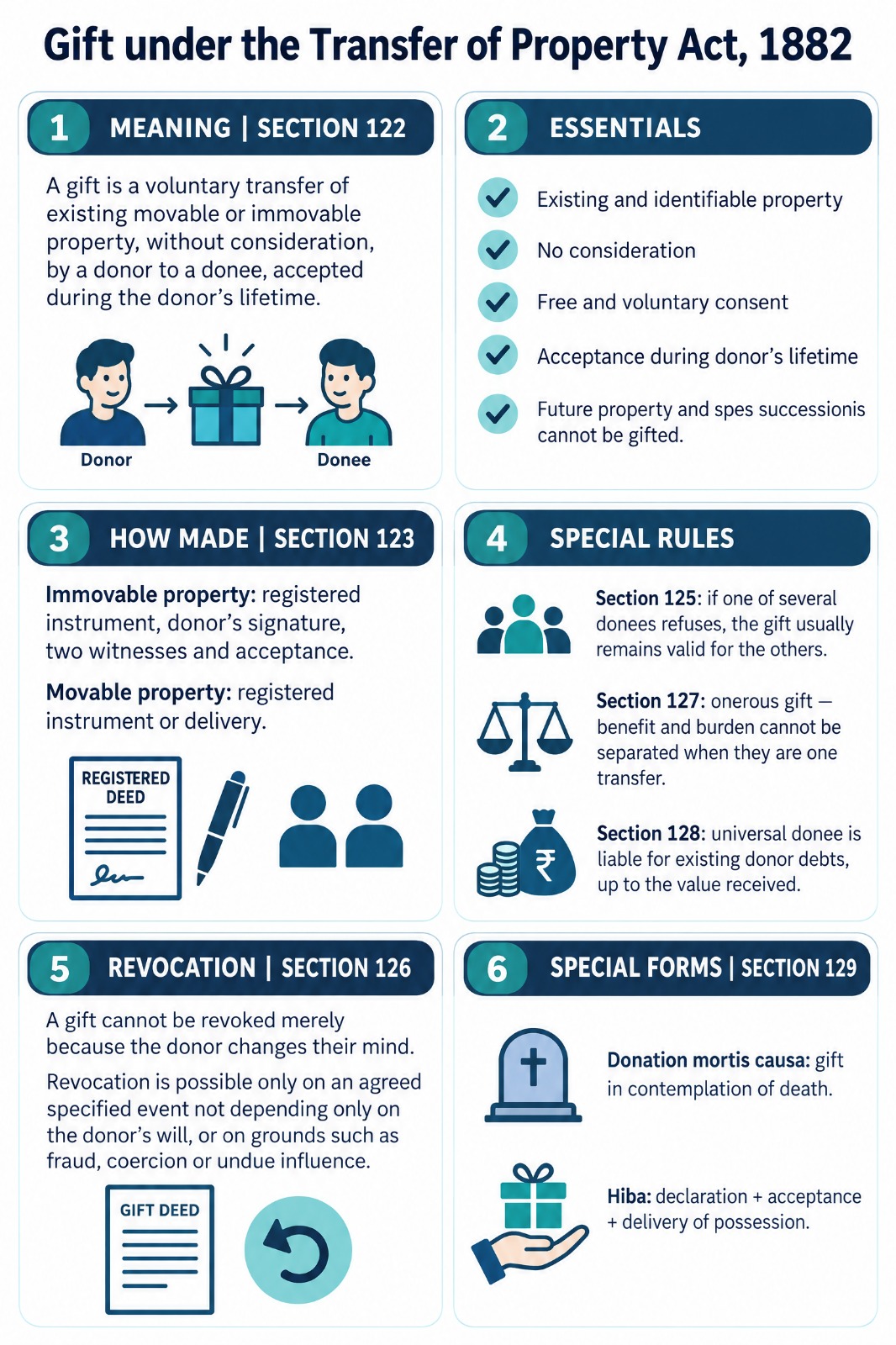
Section 122 defines a gift as the transfer of certain existing movable or immovable property made voluntarily and without consideration by a donor to a donee and accepted by or on behalf of the donee. The donor is the one who gives and the donee is the one who receives.
A gift is different from a sale or exchange. A sale involves money while an exchange involves mutual transfer of ownership. Under Section 118, A’s transfer of a plot to B in return for B’s house is an exchange, not a gift. A gift may nevertheless be subject to a lawful condition.
In the case of Mt. Brij Devi v. Shiva Nanda Prasad (1938), the court recognised that a gift may contain conditions, but the condition must be examined with the rules on revocation and restrictions. A condition cannot automatically allow the donor to recover the property merely because the donor later changes their mind.
Parties to Gift : Donor and Donee
The donor must be competent to contract and have ownership or lawful authority. A company, trust or other juristic person may make or receive a gift through its authorised representative.
The donee need not be competent to contract. A minor or person of unsound mind may receive a gift through a guardian. The donee must be identifiable, and acceptance must occur during the donor’s lifetime while the donor remains capable of giving. If the donee dies before acceptance, the gift is void.
Elements Required for Valid Gift
1. Transfer of ownership
The donor must intend to part with ownership or the interest being gifted. A mere promise to give property in the future is not a completed gift. The donor may reserve a lawful limited right, but cannot retain such control that no real transfer has occurred.
2. Existing property
Under Sections 122 and 124, the subject matter must be existing and identifiable. A gift of future property is void as to the future property. If a deed gifts, both existing and future property, the existing part may survive while the future part fails. A mere chance of inheritance, called spes successionis, cannot be gifted.
3. No consideration
The transfer must be without consideration. Love, affection, gratitude or a natural tendency to help are not monetary considerations. But, If the recipient pays money or assumes a significant financial obligation in return, the transaction might be a sale or exchange rather than a gift.
4. Voluntary and free consent
Donor’s decision must be voluntary and free from coercion, fraud, misrepresentation and undue influence. If you got a gift through pressure or deceit, you might be able to challenge the gift under the applicable law.
5. Acceptance
Acceptance is essential because a gift cannot be forced upon a person. Acceptance may be shown by taking possession, using the property, retaining the gift deed or performing another act indicating consent. It must occur during the donor’s lifetime.
In Renikuntla Rajamma v. K. Sarwanamma (2014), the Supreme Court observed that a valid registered gift of immovable property does not require delivery of possession as an essential requisite, if the acceptance is otherwise proved. In this way the donor may keep the right to use or enjoy the property during the lifetime of the donor without making the gift invalid.
How a Gift is Made : Section 123
Gift of Immovable Property
A gift of immovable property must be made through a registered instrument, signed by or on behalf of the donor and attested by at least two witnesses. Acceptance must also be proved. Mere oral statements or delivery of possession cannot replace compulsory registration. In R.N. Dawar v. Ganga Ram Saran Dhama (1993), the court emphasised that title to immovable property cannot ordinarily pass without the legally required registered instrument.
Gift of Movable Property
A gift of movable property may be made by a registered instrument or by delivery in the same manner as goods sold may be delivered. For example, a donor may gift a watch by a signed gift instrument or by voluntarily delivering it with the intention to transfer ownership and the donee’s acceptance.
Gift of Actionable Claims
An actionable claim, such as an unsecured debt, is transferred under Sections 130 onwards, generally through a written instrument signed by the transferor or authorised agent.
Gift to Several Donees : Section 125
A gift may be made to two or more donees. If one donee refuses to accept, the gift is void only as to the interest that person would have received. It remains valid for the accepting donee’s, unless the terms of the gift show that acceptance by all was essential.
Onerous gifts: Section 127
An onerous gift is a gift carrying a burden or liability. Section 127 applies the principle that a person should not accept the benefit while escaping the burden when both are part of one indivisible transfer.
Suppose A gives B, in one transaction, valuable shares in a profitable company and shares in a company requiring heavy future calls. B cannot accept only the profitable shares and reject the burdened shares. However, if the two gifts are separate and independent, B may accept the beneficial gift and refuse the onerous one.
A donee who is not competent to contract is not bound by an onerous gift merely by accepting it. But after becoming competent and knowing the burden, if the donee retains the property, they become bound by the obligation.
Universal Donee : Section 128
A Universal Donee is a person who is given the whole property of the donor as a gift. Subject to section 127, the universal donee is personally liable for the debts and liabilities of the donor existing at the time of the donation, but only to the extent of the value of the property received. This provision limits the liability to the value of the gifted estate and protects creditors.
Suspension and Revocation: Section 126
A completed gift cannot be revoked merely because the donor changes their mind. It may be suspended or revoked in two main situations.
- First, the donor and donee may agree that the gift will be suspended or revoked on the happening of a specified event that does not depend solely on the donor’s will. For example, A gifts land to B, subject to the gift ending if B dies without descendants during A’s lifetime. A cannot, however, reserve a right to revoke the gift whenever A wishes. Such a clause is void to that extent.
- Secondly, a gift may be revoked on grounds on which a contract could be rescinded, such as fraud, coercion or undue influence, but not merely for failure of consideration because a gift has no consideration. In Naramadaben Maganlal Thakker v. Pranjivandas Maganlal Thakker (1997), the Supreme Court examined whether a gift had been completed through acceptance and held that the validity of a gift depends on its terms, acceptance and completion of required formalities.
Protection of a Bona Fide Purchaser
Section 126 protects a transferee for consideration who acquires the property without notice of the condition or ground of revocation. Thus, a bona fide purchaser for value may be protected when a donee later sells the property.
Exceptions and Special Forms of Gift
Donation Mortis Causa
Section 129 saves donations mortis causa. This is a gift made in contemplation of death, usually conditional upon the donor’s death and capable of being revoked if the donor survives. It is distinct from an ordinary inter vivos gift and is governed by its special legal rules.
Hiba (Muslim Gift)
Section 129 also saves the rules of Muhammadan law relating to gifts. A Muslim gift, or hiba, is generally completed by three elements:
- declaration by the donor,
- acceptance by the donee and
- delivery of possession, actual or constructive.
Unlike an ordinary gift of immovable property under Section 123, registration is not necessarily essential if the requirements of Muslim law are proved. In Hafeeza Bibi v. Shaikh Farid (2011), the Supreme Court recognised that a genuine Muslim gift satisfying these requirements is not invalid merely because it is not registered under Section 123.
Conclusion
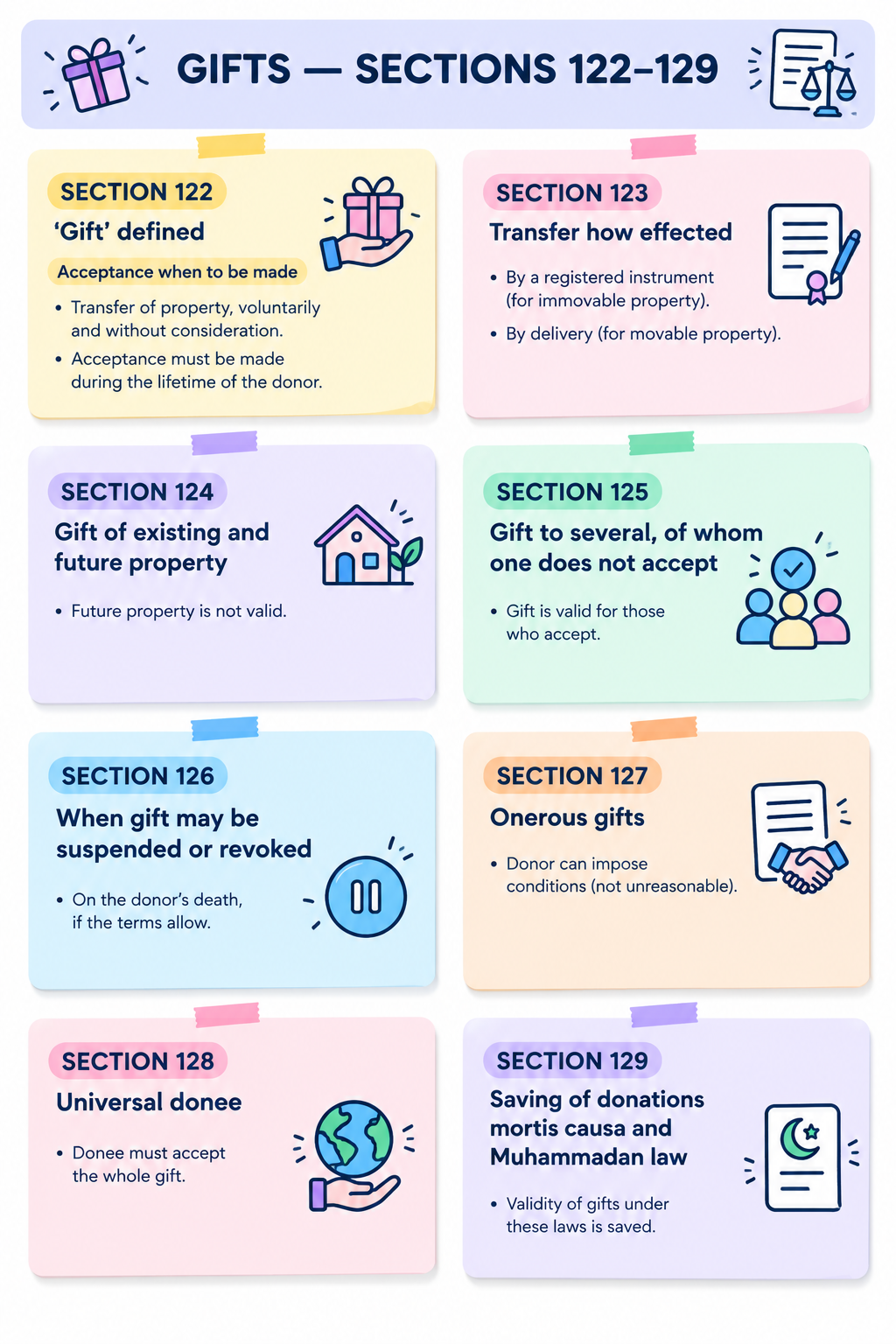
A gift is a voluntary and gratuitous transfer of existing property. For a valid gift, the donor must have capacity and title, the property must exist, the transfer must be voluntary and without consideration, and the donee must accept it during the donor’s lifetime.
Registration and attestation are essential for gifts of immovable property, while movable gifts may be made by delivery or registered instrument. The central principle is that generosity creates legal ownership only when intention, acceptance and statutory form come together.
Subscribe for updates
Join 10,000+ subscribers.
JU
Julie Nigam
Contributing author
Have a doubt about this?Ask Doubts

