
Declaratory Decrees - Specific Relief Act, 1963
Meaning and Nature of Declaratory Decree
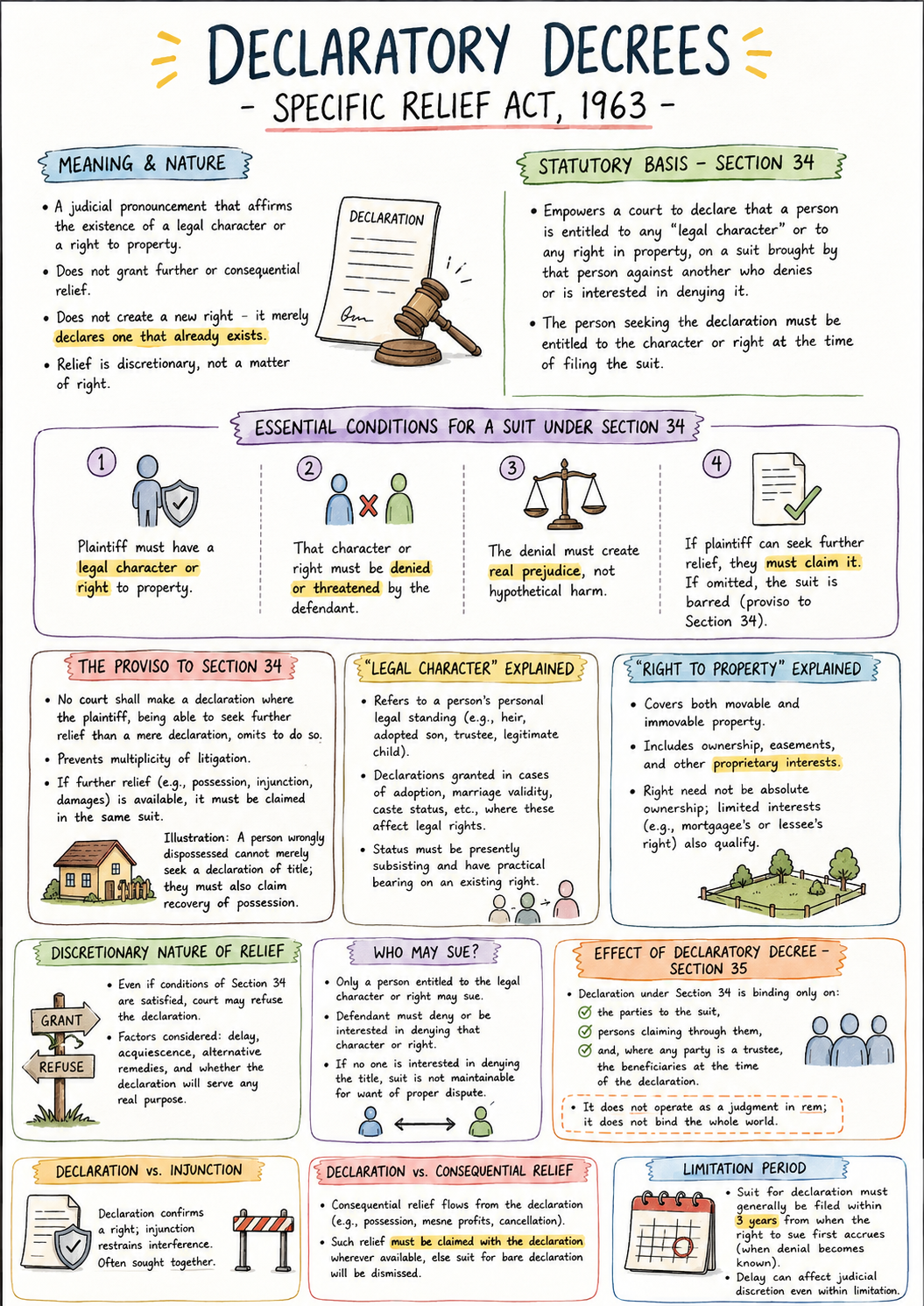
A declaratory decree is a judicial pronouncement that affirms the existence of a legal character or a right to property, without granting any further or consequential relief. It does not create a new right - it merely declares one that already exists.
The relief is discretionary, not a matter of right. Courts grant it only when the plaintiff's title or status is under a real cloud and judicial clarification is necessary to remove that cloud.
Statutory Basis - Section 34
Section 34 empowers a court to declare that a person is entitled to any "legal character" or to any right in property, on a suit brought by that person against another who denies or is interested in denying it.
The person seeking the declaration must be entitled to the character or right at the time of filing the suit. A mere expectant or contingent interest is usually insufficient.
Essential Conditions for a Suit Under Section 34
First, the plaintiff must have a legal character or right to property. Second, that character or right must be denied or threatened by the defendant. Third, the plaintiff must show the denial creates real prejudice, not hypothetical harm.
Fourth - and critical - If the plaintiff is able to seek further relief, they must claim it. If they omit it, the suit is barred. . If further relief is available and the plaintiff omits to claim it, the proviso to Section 34 bars the suit.
The Proviso to Section 34
The proviso states that no court shall make a declaration where the plaintiff, being able to seek further relief than a mere declaration, omits to do so.
This exists to prevent multiplicity of litigation. If a plaintiff can ask for possession, injunction, or damages along with the declaration, they must ask for it in the same suit - not file a bare declaratory suit and reserve consequential relief for later.
Illustration: A person wrongfully dispossessed of property cannot merely seek a declaration of title; they must also claim recovery of possession, since that further relief is available to them.
"Legal Character" Explained
Legal character (or status) refers to a person's personal legal standing - such as being an heir, adopted son, trustee, or legitimate child. Courts have granted declarations on questions of adoption, marriage validity, and caste status where these affect legal rights.
The status must be presently subsisting. Courts generally decline to declare a status that is purely academic or has no practical bearing on any existing right.
"Right to Property" Explained
This covers both movable and immovable property, and includes ownership, easements, and other proprietary interests. A declaration of title is the most common form of relief sought under this head.
The right need not be absolute ownership - a limited interest, such as a mortgagee's or lessee's right, can also be the subject of a declaratory suit.
Discretionary Nature of Relief
Even where the technical conditions of Section 34 are satisfied, the court retains discretion to refuse the declaration. This discretion must be exercised judicially, not arbitrarily.
Courts weigh factors such as delay, acquiescence, the existence of alternative remedies, and whether granting the declaration would serve any real purpose.
Who May Sue
Only a person entitled to the legal character or right in question may bring the suit - not a third party with no interest. The defendant must be someone who denies, or is interested in denying, that character or right.
If there is no one interested in denying the plaintiff's title, a declaratory suit is not maintainable for want of a proper adversarial dispute.
Effect of a Declaratory Decree - Section 35
Section 35 clarifies that a declaration made under Section 34 is binding only on the parties to the suit, persons claiming through them, and - where any party is a trustee - on the beneficiaries at the time of the declaration.
It does not operate as a judgment in rem; it does not bind the whole world, unlike certain other decrees (such as those in probate or matrimonial matters).
Declaration vs. Injunction
A declaration confirms a right; an injunction protects it by restraining interference. The two are often sought together - first establishing the right, then preventing its violation.
CLAT aspirants should note: a suit for injunction alone, without an underlying declared or admitted right, may fail if title itself is seriously disputed.
Declaration vs. Consequential Relief
Consequential relief is relief that flows naturally from the declaration - such as possession, mesne profits, or cancellation of a document. The proviso to Section 34 mandates that such relief be claimed together with the declaration wherever available.
Failure to claim consequential relief when it was available renders the suit for bare declaration not maintainable, and it will be dismissed on that technical ground alone.
Limitation Period
Under the Limitation Act, 1963, a suit for a declaration generally must be filed within three years from the date when the right to sue first accrues - typically when the denial of the plaintiff's right becomes known.
Delay can also independently affect the exercise of judicial discretion under Section 34, even within the limitation period.
Subscribe for updates
Join 10,000+ subscribers.
HA
Hanspal Bakul
Contributing author
Have a doubt about this?Ask Doubts
