
Defamation under the Law of Torts: Meaning, Essentials, Types, Defences & Remedies!
Introduction
The law protects not only a person’s life and property but also their reputation, which is an essential aspect of an individual’s dignity and social standing. Reputation often determines a person’s personal relationships, professional opportunities, and public image. Therefore, any false statement that unjustifiably harms another person’s reputation may give rise to the tort of Defamation.
The law of defamation seeks to strike a balance between two equally important rights – the right to freedom of speech and expression and the right to reputation. While individuals are free to express their opinions, they cannot misuse this freedom to spread false statements that damage another person’s reputation. Consequently, the law provides civil remedies to compensate those whose reputation has been wrongfully injured.
Meaning of Defamation
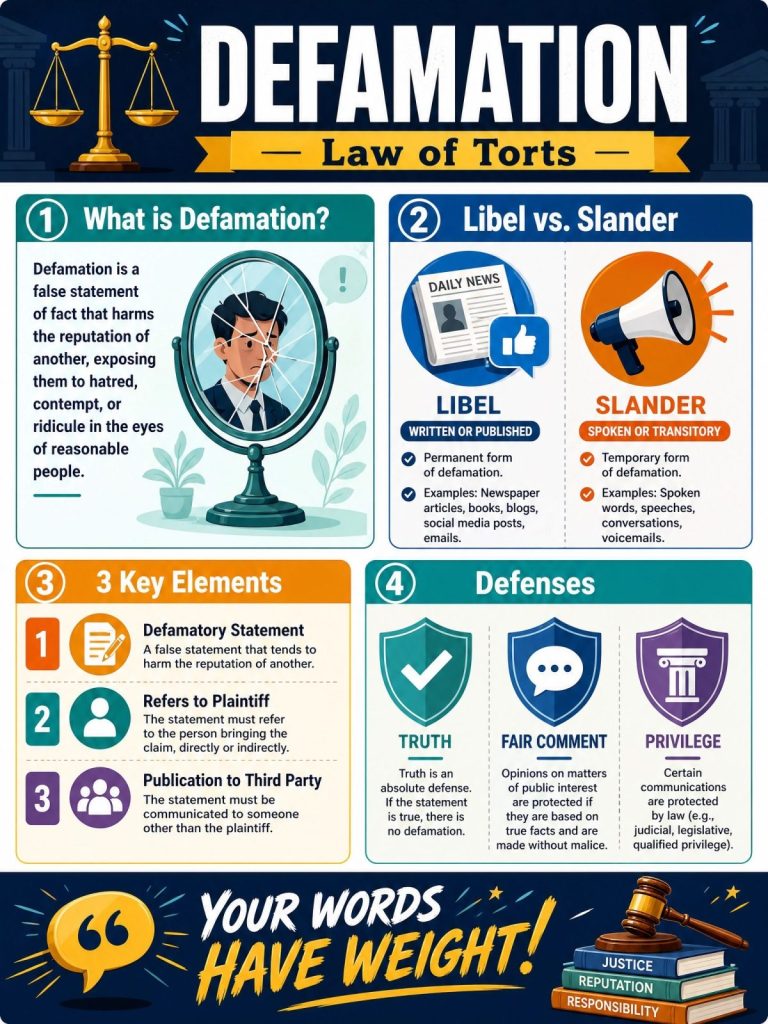
Defamation refers to the publication of a false statement concerning another person that tends to lower their reputation in the eyes of reasonable members of society. The statement must expose the person to hatred, ridicule, contempt, or cause others to avoid or shun them.
According to Winfield, defamation is the publication of a statement that tends to lower a person in the estimation of right-thinking members of society.
Similarly, Salmond defines defamation as the publication of a false and defamatory statement concerning another person without lawful justification.
The primary object of the law is to protect an individual’s reputation while ensuring that legitimate criticism and honest communication are not discouraged.
Essentials of Defamation
To establish liability for defamation, the plaintiff must prove certain essential elements.
1. Defamatory Statement
The first requirement is the existence of a defamatory statement. A statement becomes defamatory when it tends to lower a person’s reputation, expose them to public hatred or ridicule, or adversely affect their professional or social standing.
The statement may appear in the form of words, pictures, cartoons, gestures, photographs, videos, or social media posts.
2. The Statement Must Refer to the Plaintiff
The defamatory statement must concern the plaintiff either directly or indirectly. It is not necessary that the plaintiff’s name be expressly mentioned, provided reasonable persons can identify that the statement refers to them.
In Newstead v. London Express Newspaper Ltd. (1940), the Court held that liability may arise even where the publisher intended to refer to another person, if readers reasonably identify the plaintiff.
3. Publication
Publication is the foundation of every action for defamation. The defamatory statement must be communicated to at least one person other than the plaintiff.
Publication may take place through newspapers, books, television, radio, speeches, emails, WhatsApp messages, blogs, or social media platforms. A statement communicated only to the plaintiff does not amount to publication.
4. The Statement Must Be False
Truth generally operates as a complete defence in civil defamation. Therefore, the plaintiff must show that the impugned statement is false or that the defendant cannot justify its truth.
Types of Defamation
Defamation is broadly classified into Libel and Slander.
Libel
Libel refers to defamation in a permanent form. It includes statements published in newspapers, books, magazines, photographs, films, emails, websites, blogs, and social media posts.
Since libel has a lasting existence, the law presumes that it is capable of causing serious harm to a person’s reputation. Therefore, it is generally actionable per se, meaning that the plaintiff need not prove actual damage.
Illustration
Publishing a false article in a newspaper alleging that a chartered accountant has committed financial fraud amounts to libel.
Slander
Slander refers to defamation in a temporary or transitory form, such as spoken words or gestures.
Unlike libel, slander generally requires proof of actual damage. However, the law recognizes certain exceptions where slander is also actionable without proof of special damage, such as false allegations of a criminal offence, contagious disease, professional incompetence, or unchastity of a woman (under traditional common law).
Illustration
Making a false public statement during a meeting accusing a doctor of accepting illegal commissions may constitute slander.
Landmark Case Laws
Parmiter v. Coupland (1840)
The Court observed that a statement is defamatory if it tends to expose a person to hatred, ridicule, or contempt in the eyes of society. This case laid down the classic test for determining defamatory meaning.
Youssoupoff v. Metro-Goldwyn-Mayer Pictures Ltd. (1934)
The defendants portrayed Princess Youssoupoff in a film in a manner suggesting immoral conduct. The Court held that a statement may be defamatory even if it merely lowers a person’s moral or social reputation.
Cassidy v. Daily Mirror Newspapers Ltd. (1929)
The defendants published a photograph suggesting that a married man was engaged to another woman. The publication caused readers to believe that the plaintiff was merely his mistress.
The Court held that even statements appearing innocent on their face may become defamatory when viewed in light of surrounding circumstances.
Defences to Defamation
Although defamation protects reputation, the law recognises several important defences.
1. Truth (Justification)
Truth is the strongest defence to an action for defamation. If the defendant proves that the statement is substantially true, no liability arises even if the publication damages the plaintiff’s reputation.
2. Fair Comment
The law protects honest opinions expressed on matters of public interest, provided they are based on true facts and are not motivated by malice.
This defence commonly applies to reviews of books, films, sporting events, public performances, and political commentary.
3. Absolute Privilege
Certain statements receive complete legal protection irrespective of motive or falsity.
Examples include:
- Statements made during judicial proceedings.
- Parliamentary debates.
- Official communications protected by law.
The defence exists because public institutions require complete freedom of expression to function effectively.
4. Qualified Privilege
Qualified privilege protects statements made in good faith where the maker has a legal, moral, or social duty to communicate the information and the recipient has a corresponding interest in receiving it.
However, the defence fails if the plaintiff proves that the statement was made with malice.
5. Consent
A person who has expressly or impliedly consented to the publication cannot subsequently sue for defamation.
Remedies for Defamation
A person whose reputation has been injured may seek various civil remedies.
Damages
Damages constitute the principal remedy. Courts award compensation after considering factors such as the seriousness of the allegation, the extent of publication, the plaintiff’s reputation, and the conduct of the defendant.
Injunction
Where repeated publication is likely to continue causing harm, the court may grant an injunction restraining further publication.
Apology and Retraction
Although not always a complete legal remedy, a public apology or retraction may reduce the damage caused to the plaintiff’s reputation and may also influence the quantum of damages.
Conclusion
Defamation plays a vital role in protecting an individual’s reputation while preserving the constitutional value of free expression. The law does not prohibit criticism or honest opinion; rather, it seeks to prevent the publication of false statements that unjustifiably harm another person’s dignity and standing in society. As communication increasingly takes place through digital platforms, understanding the principles of defamation has become more important than ever. For CLAT PG and Judiciary aspirants, mastering the essentials of defamation, its types, recognised defences, and landmark case laws is essential for both conceptual clarity and examination success.
Subscribe for updates
Join 10,000+ subscribers.
SH
Shruti chauhan
Contributing author
Have a doubt about this?Ask Doubts
