
Diplomatic Agents under Public International Law
Introduction
When India sends an ambassador to France, or France sends an ambassador to India, that person becomes an official channel of communication between the two States. The ambassador may negotiate a trade agreement, report political developments, help protect nationals and represent the sending State at official events. Embassy officials also work every day on visas, consular communication, cultural exchanges and emergency assistance.
Diplomatic relations cannot function if representatives fear arrest, harassment or interference by the receiving State. For this reason, international law grants diplomatic agents certain privileges and immunities. These protections do not make a diplomat personally superior to the law. Their purpose is to ensure the independent and effective performance of the diplomatic mission. The main treaty is the Vienna Convention on Diplomatic Relations, 1961 (VCDR). This article explains the meaning of diplomatic agents, their appointment, functions, privileges, duties, termination of status and important cases.
Meaning and classification
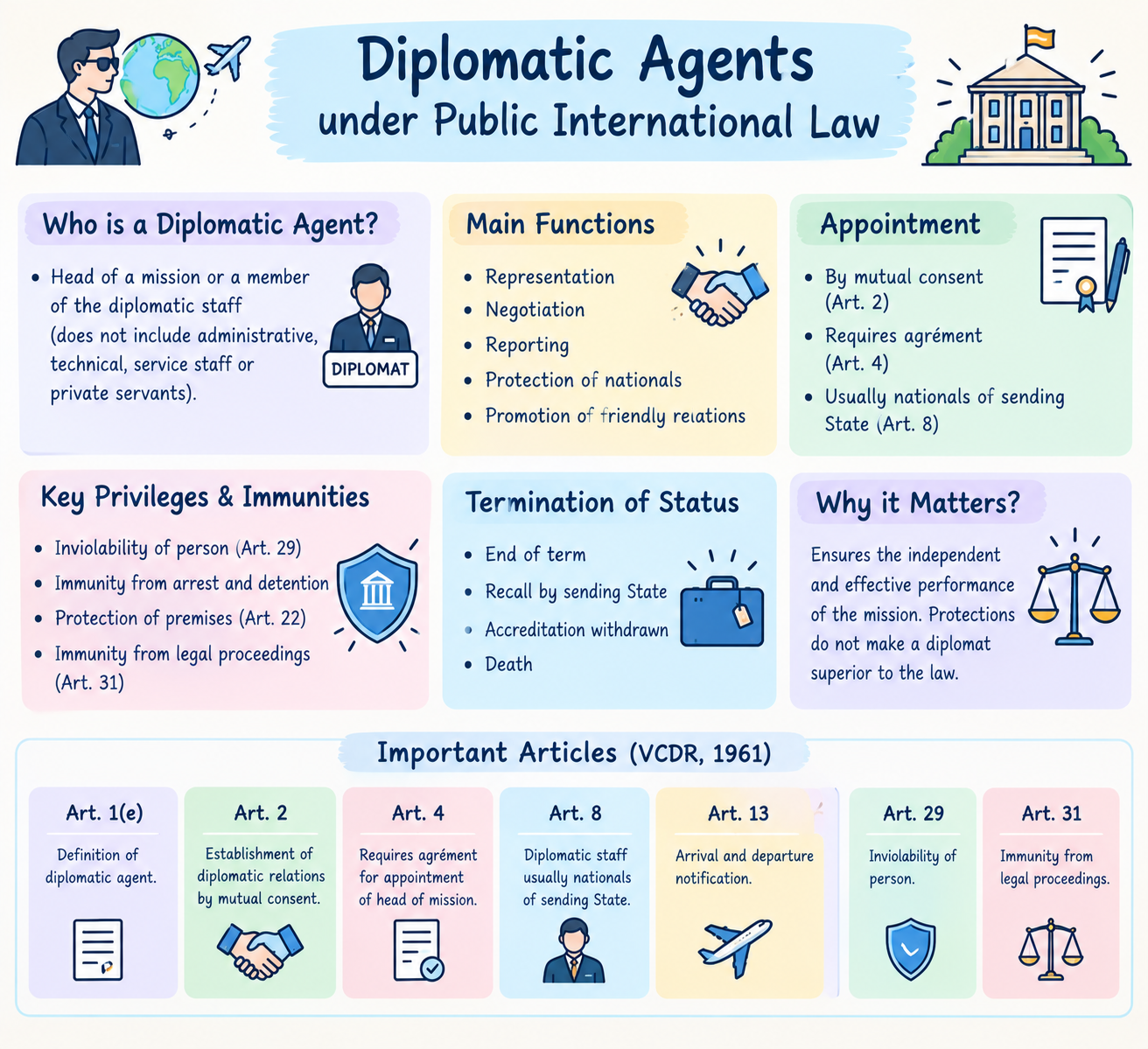
Under Article 1(e) VCDR, a diplomatic agent is the head of a mission or a member of the diplomatic staff of the mission. The term does not include every person working in an embassy. Administrative and technical staff, service staff and private servants have different legal protections.
Article 14 classifies heads of mission into three classes:
- ambassadors or nuncios,
- envoys or ministers, and
- chargés d’affaires.
The distinction is mainly one of rank and protocol. A chargé d’affaires is accredited to the receiving State’s Minister for Foreign Affairs, while an ambassador is accredited to the Head of State.
The Convention applies to diplomatic agents because diplomatic relations exist between States. It does not mean that an embassy is literally foreign territory. The premises remain in the territory of the receiving State, but international law protects them from interference.
Development and legal basis
The practice of sending representatives is ancient. Permanent missions developed gradually, and the Congress of Vienna, 1815 helped standardise diplomatic ranks. The International Law Commission later prepared rules that led to the Vienna Conference of 1961.
The VCDR was adopted on 18 April 1961 and entered into force on 24 April 1964. It codifies customary rules and sets out treaty rules on missions, privileges, immunities and termination. Its Preamble states that immunities exist not for personal benefit but for the efficient performance of diplomatic functions. This is the modern functional necessity theory. An embassy is not foreign soil in a literal sense.
Establishment and Appointment of a Mission
Under Article 2, diplomatic relations and permanent diplomatic missions are established by mutual consent. A State cannot unilaterally impose an embassy on another State.
Before appointing a head of mission, the sending State must obtain the receiving State’s agrément under Article 4. The receiving State may refuse approval without giving reasons. This protects the receiving State from being forced to accept a representative whom it considers unacceptable.
Under Article 7, the sending State generally appoints mission staff, subject to the Convention. Military, naval and air attachés may require prior approval. Diplomatic staff should normally be nationals of the sending State under Article 8, and a national of the receiving State can be appointed only with that State’s consent.
The appointment, arrival and departure of mission personnel must be notified under Article 10. A head of mission begins functions according to the local practice, usually on presentation of credentials or notification of arrival, under Article 13.
Diplomatic Agents Duties
Article 3(1) lists the principal functions of a diplomatic mission:
1. Representation: representation by the sending State in the receiving State.
2. Protection: protection of the sending State and its nationals under international law.
3. Negotiations: negotiations with the Government of the receiving State.
4. Reporting: finding out conditions and developments by lawful means and reporting them to the sending State.
5. Friendly relations: promoting political, economic, cultural and scientific relations.
For example, an ambassador may negotiate a climate agreement, protest unfair treatment of a national or organise an educational exchange. “By lawful means” is important as article 3 does not authorise espionage or unlawful interference. Under Article 3(2), a mission may also perform consular functions, but consular law remains relevant.
Important Privileges and Immunities
Inviolability of the person: Article 29
Under Article 29, a diplomatic agent is inviolable and cannot be arrested or detained by the receiving State. The receiving State shall respect the agent and shall take all appropriate measures to prevent attacks on his person, freedom or dignity. This is a wide protection, and bolsters the independence of the agent.
Inviolability of mission premises: Article 22
The premises of the mission are inviolable. Agents of the receiving State cannot enter them without the consent of the head of mission. The receiving State must protect the premises against intrusion, damage and disturbance. Mission property and vehicles are also protected from search, requisition, attachment or execution.
Inviolability does not mean that the embassy may be used for unlawful purposes. Under Article 41(3), mission premises must not be used in a manner incompatible with diplomatic functions.
Archives and communication: Articles 24 and 27
Under Article 24, the archives and documents of the mission are inviolable wherever they may be. Article 27 protects official communication. A diplomatic bag must not be opened or detained and must bear visible marks showing its character. These rules allow a mission to communicate securely with its government.
Immunity from jurisdiction: Article 31
Article 31(1) gives a diplomatic agent immunity from the criminal jurisdiction of the receiving State. Civil and administrative immunity is also granted, but it has three important exceptions: proceedings concerning private immovable property, succession matters in which the diplomat acts privately, and professional or commercial activity outside official functions.
Article 31(2) provides that a diplomat is not obliged to give evidence as a witness. The receiving State cannot use ordinary judicial procedures to compel participation.
Waiver under Article 32
Immunity is a state matter not merely the personal immunity of an individual diplomat. Under Article 32, the sending State may expressly waive immunity. Waiver of immunity from jurisdiction does not automatically waive immunity from execution of a judgment. A separate waiver is required for execution.
Other protections
Article 26 protects movement subject to security zones. Article 34 concerns tax exemptions, Article 36 customs privileges and Article 37 qualifying family members and other staff.
Duties and limits of diplomatic agents
Privileges are accompanied by duties. Under Article 41(1), diplomats must respect the laws and regulations of the receiving State and must not interfere in its internal affairs. Official business with the receiving State must ordinarily be conducted through its Ministry for Foreign Affairs under Article 41(2).
Article 42 prohibits a diplomatic agent from practising for personal profit any professional or commercial activity in the receiving State. A diplomat cannot use official status as a licence for private business. Immunity limits local jurisdiction; it does not make wrongful conduct lawful or prevent the sending State from investigating and disciplining its agent.
Persona non grata and End of Diplomatic Status
Under Article 9, the receiving State may declare a diplomat persona non grata at any time and without explaining its decision. ‘Persona non grata’ is a Latin phrase which literally means ‘a person not welcome’. The sending State must formally recall the person or terminate the person’s functions. If it fails to do so within a reasonable time, the receiving State may refuse to recognise the person as a mission member.
Under Article 43, diplomatic functions end, among other ways, when the sending State notifies the receiving State that they have ended or when the receiving State notifies the sending State that it refuses to recognise the diplomat. Under Article 39, privileges normally end when the diplomat leaves or after a reasonable period. Immunity continues for official acts performed during the diplomat’s functions.
Even during armed conflict, Article 44 requires the receiving State to facilitate departure. If relations are broken off or a mission is recalled, Article 45 requires protection of the premises, property and archives.
Important case laws
In United States Diplomatic and Consular Staff in Tehran (United States v. Iran), ICJ (1980), militants occupied the United States Embassy and held staff hostage. The Court held that Iran had violated its treaty and customary obligations. It emphasized the necessity of inviolability and held Iran liable for failing to safeguard the mission and for its subsequent endorsement of the situation.
In Arrest Warrant of 11 April 2000 (Democratic Republic of the Congo v. Belgium), ICJ (2002), the Court held that an incumbent Foreign Minister enjoyed immunity from criminal jurisdiction and inviolability under customary international law. The case should not be confused with VCDR immunity as the legal sources and scopes differ.
In Reyes v. Al-Malki [2017] UKSC 61, the United Kingdom Supreme Court considered a domestic worker’s claim against a Saudi diplomat. It held that the employment conduct could fall within the commercial-activity exception in Article 31(1)(c), particularly after the diplomat’s status ended.
Diplomatic Agents and Indian Law
India's diplomatic relations are governed by the international rules applicable to it, including the Vienna Convention on Diplomatic Relations, 1961, and relevant domestic legislation. The Diplomatic Relations (Vienna Convention) Act, 1972 gives domestic legal effect to specified provisions of the Convention in India. Diplomats must respect Indian law, while authorities must honour applicable immunities, exceptions and waivers.
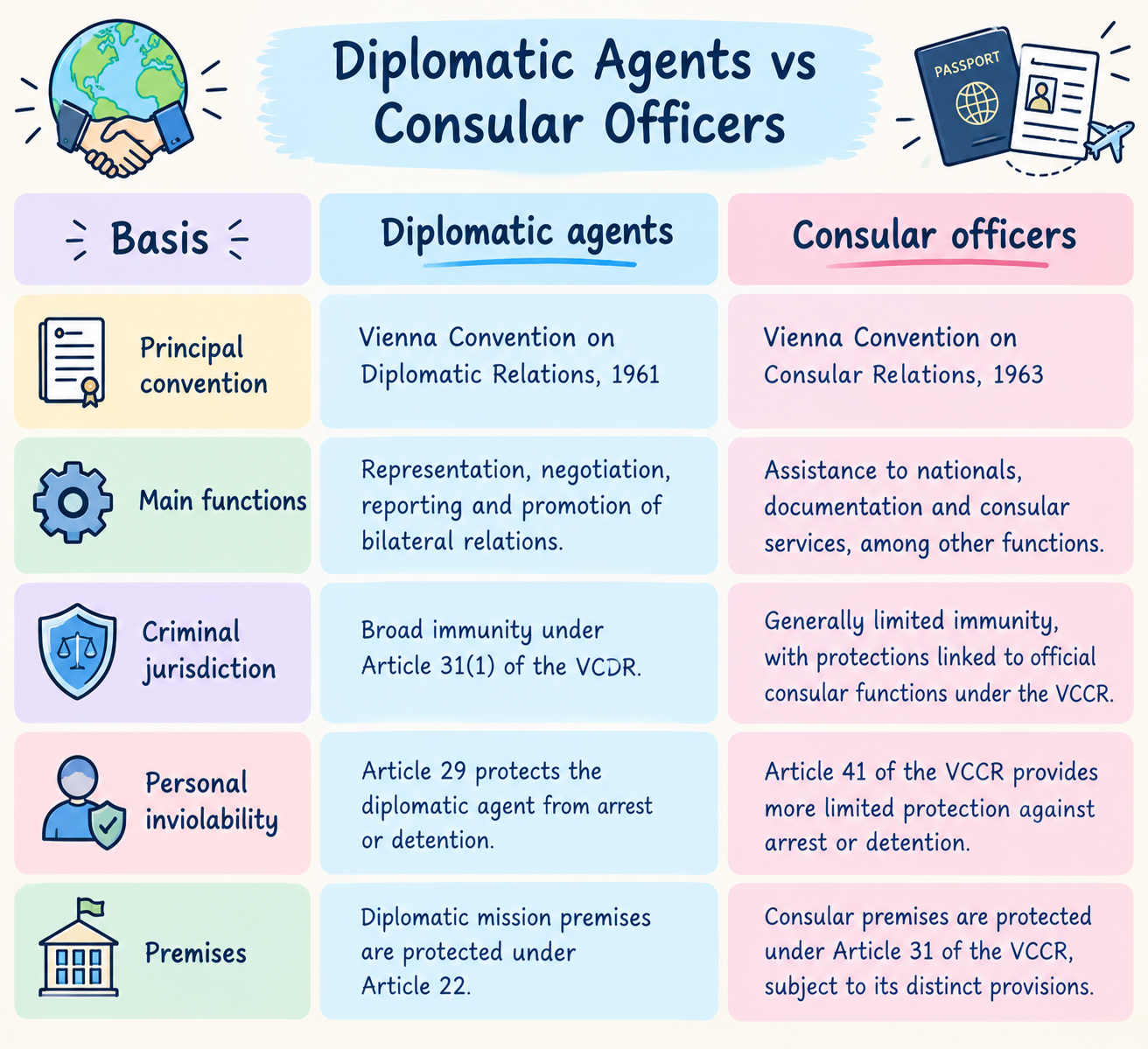
Distinction Between Diplomatic Agents and Consular Officers
Diplomatic agents and consular officers both represent the interests of their States abroad, but they operate under different legal frameworks.
Conclusion
Diplomatic agents are essential to peaceful relations because they represent States, negotiate, report and protect interests. The VCDR protects them through personal inviolability, immunity from jurisdiction, protected premises and confidential communication. These protections exist for diplomacy, not advantage.
Subscribe for updates
Join 10,000+ subscribers.
JU
Julie Nigam
Contributing author
Have a doubt about this?Ask Doubts