
Fundamental Rights: Quick Revision Notes (QRN)
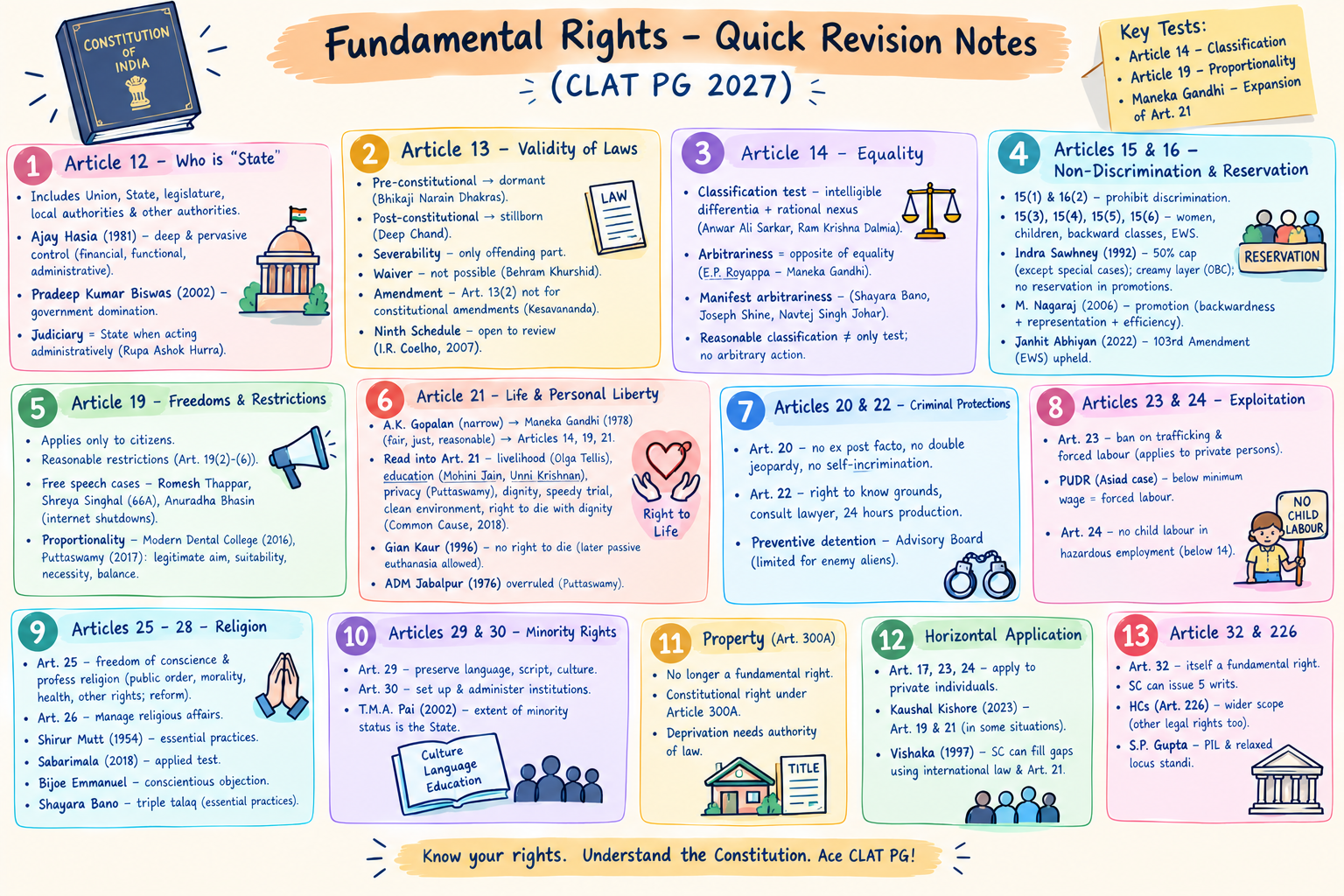
The subject of Fundamental Rights in the context of CLAT PG 2027 is highly crucial in the area of constitutional law and appears in passage-based questions every year. Each right's tests and doctrines are checked including the classification test of Article 14, proportionality test as per Article 19, and the expansion of Article 21 in the case of Maneka Gandhi.
1. Article 12: Who Is “State”
Article 12 covers the Union and State governments, legislatures and local authorities, and “other authorities”. The Ajay Hasia (1981) tests ask about deep and pervasive government control, financial, functional and administrative.
Pradeep Kumar Biswas (2002) refined this into the question whether the body is financially, functionally and administratively dominated by the government. Judiciary is State when it acts administratively but not in its judicial capacity (Rupa Ashok Hurra).
2. Article 13: Validity of Laws
- Pre-constitutional laws that conflict with fundamental rights become dormant, not void, under the doctrine of eclipse (Bhikaji Narain Dhakras).
- Post-constitutional laws in conflict are stillborn (Deep Chand).
- Severability: only the offending part falls if it can be separated.
- Waiver: fundamental rights cannot be waived (Behram Khurshid Pesikaka).
- Amendment: Article 13(2) does not cover constitutional amendments after Kesavananda Bharati (1973), but the basic structure limit applies.
3. Article 14: Equality
- Classification test: Intelligible differentia and the rational nexus to the purpose (Anwar Ali Sarkar, Ram Krishna Dalmia).
- Doctrine of arbitrariness: Arbitrariness was ruled as the opposite of equality as per E.P. Royappa's statement presented in the Maneka Gandhi case.
- Manifest arbitrariness: This term was used by Shayara Bano (2017) while cancelling a law. The Court applied it in case of Joseph Shine (in terms of adultery) and Navtej Singh Johar (in light of Section 377).
- Reasonable classification is not the only test of constitutionality; it is illegal to conduct arbitrary actions by state authorities regardless of any classification.
4. Articles 15 and 16: Non-Discrimination and Reservation
- It is imperative to point out that Articles 15(1) and 16(2) prohibit discrimination on the mentioned grounds .The provisions in Articles 15(3), 15(4), 15(5) and 15(6) are for the special provisions for women and children, socially backward classes, admission in educational institutions and economically weaker sections.
- Indra Sawhney (1992): reservations allowed only upto 50% except in special cases, creamy layer excluded in OBC reservations, no reservation in promotions (later this was changed by amendments).
- M. Nagaraj (2006): upheld the amendments in promotion rules subject to measure of backwardness and the representation and efficiency of the community under Article 335.
- Janhit Abhiyan (2022): upheld the 103rd Amendment regarding EWS reservation by 3:2 majority.
5. Article 19: Freedoms and Reasonable Restrictions
Article 19 applies only to citizens. Restrictions may only be made through law and only for the grounds mentioned in clauses (2) - (6), and these restrictions must be reasonable and proportional.
- Some examples of court cases relating to free speech include Romesh Thappar, who argued in favour of the freedom of the press; Shreya Singhal (2015), which rendered Section 66A unconstitutional and elucidated the distinction between discussion, advocacy and incitement; as well as Anuradha Bhasin (2020), on internet shutdowns, which must be proportionate, reasoned and reviewable.
- Proportionality was developed in Modern Dental College (2016) and adopted in Puttaswamy (2017). The four steps are legitimate aim, suitability, necessity and balance.
6. Article 21: Life and Personal Liberty
- A.K. Gopalan interpreted “procedure established by law” narrowly. In Maneka Gandhi (1978), the court took a contrary opinion, arguing that the procedure must also be fair, just and reasonable. This brings into operation Articles 14, 19 and 21.
- Following rights have been read into Article 21: right to livelihood (Olga Tellis), right to education (Mohini Jain, Unni Krishnan), right to privacy (Puttaswamy, 2017), right to dignity, right to speedy trial, right to clean environment and right to die with dignity (the passive euthanasia in the case of Common Cause, 2018).
- In Gian Kaur (1996), the court said that right to life does not include right to die, but later passive euthanasia was allowed with safeguards.
7. Articles 20 and 22: Criminal Protections
- Article 20: no ex post facto penal law, no double jeopardy, no self-incrimination (applies to accused persons and to testimonial compulsion).
- Article 22: rights to know the grounds of arrest, consult a lawyer and be produced before a magistrate within 24 hours. For preventive detention the Advisory Board safeguards apply. These protections are limited for enemy aliens and persons under preventive detention law.
8. Articles 23 and 24: Exploitation
Article 23 bans trafficking and forced labour, and applies against private persons. PUDR (the Asiad case) held that payment below minimum wage is forced labour. Article 24 prohibits child labour in hazardous employment below 14.
9. Articles 25 to 28: Religion
- Article 25 grants freedom of conscience and the right to profess religion, subject to the limits of public order, morality, health, and other fundamental rights. It also covers laws for reform. It permits the practice of one's religion freely.
- Article 26 gives religious groups the right to manage their own affairs according to religious law.
- The essentiality test (or that of essential religious practices) was laid down by the Supreme Court in the case of the Shirur Mutt (1954). It was applied in the Sabarimala case (2018) and in other references.
- The principle of conscientious objection was laid down in the case of Bijoe Emmanuel.
10. Articles 29 and 30: Minority Rights
Article 29 provides for the right of the citizens to preserve their language, script, and culture.
Article 30 allows the minorities to set up and administer educational institutions of their choice.In the case of T.M.A. Pai (2002), the Court ruled that the extent of minority status is the state. Certain regulations are permissible, but interference cannot happen in the affairs of the organization.
11. Property (Article 300A)
Property stopped being a fundamental right with the 44th Amendment. It is now a constitutional right under Article 300A, and deprivation needs authority of law.
12. Horizontal Application
Articles 17, 23 and 24 are to be applied to private individuals. In Kaushal Kishore (2023), Articles 19 and 21 can be enforced against private parties in certain situations. An example is Vishaka (1997), which illustrates the ability of the Supreme Court to fill gaps in the law in terms of workplace sexual harassment by means of international law and Article 21.
13. Article 32 and Article 226
Article 32 is itself a fundamental right.
The Supreme Court has the power to issue five types of writs for the violation of fundamental rights. High Courts, on the other hand, have a wider sphere of action under Article 226, in as much as they can also deal with violations of other legal rights.
Public interest litigation came into being by relaxing the requirement of locus standi, as was witness in S.P. Gupta.
Subscribe for updates
Join 10,000+ subscribers.
HA
Hanspal Bakul
Contributing author
Have a doubt about this?Ask Doubts