
Right to Equality under the Indian Constitution: A Study of Articles 14 – 18
Introduction
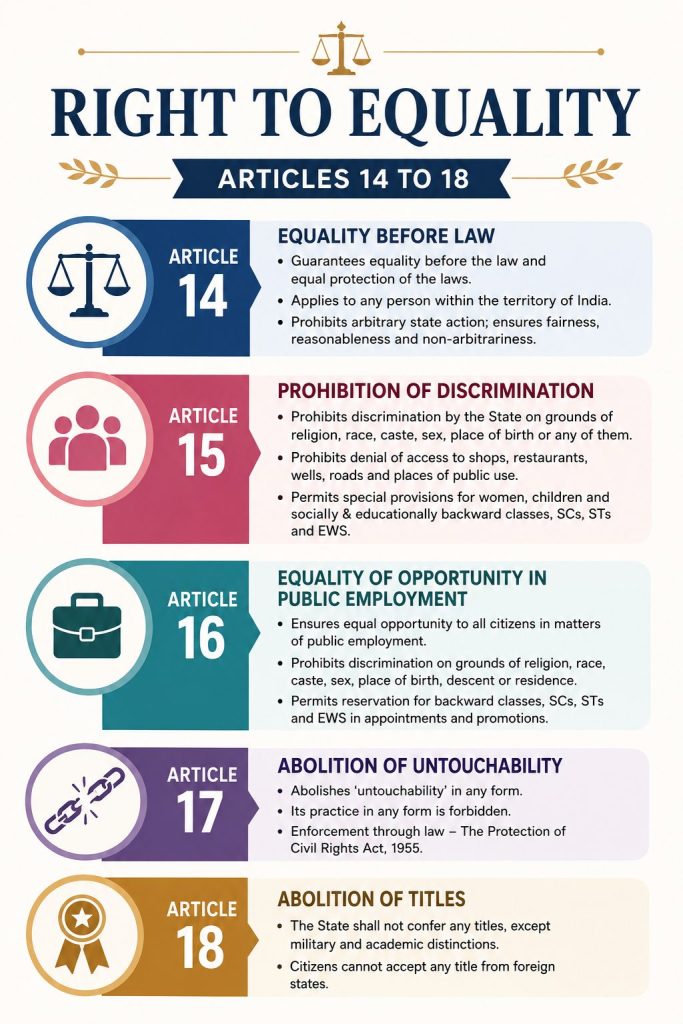
Articles 14 to 18 of Part III of the Indian Constitution provides for the right to equality to every citizen of India. Article 14 provides for the general principles of equality whereas the subsequent articles 15, 16, 17, and 18 provide for the specific aspects of equality rule. While Article 15 prohibits discrimination based on religion, race, caste, sex, or place of birth, Article 16 ensures equality in public employment. Articles 17 and 18 eliminates historical social inequalities by abolishing untouchability and titles, respectively.
Article 14 : Equality before Law
Article 14 guarantees that ‘the State shall not deny to any person equality before the law or the equal protection of the laws within the territory of India.’ When we further break down this article, it clearly provides the two expressions, “equality before law” and “equal protection of laws”. Although both the expressions seem synonymous, they do not convey the same meaning.
The phrase ‘equality before law’ is of a British origin and it is a negative concept derived from A.V. Dicey’s doctrine of Rule of Law. It is characterized as a negative concept because it implies the absence of special privileges to the individuals and subjects all classes of individuals equally to the ordinary law of land. Thus, it means that no individual is above the law.
On the other hand, the phrase ‘equal protection of law’ is of an American origin . It functions as a more positive concept, which means ‘like should be treated alike’. Under this concept, law must treat individuals placed in similar circumstances equally, both in privileges and liabilities.
It mandates that equals must be treated equally, thereby prohibiting any discrimination between one person and another. In spite of their distinct origins, both the expressions share a common fundamental objective i.e. the delivery of equal justice.
Doctrine of Reasonable Classification
In the landmark case of ‘State of West Bengal v. Anwar Ali Sarkar (1952)’ supreme court officially created the Doctrine of Reasonable classification.. In this judgment the court explicitly held that treating unequals equally creates inherent injustice. Thus, the court laid down the “Twin Test” to determine if the law’s classification is valid or arbitrary.
- The classification must use intelligible defferentia i.e it should be reasonable, clear and logical.
- The classification shall have the direct nexus or connection with the specific objective the legislature tends to achieve.
Doctrine of Non-Arbitrariness (Modern Concept of Equality)
In the case of ‘E.P. Royappa v. State of Tamil Nadu (1974)’, Justice P.N. Bhagwati has famously articulated that equality and arbitrariness are “sworn enemies”. In the same judgment, supreme court developed the new concept of equality, shifting away from traditional rules.
The court firmly held that equality is inherently opposed to arbitrariness. Therefore, whenever arbitrary action arises, Article 14 comes into action, establishing that non-arbitrariness and the principles of natural justice are the true hallmarks of equality.
In Maneka Gandhi v. Union of India (1978), Justice Bhagwati again quoted on the concept of equality, “Equality is a dynamic concept with many aspects and dimensions and it cannot be imprisoned within traditional and doctrinaire limits.”
In the same case supreme court interconnected Articles 14, 19, and 21 into a ‘Golden Triangle’. It ruled that any law depriving personal liberty must not only satisfy procedural rules but also be just, fair, and non-arbitrary. In simple terms, if the government violates the rules of natural justice, its action automatically becomes arbitrary and unconstitutional under Article 14.
Article 15 : Prohibition of discrimination on grounds of religion, race, caste, sex or place of birth
Article 15 serves as a specific application of the general principle of equality laid down in article 14. The clause (1) of article 15 explicitly states that, “ The State shall not discriminate against any citizen on grounds only of religion, race, caste, sex, place of birth or any of them.” The word ‘discriminate’ means unfavourable distinction among individuals.
The presence of the word ‘only’ indicates that if the state discriminates against any individual solely on the grounds listed above then its action will be unconstitutional hence ultra-vires. The discrimination on the ground other than the mentioned above is not prohibited.
While clause (1) of article 15 prohibits the discrimination by state, clause (2) prohibits both by state and private individuals. The purpose of article 15(2) is to end the social evils of the caste system and help build a truly united country.
Article 15(3) provides for the creation of special provision for women and children. It acts as a vital exception to the clauses 1 and 2 to article 15. It explicitly empowers the state to enact special provisions for women and children.
This is because women and children require special welfare measures due to biological and socio-economic realities. To fulfill this objective, Article 42(of part IV) works in relation with article 15(3) to secure special maternity relief for female workers.
Constitution (1st Amendment) Act , 1951 added Clause (4) to article 15. It was added to nullify the observation made under the case ‘State of Madras v. Champkam Dorairajan AIR 1951 SC 226’. In this case madras govt, issued a Government Order (G.O.) reserving seats for students based on religion, race, and caste.
The petitioner challenged G.O. on the ground that it violates Article 15(1). The court struck down the G.O. as void under article 15(1) and held that DPSP cannot override a fundamental right. To invalidate such ruling and harmonise the disparity between DPSP and fundamental rights, parliament added clause (4). This clause ensured that nothing in article 15 and article 29(2) can prevent the state from making special provisions for the advancement of socially and educationally backward classes (SEBCs), SCs, and STs.
93rd constitutional amendment, 2005 added Clause (5) to article 15. This provision empowers the state to make special laws for advancement of SEBCs, SCs, and STs regarding their admission into educational institutions, specifically in private aided or unaided institutions.
Legislature inserted this clause to nullify the judicial restrictions made under landmark judgments laid down in TMA Pai Foundation V. State of Karnataka (AIR 2003 SC 355), Islamic Academy of Education v. State of Karnataka (AIR 2003 SC 3724), and P.A. Inamdar v. State of Maharashtra. In these cases, the supreme court had held that the state could not impose reservation on private, unaided educational institutions. The supreme court upheld the constitutional validity of the 93rd constitutional amendment in the landmark case of Ashok Kumar Thakur v. UOI.
103rd constitutional amendment, 2019 added clause (6) to article 15. This provision empowers the state to reserve the admission seats for the Economically Weaker Section (EWS) of society. However, article 30 completely exempts the minority educational institutions established under it from the scope of this EWS reservation.
Article 16 : Equality of opportunity in matters of public employment
Article 16 provides equality of opportunity in matters of public employment exclusively to Indian citizens. It serves as a specific application of the general rule of equality provided under article 14.
Article 16(1) gives every citizen an equal right to apply for and hold any government office.
Clause (2) to Article 16 prohibits discrimination or disqualification for public emloyment based on the groundsof religion, race, caste, sex, place of birth, descent, or residence.
Article 16(3) creates an exception allowing parliament to set residence requirements like living in a specific state or UT’s as a condition precedent for certain government jobs.
Clause (4) to Article 16 is an enabling provision which gives the State the power to create job reservations for any backward classes of citizens who are not adequate represented in government jobs.
Article 16(4A) significantly expanded the scope of Clause 4 by extending the scope of reservations to promotions in public employment specifically for SCs and STs. Constitutional 77th Amendment Act, 1995 added this clause.
As clarified in Mukesh Kumar v. State of Uttarakhand (2020), this remains a discretionary power rather than a fundamental right, meaning the judiciary cannot compel a state government to collect data or enforce these promotional quotas.
The phrase “with consequential seniority” in article 16(4A) negates ‘catch-up rule’. Supreme court in ‘UOI v. Virpal Singh Chauhan (1995)’ held that the early promotions of reserved categories doesn’t ends the senior general candidates basic seniority once promoted. Later, in ‘Ajit Singh v. State of Punjab (1999)’ court reaffirmed the reserved candidates promoted earlier does not automatically get consequential seniority over senior general candidates in promoted cadre.
81st Constitutional Amendment Act, 2000 added article 16(4B). It further expanded the operational scope of Clause 4 by introducing the “carry-forward rule” for unfilled vacancies.
Carry-Forward rule
The rule allows the State to treat unfilled backlog vacancies from previous years as a distinct class of posts to be filled in subsequent years. This rule bypass the strict 50% legal cap on total reservations established by courts. Supreme court in ‘T. Devadasan v. UOI (1964)’ considered the scope of ‘carry forward rule’ and declared it as unconstitutional violating article 16(1). Later, in ‘Indra Sawhney v. UOI (1992)’ Supreme court reconsiderd the carry forward rule and upheld its constitutionality provided that it does not exceed 50% limit in a given year.
Article 16(5) allows the state that an official or employee managing a religious institution must belong to that specific religion or denomination, serving as a fair exception to general non-discrimination rules.
103rd Constitutional Amendment Act, added Clause (6) to article 16. This provision empowers the State to set aside up to 10% of government job posts for the Economically Weaker Sections (EWS) of citizens who are not covered under traditional caste-based reservations.
It is important to note that Article 15(6) acts as a mirror provision to Article 16(6). Introduced simultaneously by the 103rd Constitutional Amendment Act, they complement each other, while Article 15(6) provides for economic reservations (EWS) in educational admissions, Article 16(6) mirrors this power by enabling economic reservations in public employment.
Article 17: Abolition of Untouchability
Article 17 completely bans the practice of ‘untouchability’ in any form across India. Because the Constitution does not explicitly define the term ‘untouchability’, parliament passed ‘The Protection of Civil Rights Act, 1955’ to legally enforce this ban. The Supreme Court in ‘State of Karnataka v. Appu Balu Ingale (1993)’ recognized the practice as an extension of the caste system and an indirect form of slavery.
Article 18: Abolition of titles
Article 18 prohibits the State from conferring any titles, making a strict exception only for military and academic distinctions. Furthermore, it bars Indian citizens from accepting any titles from foreign nations. The Constituent Assembly added these restrictions because they firmly believed that aristocratic titles directly conflict with the core constitutional principle of equality.
In ‘Balaji Raghavan v. Union of India’, the Supreme Court ruled that national honors like the Bharat Ratna or Padma awards do not amount to the conferment of a ‘title’ under Article 18. The Court explained that these awards exist to celebrate merit, recognize excellence, and inspire others. However, the Court added a strict warning that the law legally forbids recipients from using these honors as prefixes or suffixes to their names.
Conclusion
The right to equality forms the foundation of Indian democracy by dissolving historical and social inequalities. While article 14 provides the general framework of equal justice for all, subsequent articles 15, 16, 17, and 18 apply this rule to specific areas. Together, these articles tend to transform India into a just democracy where individual rights prevails over traditional advantages and absolute state power.
Subscribe for updates
Join 10,000+ subscribers.
JU
Julie Nigam
Contributing author
Have a doubt about this?Ask Doubts
