
Directive Principles of State Policy(DPSP) under Indian Constitution: Whether enforceable like Fundamental Rights?
Here’s a question that trips up almost every law student in their first year: if a citizen’s Fundamental Rights are violated, they can walk into a High Court or the Supreme Court and demand justice. But what happens when the government itself fails to provide free legal aid, or doesn’t work towards a living wage, or ignores environmental protection? Can a citizen sue the State for that too?
The answer is no and understanding exactly why takes you straight into one of the most debated parts of the Indian Constitution: the Directive Principles of State Policy, or DPSP.
Part IV of the Constitution, Articles 36 to 51, lays out a list of goals the government is expected to work towards economic justice, education, public health, international peace, and more. None of these are enforceable in court. And yet, DPSPs have shaped some of India’s most important laws and landmark judgments. This Article breaks down what they are, why they exist, how they differ from Fundamental Rights, and where they’ve made a real difference.
What Are Directive Principles of State Policy?
The Directive Principles of State Policy are a set of guidelines contained in Part IV of the Constitution (Articles 36-51). They direct the State, meaning the government at every level, from Parliament to a local municipality to apply these principles while making laws and forming policy.
Dr. B.R. Ambedkar described them as “novel features” of the Indian Constitution. They were borrowed from the Directive Principles found in the Irish Constitution of 1937, which in turn drew inspiration from the Spanish Constitution. The idea was simple: India had just emerged from colonial rule into deep poverty and inequality. Political democracy alone, the right to vote wouldn’t be enough. The Constitution needed to also point the government toward social and economic democracy.
As Ambedkar put it during the Constituent Assembly debates, the Directive Principles were meant to ensure that whichever party came to power, it could not ignore certain fundamental goals of governance. They are, in essence, instructions to future governments regardless of ideology.
Why Aren’t DPSPs Enforceable in Court?
This is the single most important and most misunderstood feature of the Directive Principles. Article 37 states clearly that DPSPs “shall not be enforceable by any court,” but adds that they are nonetheless “fundamental in the governance of the country” and that it is the duty of the State to apply them while making laws.
In simpler terms: you cannot drag the government to court and say “you haven’t implemented Article 39(a) on equal pay,” because there’s no legal remedy attached to that failure. But the Constitution still expects and morally obligates the State to work toward these goals through legislation and policy.
Why was it designed this way? The framers were being pragmatic. India in 1950 didn’t have the economic resources to guarantee things like free education or a living wage as enforceable rights overnight. Making them legally enforceable from day one would have set the government up to fail in court almost immediately. Instead, DPSPs were framed as long-term commitments as a roadmap rather than a checklist with legal penalties.
The Main Categories of Directive Principles
Articles 36 – 51 cover a wide range of goals. They’re usually grouped into three broad categories for easier understanding:
1. Socialist Principles
These push the State toward economic justice and reducing inequality.
- Article 38: Promote a social order with justice – social, economic, and political and minimise inequalities in income, status, and opportunity.
- Article 39: Secure adequate means of livelihood, equal pay for equal work, prevention of concentration of wealth, and protection of children and workers from exploitation.
- Article 41: Right to work, education, and public assistance in cases of unemployment, old age, sickness, and disability.
- Article 43: A living wage and decent standard of life for workers.
- Article 47: Raise the level of nutrition and public health, and improve standards of living.
2. Gandhian Principles
These reflect Mahatma Gandhi’s vision of self-reliant village governance and social upliftment.
- Article 40: Organise Village Panchayats and give them powers to function as units of self-government.
- Article 43: Promote cottage industries in rural areas.
- Article 46: Promote educational and economic interests of Scheduled Castes, Scheduled Tribes, and other weaker sections, and protect them from social injustice and exploitation.
- Article 48: Organise agriculture and animal husbandry on modern, scientific lines, and prohibit the slaughter of cows, calves, and other milch and draught cattle.
3. Liberal-Intellectual Principles
These reflect broader liberal and international ideals.
- Article 44: Endeavour to secure a Uniform Civil Code for all citizens throughout India.
- Article 45: Provide early childhood care and education for children below six years (originally aimed at free and compulsory education up to age 14, now largely fulfilled through the Right to Education Act and Article 21A).
- Article 48A: Protect and improve the environment, and safeguard forests and wildlife.
- Article 49: Protect monuments and objects of national importance.
- Article 50: Separate the judiciary from the executive in public services.
- Article 51: Promote international peace and security, and encourage settlement of international disputes through arbitration.
Directive Principles That Became Real Law
DPSPs might not be enforceable directly, but many of them have quietly shaped some of India’s most significant legislation and constitutional amendments:
- Article 21A (Right to Education): The 86th Amendment (2002) converted the goal in Article 45 into a Fundamental Right, guaranteeing free and compulsory education for children aged 6 – 14.
- Panchayati Raj system: The 73rd and 74th Amendments (1992) gave constitutional status to Village Panchayats and Municipalities, directly fulfilling the vision in Article 40.
- Equal Remuneration Act, 1976: Enacted to give effect to Article 39(d), which calls for equal pay for equal work for men and women.
- Minimum Wages Act and Environment Protection Act: Reflect the goals set out in Articles 43 and 48A respectively.
- Legal Services Authorities Act, 1987: Article 39A directs the State to provide free legal aid to ensure justice isn’t denied due to economic hardship, this Act operationalised that promise, creating Lok Adalats and Legal Services Authorities across the country.
This is the real strength of DPSPs: they don’t force immediate compliance, but they set the direction for legislative reform over decades.
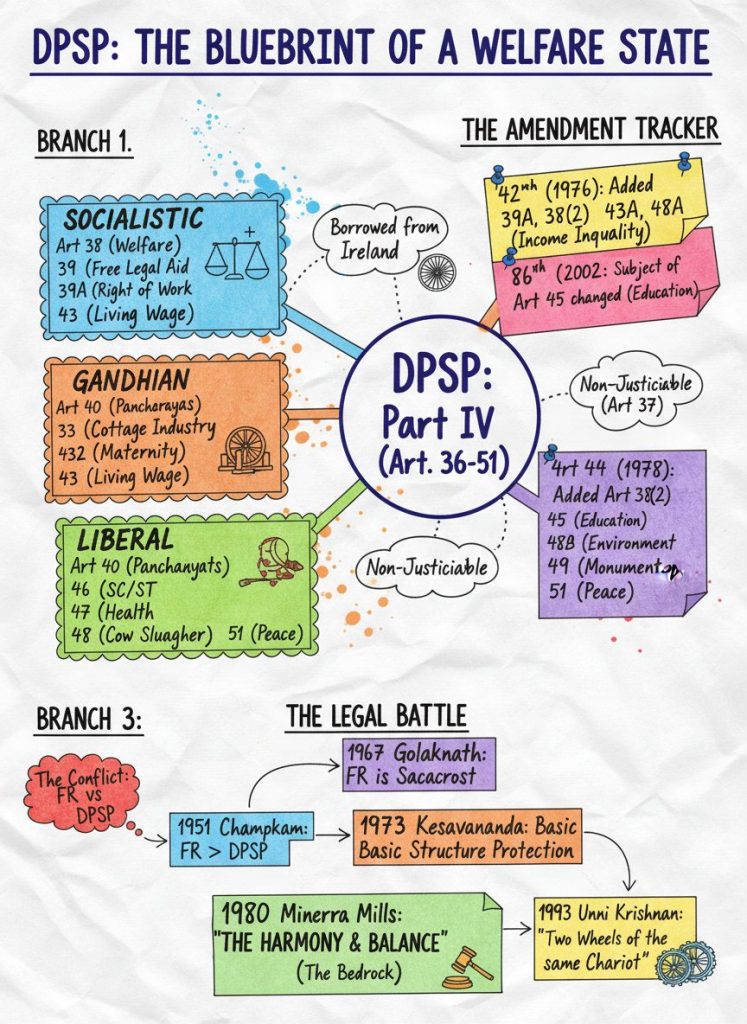
Landmark Cases That Shaped the DPSP v. Fundamental Rights Relationship
The relationship between Part III and Part IV has been one of the most litigated questions in Indian constitutional history. A few cases every student should know:
Champakam Dorairajan v. State of Madras (1951) – The Supreme Court held that in case of conflict, Fundamental Rights would prevail over Directive Principles, since DPSPs are not enforceable. This triggered the First Constitutional Amendment.
Kesavananda Bharati v. State of Kerala (1973) – The landmark case that introduced the Basic Structure Doctrine. While primarily about the limits of Parliament’s amending power, it also acknowledged that Fundamental Rights and Directive Principles must be balanced, not treated as strictly separate or opposed.
Minerva Mills v. Union of India (1980) – The Supreme Court struck down provisions of the 42nd Amendment that gave DPSPs unconditional primacy over Fundamental Rights, holding that the harmony and balance between Parts III and IV is itself part of the Constitution’s basic structure. Neither can be given absolute primacy over the other.
State of Kerala v. N.M. Thomas (1976) and later judgments moved toward reading Fundamental Rights and Directive Principles together, rather than as opposing forces, an approach the courts have broadly continued since.
The trend across these cases is clear: from an early view that Fundamental Rights always trump Directive Principles, Indian constitutional law has evolved toward harmonious construction, reading both parts together to fulfil the Constitution’s broader vision, wherever reasonably possible.
The Directive Principles were never meant to be a courtroom weapon, they were meant to be a compass. Seven decades on, that compass has quietly guided some of India’s most defining laws, from free education to legal aid for the poor. They remind us that a Constitution isn’t just about what the State cannot do to its citizens, but what it must keep striving to do for them. In that sense, Part IV isn’t the Constitution’s fine print rather it’s its conscience.
Subscribe for updates
Join 10,000+ subscribers.
SH
Shruti chauhan
Contributing author
Have a doubt about this?Ask Doubts
