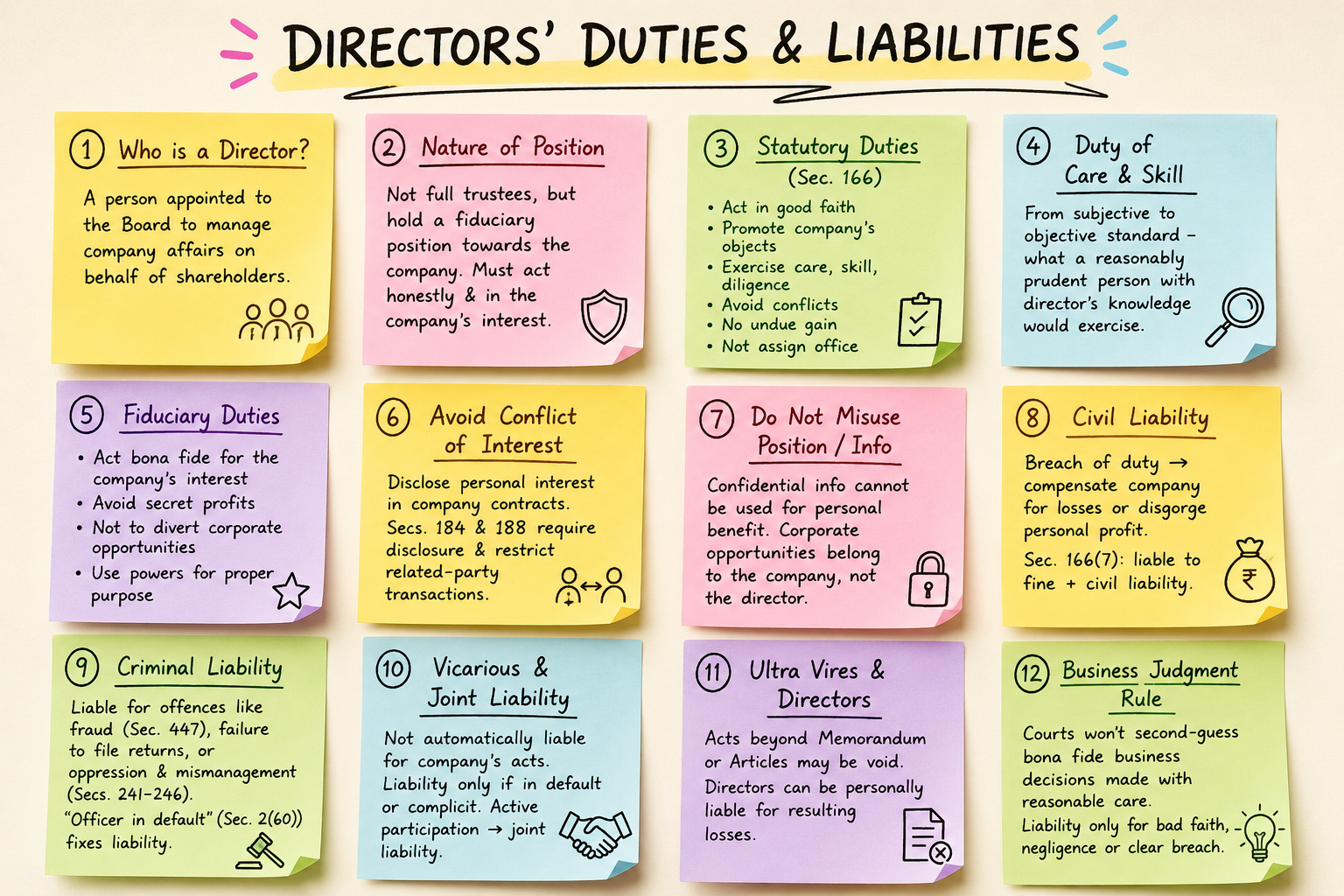
In this article, let's explore about duties and liabilities of director under company law. It is important to remember sections as they are sometimes directly asked in the exam.
1. Who is a Director
A director is a person appointed to the Board of a company to manage its affairs on behalf of shareholders. Under Section 2(34) of the Companies Act, 2013,"director" means a director appointed to the Board. Directors act as agents, trustees, and organs of the company simultaneously, depending on the context of the transaction.
2. Nature of the Director's Position
Directors are not full trustees in the technical sense rather they are treated as trustees of the powers they exercise and the company funds entrusted to them, but they hold a fiduciary position toward the company.
This means they must act honestly, avoid conflicts of interest, and never misuse their office for personal gain. Courts have repeatedly emphasised that this fiduciary character underlies almost every duty discussed below.
Section 166(2)codifies directors' duties in India. A director must act in accordance with the company's Articles; act in good faith to promote the company's objects for the benefit of members as a whole; exercise independent judgment; exercise reasonable care, skill, and diligence; avoid conflicts of interest; not achieve undue gain or advantage; and not assign his office to another person.
Duty of Care and Skill
Traditionally, courts applied a lenient, subjective standard - a director only needed the skill reasonably expected given his own knowledge and experience (Re City Equitable Fire Insurance).
WhileSection 166(3)simply mandates 'due and reasonable care, skill and diligence', judicial interpretation has shifted this from the old subjective rule toward a more stringent, objective conception of directorial competence: what a reasonably prudent person with the director's knowledge and experience would exercise.
Fiduciary Duties
These require directors to act bona fide in the company's interest, not their own. This branch includes the duty to avoid secret profits (Regal Hastings v. Gulliver), the duty not to divert corporate opportunities (Industrial Development Consultants v. Cooley), and the duty to exercise powers for their proper purpose, such as share allotment(Dale & Carrington v. Prathapan).
Duty to Avoid Conflict of Interest
Directors must disclose any personal interest in a contract or arrangement involving the company. Sections 184 and 188 of the 2013 Actrequire disclosure of interest and impose restrictions on related-party transactions. Failure to disclose can render the contract voidable and expose the director to penalties.
Duty Not to Misuse Position or Information
Confidential information obtained through directorship cannot be used for personal benefit. This overlaps with the corporate opportunity doctrine - an opportunity that comes to a director because of his office belongs to the company, not to him personally, even if he later resigns to pursue it.
Civil Liability
A director who breaches these duties can be held liable to compensate the company for losses caused, or to disgorge any personal profit made in breach of fiduciary duty. Section 166(7) specifically provides that a contravening director is punishable with a fine, in addition to any civil liability for the breach itself.
Criminal Liability
Directors can face criminal liability for specific statutory offences - for instance, fraud under Section 447, failure to file statutory returns, or oppression and mismanagement provisions under Sections 241-246. "Officer in default" under Section 2(60) fixes liability on specific directors responsible for a default, not the entire Board automatically.
Vicarious and Joint Liability
Ordinarily, directors are not automatically liable for a company's acts merely by virtue of office; liability must attach to specific individuals shown to be in default or complicit. However, where a director actively participates in or authorises wrongdoing, both the company and that director may be held jointly liable.
Doctrine of Ultra Vires and Directors
If directors act beyond the powers conferred by the Memorandum or Articles, such acts may be void, and directors can be held personally liable for resulting losses since they are expected to ensure the company acts within its constitutional limits.
Business Judgment Rule
Indian courts, drawing from comparative jurisprudence, generally do not second-guess bona fide commercial decisions made with reasonable care, even if they later turn out to be poor decisions. Liability attaches only where there is bad faith, negligence, or a clear breach of duty - not for honest errors of business judgment.