
Environment Protection Act, 1986: Part 1 - Foundational Provisions
Background and Objective
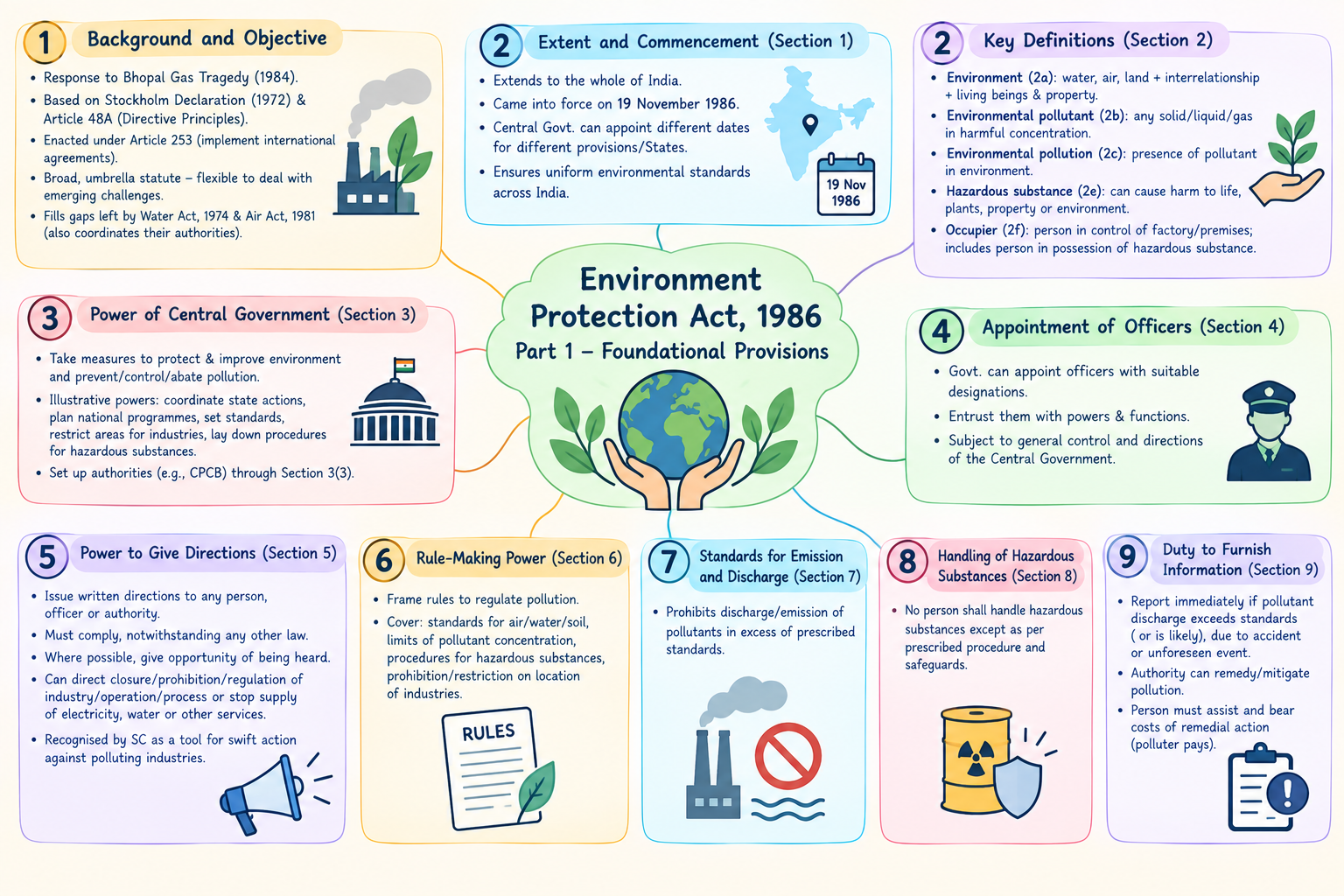
The Environment (Protection) Act, 1986 emerged as a direct legislative response to the Bhopal Gas Tragedy of 1984, reflecting India's obligations under the Stockholm Declaration of 1972 and Article 48A of the Constitution, which directs the State to protect and improve the environment.
Parliament enacted this legislation as an umbrella statute under Article 253, empowering the Union to implement decisions taken at international conferences concerning environmental protection.
The Act's preamble describes it as a law to provide for the protection and improvement of the environment and for matters connected therewith, deliberately drafted in broad terms to allow the Central Government flexibility in addressing emerging environmental challenges.
This umbrella character distinguishes it from the earlier, more specific pollution statutes, since it fills regulatory gaps left by the Water Act, 1974 and the Air Act, 1981, while also coordinating the activities of authorities established under those earlier laws.
Extent and Commencement: Section 1
Section 1 extends the Act to the whole of India, and it came into force on November 19, 1986, though the Central Government retained the power to appoint different dates for different provisions and different states through notification.
This uniform territorial application ensures that environmental standards do not vary across state boundaries, addressing the inherently transboundary nature of pollution and ecological harm.
Key Definitions: Section 2
Section 2(a) defines "environment" broadly to include water, air, and land, along with the interrelationship that exists among and between them and human beings, other living creatures, plants, micro-organisms, and property.
This expansive definition allows courts and regulatory authorities to address environmental harm across multiple media rather than confining protection to any single element like air or water alone.
Section 2(b) defines "environmental pollutant" as any solid, liquid, or gaseous substance present in such concentration as may be, or tend to be, injurious to the environment, while Section 2(c) defines "environmental pollution" as the presence of any environmental pollutant in the environment.
Section 2(e) defines "hazardous substance" as any substance or preparation which, by reason of its chemical or physico-chemical properties or handling, is liable to cause harm to human beings, other living creatures, plants, micro-organisms, property, or the environment.
Section 2(f) defines "occupier" in relation to any factory or premises as the person who has control over the affairs of the factory or premises, extending this definition to include, in relation to hazardous substances, the person in possession of that substance.
This definition proves significant for allocating liability under the Act, since it fixes responsibility on the person exercising actual control rather than merely nominal ownership.
Power of Central Government to Take Measures: Section 3
Section 3(1) empowers the Central Government to take all such measures as it deems necessary or expedient for the purpose of protecting and improving the quality of the environment and preventing, controlling, and abating environmental pollution.
This provision functions as the Act's operative core, granting the Central Government wide discretionary authority rather than confining it to an enumerated list of powers.
Section 3(2) illustrates this general power through specific examples without limiting its scope, including coordinating actions by state governments and other authorities, planning and executing nationwide programmes for environmental protection, laying down standards for the quality of environment and for emissions or discharges of pollutants, restricting areas where industries may not be carried out subject to safeguards, and laying down procedures and safeguards for handling hazardous substances.
Section 3(3) further empowers the Central Government to constitute an authority or authorities for exercising and performing such powers and functions as may be specified in the constituting order, a provision under which bodies like the Central Pollution Control Board's expanded mandate and various environmental authorities derive their powers.
Appointment of Officers: Section 4
Section 4 empowers the Central Government to appoint officers with such designations as it thinks fit for the purposes of the Act, and to entrust them with such powers and functions as it deems fit.
These officers function subject to the general control and directions of the Central Government, creating an administrative hierarchy through which the Act's broad mandate translates into ground-level enforcement.
Power to Give Directions: Section 5
Section 5 empowers the Central Government to issue directions in writing to any person, officer, or authority, who is then bound to comply with such directions, notwithstanding anything contained in any other law.
The proviso requires that, wherever practicable, the person, officer, or authority likely to be affected must be given an opportunity of being heard before a direction is issued.
This power specifically extends to directing the closure, prohibition, or regulation of any industry, operation, or process, or the stoppage or regulation of the supply of electricity, water, or any other service.
The Supreme Court has recognised Section 5 as a potent tool enabling swift executive action against polluting industries, since it allows the Central Government to bypass otherwise lengthy adjudicatory processes where environmental harm demands urgent intervention.
Rule-Making Power to Regulate Pollution: Section 6
Section 6 empowers the Central Government to make rules for regulating environmental pollution, covering matters such as standards of quality of air, water, or soil for various areas and purposes, maximum permissible limits of pollutant concentration for different areas, procedures for handling hazardous substances, and prohibition or restriction on the location of industries in certain areas.
This rule-making power operationalises the general standard-setting authority under Section 3, translating broad policy objectives into specific, measurable compliance benchmarks.
Standards for Emission and Discharge: Section 7
Section 7 prohibits any person carrying on any industry, operation, or process from discharging or emitting any environmental pollutant in excess of the standards prescribed under the Act.
This provision creates a direct, enforceable obligation on industrial operators, distinct from the Central Government's general regulatory powers, since it imposes liability on the polluter for exceeding prescribed limits regardless of whether a specific direction has been issued against them.
Handling of Hazardous Substances: Section 8
Section 8 requires that no person shall handle, or cause to be handled, any hazardous substance except in accordance with such procedure and after complying with such safeguards as may be prescribed.
This provision, read alongside the Hazardous Waste Management Rules framed under Section 6, establishes a comprehensive procedural framework governing the manufacture, storage, transport, and disposal of substances capable of causing serious environmental or health harm.
Duty to Furnish Information: Section 9
Section 9 imposes a duty on any person carrying on an industry, operation, or process to intimate the prescribed authority immediately if the discharge of any environmental pollutant occurs, or is apprehended to occur, in excess of prescribed standards, due to any accident or unforeseen act or event.
This provision also empowers such authority to remedy or mitigate the pollution and obligates the person concerned to render all assistance, apportioning the associated expenses to the polluter under the principle that the person responsible for pollution should bear the cost of remedial action.
Subscribe for updates
Join 10,000+ subscribers.
HA
Hanspal Bakul
Contributing author
Have a doubt about this?Ask Doubts
