Environment Protection Act, 1986: Part 2 - Enforcement, Offences, and Procedural Provisions
Environment Protection Act, 1986: Part 2 - Enforcement, Offences, and Procedural Provisions
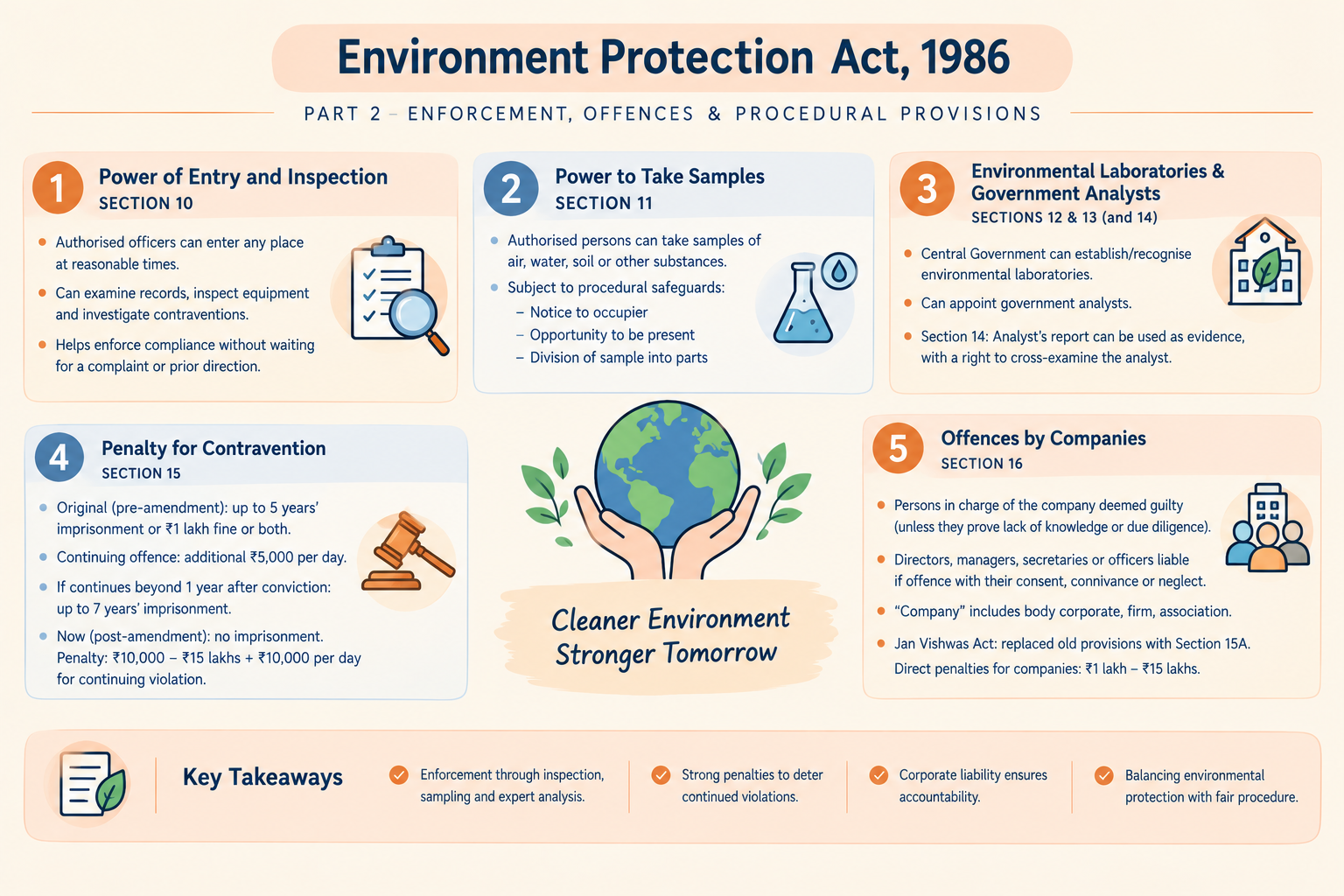
Power of Entry and Inspection: Section 10
Section 10 empowers any person authorised by the Central Government to enter, at all reasonable times, any place for the purpose of performing functions under the Act, including examining records, inspecting equipment, or investigating whether contravention of the Act has occurred.
This power allows authorised officers to search for evidence of pollution and enforce compliance without necessarily waiting for a formal complaint or prior direction, making it a critical investigative tool.
Power to Take Samples: Section 11
Section 11 empowers authorised persons to take samples of air, water, soil, or other substances from any factory, premises, or other place for the purpose of analysis, subject to specific procedural safeguards prescribed under the Section.
These safeguards require serving notice on the occupier of the intention to have the sample analysed, giving the occupier an opportunity to be present, and dividing the sample into parts for separate analysis, ensuring procedural fairness in subsequent prosecutions relying on such sample evidence.
Environmental Laboratories and Government Analysts: Sections 12 and 13
Section 12 empowers the Central Government to establish or recognise environmental laboratories for the purpose of performing functions entrusted under the Act, while Section 13 empowers it to appoint government analysts qualified to analyse samples sent to these laboratories.
Section 14 provides that a report signed by a government analyst may be used as evidence of the facts stated in any proceeding under the Act, subject to the accused's right to require the analyst be summoned for cross-examination, balancing evidentiary efficiency with the fundamental right to a fair trial.
Penalty for Contravention: Section 15
Section 15(1) prescribes the penalty for failure to comply with, or contravention of, any provision of the Act or the rules, orders, or directions issued thereunder, providing imprisonment for a term which may extend to five years, or a fine which may extend to one lakh rupees, or both.
Where the failure or contravention continues, an additional fine of up to five thousand rupees per day applies for every day during which such failure or contravention continues after conviction.
Section 15(2) provides for enhanced punishment where the failure or contravention continues beyond a period of one year after the date of conviction, prescribing imprisonment which may extend to seven years.
This graduated penalty structure reflects a deliberate legislative attempt to deter continuing environmental violations through escalating consequences rather than treating pollution as a one-time punishable event.
(Imprisonment under this has been completely abolished. Under the amended Section 15, if a person violates the Act, they face a financial penalty between ₹10,000 and ₹15 Lakhs. If the violation continues, an additional penalty of ₹10,000 per day applies.)
Offences by Companies: Section 16
Section 16(1) provides that where an offence under the Act has been committed by a company, every person who, at the time the offence was committed, was directly in charge of and responsible to the company for the conduct of its business shall be deemed guilty, along with the company itself, unless such person proves that the offence was committed without their knowledge or that they exercised all due diligence to prevent its commission.
This deeming provision reflects the principle of vicarious liability commonly employed in regulatory offences, shifting the burden onto the accused to establish the statutory defence.
Section 16(2) further extends liability to any director, manager, secretary, or other officer of the company where it is proved that the offence was committed with their consent, connivance, or was attributable to their neglect.
The Explanation to Section 16 clarifies that "company" includes any body corporate, firm, or association of individuals, and "director" in relation to a firm means a partner in that firm, ensuring the provision captures diverse forms of business organisation.
(The Jan Vishwas Act substituted the old criminal sections with Section 15A. Companies face direct structural penalties. A company violating the Act faces an administrative penalty between ₹1 Lakh and ₹15 Lakhs.
Continuing violations attract a massive penalty of ₹1 Lakh per day. Corporate officers are dealt with under administrative penalty guidelines rather than traditional criminal magistrate courts.)
Offences by Government Departments: Section 17
Section 17 extends a parallel liability framework to offences committed by any department of the Government, providing that the Head of the Department shall be deemed guilty of the offence, unless they prove that the offence was committed without their knowledge or that they exercised all due diligence to prevent its commission.
This provision ensures that governmental bodies do not enjoy blanket immunity from environmental accountability merely by virtue of their public character.
(This section has been replaced by Section 15B.Shifting away from criminal conviction, the Head of the Department is now liable to an administrative penalty equal to one month of their basic salary if the department contravenes the Act. )
The New Enforcement Machinery (Sections 15C and 15D)
Because these offences are no longer criminal crimes tried before a Magistrate, the Central Government now appoints Adjudicating Officers (Joint Secretary level or State Secretary level) under Section 15C to hold inquiries and levy these penalties. Appeals against their orders go to the National Green Tribunal (NGT) under Section 15D.
Protection of Action Taken in Good Faith: Section 18
Section 18 protects the Government or any officer or authority from suit, prosecution, or other legal proceedings in respect of anything done, or intended to be done, in good faith in pursuance of the Act or the rules or orders made thereunder.
This provision shields bona fide regulatory action from harassment through litigation, encouraging authorities to act decisively against polluters without fear of personal liability for good-faith enforcement decisions.
Cognizance of Offences: Section 19
Section 19 provides that no court shall take cognizance of any offence under the Act except on a complaint made by the Central Government or any authority or officer authorised by it, or by any person who has given notice of not less than sixty days of the alleged offence and their intention to make a complaint to the Central Government or the authorised authority.
This sixty-day notice requirement, while enabling citizen enforcement of environmental law, has attracted criticism for potentially allowing continued pollution during the mandatory waiting period, though it also affords the alleged offender an opportunity to remedy the violation before facing prosecution.
Because the Jan Vishwas Act replaced criminal penalties for standard violations with administrative penalties under an Adjudicating Officer, Section 19 was explicitly amended to add clause (aa).
(Courts can now also take cognizance on a complaint made by the "adjudicating officer or any officer authorised by him in this behalf". Furthermore, because standard contraventions are now handled by these executive adjudicators rather than Magistrate courts, Section 19's judicial filing workflow is primarily triggered only when specialized criminal non-compliance occurs.)
Furnishing of Reports and Returns: Section 20
Section 20 empowers the Central Government to require any person, officer, state government, or other authority to furnish information, reports, or returns relating to the functions performed under the Act, in such form and manner as may be prescribed.
This provision facilitates centralised monitoring of environmental compliance, allowing the Central Government to track implementation across diverse regulatory bodies and geographic regions.
Public Servant Status: Section 21
Section 21 deems every member, officer, and employee of any authority constituted under the Act to be a public servant within the meaning of Section 2(28) of the Bharatiya Nyaya Sanhita, while exercising or performing powers and functions under the Act.
This deeming fiction extends the protections and liabilities applicable to public servants to persons administering the Act, aligning their accountability with that of other government functionaries.
Bar of Jurisdiction: Section 22
Section 22 bars civil courts from entertaining any suit or proceeding in respect of anything done, action taken, or order or direction issued by the Central Government or any other authority or officer in pursuance of any power conferred by, or in relation to any of its functions under, the Act.
This ouster of civil court jurisdiction channels disputes arising under the Act toward the specialised administrative and appellate mechanisms the Act itself contemplates, rather than allowing parallel civil litigation to delay environmental enforcement.
Power to Delegate: Section 23
Section 23 empowers the Central Government, through notification, to delegate any of its powers and functions under the Act, except the power to make rules, to any officer, state government, or other authority, subject to conditions the notification may specify.
This delegation power enables practical, decentralised enforcement while preserving the Central Government's exclusive rule-making authority over the Act's core standard-setting function.
Effect of Other Laws: Section 24
Section 24(1) provides that where any act or omission constitutes an offence punishable under the Environment Protection Act and also under any other law, the offender shall be liable to be punished under the other law rather than under this Act, thereby avoiding double jeopardy while ensuring that more specific legislation takes precedence over the Act's general provisions.
Section 24(2) clarifies that, except as provided in the Water Act, 1974 and the Air Act, 1981, the provisions of this Act, and rules or orders made thereunder, shall have effect notwithstanding anything inconsistent contained in any enactment other than these two specific Acts, confirming the Environment Protection Act's overriding character relative to most other legislation while preserving harmony with the earlier pollution-specific statutes.
Rule-Making Power and Parliamentary Oversight: Sections 25 and 26
Section 25 empowers the Central Government to make rules for carrying out the purposes of the Act, covering the wide range of matters specified throughout its provisions, from environmental standards to procedural safeguards for hazardous substance handling.
Section 26 requires that every rule made under the Act be laid before each House of Parliament while it is in session, for a total period of thirty days, subject to Parliament's power to modify or annul the rule, ensuring legislative oversight over the executive's extensive delegated rule-making authority under this umbrella statute.
Subscribe for updates
Join 10,000+ subscribers.
HA
Hanspal Bakul
Contributing author
Have a doubt about this?Ask Doubts

