India has a country of many languages, religion, culture and regional identities. Managing such diversity requires a system in which the national government can protect unity. While states can address local needs. Federalism provides this balance by diverting government powers between two levels i.e. the Union government and State government. Let's read more about Federalism and Centre-State Relationship in India.
The Indian constitution creates a federal system, but it also gives greater power to the union. For this reason, India has often been described as a quasi-federal state, federal in structure, but with a strong unitary and centralising feature. Understanding this balance is important for CLAT PG students because questions on federalism connect constitutional law with current political and administrative issues.
Concept of Federalism
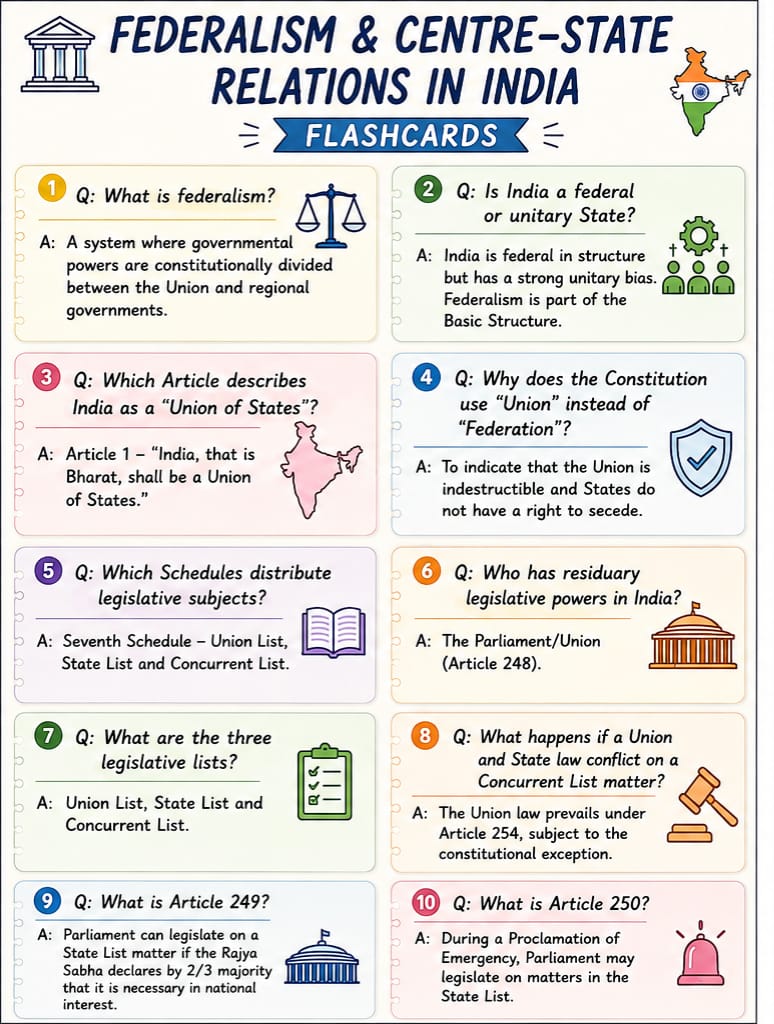
Federalism is a method of government in which powers are constitutionally divided between a central government and regional governments. Both levels have their own areas of authority. The central government deals with national matters while regional governments handle subjects that are mainly local.
The purpose of federalism is to combine national unity with regional autonomy. In a unitary system, local governments receive the powers from the centre. In a federal system, regional powers are protected by the Constitution. A federal system normally has a written constitution, division of power, constitutional supremacy, and an independent judiciary. Modern federalism also involves cooperation between the two levels.
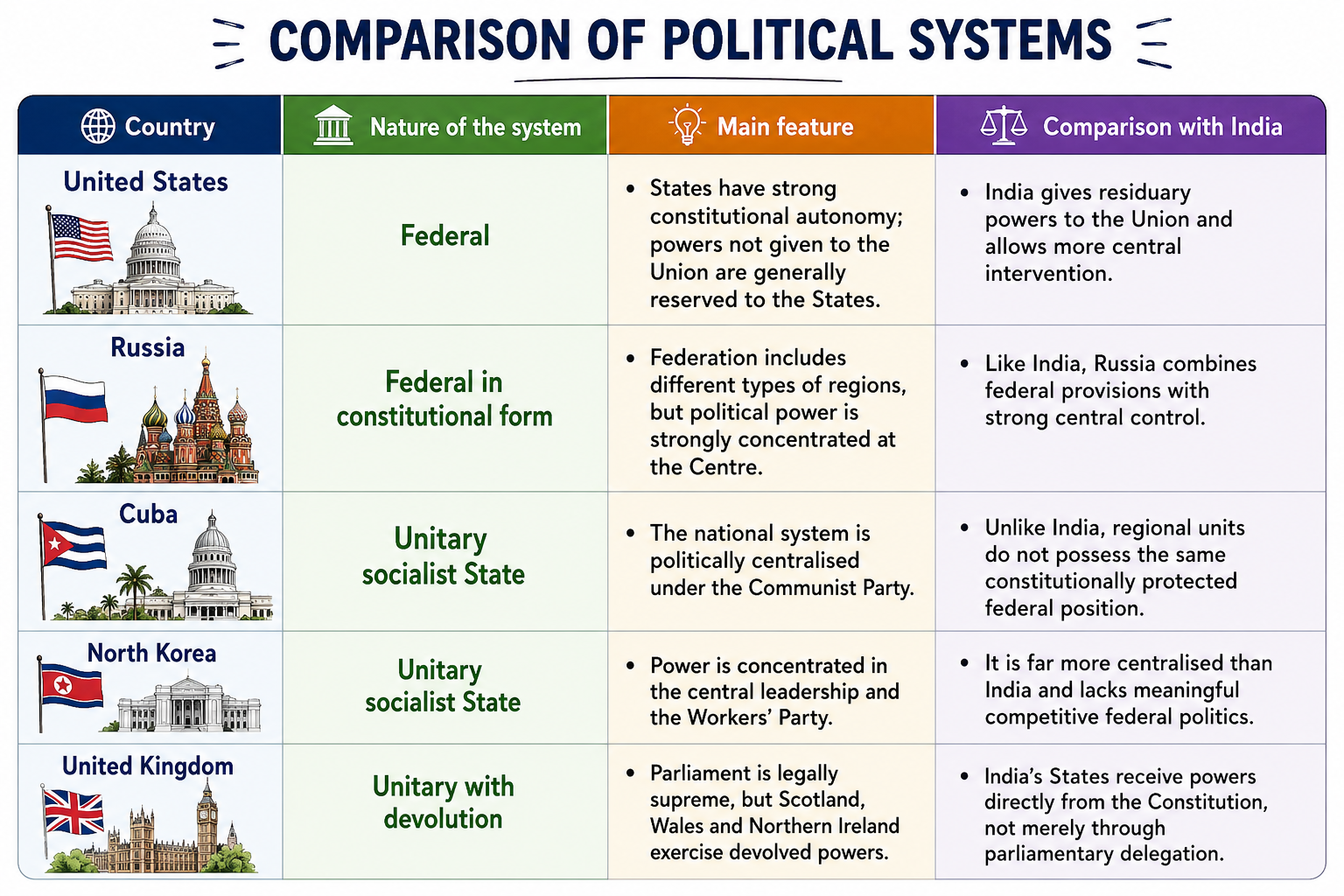
K.C. Wheare described ‘federal government’ as a system in which general and regional governments are coordinated and independent within their own spheres. However, federalism takes different forms. The United States gives strong autonomy to its states, Russia is federal in form but highly centralised and practical. The UK is mainly unitary, though it has devolved powers to Scotland, Wales, and Northern Island.
Evolution of federalism in India and its sources
The Indian federal structure developed from both colonial experience and the needs of an independent, diverse country. The Government of India Act, 1935 provided an important foundation. It introduced provincial autonomy and divided subjects between the federal and provincial levels. Although its proposed Federation was never fully implemented.
The makers of the Indian constitution, studied several constitutional systems and adopted selected features rather than copying any one model. The idea of federation with a string centre was influenced mainly by the Canadian Constitution.
The division of powers into Union, State and Concurrent Lists was influenced by the Australian model. Fundamental rights and judicial reviews were influenced by the United States, while the Parliamentary form of government came from the United Kingdom. Emergency provision and several administrative arrangements also reflected the experience of the Government of India Act, 1935.
The constituent assembly gave greater authority to the Union because India had faced partition, violence, economic weakness, and the difficult integration of princely states. The farmers wanted a Centre strong enough to protect unity, while still giving constitutional status to State governments.
Is India a federal state?
Article 1 of the Indian Constitution describes India as a ‘Union of States’. This expression indicates that the Union is not the result of an agreement among independent states. States do not have a constitutional right to secede, and Parliament can alter their boundaries or names under Article 3 of the Indian Constitution, after following the prescribed procedure.
India has several federal features. The Constitution is written and supreme. Legislative powers are divided under Article 246and Seventh schedule of the Union List, State List and Concurrent List.
The Union legislators on subjects such as defence for an affairs, currency and railways. States generally deal with police, public order, agriculture, and public health. Both levels can legislate on Concurrent List subjects such as education, forest, marriage and criminal law. An Independent judiciary interprets the Constitution and settles disputes.
At the same time, India has a strong unitary feature. Residuary powers belong to parliament under Article 248. Parliament can legislate on State subjects in certain situations, including national interest, an emergency, an international obligation or request by two or more states. Union law generally prevails over conflicting state law on a Concurrent List subject.
India also has a single citizenship, an integrated Judiciary, All-India services and a common constitutional framework.
Article 356permits the President's Rule when the constitutional machinery of the state fails. Although this power was sometimes used politically in the past, the Supreme Court limited its misuse in S.R. Bommai v. Union of India. The court held that federalism is part of the Constitution's basic structure and that the state government’s majority should ordinarily be tested on the floor of a legislative assembly.
Centre-State Relations in India: Important Constitutional Articles
The Constitution deals with Centre-State relations through legislative, administrative, financial and emergency provisions.
Area
Important Articles
What they provide
Union and State territory
Articles 1 to 4
India is a Union of states, Parliament can admit, create, alter or rename states, subject to the constitutional procedure.
Legislative powers
Legislative and Administrative Relations
Legislative relations are mainly governed by article 245-255 and the seventh schedule Administrative relations are covered broadly by article 256-263. States must implement Parliamentary laws and the union may issue directions in a limited situation. The inter-state council under article 263 can promote discussion and cooperation on matters of common interest.
Financial Relations
Financial relations are covered by article 268-293. The union has greater taxation capacity, while states major responsibilities in areas such as health, education, agriculture and local development. The Finance Commission recommends the sharing of tax revenue and grants between the Union and States.
The Goods and Services Tax (GST) Council is another example of shared decision-making, although states have also raised concerns about reduced tax autonomy, and delayed compensation.
The Governor
Major tensions include the role of governors, the use of central agencies, water disputes, distribution of funds, centrally sponsored schemes and disagreements over laws made on concurrent list subjects. These conflicts do not automatically mean that federalism has failed. In a democracy, disagreement is natural. The real requirement is that disputes should be resolved through constitutional institutions, consultation, and judicial review.
Comparison with Other Countries
United States
The United States is a classic Federation. Powers not given to the federal government are generally reserved to the states under the 10th amendment. States have their own constitutions, legislatures and courts, and the Senate gives equal representation to every state. India differs because residuary powers belong to the Union, representation in the Rajya Sabha is not equal, and States cannot claim a right to secede.
Russia
Russia formally recognised it as a federal structure and different types of constituent units. In practice, the Centre exercises strong political and administrative control. Like India, Russia therefore combines federal provisions with centralising features. India, however, has a more competitive multi-party framework in which regional parties play an important role.
Cuba and North Korea
Cuba and North Korea are generally treated as unitary social States. Political authority is concentrated at national level, and regional bodies operate within a centrally directed system. Unlike these countries, India has a constitutionally recognised State governments, regular elections, and independent judiciary, and genuine competition between national and regional parties.
United Kingdom
The United Kingdom is traditionally unitary because Parliament is legally supreme. Scotland, Wales and the northern island exercise devolved powers, but these powers can legally be altered by the Parliament. In India, the division of power is constitutionally secured. Indian federalism is therefore stronger than British devolution, although the Indian union has more centralising power than the United States.
Conclusion
Indian federalism is therefore carefully designed. Its federal character is visible in the written constitution, division of powers, and independent judiciary. Its unitary side appears and powers, emergency provisions, single citizenship, and Union’s ability to intervene in specified situations.
Comparison with other countries show that there is no single model of federalism. The US has given greater autonomy to its states, Russia combines federal form with centralized practice, Cuba and North Korea represent a highly centralized unitary system and the UK relies on devolution within a unitary framework. India occupies a middle position. For Indian federalism to work well, the Union and States must respect constitutional limits and corporate in good faith.