
General Defences under the Law of Torts (Part I): Complete Notes for CLAT PG!
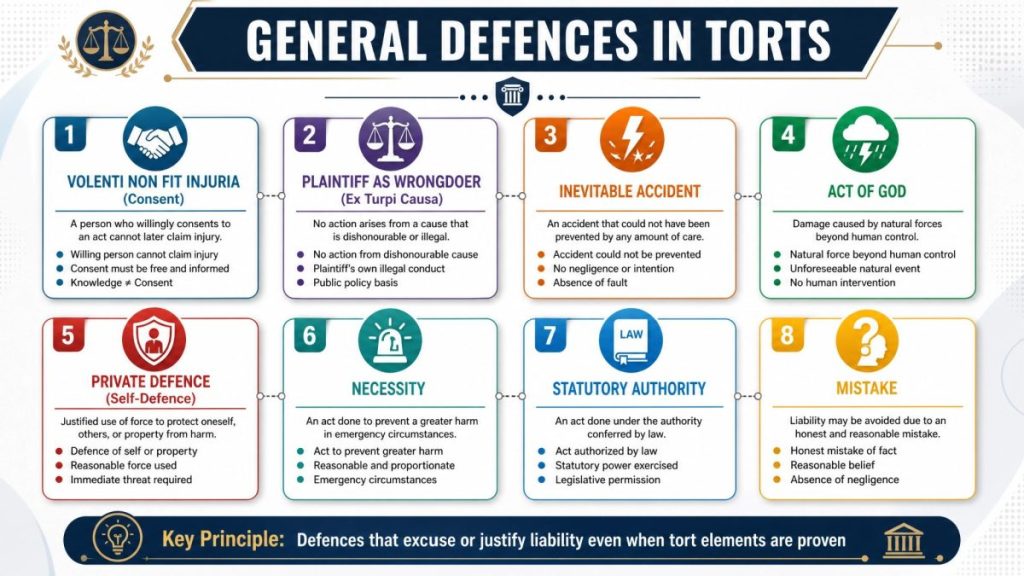
General Defences are legal excuses available to a defendant in an action for tort. Even where the plaintiff successfully proves the existence of a tort, the defendant may avoid liability by establishing that the act falls within one of the recognised legal defences.
These defences are based on the principle that the law should not impose liability where the defendant has acted with lawful justification, under unavoidable circumstances, or with the plaintiff’s consent.
Importance of General Defences
General defences play a crucial role in ensuring fairness within the legal system because they:
- Prevent unjust liability.
- Recognise lawful conduct under exceptional circumstances.
- Balance the interests of both plaintiffs and defendants.
- Promote justice by considering the facts and surrounding circumstances of each case.
Volenti Non Fit Injuria as a General Defence
The maxim Volenti Non Fit Injuria literally means “to a willing person, no injury is done.” It is one of the oldest and most significant general defences in the law of torts. The defence is based on the principle that a person who voluntarily and knowingly agrees to suffer a particular risk cannot later complain of the resulting injury.
The rationale behind this defence is that the law respects individual autonomy. A person who freely consents to undertake a known risk cannot subsequently shift the consequences of that decision onto another. However, the defence is not founded merely on knowledge of the risk; it requires free and voluntary consent to accept that risk.
To successfully invoke this defence, the defendant must establish three essential conditions:
(a) Knowledge of the Risk
The plaintiff must have full knowledge of the nature and extent of the risk involved. Mere awareness that some danger exists is insufficient unless the plaintiff appreciates the specific risk that caused the injury.
For example, a spectator attending a cricket match understands that there is a possibility of being struck by a ball hit into the stands. If such an injury occurs during the normal course of the game, the spectator cannot ordinarily recover damages.
(b) Free and Voluntary Consent
Knowledge alone does not amount to consent. The plaintiff must voluntarily agree to undertake the risk without any coercion, fraud, or compulsion.
For instance, an employee who continues working in unsafe conditions because losing the job would threaten their livelihood cannot always be said to have freely consented to the risk. Courts carefully examine whether the consent was genuinely voluntary.
(c) The Injury Must Arise from the Accepted Risk
The injury suffered must fall within the scope of the risk that the plaintiff agreed to undertake. If the defendant acts negligently beyond the ordinary risk accepted by the plaintiff, the defence fails.
For example, while a participant in a boxing match accepts the possibility of receiving lawful blows during the contest, they do not consent to deliberate attacks outside the rules of the sport.
Landmark Case: Hall v. Brooklands Auto Racing Club Ltd. (1933)
The plaintiff was a spectator at a motor racing event. During the race, two cars collided, causing one of them to crash into the spectators and injure the plaintiff. He brought an action against the organizers, alleging negligence.
The Court held that spectators attending motor races voluntarily accept the ordinary risks associated with such events. Since the organizers had taken reasonable safety precautions and the accident arose from an inherent risk of the sport, the defence of Volenti Non Fit Injuria succeeded.
This case established that a person who knowingly participates in or watches an inherently dangerous activity is deemed to have accepted the ordinary risks incidental to that activity.
Limitations of the Defence
The defence of Volenti Non Fit Injuria is not absolute and cannot be invoked in every case.
- Rescue Cases
A person who voluntarily exposes themselves to danger in order to rescue another is not considered to have consented to the risk.
In Haynes v. Harwood (1935), the defendant negligently left horses unattended in a public street. When the horses bolted, a police officer attempted to stop them to protect the public and sustained injuries. The defendant argued that the officer had voluntarily accepted the risk.
The Court rejected this argument and held that the law encourages rescue rather than discourages it. A rescuer acting under a moral or legal duty cannot be denied compensation merely because they knowingly faced danger.
- Illegal Acts
Consent cannot legalise an unlawful act. A person cannot rely upon this defence where the conduct itself is prohibited by law.
- Negligence Beyond the Accepted Risk
The plaintiff consents only to the ordinary risks of an activity and not to risks created by the defendant’s negligence.
For example, a passenger travelling in an amusement ride accepts the ordinary risks of the ride but does not consent to injuries caused by poor maintenance or mechanical defects resulting from the operator’s negligence.
This is how one can establish the defence of Volenti Non Fit Injuria under Law of Torts.
Subscribe for updates
Join 10,000+ subscribers.
SH
Shruti chauhan
Contributing author
Have a doubt about this?Ask Doubts
