
How to Prepare for CLAT PG 2027 in 3 Months
CLAT PG 2027 preparation doesn’t need to take six months. If you prepare for CLAT PG 2027 strategically, then 3 months are enough to strategically crack the exam. Test yourself in Month 1, practice old papers and mock tests in Month 2, and revise with daily mocks in Month 3. Focus on Constitutional Law and Jurisprudence first, since together they make up almost half the exam.
CLAT PG 2027 is expected to happen on December 6, 2026, and the form is already out. Here’s a complete CLAT PG 2027 preparation roadmap covering the exam pattern, eligibility, what to study first, which books to use, when to start mock tests, and mistakes to avoid.
How To Prepare For CLAT PG 2027 in 3-Months ?
3 months are enough to crack the CLAT PG exam if you prepare the right way. Students who clear CLAT PG on their first try usually don’t read a huge pile of books. They stick to a small set of material and go over it again and again.
Most guides suggest 4 – 6 months, but that extra time is often spent reading without a clear goal, not on the things that actually raise your score. CLAT PG is mostly a reading and thinking test, and you can get faster at that in a short, focused window if you study the right things first.
Stop trying to read more books. Start training your brain to think fast.
CLAT PG 2027 Exam Pattern and Eligibility
Before you plan your schedule, know exactly what you are preparing for-
Format: CLAT PG is a single-paper, offline (pen-and-paper) objective test with 120 multiple-choice questions, to be completed in 120 minutes.
Marking scheme: each correct answer earns 1 mark; each incorrect answer carries a penalty of 0.25 marks.
Question style: most questions are passage-based, drawn from primary legal material like statutes, landmark judgments, and regulations, testing whether you can apply a legal principle to a new fact pattern rather than recall it from memory.
Eligibility: candidates must hold a professional law degree (a 3-year or 5-year LLB). Final-year LLB students can typically apply too, provided they submit qualifying certificates at the time of admission.
Which Subjects to Study First
Start with Constitutional Law, Jurisprudence, and Administrative Law as they build the base you need to understand harder passages. Once these feel solid, move to Contract, Criminal Law, and Torts, and then the smaller subjects like IPR, Family Law, Environmental Law, and International Law.
This order isn’t random. Constitutional Law alone has consistently accounted for almost half of CLAT PG papers over recent years, with Fundamental Rights, Directive Principles, and Emergency Provisions among the highest-yield sub-topics.
For the full topic-by-topic breakdown, see our CLAT PG 2027 syllabus.
Understand what each smaller subject covers and the key concepts to know:
- IPR: focus on the basics of copyright, patents, and trademark law: definitions, duration of protection, and infringement principles rather than case-heavy detail.
- Family Law: focus on marriage, divorce, maintenance, and succession principles across the major personal laws.
- Environmental Law: focus on the core statutes (Environment Protection Act, key pollution-control laws) and the “polluter pays” and precautionary principles, which show up often in passages.
- International Law: focus on the sources of international law, treaty basics, and India’s relationship with international conventions, not exhaustive treaty text.
Books matter less than you think. Bare acts and old papers matter more. Use textbooks to build a first understanding, then spend most of your time on bare acts and old papers.
3-Month Roadmap to Crack CLAT PG 2027
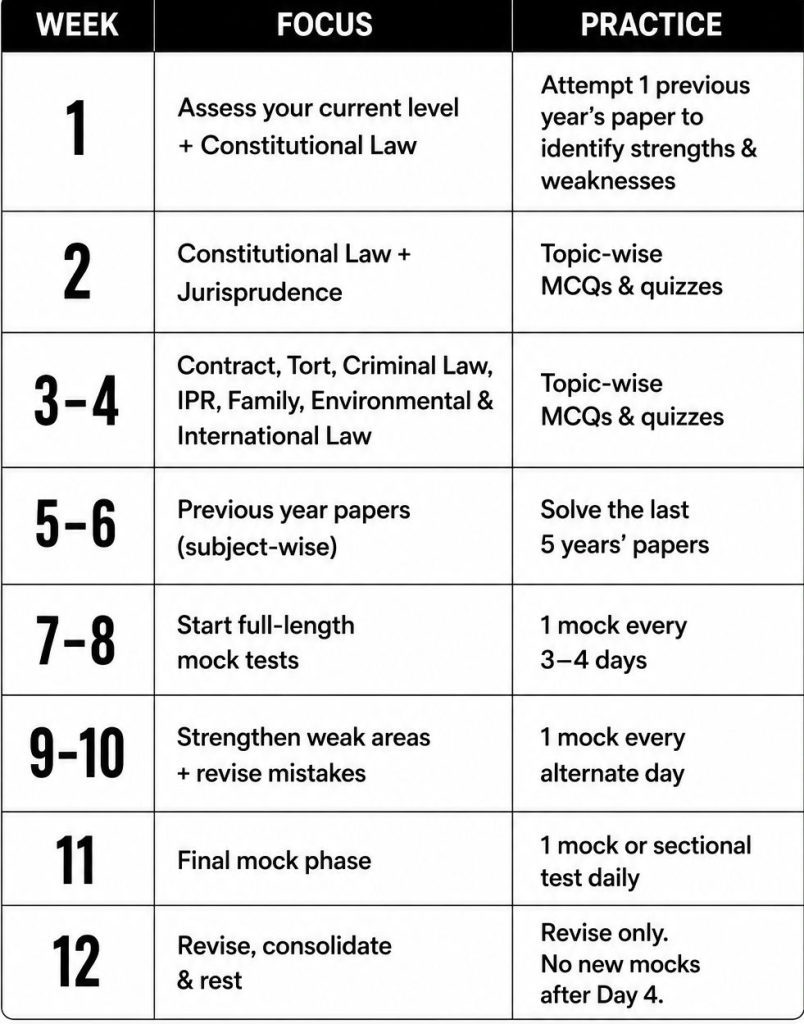
Image 1: CLAT PG 2027: 12-Week Study Plan
Month 1: Test yourself and learn the basics (Weeks 1 – 4)
Week 1: Start with a test, not a textbook. Solve one full old CLAT PG paper without any preparation. This shows you exactly which subjects need the most work, instead of guessing based on what feels scary.
Weeks 2-3: Constitutional Law and Jurisprudence are the heart of the exam. Use M.P. Jain’s Indian Constitutional Law (or the shorter V.N. Shukla if you want something quicker) and cover fundamental rights, the basic structure doctrine, federalism, emergency powers, and recent important judgments: see our CLAT PG book recommendations and reviews for a full comparison. Pair this with V.D. Mahajan’s Jurisprudence for the main schools of legal thought, theories of punishment, and basic ideas like ownership and rights.
Week 4: Cover the rest of the subjects like Contract Law (Avtar Singh), Tort Law (R.K. Bangia), Criminal Law basics (PSA Pillai), and a working knowledge of IPR, Family Law, Environmental Law, and International Law. You do not need to know everything in detail but know just enough to recognize the rule the moment it shows up in a passage.
Daily plan: 4-5 hours of focused study which includes 2 hours reading, 1 hour on bare acts and case law, 1 hour making short, clear notes, and 1 hour on legal news.
Month 2: Practice PYQ and mock tests (Weeks 5 – 8)
This is the month most students get wrong as they keep reading long after it stops helping. Flip your routine now: 70% practice, 30% reading.
Weeks 5 – 6: PYQs come first. After finishing each topic, immediately solve questions on that topic from the last five years of previous year papers. This matters more than fresh mock questions right now, because old papers show you exactly how the real exam asks questions.
Keep a mistake list and write down why you got each one wrong including missed keywords, misunderstood the rule, ran out of time, or simply didn’t know it. This list tells you what to fix next.
Weeks 7 – 8: Start full mock tests. Begin taking full-length mock tests, one every 3 – 4 days, under real exam conditions: 120 minutes, no phone, one sitting. After each test, spend 90 minutes going over it. Read every passage you got wrong again to understand what you missed.
Daily plan: Read legal news everyday without fail. Spend 30 – 45 minutes reading about recent Supreme Court judgments, new laws, and important legal updates from the past year.
Month 3: Revise and get faster (Weeks 9 – 12)
Stop learning anything new after week 10. This month is only about revising and getting quicker.
Weeks 9 – 10: Take a mock test every other day. On the days in between, focus on your two or three weakest subjects. Redo the old questions you got wrong earlier, without checking the answers first. Try to answer each question in under a minute.
Weeks 11 – 12: Take a mock or sectional test daily through day 8. Go through your notes twice: once slowly and carefully, and once quickly a few days before the exam. Stop taking new mocks in the last 3-4 days. Use that time only to review and rest.
Common Mistakes to Avoid
- Buying too many books: Students who clear the exam on their first try don’t collect a lot of books or study randomly. They stick to what actually matters including bare acts, revision, mocks, old papers, and legal news.
- Thinking mock tests matter more than old papers: Mocks are just practice. Old papers show you exactly how the real exam-makers ask questions. Skipping old papers to fit in more mocks isn’t a smart trade.
- Ignoring the pattern in your mistakes: Looking at a wrong answer and moving on isn’t enough. The real value is noticing when you make the same kind of mistake again and again: that pattern should guide what you study next.
- Rushing through passages: Don’t rush through topics. Take your time to understand each passage and question fully. Being consistent matters more than studying for long hours.
FAQs About CLAT PG 2027
Is 3 months enough to prepare for CLAT PG 2027?
Yes. CLAT PG rewards focused, practical study more than years of slow, unfocused reading. A clear 3-month plan built around old papers and mock tests can beat a full year of passive reading. Preparing hard for 2-3 months can still get you a good rank if you stay disciplined.
When is CLAT PG 2027?
CLAT PG 2027 is expected to take place on December 6, 2026. As of August 3, 2026, the application form has already been released. Always check the official Consortium of NLUs website closer to the date for the confirmed schedule.
What is the CLAT PG 2027 exam pattern?
CLAT PG is a 120-question, 120-minute objective (MCQ) test conducted offline. Each correct answer earns 1 mark, and each incorrect answer carries a 0.25-mark penalty. Most questions are passage-based and test application of legal principles rather than memorization.
What is the eligibility for CLAT PG 2027?
Candidates need a professional law degree (3-year or 5-year LLB); final-year students can typically apply and submit qualifying certificates at admission. Confirm exact percentage requirements and category relaxations against the official notification.
What should I focus on most for CLAT PG 2027?
Constitutional Law and Jurisprudence carry the most weight, so study them first. Then build steady practice in Contract, Tort, Criminal Law, and the rest.
Should I solve old papers or take mock tests first?
Solve PYQs first, because they show you exactly how the real exam asks questions. Mock tests come next, once you have a solid base, to build speed and stamina for exam day.
How many mock tests should I take before CLAT PG 2027?
Aim for at least 15-20 full-length mock tests in your last six weeks, along with regular PYQ practice starting from Month 2.
Subscribe for updates
Join 10,000+ subscribers.
SH
Shatakshi Singh
Contributing author
Have a doubt about this?Ask Doubts
