
Quick Revision Notes (QRN): Muslim Law for CLAT PG
JU
Julie Nigam12 min readQuick Revision Notes: Muslim Law
Muslim Law is studied in India through a combination of classical principles, personal-law legislation, judicial decisions and general statutes. These quick revision notes on Muslim law for CLAT PG students cover sources and schools, nikah, dower, valid and irregular marriage, divorce, triple talaq, maintenance, iddat, inheritance and waqf. Students should first understand the sources and schools of Muslim Law. They should then revise the essentials and classification of marriage, dower, prohibited relationships, dissolution of marriage, iddat and maintenance. A basic understanding of inheritance and waqf is also useful for passage-based questions.
For detailed topic-wise reading, see CLATalogue’s articles on Marriage under Muslim Law, Divorce under Muslim Law and Maintenance of a Muslim Wife.
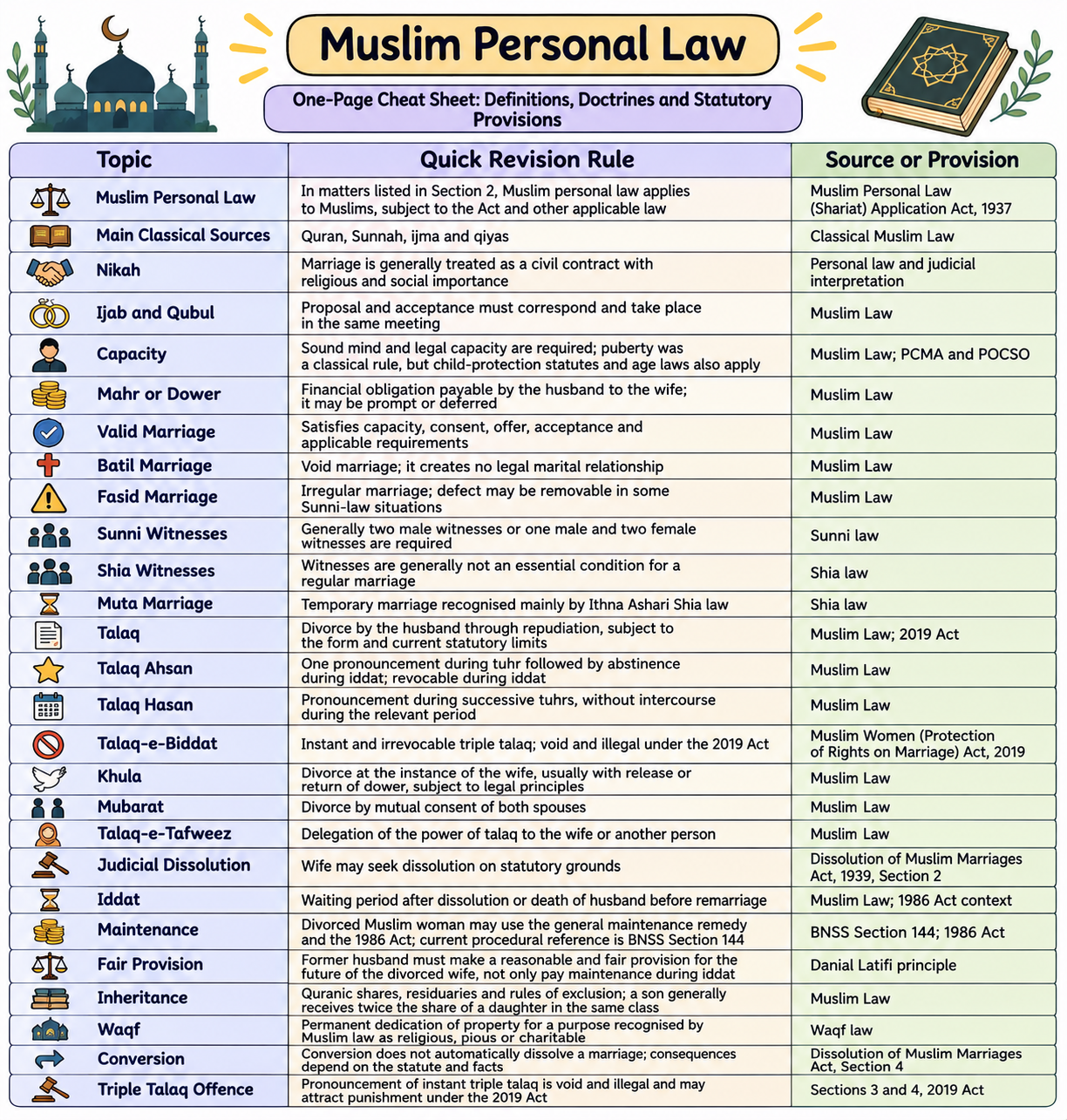
1. Sources and Schools of Muslim Law
Primary Sources
Quran
The Quran is the fundamental source of Muslim Law. It contains principles relating to marriage, divorce, inheritance, maintenance, guardianship, property and social obligations.
Sunnah or Hadith
Sunnah refers to the practices, sayings and approvals of the Prophet. Hadith are the recorded reports through which the Sunnah is known. Classical writers commonly describe three forms: sayings, acts and tacit approvals.
Ijma
Ijma means the consensus of qualified jurists on a legal question. It developed as a method for settling issues on which the Quran and Sunnah did not provide a direct answer.
Qiyas
Qiyas is reasoning by analogy. A new issue is decided by extending the legal principle of an existing issue with a similar effective cause. The acceptance and scope of qiyas differ between schools.
Secondary Sources
Custom, judicial decisions, legislation, equity, justice and good conscience may assist in the development and application of Muslim Law. In India, legislation has modified several areas of personal law. Courts also interpret personal-law rules in the light of constitutional guarantees and statutory remedies.
Schools
The two broad divisions are Sunni and Shia. The main Sunni schools are Hanafi, Maliki, Shafii and Hanbali. The major Shia school followed in India is Ithna Ashari, with Ismaili and other branches also recognised in appropriate contexts.
For examination purposes, remember that the schools may differ on witnesses, muta marriage, the effect of irregular marriages, guardianship and the use of qiyas. A question should not be answered by treating one school’s rule as universal.
2. Muslim Personal Law (Shariat) Application Act, 1937
Section 2 provides that in questions relating to intestate succession, special property of females, marriage, dissolution of marriage including talaq, ila, zihar, lian, khula and mubarat, maintenance, dower, guardianship, gifts, trusts and trust properties, and wakfs, the rule of decision where the parties are Muslims shall be Muslim Personal Law, subject to the Act and applicable law.
Section 3 permits a Muslim to make a declaration so that certain matters, including adoption, wills and legacies, are governed by Muslim Personal Law where the statutory conditions are fulfilled.
The Shariat Act does not codify every rule of Muslim Law. It identifies the governing personal-law principle in the matters covered by it. The precise issue may still be controlled by a later statute, court judgment or general law.
3. Marriage or Nikah
Nature of Muslim Marriage
Muslim marriage, or nikah, is generally described as a civil contract. It creates legal rights and duties between the spouses, including the wife’s right to dower and maintenance and the parties’ mutual rights of inheritance. It also has religious and social significance, so reducing it to a purely commercial contract would be incomplete.
Essentials of a Valid Marriage
Capacity
The parties must have legal capacity and be of sound mind. Classical Muslim Law used puberty as an important marker of capacity, but this rule cannot be used to avoid present-day child-protection statutes. Regardless of personal law arguments, statutes such as the Prohibition of Child Marriage Act, 2006, and the Protection of Children from Sexual Offences Act, 2012, may still apply. Consequently, child marriages can trigger distinct legal issues concerning validity, voidability, criminal liability, and child protection.
Proposal and Acceptance
There must be a clear proposal, called ijab, and acceptance, called qubul. They must correspond and take place in the same meeting. The parties or their authorised representatives must understand the transaction. Acceptance cannot be based on a proposal that has already lapsed or been rejected.
Free Consent
Consent is invalid if secured via coercion, fraud or a material mistake. In the absence of legally valid consent, the marriage may be deemed void or voidable, depending on the specific facts and governing legal rules.
Witnesses
Under Sunni law, witnesses are generally necessary. The traditional requirement is two male witnesses or one male and two female witnesses. Under Shia law, witnesses are not generally an essential condition for a regular marriage, although they are important for proof and other legal purposes.
No Prohibited Relationship
Marriage is prohibited on grounds of:
- Consanguinity: close blood relationship,
- Affinity: relationship created by marriage, and
- Fosterage: relationship created by suckling or fosterage in circumstances recognised by law.
A marriage within an absolute prohibition is generally batil. Other impediments may create an irregular marriage under Sunni law.
Registration
A nikah may be proved through a nikahnama, testimony of witnesses, conduct, cohabitation and other reliable material. Registration strengthens proof and may be required under a state law or court direction. Non-registration should not be treated in every case as proof that no marriage existed. As the legal effect depends on the applicable statute and facts.
Effects of a Valid Marriage
A valid marriage creates the wife’s right to dower and maintenance, mutual inheritance between spouses, legitimacy of children and rules of prohibited relationship by affinity. The husband and wife also assume reciprocal rights and duties recognised by Muslim Law and applicable legislation.
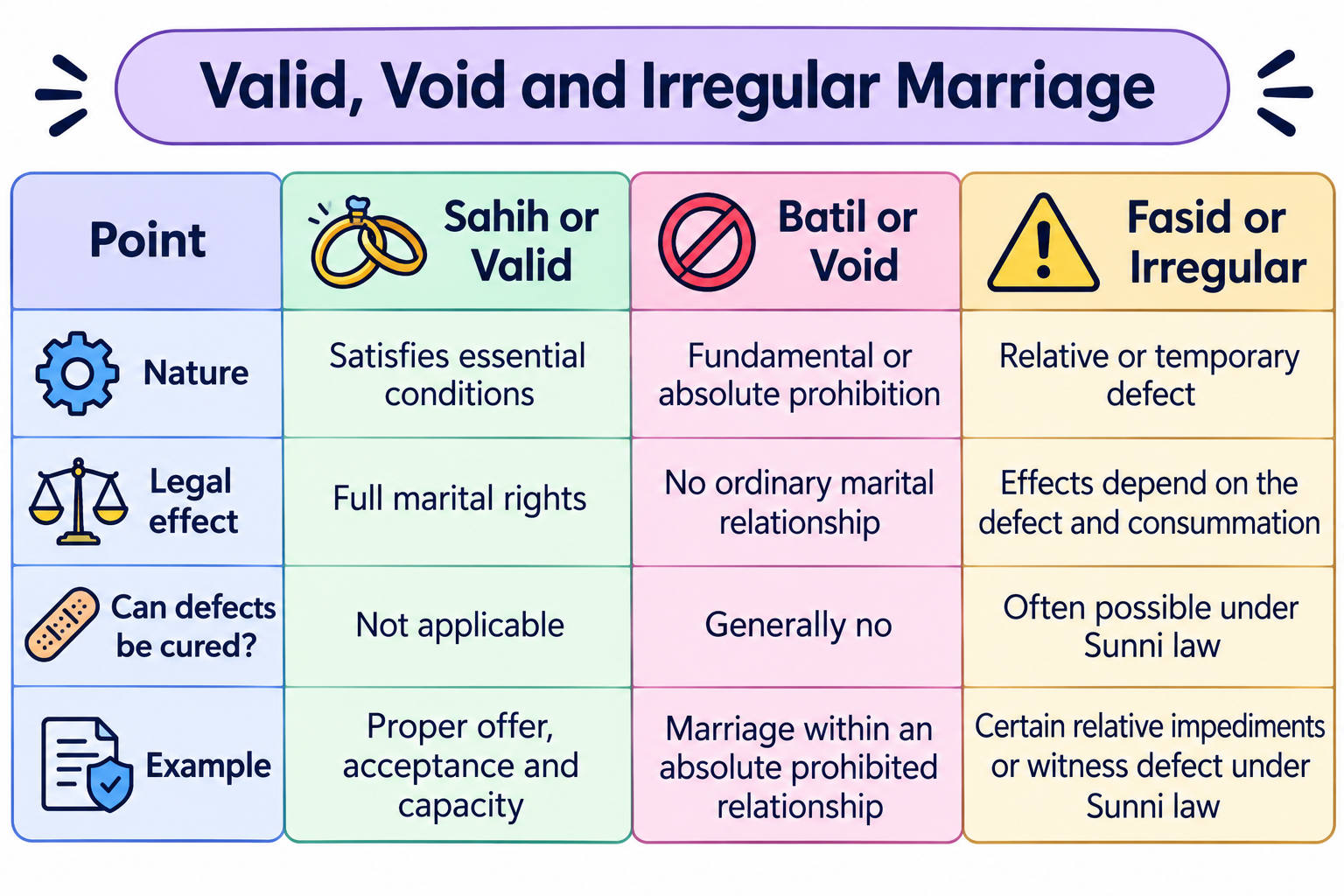
4. Types of Muslim Marriage
Valid or Sahih Marriage
A sahih marriage fulfills all essential legal requirements and produces complete legal consequences, such as the legitimacy of children, dower (mahr), maintenance, inheritance rights, and the requirement to observe iddat following dissolution.
Batil or Void Marriage
A batil marriage is void from the beginning because of an absolute prohibition or fundamental defect. It does not create the ordinary rights of a valid marriage. The status of children and other consequences must be analysed under the applicable law rather than assumed automatically.
Fasid or Irregular Marriage
A fasid marriage has a temporary or relative defect, such as a prohibited conjunction or absence of witnesses under Sunni law. The effect differs before and after consummation. In some cases the defect can be removed and the marriage can become valid. This classification is mainly important under Sunni law and should not be mechanically applied to Shia law.
Muta Marriage
Muta is a temporary marriage recognised mainly by Ithna Ashari Shia law. The period and dower must be specified. The marriage ends on expiry of the term or by the husband’s release of the remaining term. It does not create the same mutual inheritance rights as a permanent marriage between spouses, although children are treated according to the applicable law.
5. Dower or Mahr
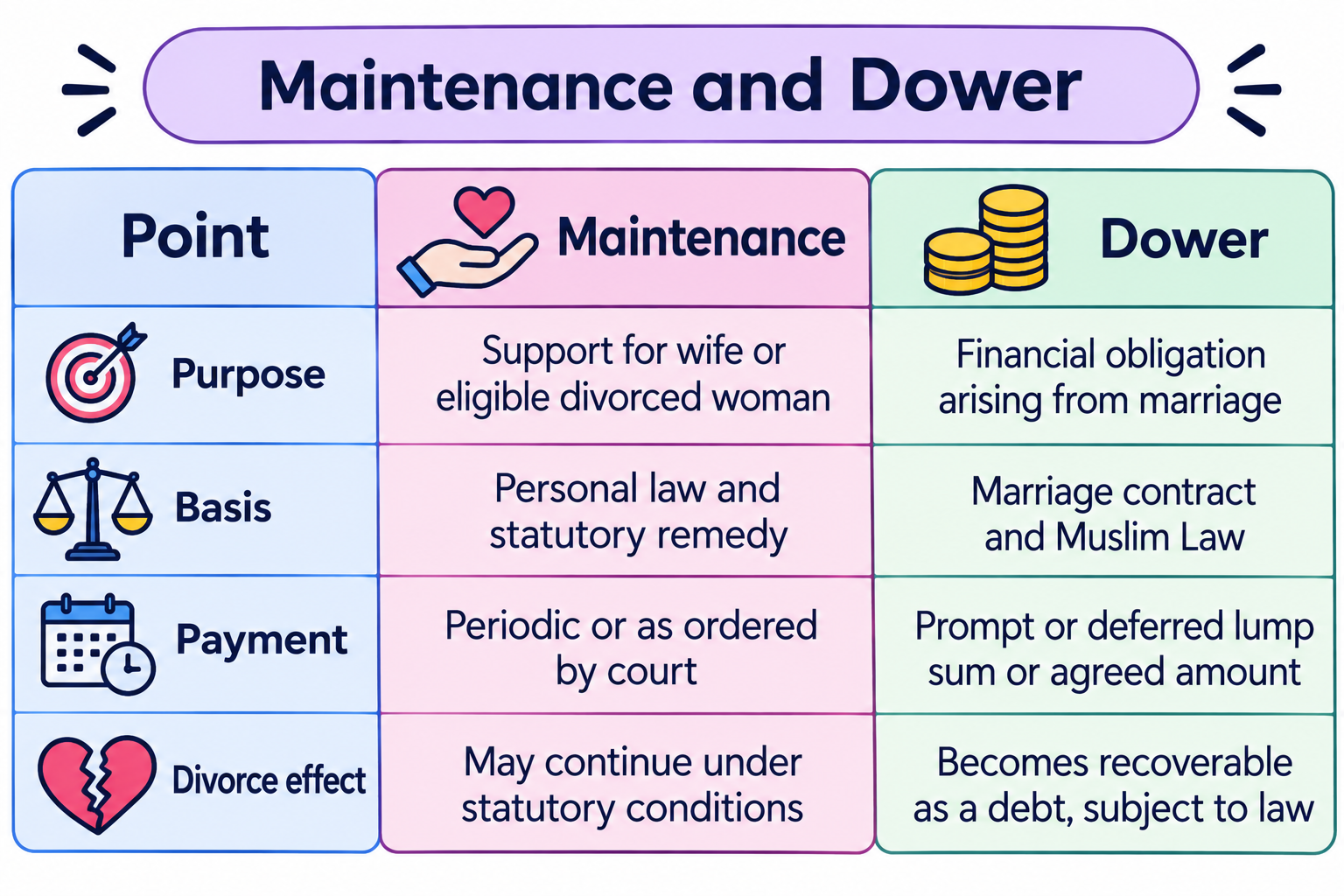
Dower is a financial obligation of the husband payable to the wife. It is not the same as a dowry demanded from the wife’s family. Dower is the wife’s own right and may be fixed at the time of marriage or determined later.
Types of Dower
- Specified dower: fixed by agreement or at the time of marriage.
- Proper dower: determined by reference to the wife’s family, status, age, education, circumstances and the terms recognised by the applicable school.
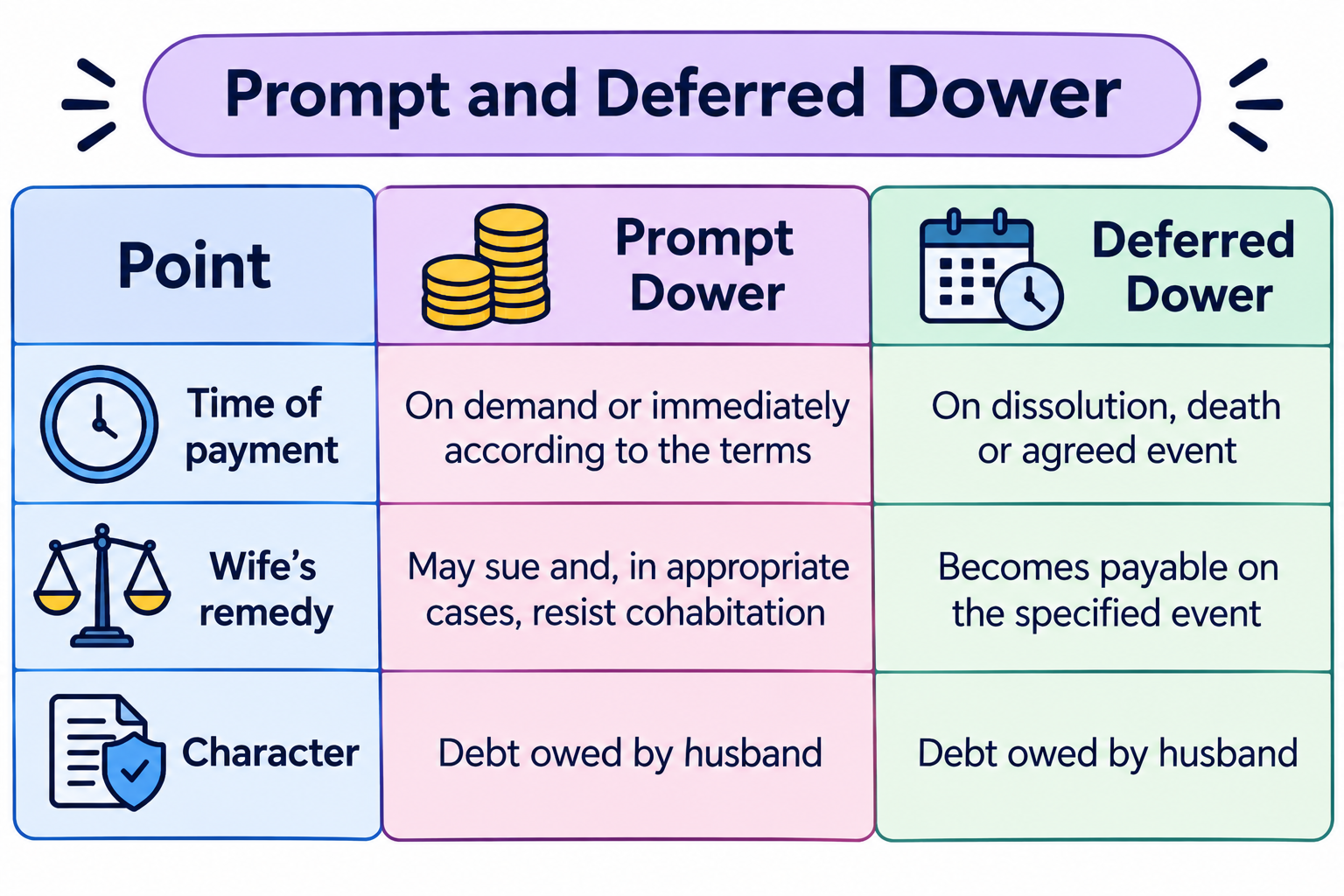
- Prompt dower: payable immediately or on demand. The wife may refuse cohabitation in an appropriate case until it is paid.
- Deferred dower: payable on dissolution of marriage or death, or on the event fixed by the agreement.
Dower is a debt owed by the husband. The wife may sue for recovery. After the husband’s death, the claim may be made against the estate subject to the rules of succession and debts.
In Hamira Bibi v. Zubaida Bibi, the Privy Council treated dower as a debt and recognised the widow’s right to retain possession of the husband’s property in certain circumstances until the dower debt was satisfied. The right of retention is a defensive right and does not by itself make the widow owner of the property.
6. Divorce under Muslim Law
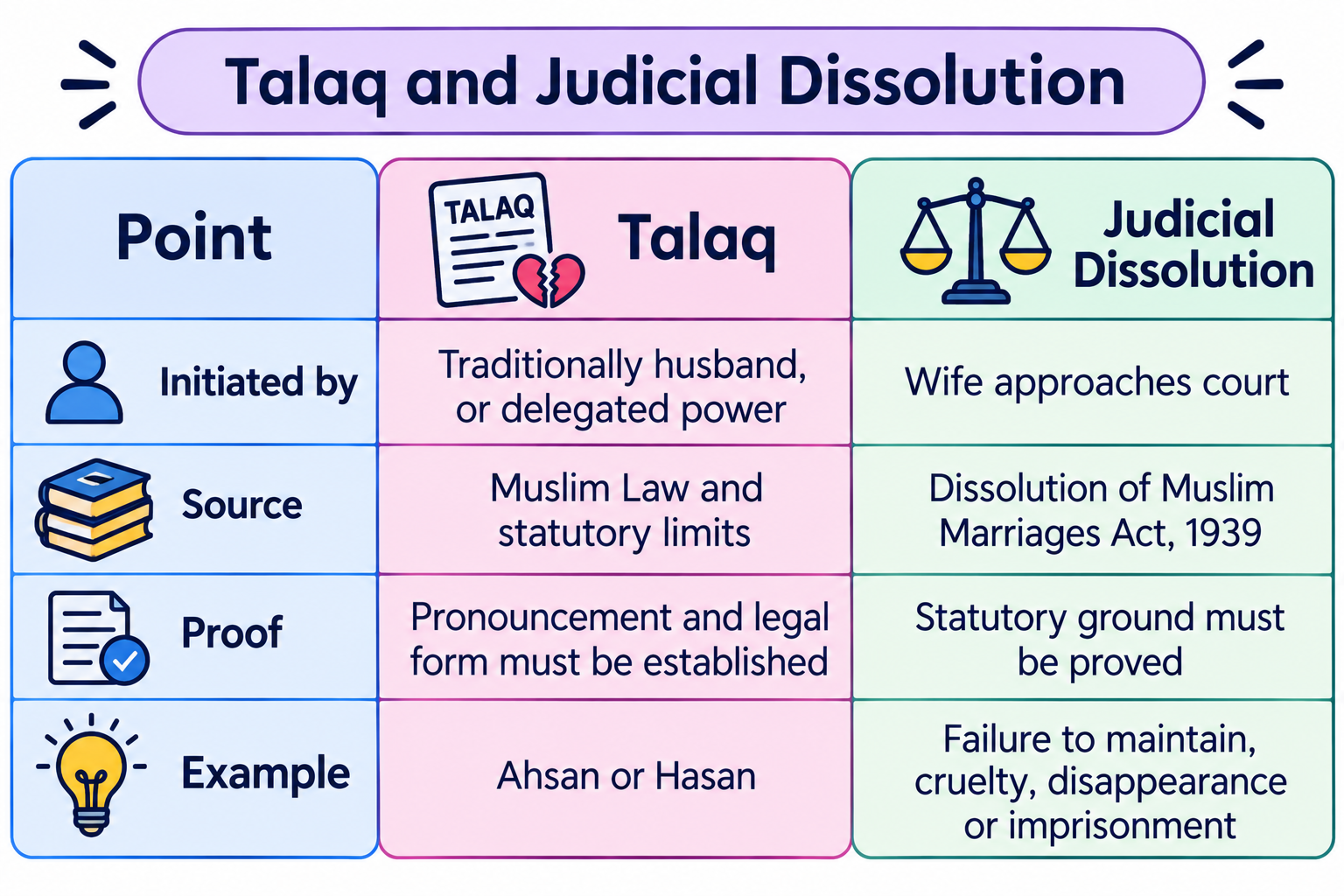
Muslim Law recognises several forms of dissolution. The effect of a particular form depends on the school, the wording used, the intention, statutory changes and the facts.
Talaq by the Husband
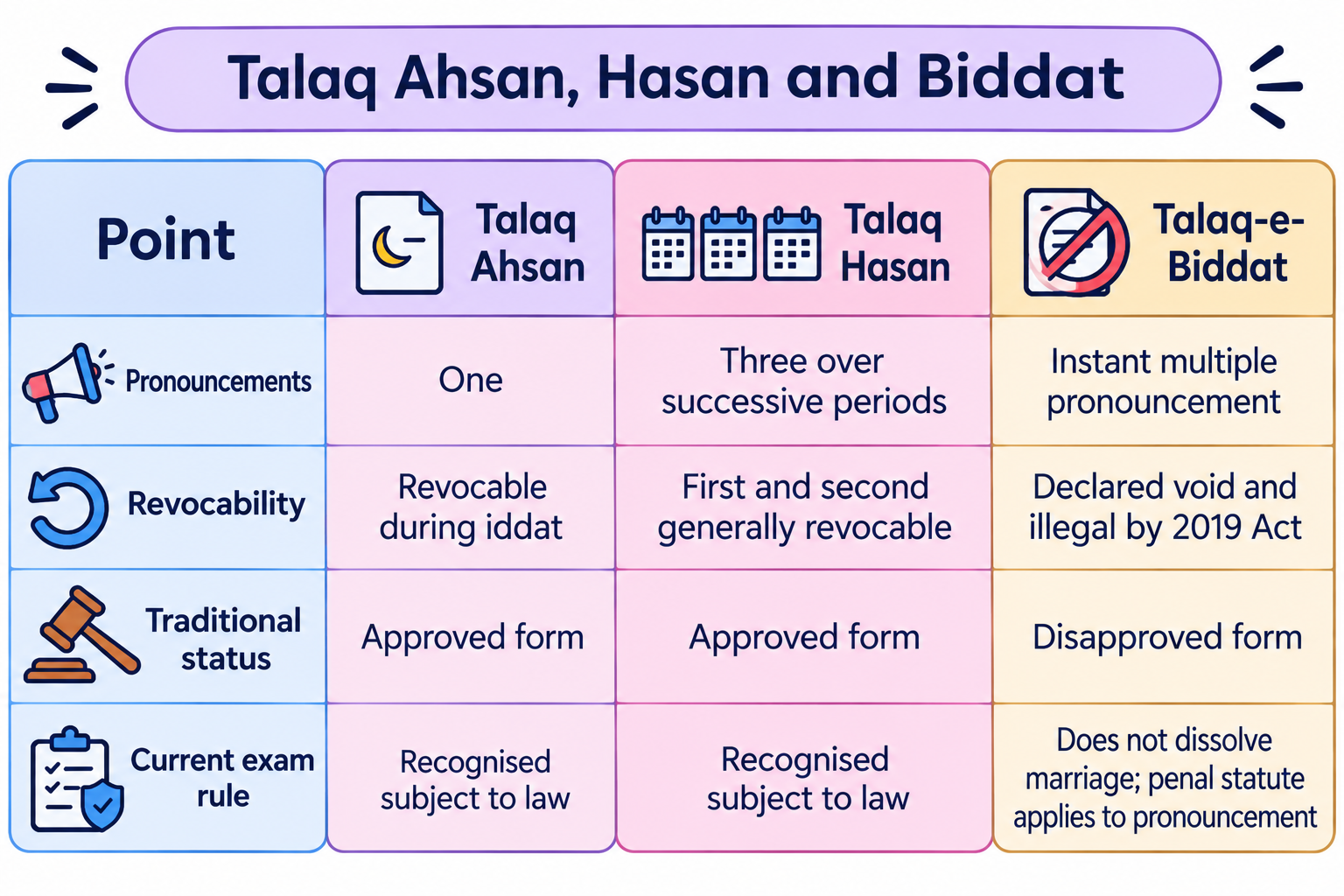
Talaq Ahsan
The husband makes one pronouncement during a period of purity, called tuhr, when there has been no intercourse during that period, followed by abstinence throughout iddat. It is revocable during iddat. If revocation does not occur, divorce becomes effective after iddat.
Talaq Hasan
The husband makes a pronouncement during three successive periods of purity, with no intercourse during those periods. The first and second pronouncements are revocable. The third makes the divorce final under the traditional rule.
Talaq-e-biddat
Instant triple talaq means an attempt to end the marriage immediately through an irrevocable pronouncement. In Shayara Bano v. Union of India, the Supreme Court by a majority set aside talaq-e-biddat. The Muslim Women (Protection of Rights on Marriage) Act, 2019 subsequently declares such pronouncement void and illegal and provides penal consequences.
Talaq by Agreement or at the Wife’s Initiative
- Khula: divorce initiated by the wife, generally with an offer to give consideration or release the husband from dower, subject to the applicable principles.
- Mubarat: divorce by mutual consent. In this the desire to separate comes from both spouses.
- Talaq-e-tafweez: delegation of the power of talaq by the husband to the wife or another person. The delegation may be contained in the marriage contract.
- Lian: where the husband falsely accuses the wife of adultery, the wife may seek dissolution on the applicable legal basis.
Judicial Dissolution by the Wife
The Dissolution of Muslim Marriages Act, 1939 gives a Muslim wife statutory grounds to seek dissolution. Section 2 includes grounds such as:
- husband’s whereabouts unknown for four years,
- failure to maintain for two years,
- husband’s imprisonment for seven years or more,
- failure to perform marital obligations for three years without reasonable cause,
- impotence existing at the time of marriage and continuing,
- insanity or serious disease in the circumstances specified by the Act,
Section 4 clarifies that a married Muslim woman’s renunciation of Islam or conversion to another faith does not by itself dissolve the marriage. She may still seek dissolution on a ground recognised by the Act.
Cruelty under Section 2(viii)
Cruelty includes physical assault and conduct that makes the wife’s life miserable even without physical ill-treatment. It also covers association with women of bad reputation or leading an infamous life, attempts to force an immoral life, disposal of her property, obstruction of religious practice and inequitable treatment among co-wives where the husband has more than one wife.
7. Muslim Women (Protection of Rights on Marriage) Act, 2019
The 2019 Act was enacted after the Supreme Court’s judgment in Shayara Bano. Section 3 declares that pronouncement of talaq by a Muslim husband, in spoken, written, electronic or any other manner, is void and illegal. The Act applies to instant and irrevocable talaq, commonly described as talaq-e-biddat.
Section 4 provides punishment for pronouncing such talaq. The offence is cognisable, subject to the statutory safeguards, and the Act contains rules concerning bail, custody of minor children and subsistence allowance. Students should read the exact statutory text because the Act uses a special procedure and does not treat every marital dispute as an offence.
8. Iddat
Iddat is the waiting period observed after dissolution of marriage or the husband’s death. Its traditional purposes include determining pregnancy, protecting lineage and allowing a period before remarriage.
The duration depends on the circumstances. Traditionally, it is three menstrual courses for a woman who menstruates, three lunar months for one who does not menstruate and until delivery for a pregnant woman. After the husband’s death, the traditional period is four months and ten days, subject to the rule concerning pregnancy.
Iddat is not the same as maintenance. It is a waiting period, whereas maintenance is financial support. A divorced woman’s statutory rights cannot be reduced merely by describing her as being within iddat.
9. Maintenance of a Muslim Wife and Divorced Woman
During Marriage
A Muslim wife may claim maintenance under personal law and under a general statutory remedy where its conditions are satisfied. Failure to maintain may also be a ground for judicial dissolution under Section 2(ii) of the Dissolution of Muslim Marriages Act, 1939.
General Maintenance Remedy
The older leading cases use Section 125 of the Code of Criminal Procedure. Under the present procedural framework, the corresponding provision is Section 144 of the Bharatiya Nagarik Suraksha Sanhita, 2023. It is a secular remedy intended to prevent destitution. A divorced Muslim woman can invoke the remedy when the statutory conditions are fulfilled.
Muslim Women (Protection of Rights on Divorce) Act, 1986
The 1986 Act provides for reasonable and fair provision and maintenance to be made and paid to a divorced woman within the iddat period by her former husband. It also addresses payment of mahr and delivery of properties given to her before or at marriage or after marriage by relatives, friends, husband or his relatives.
In Danial Latifi v. Union of India, the Supreme Court affirmed the constitutional validity of the 1986 Act. The court interpreted the legislation to mean that a husband is obligated to make reasonable and fair provisions for his divorced wife’s future within the iddat period, extending beyond maintenance strictly during that iddat.
Important later position
In Mohd. Abdul Samad v. State of Telangana, the Supreme Court reaffirmed that a divorced Muslim woman can seek maintenance under the general criminal-procedure remedy. The 1986 Act does not take away that secular remedy. The court also explained that the remedies under the two laws should be understood harmoniously.
In Shah Bano v. Imran Khan, the Court held that a divorced Muslim woman can claim maintenance under Section 125 CrPC so long as she has not remarried and satisfies the statutory conditions. In Iqbal Bano v. State of U.P., the Court adopted a beneficial and practical approach to a maintenance proceeding and held that technical description of the application should not defeat substantive relief.
10. Inheritance under Muslim Law: Quick Revision Notes
Muslim inheritance is based on the principle that succession opens only on the death of a person. There is no birthright in the ancestor’s property in the same sense as under the Mitakshara coparcenary system. A living person cannot ordinarily transfer an expected inheritance as a present right.
Classes of Heirs
- Sharers: persons whose shares are fixed by the Quran or applicable law.
- Residuaries: heirs who take what remains after the sharers receive their portions.
- Distant kindred: relatives who inherit in the absence of sharers and residuaries, subject to the school and rules applicable.
A son generally receives twice the share of a daughter when they inherit together in the same category. This is a rule of succession and should not be used as a general statement about every inheritance situation. The presence or absence of other heirs can change the actual shares.
Principles to Remember
- An heir who survives the deceased inherits. Therefore a person who dies before the deceased does not inherit.
- The nearest degree may exclude a more remote degree.
- A Muslim can transfer property during life through a valid gift, but a will is generally limited to one-third of the net estate unless heirs consent to a larger bequest after death.
- A widow’s share depends on the existence of children or descendants.
- Debts, funeral expenses and valid bequests are dealt with before distribution of the estate.
11. Waqf: Basic CLAT PG Revision
Waqf is the permanent dedication of property for a purpose recognised by Muslim Law as religious, pious or charitable. The person creating the waqf is the waqif. The manager is the mutawalli. The property is dedicated to the purpose and is not treated as an ordinary private asset of the mutawalli.
A mutawalli manages the waqf but is not ordinarily the owner of the waqf property. The administration of waqf is governed by the applicable legislation, including statutory rules concerning registration, boards, tribunals and management.
Students must differentiate a waqf from a private gift, a trust, or mosque property, as its legal nature is defined by its specific purpose, dedication, management structure, and governing statutory framework.
15 Important Muslim Law Judgments: One-Liners
| S. No. | Case Name | Legal Principle / One-Line Holding |
| 1. | Abdul Kadir v. Salima | Muslim marriage has the nature of a civil contract, and the wife’s dower and reciprocal rights are important legal incidents of the marriage. |
| 2. |
Next subject: Related Notes, Judgments and Mock Tests
After completing Muslim Law, revise the connected family-law subjects and practice resources:
Subscribe for updates
Join 10,000+ subscribers.
JU
Julie Nigam
Contributing author
Have a doubt about this?Ask Doubts