
Maintenance for a Muslim Wife: Muslim Law
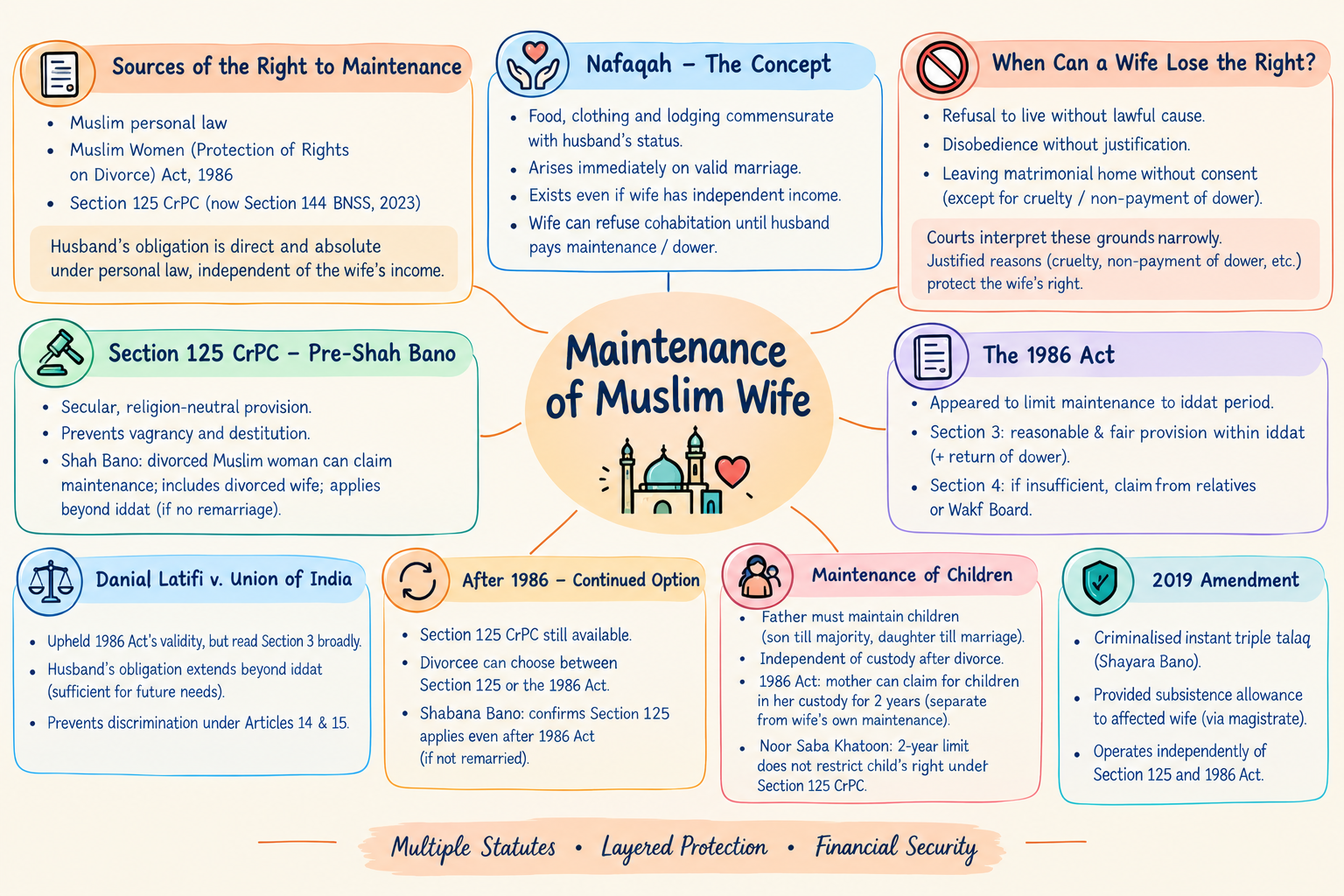
The maintenance for a Muslim wife under Indian law involves a layered interplay between personal law, the Muslim Women (Protection of Rights on Divorce) Act, 1986, and Section 125 of the CrPC, made all the more significant by landmark rulings like Shah Bano and Danial Latifi.
For CLAT PG aspirants, this remains one of the most frequently tested and nuanced areas of Muslim family law.
Sources of the Right to Maintenance
Maintenance of a Muslim wife draws from Muslim personal law, the Muslim Women (Protection of Rights on Divorce) Act, 1986, and the secular remedy under Section 125 of the Code of Criminal Procedure, 1973, now Section 144 of the Bharatiya Nagarik Suraksha Sanhita, 2023.
Under traditional Muslim law, the husband bears an absolute obligation to maintain his wife as a direct consequence of a valid marriage, and this obligation exists independently of the wife's own financial means, distinguishing it from certain other maintenance frameworks that consider the claimant's need as a threshold requirement.
Nafaqah: The Concept of Maintenance under Muslim Law
Nafaqah refers to the husband's obligation to provide his wife with food, clothing, and lodging commensurate with his financial position and social status, arising immediately upon a valid marriage and continuing throughout its subsistence.
This obligation persists even if the wife possesses independent property or income of her own, since the husband's duty flows from the marital relationship itself rather than from any assessment of the wife's actual need.
The wife may lawfully refuse to perform marital obligations, including cohabitation, until the husband fulfils his duty to maintain her, particularly where prompt dower remains unpaid.
Grounds on Which a Wife May Lose the Right to Maintenance
A Muslim wife may forfeit her right to maintenance under traditional law in certain circumstances, including where she refuses to live with her husband without lawful cause, where she is disobedient without justification, or where she leaves the matrimonial home without her husband's consent absent valid grounds such as cruelty or non-payment of dower.
However, courts have generally construed these forfeiture grounds narrowly, recognising that a wife's refusal to cohabit becomes justified where she can show cruelty, non-payment of prompt dower, or other reasonable cause for living separately.
Maintenance under Section 125 CrPC: The Pre-Shah Bano Position
Prior to any special legislation for Muslim women, courts applied Section 125 of the Code of Criminal Procedure uniformly across religious communities, treating it as a secular and religion-neutral provision aimed at preventing vagrancy and destitution.
In Mohd. Ahmed Khan v. Shah Bano Begum, the Supreme Court held that a divorced Muslim woman unable to maintain herself could claim maintenance from her former husband under Section 125, holding that this secular remedy operates independently of and in addition to any rights available under Muslim personal law.
The Court further held that the term "wife" under Section 125 includes a divorced wife, entitling her to maintenance beyond the iddat period so long as she remains unable to support herself and has not remarried.
The Muslim Women (Protection of Rights on Divorce) Act, 1986
The Shah Bano judgment generated significant political controversy, since it appeared to override the traditional Muslim law position limiting the husband's maintenance obligation to the iddat period.
Parliament responded by enacting the Muslim Women (Protection of Rights on Divorce) Act, 1986, which, on its face, appeared to confine a Muslim husband's obligation to provide maintenance to the iddat period alone, after which the divorced wife would need to seek support from relatives entitled to inherit her property under Muslim law, or failing that, from the State Wakf Board.
Section 3 of the 1986 Act specifically entitles a divorced Muslim woman to a reasonable and fair provision and maintenance to be made and paid to her within the iddat period by her former husband, along with the return of her dower or any properties given to her at the time of marriage.
Section 4 provides the residual mechanism directing maintenance claims to relatives or the Wakf Board where the husband's obligation under Section 3 proves insufficient or unenforceable.
Danial Latifi v. Union of India: Reconciling the 1986 Act with Shah Bano
In Danial Latifi v. Union of India, a five-judge Constitution Bench upheld the constitutional validity of the Muslim Women (Protection of Rights on Divorce) Act, 1986, while interpreting Section 3 in a manner that preserved the substance of the Shah Bano ruling.
The Court held that the phrase "reasonable and fair provision and maintenance" obligates the husband to make a provision extending beyond the iddat period, sufficient to secure the divorced wife's future needs, rather than confining his liability strictly to that limited window.
The Court reasoned that if Parliament intended the 1986 Act to leave divorced Muslim women worse off than women of other communities entitled to maintenance under Section 125, the Act itself would fall foul of Articles 14 and 15 of the Constitution.
By reading a forward-looking and comprehensive maintenance obligation into Section 3, the Court managed to uphold the statute's validity while ensuring it did not discriminate against Muslim women relative to their counterparts governed by secular or other personal laws.
Continued Applicability of Section 125 CrPC after 1986
Following Danial Latifi, courts have consistently held that a divorced Muslim woman retains the option to seek maintenance either under Section 125 of the CrPC or under Section 3 of the 1986 Act, since the special statute does not operate as the sole and exclusive remedy displacing the general secular provision.
In Shabana Bano v. Imran Khan, the Supreme Court reaffirmed that Section 125 CrPC continues to apply to a divorced Muslim woman even after the enactment of the 1986 Act, provided she has not remarried, thereby preserving the choice of remedy for Muslim women navigating maintenance claims.
Maintenance of Children under Muslim Law
A Muslim father remains obligated to maintain his children, whether born within or outside the subsisting marriage, until the sons attain the age of majority and the daughters are married, and this obligation exists independently of the custodial arrangement following divorce.
The Muslim Women (Protection of Rights on Divorce) Act, 1986 additionally entitles a divorced Muslim woman to claim maintenance for the children in her custody for a period of two years from their respective dates of birth, distinguishing this children-specific claim from the wife's own maintenance entitlement under Section 3.
In Noor Saba Khatoon v. Mohd. Quasim (1997) the Supreme Court held that the 2-year window provided under Section 3(1)(b) of the 1986 Act does not limit or supersede a child's independent right to maintenance under Section 125 CrPC.
The 2-year provision is an additional right given to the mother to claim maintenance for an infant, but the father's absolute obligation to maintain minor children until majority remains uncompromised.
The 2019 Amendment and Its Limited Impact on Maintenance
The Muslim Women (Protection of Rights on Marriage) Act, 2019, enacted following Shayara Bano v. Union of India, criminalised the pronouncement of instant triple talaq and separately entitled a wife subjected to such talaq to claim subsistence allowance from her husband, determined by the magistrate.
This subsistence allowance operates independently of, and in addition to, the wife's existing maintenance remedies under Section 125 CrPC and the 1986 Act, reflecting Parliament's continued recognition that a divorced or repudiated Muslim woman requires layered statutory protection against financial destitution.
Subscribe for updates
Join 10,000+ subscribers.
HA
Hanspal Bakul
Contributing author
Have a doubt about this?Ask Doubts
