Maintenance of Hindu Wife
The maintenance of Hindu wife under Indian personal law spans multiple statutes, including the Hindu Adoptions and Maintenance Act, 1956, the Hindu Marriage Act, 1955, and Section 125 of the CrPC, each offering distinct yet overlapping remedies.
For CLAT PG aspirants, understanding how these provisions interact, along with landmark rulings like Rajnesh v. Neha, is essential to mastering this frequently tested area of family law.
Statutory Framework
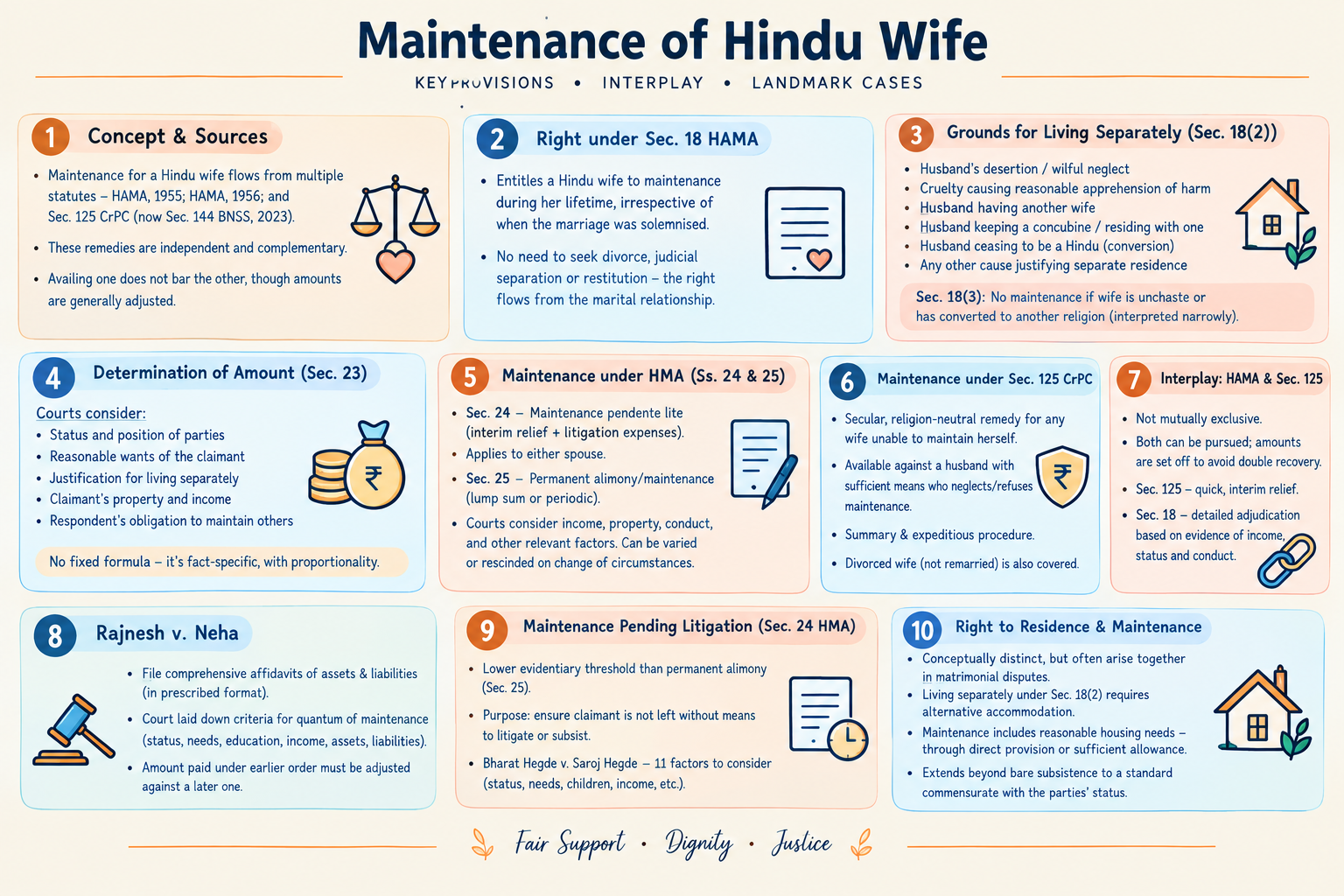
Maintenance of a Hindu wife draws from multiple overlapping sources, primarily the Hindu Adoptions and Maintenance Act, 1956, the Hindu Marriage Act, 1955, and the secular remedy under Section 125 of the Code of Criminal Procedure, 1973, now Section 144 of the Bharatiya Nagarik Suraksha Sanhita, 2023.
Each source operates independently, allowing a Hindu wife to invoke whichever remedy best serves her circumstances, and courts have consistently held that availing one remedy does not automatically bar recourse to another, though amounts already paid under one are generally adjusted against liability under the other.
Right to Maintenance under Section 18 of HAMA
Section 18(1) of the Hindu Adoptions and Maintenance Act, 1956 entitles a Hindu wife to claim maintenance from her husband during her lifetime, regardless of whether the marriage was solemnised before or after the Act came into force.
This right exists independently of any matrimonial proceedings, meaning a wife need not seek divorce, judicial separation, or restitution of conjugal rights to claim maintenance under this provision, since the obligation flows directly from the marital relationship itself.
Grounds for Living Separately: Section 18(2)
Section 18(2) entitles a Hindu wife to live separately from her husband without forfeiting her claim to maintenance, provided she establishes one of several specified grounds.
These include
- Husband's desertion or wilful neglect,
- Cruelty causing reasonable apprehension of harm,
- Husband having another wife living,
- Husband keeping a concubine in the same house or habitually residing with one elsewhere,
- Husband ceasing to be a Hindu by conversion, and
- Any other cause justifying the wife's living separately.
Section 18(3) carves out a significant limitation, providing that a wife is not entitled to separate residence and maintenance if she is unchaste or has ceased to be a Hindu by conversion to another religion.
This provision has attracted criticism for its moralistic tone, though courts have generally construed the unchastity bar narrowly, requiring clear proof rather than mere suspicion or allegation.
Determination of the Amount: Section 23
Section 23 guides courts in determining the quantum of maintenance, directing them to have due regard to the position and status of the parties, the reasonable wants of the claimant, whether the claimant is justified in living separately, the value of the claimant's property and income, and the number of persons the respondent is obligated to maintain.
Courts exercise considerable discretion under this provision, and the determination remains fact-specific rather than governed by any fixed formula, though appellate courts have increasingly emphasised proportionality between the sums awarded and the paying spouse's actual income.
Maintenance under the Hindu Marriage Act: Sections 24 and 25
Section 24 of the Hindu Marriage Act, 1955 empowers courts to award maintenance pendente lite, meaning interim maintenance and litigation expenses to a spouse lacking independent income sufficient for support during the pendency of any matrimonial proceeding under the Act.
Since the provision applies to either spouse, a wife may claim interim maintenance regardless of whether she is the petitioner or respondent in the underlying matrimonial suit.
Section 25 provides for permanent alimony and maintenance, empowering courts, at the time of passing any decree or subsequently, to order either spouse to pay the other a gross sum or periodical payment, having regard to the respondent's income and property, the claimant's income and property, the conduct of the parties, and other relevant circumstances.
This maintenance may take the form of a lump sum or periodic payments, and Section 25(2) allows courts to vary, modify, or rescind the order upon a material change in circumstances of either party.
Maintenance under Section 125 CrPC
Section 125 of the Code of Criminal Procedure, 1973 offers a secular, religion-neutral remedy available to any wife, including a Hindu wife, unable to maintain herself, allowing her to claim maintenance from a husband possessing sufficient means who neglects or refuses to maintain her.
This remedy operates as a summary and expeditious procedure designed to prevent vagrancy and destitution, and it remains available irrespective of the personal law governing the parties' marriage.
A divorced wife who has not remarried also falls within the definition of "wife" under this provision, entitling her to claim maintenance even after the dissolution of marriage, provided she remains unable to maintain herself.
Interplay between HAMA and Section 125 CrPC
Courts have consistently held that the right to maintenance under Section 18 of HAMA and the remedy under Section 125 CrPC are not mutually exclusive, and a Hindu wife may pursue both, though amounts recovered under one head are typically set off against liability under the other to prevent double recovery.
Section 125 provides a summary, interim remedy usually granted swiftly, while Section 18 permits a more comprehensive adjudication of maintenance based on detailed evidence of income, status, and conduct, making the two provisions complementary rather than competing remedies.
Rajnesh v. Neha: Uniform Guidelines on Maintenance
In Rajnesh v. Neha, the Supreme Court addressed the widespread problem of overlapping maintenance claims filed under different statutes and the resulting confusion, delay, and inconsistency across courts.
The Court directed that parties file comprehensive affidavits of disclosure of assets and liabilities in a prescribed format, aimed at preventing both the suppression of income by the paying spouse and inflated or unsubstantiated claims by the recipient spouse.
The Court further laid down criteria for determining the quantum of maintenance, including the status of the parties, reasonable needs of the claimant and dependent children, the claimant's educational qualifications and employment prospects, income and assets of both parties, and the liabilities of the respondent.
It also clarified that where maintenance is granted under multiple proceedings, the court must adjust the amount already paid under an earlier order against the amount payable under a subsequent one, ensuring the wife receives fair support without permitting duplication of recovery.
Maintenance Pending Litigation: Interim Relief Principles
Courts granting interim maintenance under Section 24 of the Hindu Marriage Act generally apply a lower evidentiary threshold than for permanent alimony under Section 25, since the purpose of interim relief is to ensure the claimant is not left without means to litigate or subsist during the pendency of proceedings.
The Delhi High Court, in Bharat Hegde v. Saroj Hegde, laid down eleven factors relevant to determining interim maintenance, including the status of the parties, reasonable needs of the wife and dependent children, and the independent income or property of the claimant, factors that have since guided courts across jurisdictions in assessing interim maintenance applications.
Right to Residence and Its Relationship with Maintenance
Although maintenance and the right to residence are conceptually distinct, they often arise together in matrimonial disputes, since a wife living separately under Section 18(2) of HAMA necessarily requires alternative accommodation.
Courts have recognised that the obligation to maintain a wife implicitly includes providing for her reasonable residential needs, whether through direct provision of a residence or through a maintenance amount sufficient to cover reasonable housing expenses, reinforcing that maintenance under Hindu law extends beyond bare subsistence to a standard of living commensurate with the parties' social and economic status.
Subscribe for updates
Join 10,000+ subscribers.
HA
Hanspal Bakul
Contributing author
Have a doubt about this?Ask Doubts