Quick Revision Notes (QRN): Transfer of Property Act, 1882
JU
Julie Nigam14 min readQuick Revision Notes (QRN): TPA
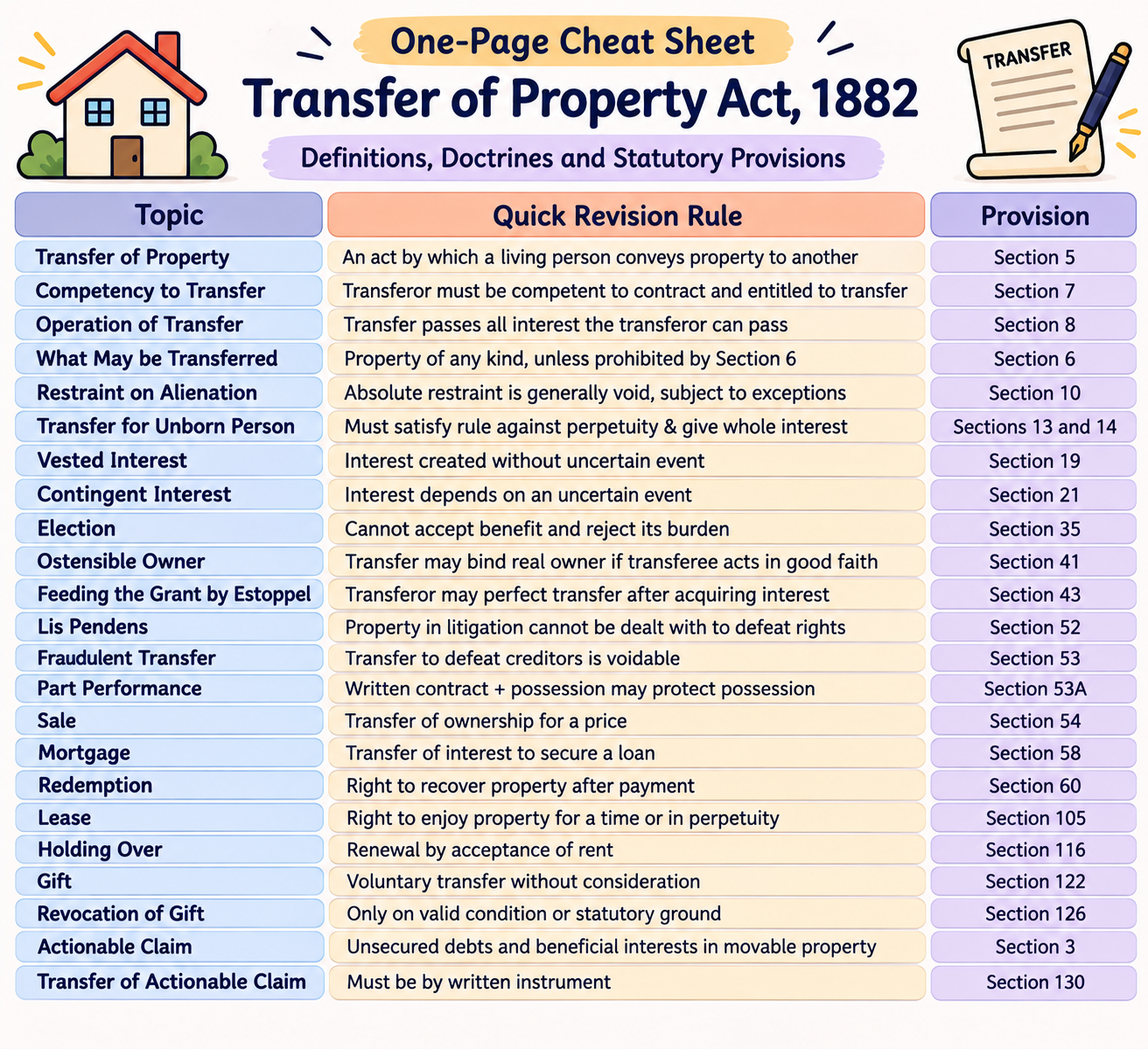
The Transfer of Property Act, 1882, or TPA, regulates voluntary transfers of property between living persons. These quick revision notes on TPA cover the important topics for CLATPG, students should revise the general rules of transfer first and then study the specific transactions of sale, mortgage, lease, gift and transfer of actionable claims.
The most tested areas include what property may be transferred, who can transfer it, restrictions on transfer, vested and contingent interests, conditional transfers, election, transfer by an ostensible owner, feeding the grant by estoppel, lis pendens, fraudulent transfer, part performance, sale, mortgage, lease, gift and actionable claims. For detailed reading, use CLATalogue’s Basic Introduction to the Transfer of Property Act, 1882, Sale under the Transfer of Property Act, Mortgage under TPA, Lease under the Transfer of Property Act, Gift under the TPA and Actionable Claim under the TPA.
1. Meaning, Scope and Object of the TPA
The TPA mainly deals with transfers of immovable property and certain intangible rights. It does not contain the complete law of property. Personal laws, contract law, the Registration Act, the Specific Relief Act, the Indian Succession Act and local tenancy laws may also apply.
The Act generally concerns transfers inter vivos, meaning transfers between living persons. In contrast, transfers through a will take effect only upon death and fall mainly under succession laws. Similarly, transfers resulting from the operation of law, such as inheritance or court-ordered sales, are distinct from voluntary transfers covered under section 5.
Essential Elements of a Transfer under Section 5
To constitute a valid transfer under section 5, the following elements are generally necessary:
- A specific act of conveyance or transfer,
- A living person acting as the transferor,
- One or more living persons (or juristic persons) as the transferee,
- Clearly identifiable property, and
- A clear intention to pass an interest in that property.
Such a transfer can be either absolute or conditional in nature. Depending on the arrangement, it may pass full ownership, a specific interest, the right of enjoyment, or a security interest in the property.
Property and Immovable property
The TPA does not provide a complete definition of immovable property. Section 3 explains that immovable property does not include standing timber, growing crops or grass. The General Clauses Act includes land, benefits arising out of land and things attached to the earth.
Fixtures, buildings, rights of way, rent and certain benefits arising from land may be treated differently depending on the provision and facts. In a problem question, identify the nature of the right rather than relying only on its name.
2. What Property may be Transferred?
Section 6 begins with a broad rule: property of any kind may be transferred unless the Act or another law prohibits the transfer. The section then lists exceptions.
The following interests generally cannot be transferred:
- a mere chance of succession, known as spes successionis,
- a mere right of re-entry for breach of a condition, except to the owner of the property affected,
- an easement apart from the dominant heritage,
- an interest restricted to the owner personally,
- a right to future maintenance,
- a mere right to sue,
3. Who can Transfer Property?
Under Section 7, a person competent to contract and entitled to transferable property, or authorised to dispose of it, can transfer the property. Capacity, title and authority are separate questions.
A minor generally lacks contractual capacity. A guardian may transfer a minor’s property only within the limits of the relevant personal law and guardianship statute, usually with court permission where required.
A co-owner has the right to transfer their specific share in a property. When this happens, the transferee takes on the transferor’s legal standing and may request a partition, provided this aligns with the property’s nature and respects the rights to the remaining co-owners.
Even without physical possession, an individual can legally transfer property as long as they hold a transferable interest in it. Nevertheless, a transferor generally cannot convey a superior title than what they themselves own, unless a specific statutory exception permits it.
4. Restrictions on Transfer and Doctrines
Section 10: Restraint on Alienation
Any condition that completely prohibits a transferee from further transferring their acquired interest is generally void. In such cases, the underlying transfer remains valid, while only the restrictive condition becomes unenforceable.
On the other hand, a partial or limited restraint may be upheld depending on its specific wording, underlying purpose, and statutory context. Additionally, restrictions within a lease agreement and conditions inserted to protect the lessor’s interest are treated as distinct exceptions.
Transfer for the Benefit of an Unborn Person: Section 13
A transfer cannot normally create a direct interest for a person not in existence at the date of transfer. The transfer must first create a prior interest in a living person and then give the unborn person the whole of the remaining interest of the transferor.
A limited interest cannot be given to an unborn person if it leaves an undisposed remainder in the transferor. The rule prevents property from being tied up through successive limited interests.
Rule Against Perpetuity: Section 14
An interest cannot be created to take effect beyond the lifetime of persons living at the date of transfer plus the minority of a person who is in existence at the end of that period. This rule restricts the distant vesting of property interests and ensures that property cannot be indefinitely tied up or withheld from future transfers.
Vested and Contingent Interests
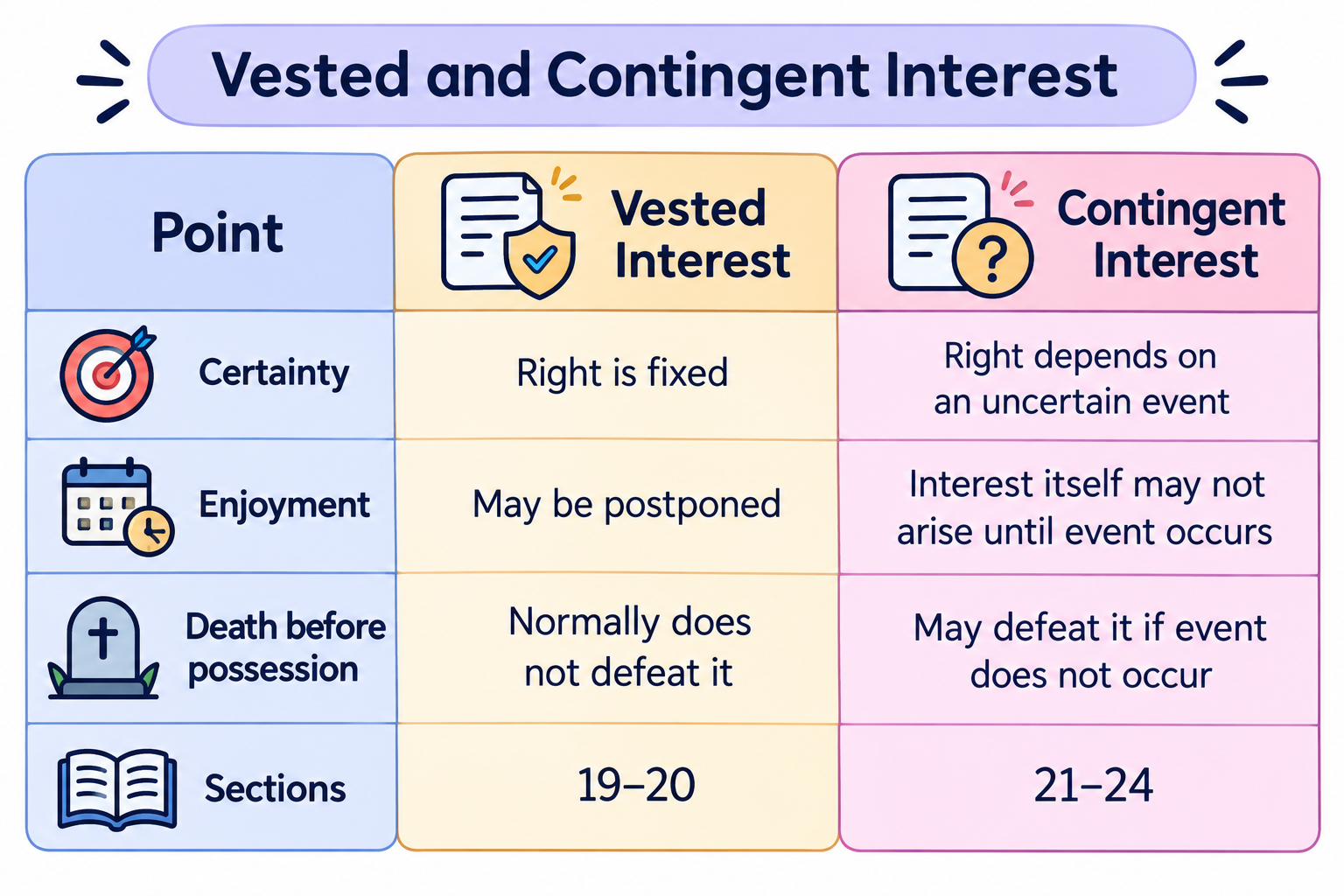
A vested interest is created when the right is fixed, even though enjoyment may be postponed. Death of the transferee before possession does not normally defeat a vested interest.
A contingent interest depends on an uncertain event. It becomes vested when the event happens or when the event becomes impossible, according to the terms of the transfer.
Conditional Transfer
A transfer may be subject to a condition precedent or subsequent. A condition precedent must be satisfied before the interest arises. A condition subsequent may defeat an interest that has already arisen. The condition must be lawful and capable of being enforced.
Doctrine of Election: Section 35
When a person purports to transfer property that belongs to someone else and, in the same transaction, gives a benefit to the true owner, the owner must elect. The owner cannot accept the benefit and reject the transfer, or accept the property and give up the benefit, without consequences.
The one who is making the election shall be well-versed with the facts and their legal duty. Acceptance of only the benefit may amount to confirmation of the transfer in appropriate circumstances.
Transfer by Ostensible Owner: Section 41
An ostensible owner appears to be the owner with the consent, express or implied, of the real owner. A transfer by such a person can be protected when:
- the transferor is the ostensible owner,
- the real owner consented to that appearance,
- the transfer is for consideration,
- the transferee took reasonable care to ascertain authority, and
- the transferee acted in good faith.
Feeding the Grant by Estoppel: Section 43
When a person fraudulently or erroneously represents that they are authorised to transfer property and transfers it for consideration, the transfer may operate on any interest later acquired by that transferor. The transferee may choose to enforce the transfer while it remains in force.
Section 52: Lis Pendens
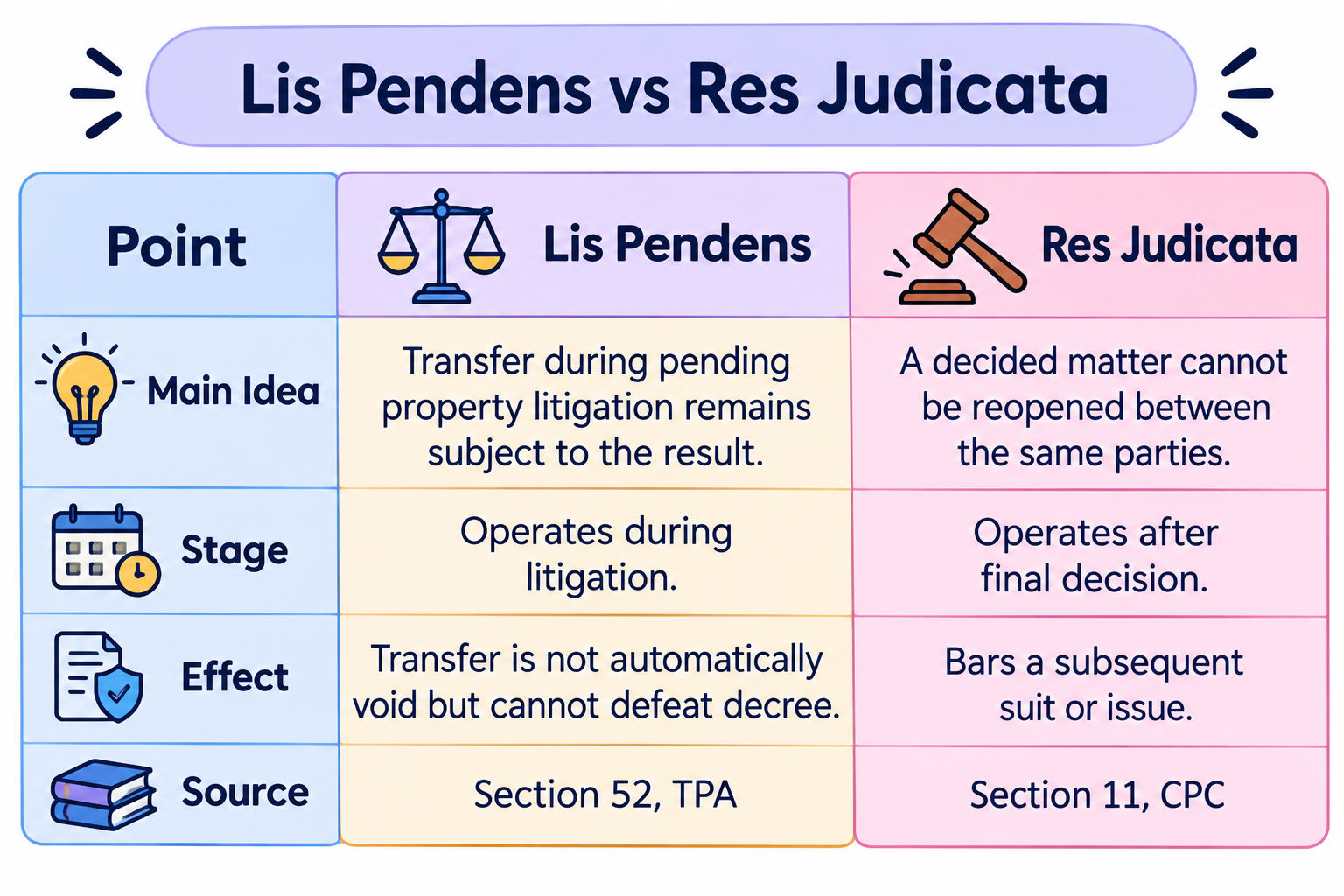
While a genuine, non-collusive lawsuit directly involving rights to immovable property is pending, no party to the dispute may transfer or otherwise deal with that property in a way that compromises another party’s rights under the court's final decree.
A transfer during litigation is not automatically void. It remains subject to the result of the suit. The doctrine protects the court’s jurisdiction and prevents parties from defeating the decree through private transfers.
Fraudulent Transfer: Section 53
A transfer of immovable property made with intent to defeat or delay creditors is voidable at the option of a creditor so defeated or delayed. A bona fide transferee for consideration is protected in the manner recognised by the section.
Part Performance: Section 53A
Part performance is an equitable protection for a transferee who has:
- a written contract to transfer immovable property for consideration,
- a contract signed by the transferor or someone authorised by them,
- taken possession, continued in possession or done an act in furtherance of the contract, and
- performed or is willing to perform their part of the contract.
The doctrine is defensive. It protects possession against the transferor, but does not by itself create title. After the statutory registration changes, an unregistered contract that requires registration cannot generally be relied upon for Section 53A protection unless the statutory requirements are met.
5. Sale under the TPA
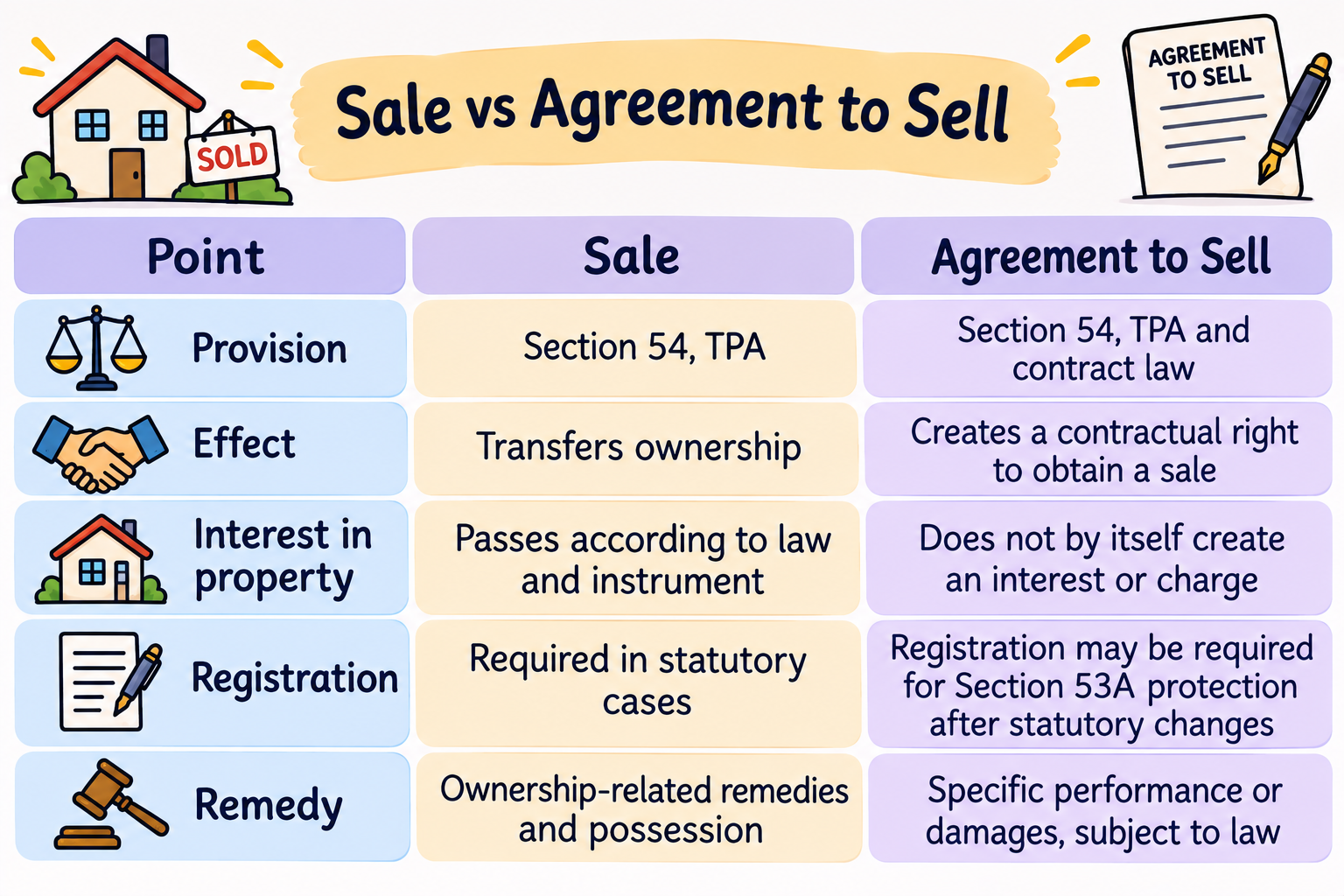
Section 54 defines sale as a transfer of ownership in exchange for a price paid, promised or partly paid and partly promised.
Essentials of Sale
- There must be parties competent to transfer and receive property.
- The subject matter must be transferable property.
- Ownership must be intended to pass.
- There must be a price in money, paid or promised.
- The formal requirements must be satisfied.
A mere agreement to sell does not, by itself, create an interest or charge in the property. It creates a contractual right to obtain another document or seek specific relief.
Registration
A sale of tangible immovable property of the statutory value or more requires a registered instrument. A sale of a reversion or other intangible interest also requires a registered instrument. A tangible immovable property below the statutory value may be transferred through a registered instrument or delivery, according to Section 54.
Rights and Liabilities
The seller must disclose material defects, produce title documents, answer relevant questions, execute a proper conveyance, take reasonable care of the property and deliver possession according to the contract. The buyer must disclose facts known to them that materially increase the value of the seller’s interest, pay the price and complete the transaction.
The respective rights of the buyer and seller over the property, as well as any associated rents or profits, are governed by the terms of the contract and whether ownership has officially passed.
Important Cases
- Suraj Lamp & Industries v. State of Haryana: Agreements to sell, powers of attorney and wills do not independently transfer title to immovable property. A legally valid deed of conveyance is necessary to pass ownership, barring established exceptions.
- Narandas Karsondas v. S.A. Kamtam: a contract for sale does not create an interest or charge in immovable property; the right of redemption continues until a registered conveyance or equivalent legal event.
- V. Pechimuthu v. Gowrammal: An agreement to sell establishes binding contractual obligations between the parties, but it does not confer property ownership on its own.
For better understanding read Sale under the Transfer of Property Act, 1882.
6. Mortgage under the TPA
Section 58 defines a mortgage as the transfer of an interest in specific immovable property for securing the payment of money advanced or to be advanced by way of loan, an existing or future debt or the performance of an engagement that may give rise to a financial liability.
The transferor is the mortgagor. The transferee is the mortgagee. The secured amount is the mortgage money, and the instrument is the mortgage deed.
Types of mortgage
- Simple mortgage: In this possession is not delivered. The mortgagor personally promises repayment and agrees that the mortgagee may cause the property to be sold through court if the loan is not repaid.
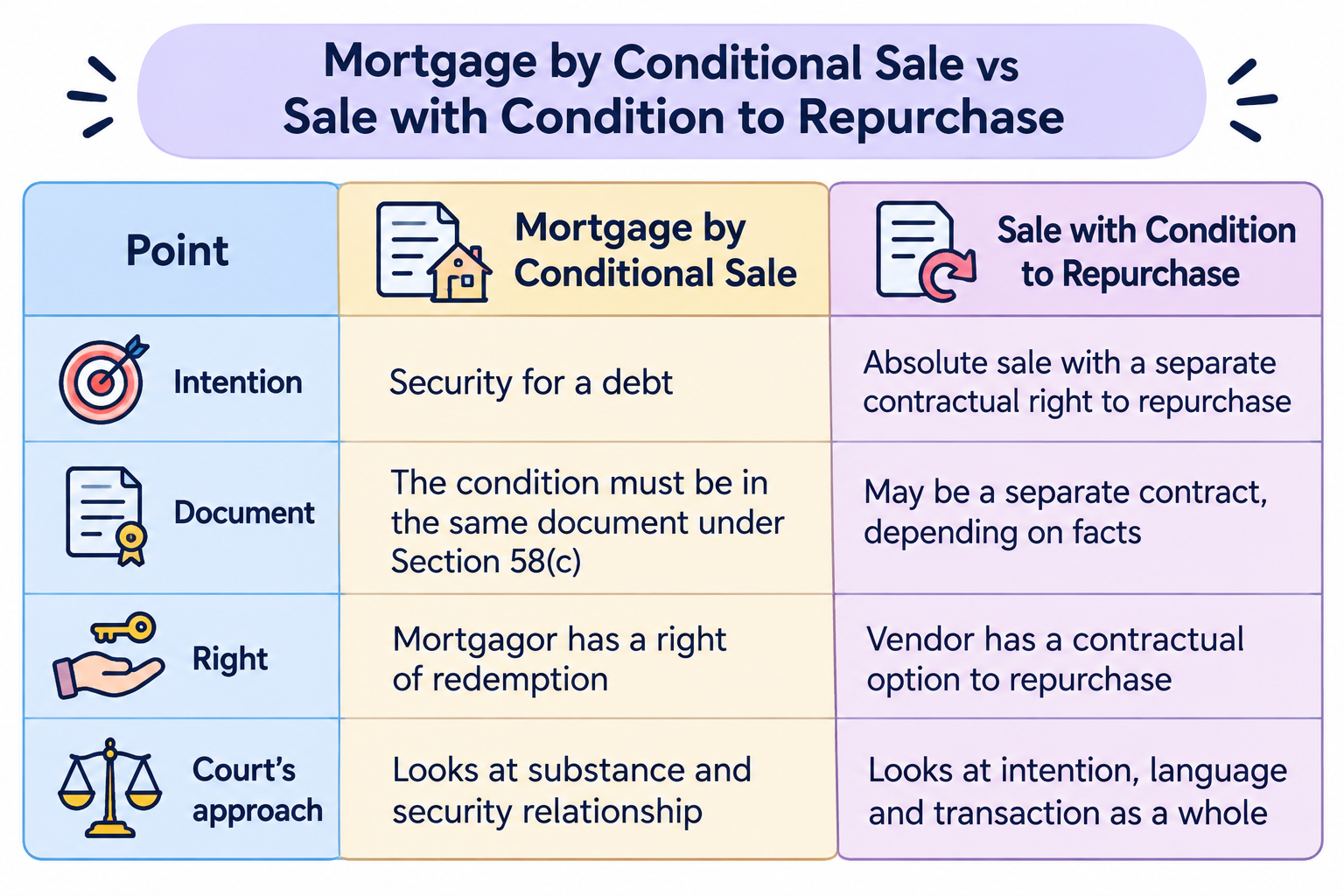
- Mortgage by conditional sale: The mortgagor enters into an apparent sale of the property on the condition that the sale becomes void once the loan is repaid, or becomes final if the borrower defaults. This condition must be included in the same document as the sale itself.
- Usufructuary mortgage: The mortgagor handover the possession or agrees to hand over the possession of the property to the lender, allowing the lender to collect rent and profits from the property to pay off the interest, the principal or both.
- English mortgage: The borrower commits to repaying the debt by a fixed date and transfers ownership of the property to the lender, with the agreement that the lender will transfer it back once the debt is paid.
- Mortgage by deposit of title deeds: The borrower hands over the property’s ownership documents to the lender in a notified town or area with the clear intention of using the property as security for the loan.
Right of Redemption: Section 60
Once the loan amount is due, the borrower has the legal right to reclaim the property by paying or property offering the owed sum. Exercising this right restores both the property and its title documents to the borrower, subject to the legal terms of the mortgage.
Because the right of redemption is guaranteed by law, any clause that unfairly restricts it can be invalidated by a court as a ‘clog on redemption’. To decide this, the court looks closely at the overall transaction, the bargaining power of both parties, the surrounding circumstances, and whether the condition is fair.
Foreclosure and Sale
Foreclosure prevents the mortgagor from redeeming in cases and by a decree permitted by law. A mortgagee’s right to sell without court intervention is limited and depends on Section 69 and the circumstances specified there. A simple mortgage normally requires court proceedings for sale.
Subrogation
A person who redeems a mortgage may, in appropriate cases, step into the shoes of the mortgagee whose mortgage has been redeemed. Subrogation may arise by operation of law or by agreement, subject to the statutory provisions.
Important cases
- Ganga Dhar v. Shankar Lal: A borrower’s right to reclaim their property cannot be blocked by harsh or unfair contract terms that prevent redemption.
- Pomal Kanji Govindji v. Vrajlal Karsandas Purohit: Determining whether a clause acts as an unfair barrier to redemption depends on the specific facts, the nature of the deal, and the situation of both parties.
- Narandas Karsondas v. S.A. Kamtam: A borrower keeps their right to redeem the property until that right is officially ended through a legally valid process.
- K.J. Nathan v. S.V. Maruthi Rao: Simply handing over ownership papers is not enough to create a mortgage by deposit of title deeds. There must also be a clear intention to use the property as security for the loan.
For better understanding read Mortgage under the Transfer of Property Act.
7. Lease under the TPA
Section 105 defines a lease as a transfer of a right to enjoy immovable property for a certain time, express or implied, or in perpetuity, in consideration of a price, rent, share of crops, service or another thing of value.
The transferor is the lessor, the transferee is the lessee, the price is the premium and the recurring consideration is rent.
Essentials of a Lease
- competent lessor and lessee,
- identifiable immovable property,
- transfer of a right to enjoy, not ownership,
- duration or a legally determinable period, and
- consideration such as rent, premium or service.
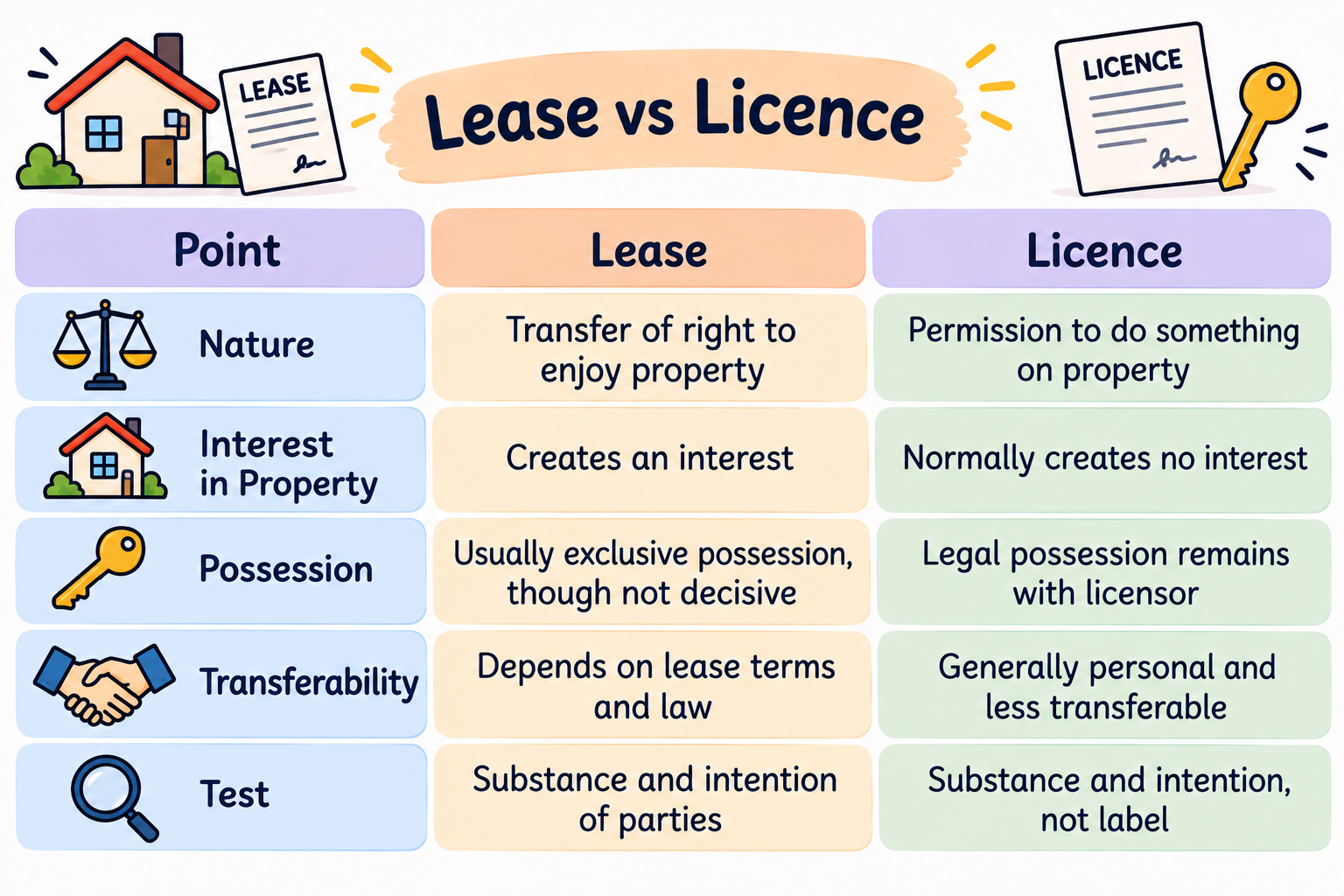
A lease differs from a licence. A lease creates an interest in the property, while a licence generally gives permission to do something on another’s property without creating an interest.
Duration and Registration
Section 106 supplies default rules when there is no contract, local law or usage to the contrary. A lease for agricultural or manufacturing purposes is generally treated differently from another lease in relation to duration and notice.
A lease from year to year, for a term exceeding one year or reserving yearly rent generally requires a registered instrument under Section 107 and the Registration Act. Other leases may be created according to the statutory rule and local law.
Rights and Duties
The lessor must disclose material defects, put the lessee in possession and allow quiet enjoyment while the lessee performs the lease. The lessee must pay rent, use the property prudently, avoid destructive use, inform the lessor of encroachments and return possession after determination.
Determination of Lease: Section 111
A lease may end by:
- expiry of time,
- happening of a specified event,
- termination of the lessor’s interest,
- merger,
- express surrender,
- implied surrender,
- forfeiture, or
Waiver and Relief Against Forfeiture
Acceptance of rent or other conduct may waive a forfeiture or notice in appropriate circumstances. Section 114 gives relief against forfeiture for non-payment of rent if the statutory requirements are fulfilled. Section 114A deals with certain breaches and notice to remedy.
Holding Over: Section 116
If a tenant stays in the property after their lease expires and the landlord accepts rent or otherwise agrees to their continued stay, the lease automatically renews on a yearly or monthly basis depending on the original agreement’s purpose and terms.
Important Cases
- Anthony v. K.C. Ittoop & Sons: Even if an unregistered lease fails to create a valid long-term tenancy because it legally requires registration, continued possession and rent payments can still establish a valid month to month tenancy under the law.
- R.V. Bhupal Prasad v. State of Andhra Pradesh: A tenant who stays on after their lease expires does not automatically become a ‘tenant holding ever’. The landlord’s consent is essential.
- Shaha Ratansi Khimji & Sons v. Kumbhar Sons Hotel: The true nature of a lease is determined by the actual legal rights it creates, the parties’ intentions, and the core substance of the deal.
- Delta International Ltd. v. Shyam Sundar Ganeriwalla: To tell the difference between a lease and a license, a court must look at the actual intent and real substance of the agreement rather than simply what the parties chose to call it.
For better understanding read Lease under the Transfer of Property Act, 1882.
8. Gift under the TPA
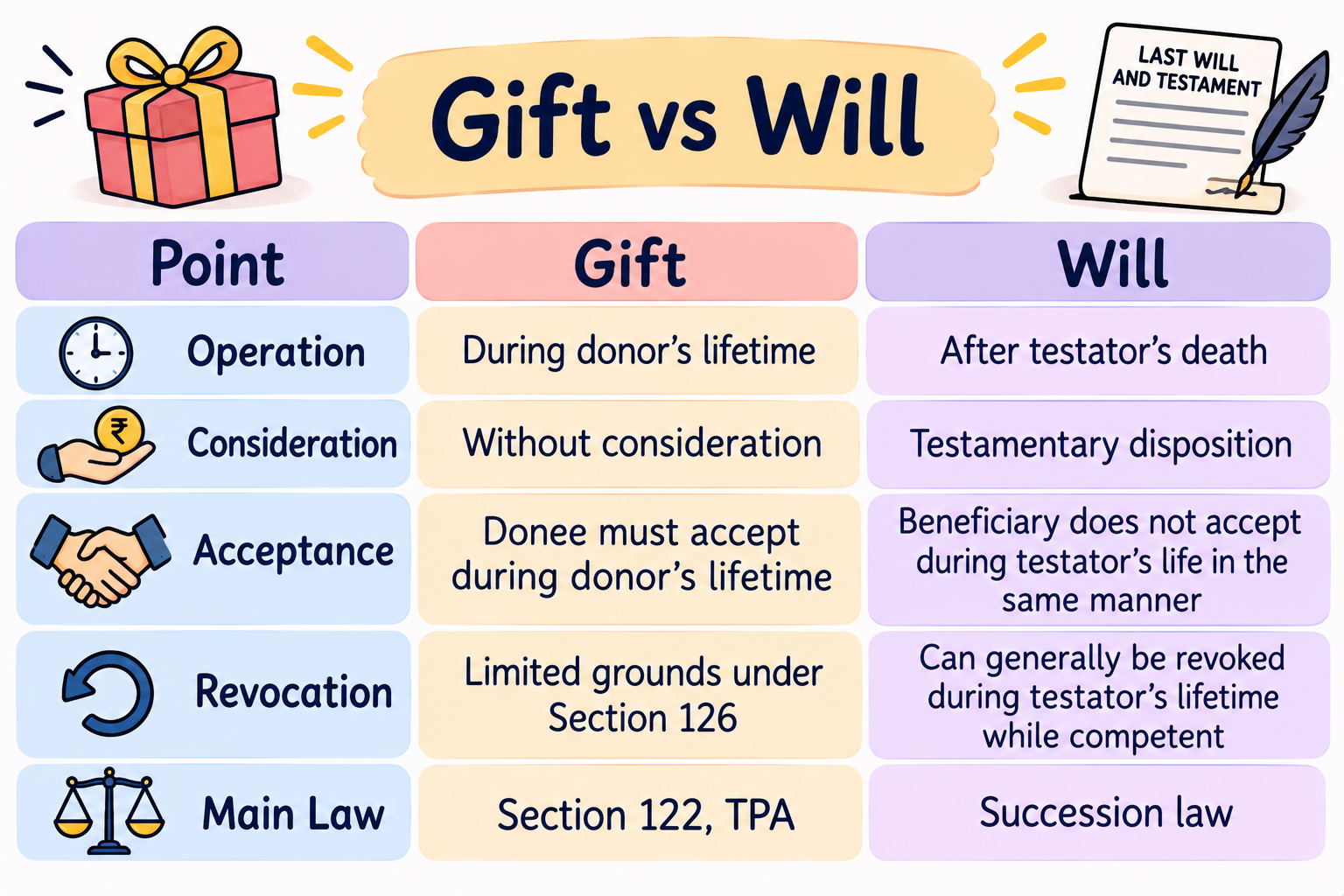
Section 122 defines a gift as the transfer of certain existing movable or immovable property made voluntarily and without consideration by one person, called the donor, to another, called the donee, and accepted by or on behalf of the donee.
Essentials of a Valid Gift
- donor has capacity and authority,
- property is existing and identifiable,
- transfer is voluntary,
- transfer is without consideration,
- donee accepts the gift during the donor’s lifetime and while capable of accepting, and
- formalities are completed.
A gift of immovable property must be made through a registered instrument signed by or on behalf of the donor and attested by at least two witnesses. A gift of movable property may be made through a registered instrument or delivery.
Acceptance
Acceptance may be express or inferred from conduct. It must occur during the donor’s lifetime and while the donor is capable of giving. If the donee dies before acceptance, the gift fails.
Gift to Several Donees
If one of several donees does not accept, the gift is void as to that share. Acceptance by another donee does not necessarily cure the non-acceptance.
Onerous Gift: Section 127
A gift of several things, some burdened and some beneficial, requires the donee to accept the whole. A person who is not competent to contract cannot accept an onerous gift in the same way as a competent person; upon becoming competent, they may accept or reject it.
Universal Donee: Section 128
A universal donee takes the donor’s whole property and is liable for the donor’s debts and liabilities to the extent of the property received.
Revocation: Section 126
A gift may be suspended or revoked if the donor and donee agree that it will be revoked on the happening of a specified event that does not depend solely on the donor’s will. A gift may also be revoked on grounds on which a contract may be rescinded. A gift cannot be revoked merely because the donor changes their mind.
Important Cases
- K. Balakrishnan v. K. Kamalam: A recipient’s acceptance of a gift can be understood from their actions and the surrounding situation, rather than requiring a formal statement.
- Renikuntla Rajamma v. K. Sarwanamma: A gift of immovable property remains valid even if the giver keeps the right to use or enjoy the property for the rest of their life.
- Naramadaben Maganlal Thakker v. Pranjivandas Maganlal Thakker: Acceptance is required to make a gift legally binding, so a gift deed left unfinished due to lack of acceptance may not be valid.
- Asokan v. Lakshmikutty: To decide if a gift is legally complete, a court must evaluate the giver’s intent, the recipient’s acceptance, and all legal formalities together.
9. Actionable Claims
An actionable claim under Section 3 is a claim to an unsecured debt, other than a debt secured by mortgage of immovable property or hypothecation or pledge of movable property, or a beneficial interest in movable property not in the possession of the claimant, which civil courts recognise as giving grounds for relief.
Examples may include an unsecured debt or an interest in movable property that the claimant cannot presently possess. A mere right to sue for damages is not an actionable claim that can be transferred under the TPA.
Transfer: Section 130
A transfer of an actionable claim must be made only by a written instrument signed by the transferor or an authorised agent. The transfer becomes complete upon execution of the instrument. Notice to the debtor is not essential to complete the transfer between transferor and transferee, but notice is important to protect the transferee against a payment made to the transferor in ignorance of the assignment.
The transferee takes the claim subject to equities and liabilities existing between the original parties. The new holder receives the claim along with any existing rights or obligations between the original parties, meaning the debtor can still use any legal defenses they originally had against the previous holder, as permitted by law.
Section 131: Notice
Any notice of transfer must be in writing and signed by the original holder or their authorized agent, clearly identifying the new holder. Sending this notice is crucial in practice because, without it, the debtor can legally settle the debt by paying the original creditor.
Important Case
- Jugalkishore Saraf v. Raw Cotton Co. Ltd.: An actionable claim can be transferred using a written document, with the new holder’s rights determined by the nature of the claim and applicable legal rules.
- Sunrise Associates v. Government of NCT of Delhi: While reviewing lottery transactions, the Supreme Court clarified that an actionable claim refers to a right to a debt or a beneficial interest in movable property not currently in one’s possession, and it must be strictly interpreted according to its legal definition.
Read more about Actionable Claim under the Transfer of Property Act, 1882.
15 Important TPA Judgments: One-Liners
| S. No. | Case Name | Legal Principle / One-Line Holding |
| 1. | Jumma Masjid, Mercara v. Kodimaniandra Deviah | Section 43 can apply when a transferor falsely or mistakenly represents authority and later acquires the interest, subject to the transferee’s choice and statutory conditions. |
| 2. |
Next subject: Related Notes, Judgments and Mock Tests
After completing the TPA, revise the connected topics below:
Subscribe for updates
Join 10,000+ subscribers.
JU
Julie Nigam
Contributing author
Have a doubt about this?Ask Doubts