
Incorporation of a Company
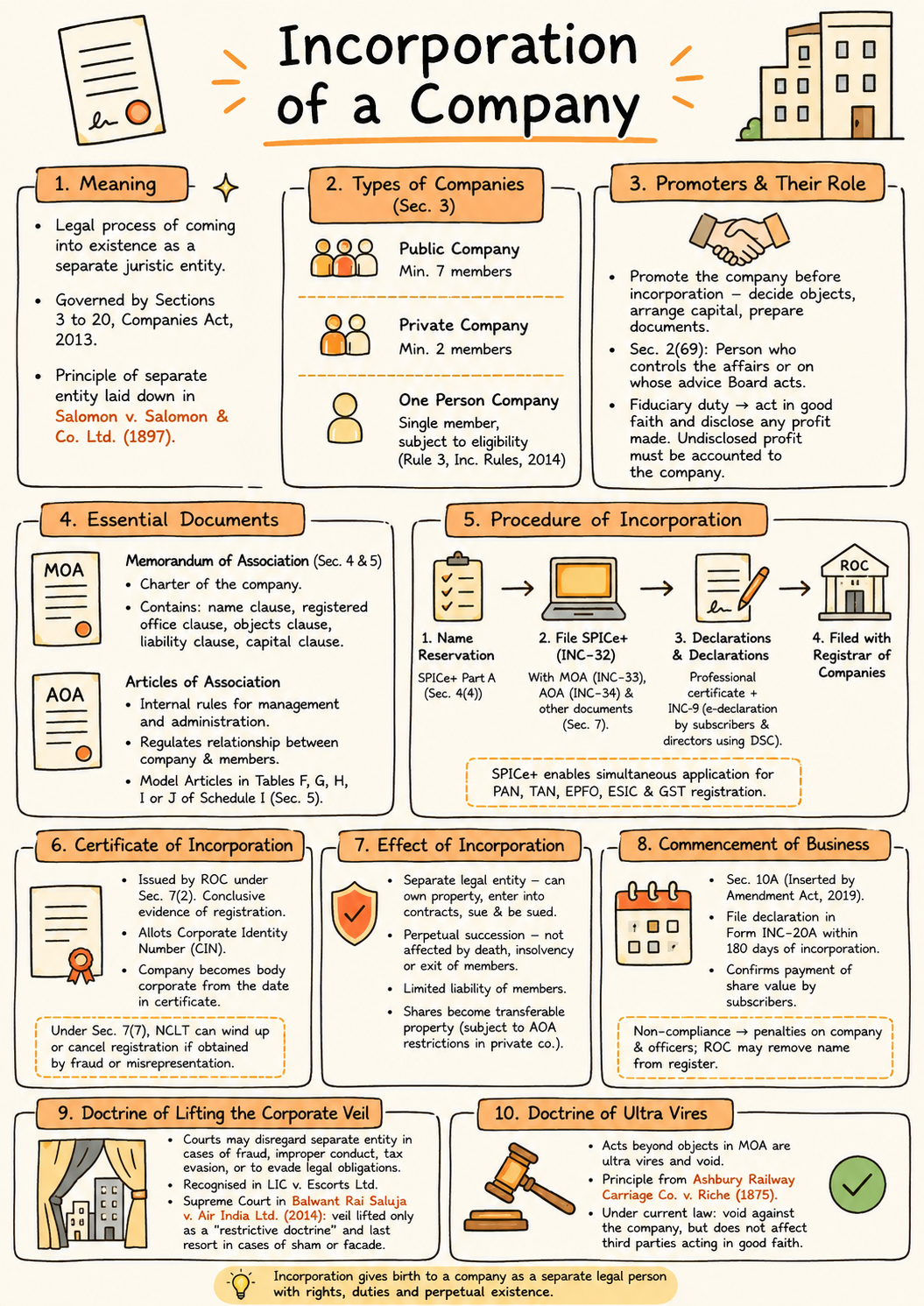
Incorporation is the legal process through which a company comes into existence as a separate juristic entity, distinct from its members. It is governed under the Companies Act, 2013, particularly Sections 3 to 20. Once incorporated, a company acquires a legal personality independent of its shareholders and directors.
The concept was firmly established in the landmark English case Salomon v. Salomon & Co. Ltd. (1897). The House of Lords held that a company, once validly incorporated, is a separate legal entity distinct from its subscribers, even if one person effectively controls it. This principle remains the foundation of modern company law.
Types of Companies for Incorporation
Under Section 3 of the Companies Act, 2013, a company may be incorporated as a public company, private company, or One Person Company (OPC). A private company requires a minimum of two members, while a public company requires a minimum of seven.
An OPC can be formed with a single member, subject to eligibility conditions under Rule 3 of the Companies (Incorporation) Rules, 2014.
Promoters and Their Role
Before incorporation, promoters undertake preliminary steps such as deciding the company's objects, arranging capital, and preparing incorporation documents. Section 2(69) defines a "promoter" as a person named as such in the prospectus or annual return, or one who controls the company's affairs, or on whose advice the Board is accustomed to act.
Promoters occupy a fiduciary position towards the company. They must act in good faith and disclose any personal profit made in transactions relating to the company's promotion. Failure to disclose such profit renders the promoter liable to account for it to the company.
Essential Documents for Incorporation
Two foundational documents are required: the Memorandum of Association (MOA) and the Articles of Association (AOA). The MOA, governed by Sections 4 and 5, defines the company's objects, scope, and powers, and constitutes its charter. It contains clauses such as the name clause, registered office clause, objects clause, liability clause, and capital clause.
The AOA contains the internal rules and regulations governing the company's management and administration. It regulates the relationship between the company and its members, and among members inter se. Under Section 5, a company may adopt any of the model articles prescribed in Tables F, G, H, I, or J of Schedule I.
Procedure of Incorporation
The incorporation process begins with reservation of the company name through the SPICe+ Part A form, in compliance with Section 4(4). The proposed name must not be identical or closely resembling an existing company or registered trademark.
Thereafter, the promoters file the SPICe+ (INC-32) form along with the MOA (INC-33), AOA (INC-34), and other prescribed documents with the Registrar of Companies (ROC) under Section 7. This integrated form also enables simultaneous application for PAN, TAN, EPFO, ESIC, and GST registration.
The application must be accompanied by a declaration from a professional (Chartered Accountant, Company Secretary, or Advocate) confirming compliance with the Act, along with an affidavit from subscribers and directors regarding non-conviction and honesty in forming the company.
However, the declaration from subscribers and directors regarding non-conviction is no longer a physical affidavit. It has been converted into an auto-generated, electronic declaration form (Form INC-9) that they sign using their Digital Signature Certificate (DSC).
Certificate of Incorporation
Once the Registrar is satisfied that all requirements have been complied with, a Certificate of Incorporation is issued under Section 7(2). This certificate is conclusive evidence that all requirements of the Act have been complied with, and the company has been duly registered.
Under Section 7(7), if a company is found to have been incorporated by furnishing false or fraudulent information or by concealing material facts, the National Company Law Tribunal (NCLT) has the power to order the winding up of the company, cancel its registration, or change its liability structure. Therefore, the certificate is conclusive proof of its existence, but it can be undone if fraud is proven.
The certificate also allots a Corporate Identity Number (CIN) to the company. From the date mentioned in the certificate, the company becomes a body corporate capable of exercising all functions of an incorporated company, with perpetual succession and a common seal (where adopted).
Effect of Incorporation
Upon incorporation, the company acquires several legal consequences. It becomes a separate legal entity capable of owning property, entering contracts, suing and being sued in its own name, independent of its members. This is often referred to as the "corporate veil" separating the company from its shareholders.
The company also enjoys perpetual succession, meaning its existence is unaffected by the death, insolvency, or exit of members. Shares become transferable property, subject to restrictions under the AOA in case of private companies. Members enjoy limited liability, restricted to unpaid share capital or the amount guaranteed.
Commencement of Business
Section 10A, inserted by the Companies (Amendment) Act, 2019, mandates that a company having share capital must file a declaration in Form INC-20A within 180 days of incorporation, confirming that subscribers have paid the value of shares agreed to be taken by them, before commencing business or exercising borrowing powers.
Non-compliance with Section 10A attracts penalties on the company and every officer in default, and the Registrar may initiate action for removal of the company's name from the register if the declaration is not filed within the prescribed period.
Doctrine of Lifting the Corporate Veil
Although incorporation creates a separate legal personality, courts may disregard this fiction in specific circumstances, such as fraud, improper conduct, tax evasion, or where the corporate form is used to evade legal obligations. This is known as "lifting the corporate veil," recognized both statutorily and judicially, as seen in cases like Life Insurance Corporation of India v. Escorts Ltd.
Supreme Court of India dramatically refined this rule in the landmark case Balwant Rai Saluja v. Air India Ltd. (2014). The court held that the veil should only be lifted as a "restrictive doctrine" and a last resort when it is absolutely clear that the corporate structure is a mere "sham" or "facade" deliberately created to evade liability or commit fraud.
Doctrine of Ultra Vires
Any act done by the company beyond the objects stated in its MOA is void and cannot be ratified, even by unanimous consent of all shareholders. This doctrine, established in Ashbury Railway Carriage Co. v. Riche (1875), protects shareholders and creditors by ensuring the company acts within its defined objects.
Under the Companies Act, 2013, companies are now allowed to have a broad "general object clause" or state that they can pursue any lawful business.
Furthermore, under current law, an ultra vires act is void against the company, but it does not affect third parties who acted in good faith if the company alters its objects retroactively or if it falls under general corporate capacity.
Subscribe for updates
Join 10,000+ subscribers.
HA
Hanspal Bakul
Contributing author
Have a doubt about this?Ask Doubts
