
Indian Partnership Act, 1932: Quick Revision Notes(QRN) for CLAT PG
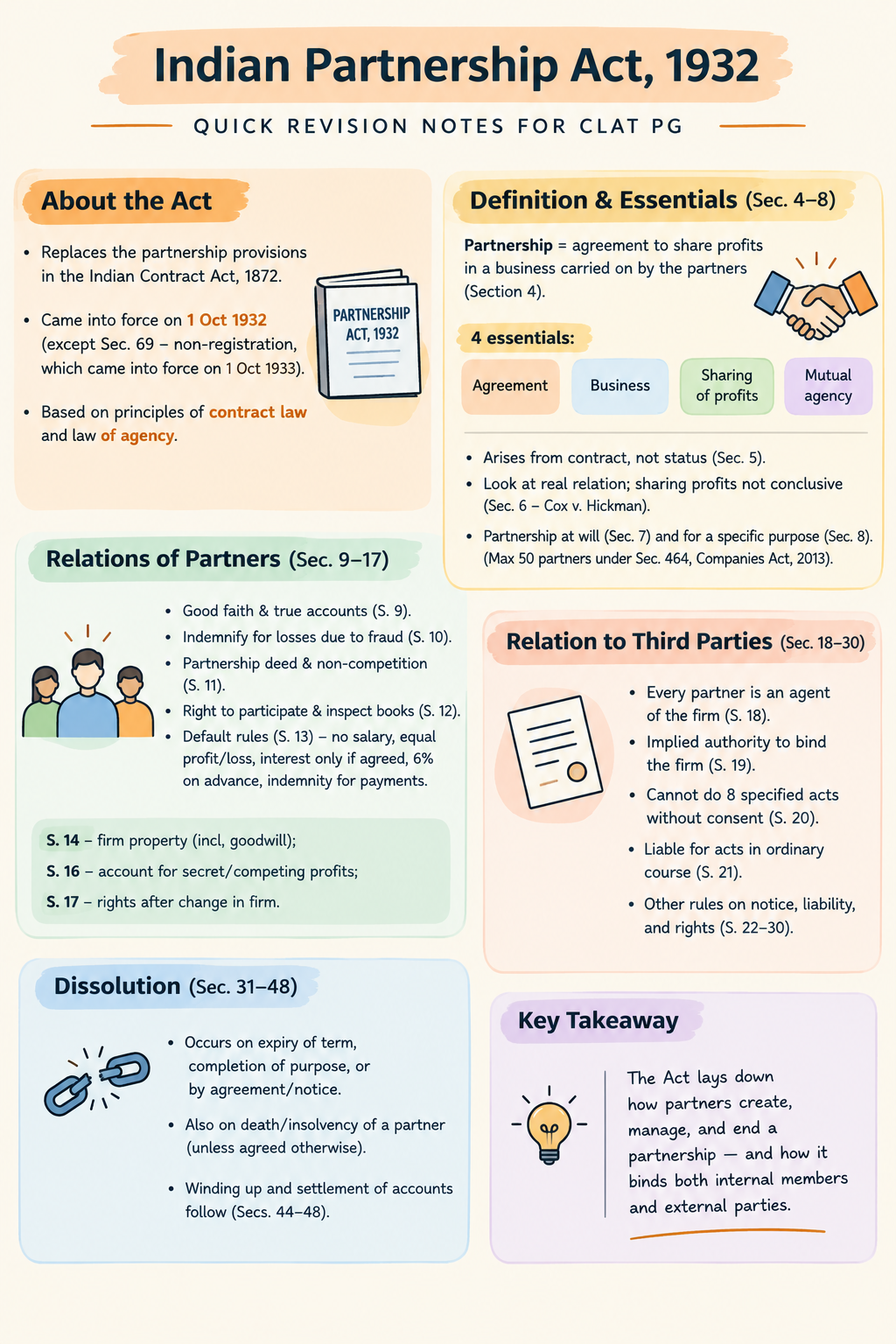
The Indian Partnership Act, 1932 is the foundation of law regarding the partnership. It has replaced the Chapter concerning Partnership in the Indian Contract Act, 1872. It was implemented on October 1, 1932, with the exception of Section 69 regarding non-registration, which came into force on October 1, 1933.
The law is based on the principles of contract law and the law of agency, as these two are closely related to each other.
Definition and Essentials: Sections 4 to 8 Indian Partnership Act, 1932
Partnership is defined in Section 4. It states that Partnership is the relationship between parties who have agreed to share the profits in a business carried on by the partners independently. Such partners may be referred to as partners.
The partnership definition entails four basic elements: an agreement, a business, sharing of profits, and mutual agency.
Section 5 states that partnership arises from contract and not from status. Hence members of a Hindu undivided family do not become partners merely by being joint family members.
Section 6 directs the court to look at the real relation between the parties, and sharing profits is not conclusive proof of partnership, as Cox v. Hickman held. Mutual agency is the stronger test - whether the business is carried on by persons acting as agents for each other.
Section 7 states about the partnership at will, i.e. the partnership without a specific duration, and Section 8 discusses a specific partnership which exists for a particular purpose. Under Section 464 of the Companies Act, 2013, the number of partners is limited to 50 on the grounds of the provisions contained in that Act.
Relations of Partners: Sections 9 to 17 Indian Partnership Act, 1932
Section 9 deals with the good faith of partners, the need of making true accounts and providing complete information. Section 10, on the other hand, lays down the requirement of a partner indemnifying the firm for any loss suffered due to his cheating.
Section 11 mentions the possibility of determining the rights and obligations of the partners by means of the partnership deed as well as restricting the partners from engaging in competition with each other during the time the partnership continues.
Section 12 gives every partner the right to take part in the business and to inspect the books. Ordinary differences are decided by majority, but a change in the nature of the business needs everyone’s consent. Section 13 lays down the default rules when the deed is silent:
- A partner gets no salary or remuneration for taking part in the business.
- Profits are shared equally, and losses are borne in the same proportion.
- Interest on capital is payable only if agreed, and it comes out of profits.
- Interest on a partner’s advance beyond his capital is payable at 6 percent per annum.
- The firm indemnifies a partner for payments made in the ordinary and proper conduct of the business.
Section 14 treats all property brought in or acquired for the firm, including goodwill, as firm property. Section 16 forces a partner to account for secret profits made from firm transactions, and for profits from a competing business he runs. Section 17 deals with rights after a change in the firm.
Relation to Third Parties: Sections 18 to 30 Indian Partnership Act, 1932
Section 18 makes every partner an agent of the firm for its business. Section 19 gives each partner implied authority to bind the firm by acts done in the usual way of business.
In the absence of a custom, a partner cannot do eight listed acts on the firm’s behalf. The alternatives here may include such acts as referring a dispute to arbitration, settling the dispute, abandoning his claim through withdrawing the case, acknowledging one’s liability, opening a bank account in one’s own name, disposing or acquiring the firm’s immovable property, entering into a partnership agreement.
Section 20 provisions for limiting the authority of the partners and Section 21 also grants one of the partners with the right to undertake emergency actions for protecting the firm from losses. The provisions of Section 22 refer to actions performed by a partner in accordance with the will of the firm. Section 23 states that all the partner’s declarations concerning the entities of the firm may serve as evidence for the firm. Finally Section 24 treats notice to a partner who habitually acts in the business as notice to the firm.
Section 20 allows partners to restrict this authority, and Section 21 gives a partner emergency authority to protect the firm from loss. Section 22 requires the act to be done in the firm’s name or in a way that shows an intention to bind it.
Section 23 makes a partner’s admissions about the firm’s affairs evidence against the firm, and Section 24 treats notice to a partner who habitually acts in the business as notice to the firm.
Section 25 makes partners jointly and severally liable for all acts of the firm done while they are partners. Section 26 makes the firm liable for a partner’s wrongful act done in the ordinary course of business, and Section 27 makes it liable for a partner’s misapplication of money received from a third party.
Together, these sections make the firm vicariously liable on agency principles.
Section 28 covers holding out. A person who represents himself, or knowingly lets himself be represented, as a partner becomes liable to anyone who gave credit to the firm in reliance on that representation. It works as an estoppel and does not make him a true partner.
Special Cases: Sections 29 and 30 Indian Partnership Act, 1932
Section 29 limits a transferee of a partner’s interest. The transferee cannot interfere in the management or demand accounts while the firm continues, but he is entitled to the transferor’s share of profits. On dissolution, he can claim the share of assets and an account.
Section 30 deals with minors. A minor cannot be a partner, but all partners can admit him to the benefits of the partnership. His liability is limited to his share in the firm’s property and profits. Within six months of reaching majority, or of learning that he was admitted, whichever is later, he must elect by public notice whether to become a partner. If he gives no notice, he becomes a partner.
Changes in the Firm: Sections 31 to 38 Indian Partnership Act, 1932
A new partner can join only with the consent of all partners, unless the contract says otherwise (Section 31). A partner can retire with everyone’s consent, as per an express agreement, or at will by giving notice in a partnership at will (Section 32).
A retiring partner remains liable for earlier acts, and for later acts too until public notice of his retirement is given.
Section 33 permits expulsion only by a power conferred by contract, exercised in good faith and in the interest of the firm. Section 34 makes a partner cease to be one on being adjudicated insolvent.
Section 35 excludes the estate of a deceased partner from liability for acts done after his death. Sections 36 and 37 deal with an outgoing partner’s right to carry on a competing business and to share subsequent profits.
Dissolution: Sections 39 to 55 Indian Partnership Act, 1932
Section 39 treats dissolution of the partnership between all partners as dissolution of the firm. The modes are these:
| Mode | Section | Key point |
| By agreement | 40 | All partners consent, or the contract provides for it |
| Compulsory |
Section 44 lets the court dissolve the firm where a partner is of unsound mind, permanently incapable, guilty of misconduct affecting the business, or in wilful or persistent breach of the agreement.
The same section covers transfer of a partner’s whole interest, a business that can only be run at a loss, and any case where the court thinks dissolution is just and equitable.
After dissolution, Section 45 keeps partners liable for acts done as partners until public notice is given. Section 48 fixes the order for settling accounts. Losses are met first from profits, then from capital, and finally by the partners individually in their profit-sharing ratio. The assets are applied to the debts owed to outsiders, then to partners’ advances, then to capital, and the residue goes to the partners in their profit ratio.
Section 49 gives firm creditors priority over the firm’s property and separate creditors priority over a partner’s separate property.
Section 54 allows partners to agree that no one will carry on a similar business within specified limits after dissolution, which is an exception to Section 27 of the Contract Act. Section 55 allows a partner to sell the firm’s goodwill and lets the seller compete in a limited way, but he cannot use the firm’s name.
Registration: Sections 56 to 71 Indian Partnership Act, 1932
It is not mandatory to register, but registration has its own disadvantages. To begin with, a partner cannot sue the company or other partner for enforcing his or her rights, whether under contract or statute, unless the firm is registered and the name of partner mentioned in the Register of Firms.
Furthermore, the company cannot sue other parties for enforcing any rights arising from a contract unless the company is registered. The prohibition has some exceptions as the same does not block the filing to dissolve or to have accounts before the court or can be limited in application to claims of insignificant value (not exceeding ₹100). Third parties can sue unregistered firms.
In Haldiram Bhujiawala v. Anand Kumar Deepak Kumar, the Supreme Court ruled that Sec 69(2) does not prevent the unregistered firm from enforcing statutory or common law rights, like an action of passing off.
Attempt this quiz for testing your knowledge on the Indian Partnership Act, 1932 !
Subscribe for updates
Join 10,000+ subscribers.
HA
Hanspal Bakul
Contributing author
Have a doubt about this?Ask Doubts