
Sale of Goods Act, 1930: Quick Revision Notes (CLAT PG)
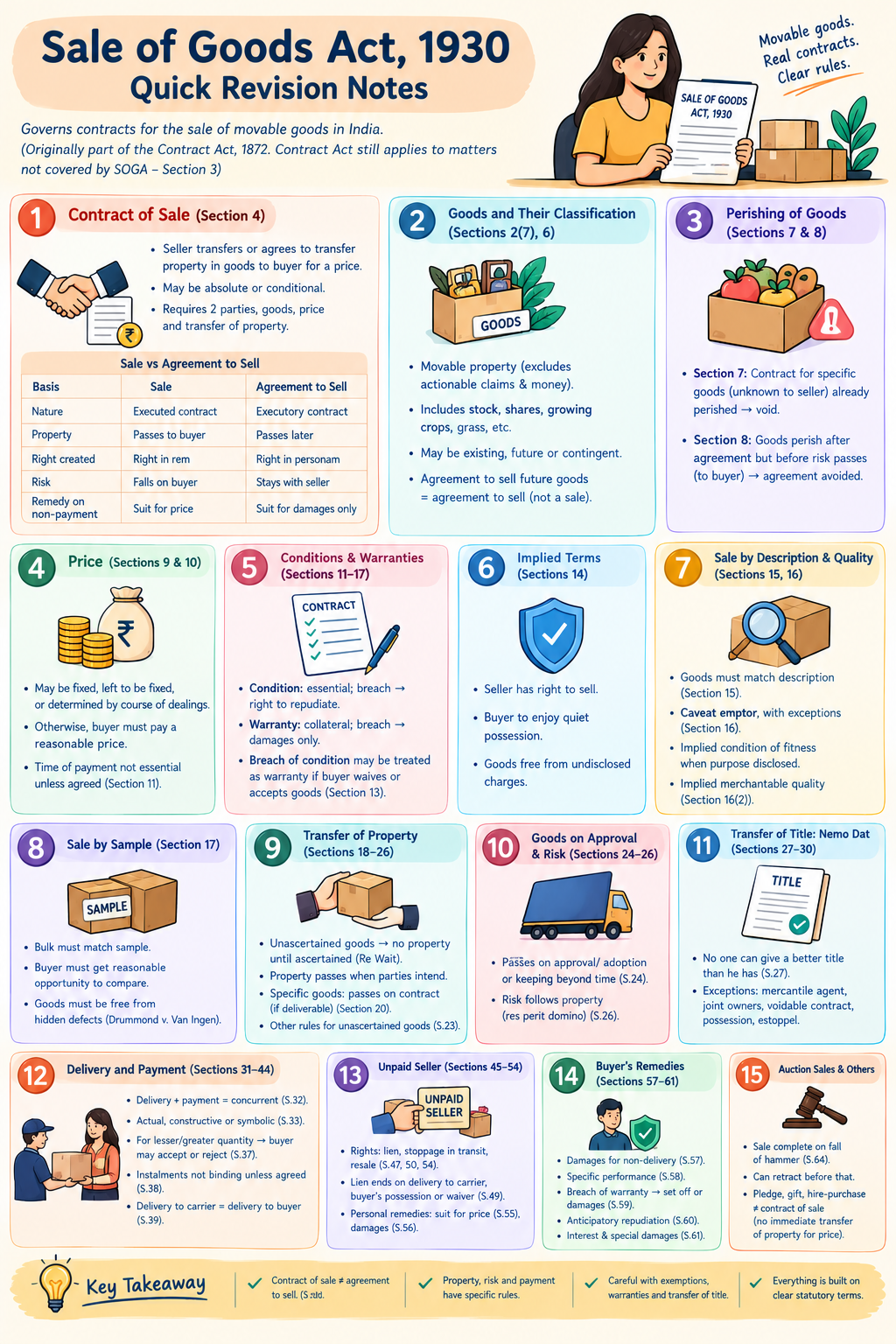
Sale of Goods Act, 1930: Quick Revision Notes cover the law that governs contracts for the sale of movable goods in India. Originally part of the Indian Contract Act, 1872, the Act was enacted separately in 1930 and the Contract Act still applies to matters SOGA does not cover (Section 3).
These notes walk through the essentials in one place: the contract of sale, conditions and warranties, transfer of property and title, the rights of the unpaid seller, and the remedies of the buyer. They are written for CLAT PG aspirants who want to revise the key sections and leading cases quickly.
Contract of Sale (Section 4 of Sale of Goods Act, 1930)
A contract of sale is one where the seller transfers or agrees to transfer the property in goods to the buyer for a price. It may be absolute or conditional. It requires two parties (seller and buyer), goods, a price in money, and transfer of property.
Under Section 4(3), where property passes at once, it is a sale. Where transfer is at a future time or on a condition, it is an agreement to sell, which becomes a sale when the time elapses or the condition is fulfilled (Section 4(4)).
| Basis | Sale | Agreement to Sell |
| Nature | Executed contract | Executory contract |
| Property |
Goods and Their Classification (Sections 2(7), 6 of Sale of Goods Act, 1930)
Goods mean every kind of movable property other than actionable claims and money. They include stock, shares, growing crops, grass, and things attached to the land that are agreed to be severed before sale.
Goods may be existing, future or contingent. Section 6(3) says an agreement to sell future goods operates as an agreement to sell, not a sale.
Perishing of Goods (Sections 7 and 8 of Sale of Goods Act, 1930)
Under Section 7, a contract for specific goods that, unknown to the seller, have already perished at the time of contract is void. Under Section 8, if specific goods perish after the agreement to sell but before the risk passes to the buyer, without fault of either party, the agreement is avoided.
Price (Sections 9 and 10 of Sale of Goods Act, 1930)
Price may be fixed by the contract, left to be fixed in a manner agreed, or determined by the course of dealings. Otherwise the buyer must pay a reasonable price. Under Section 11, time of payment is not ordinarily of the essence unless a contrary intention appears.
Conditions and Warranties (Sections 11-17 of Sale of Goods Act, 1930)
A condition is essential to the main purpose of the contract, and its breach gives the right to repudiate. A warranty is collateral to the main purpose, and its breach gives only a right to damages (Section 12).
Under Section 13, a breach of condition may be treated as a breach of warranty if the buyer waives the condition or accepts the goods. This applies to non-severable contracts once the buyer has accepted the goods.
Implied Terms as to Title (Section 14 of Sale of Goods Act, 1930)
Section 14 implies a condition that the seller has the right to sell. It also implies two warranties: that the buyer will enjoy quiet possession, and that the goods are free from any undisclosed charge or encumbrance.
In Rowland v. Divall (1923), the buyer recovered the full price because the seller had no title. The buyer had received none of what he bargained for, so there was a total failure of consideration.
Sale by Description and Quality (Sections 15, 16 of Sale of Goods Act, 1930)
Under Section 15, goods sold by description must correspond with it. Under Section 16(1), the rule is caveat emptor, subject to exceptions. Where the buyer discloses the purpose and relies on the seller’s skill or judgment, there is an implied condition of fitness.
Section 16(2) implies merchantable quality where goods are bought by description from a seller who deals in such goods. This does not extend to defects that a reasonable examination by the buyer would have revealed. Grant v. Australian Knitting Mills (1936) is the leading case.
Sale by Sample (Section 17 of Sale of Goods Act, 1930)
In a sale by sample, the bulk must correspond with the sample, and the buyer must have a reasonable opportunity to compare them. The goods must also be free from any defect not apparent on reasonable examination. Drummond v. Van Ingen (1887) is the standard authority.
Transfer of Property (Sections 18-26 of Sale of Goods Act, 1930)
Section 18 provides that where goods are unascertained, no property passes until they are ascertained. In Re Wait (1927), the buyer of 500 tons from a larger cargo got no property because the goods were never separated.
Under Section 19, property passes when the parties intend it to pass. For specific goods in a deliverable state, Section 20 says property passes when the contract is made, irrespective of when payment or delivery occurs. Section 23 deals with unascertained goods, where property passes on unconditional appropriation with the assent of the other party.
Goods on Approval and Risk (Sections 24-26 of Sale of Goods Act, 1930)
Under Section 24, goods sent on approval pass to the buyer when he signifies approval or does an act adopting the transaction. They also pass if he keeps them beyond the agreed or a reasonable time without rejecting them.
Under Section 26, risk follows property unless otherwise agreed (res perit domino). If delivery is delayed by the fault of either party, that party bears any loss that would not have occurred but for the fault.
Transfer of Title: Nemo Dat (Sections 27-30 of Sale of Goods Act, 1930)
Section 27 states the general rule that no one can give a better title than he has (nemo dat quod non habet). The exceptions rest on protecting innocent buyers.
These are sale by a mercantile agent with the owner’s consent (Section 27 proviso), sale by one of several joint owners in sole possession (Section 28), and sale by a person holding goods under a voidable contract that has not been avoided (Section 29).
They also include a seller or buyer remaining in possession after sale (Section 30), and sale by estoppel.
Delivery and Payment (Sections 31-44 of Sale of Goods Act, 1930 )
The seller must deliver and the buyer must accept and pay, and delivery and payment are concurrent conditions (Section 32). Delivery may be actual, constructive or symbolic (Section 33). If the seller delivers more or less than contracted, the buyer may accept or reject under Section 37.
Under Section 38, where goods are to be delivered by instalments, the buyer is not bound to accept delivery in instalments unless the contract so provides. Section 39 makes delivery to a carrier prima facie delivery to the buyer.
Unpaid Seller (Sections 45-54 of Sale of Goods Act, 1930 )
A seller is unpaid when the whole price has not been paid or tendered, or when a bill of exchange given for it has been dishonoured (Section 45). He has rights against the goods and against the buyer personally.
Rights against the goods are lien (Section 47), stoppage in transit when the buyer becomes insolvent (Section 50), and resale (Section 54). Lien ends if the seller delivers the goods to a carrier without reserving the right of disposal, if the buyer lawfully obtains possession, or on waiver (Section 49).
Resale and Personal Remedies of Seller
A seller may resell perishable goods, or other goods after giving notice to the buyer and waiting a reasonable time. He can recover any loss from the original buyer. A buyer on resale acquires a good title as against the original buyer (Section 54).
Personal remedies include a suit for price under Section 55, where property has passed or where price is payable on a fixed day. They also include damages for non-acceptance (Section 56).
Remedies of the Buyer (Sections 57–61 of Sale of Goods Act, 1930)
The buyer may sue for damages for non-delivery (Section 57) and for specific performance of a contract for specific or ascertained goods (Section 58). For breach of warranty, he may set up the breach against the price or sue for damages (Section 59).
Section 60 covers anticipatory repudiation by either party. Section 61 preserves the right to interest and special damages.
Auction Sales and Other Points
In an auction sale, the sale is complete on the fall of the hammer, and any bidder may retract before that (Section 64). A pledge, a gift and a hire-purchase agreement are not contracts of sale, because the property is not transferred for a price at once.
To test your knowledge for CLAT PG attempt these following tests on SOGA
All the best !
Subscribe for updates
Join 10,000+ subscribers.
HA
Hanspal Bakul
Contributing author
Have a doubt about this?Ask Doubts