
Basics of Administrative Law
Introduction
People usually come into contact with the government via an administrative office, not always through parliament or a court. For example, one may apply for a licence, admission, a welfare benefit, a passport, environmental approval or a government job. An official or organisation then reaches a decision which can have an effect on the person’s liberty, property and means of livelihood.
Administrative law asks a simple but important question: when public power is exercised over us, was it done so lawfully, fairly and reasonably?
The administration involves finding a balance between two requirements i.e. the government must retain sufficient flexibility so that it can deal rapidly with public problems, but at the same time officials should not become arbitrary or unaccountable. The article deals with the meaning, nature, extent, origins and evolution of administrative law, its connection with constitutional law, the Rule of Law, the separation of powers, parliamentary sovereignty and limited legislative power, and the various kinds of administrative action.
Meaning, Definition, Nature and Scope
There is no single definition of an administrative law. Ivor Jennings described it as the law concerned with administration. Dicey linked it to the legal status and liabilities of public officials and to the rights of citizens, and Kenneth C. Davis emphasized agency powers, procedures and judicial review.
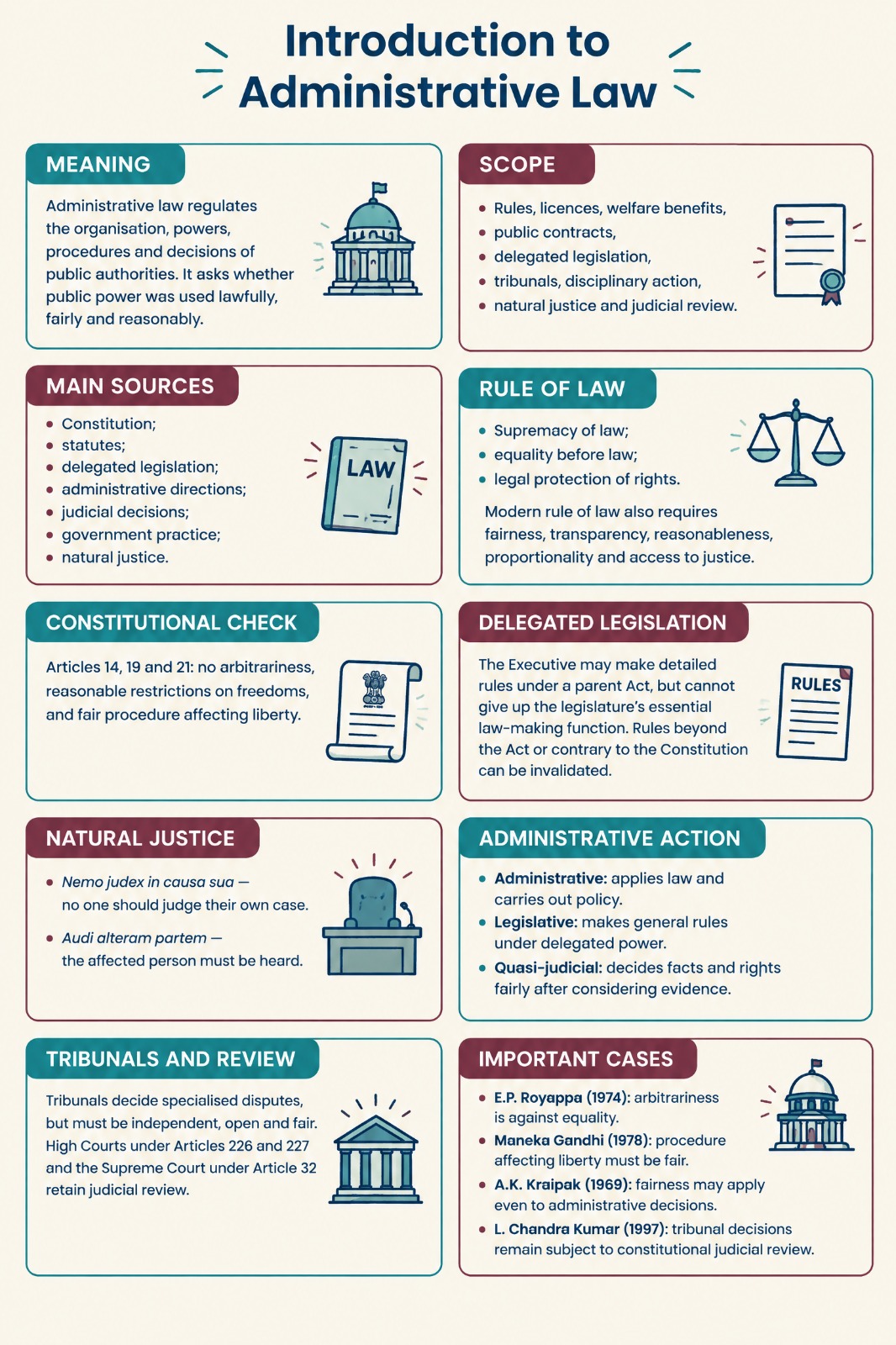
In simple terms, administrative law is the body of law which regulates the organisation, powers, procedures and decisions of public authorities. It covers the executive's power to make rules, administrative directions, licensing, public contracts, decisions concerning welfare, disciplinary action, administrative adjudication, tribunals, natural justice and judicial review.
It is primarily a section of public law since it deals with the relations between the state and individuals. In India it is mostly not set down in writing. The rules in this area are derived from the Constitution, statutes, delegated legislation, judicial rulings, governmental practice and from principles like fairness, reasonableness and natural justice.
Since India is a welfare state its scope has widened. The executive is responsible for matters relating to education, health, labour, the environment, taxation, transport, markets and technology. Legislatures are not in a position to deal with all the technical details and ordinary courts cannot quickly decide every specialised dispute. It is therefore administrative law which occupies this area while at the same time ensuring that public power remains lawful.
Origin and development in different countries
United Kingdom
The British system traditionally relied on parliamentary government and the Rule of Law. Dicey was doubtful regarding the need for a distinct administrative law since he thought that officials should usually be brought before ordinary courts. In reality, as the welfare State expanded there was an increase in delegated legislation, the number of public bodies and tribunals.
The Crown Proceedings Act of 1947 allowed civil suits to be brought against the Crown in a variety of cases, and subsequent reforms then improved the control over tribunals and administrative decisions.
United States of America
The United States established a large number of independent regulatory agencies. The Administrative Procedure Act of 1946 laid down standards for the process of making rules, for hearings, and for judicial review. American administrative law is closely linked with due process and the separation of powers.
France
France adopted a particular system known as ‘Droit Administratif ’. Instead of referring to ordinary civil courts, administrative disputes were normally settled by specialised administrative courts, particularly the Conseil d’État. This approach stressed the legality of administrative actions, focused on specialised review and maintained the distinct status of public administration.
Even though India did not fully copy the French system, the concept of specialised tribunals and administrative justice shows that it was influenced by France.
India
Administration had already been organised in the ancient kingdoms of India, but it was during the period of British rule that modern administrative law emerged and it was afterwards that it expanded. Since the Constitution established a welfare-oriented and democratic state, the duties of the government had increased considerably. In response to this, the courts developed the principles of judicial review, natural justice, legitimate expectation, proportionality and remedies by means of Articles 32 and 226.
Sources of administrative law
The main sources are the Constitution, the Acts passed by Parliament and the State Legislatures, delegated legislation including rules and regulations, administrative directions and circulars, judicial precedents, government conventions, and the principles of natural justice. International standards and comparative public law can also be used to assist with interpretation, particularly in cases where they uphold dignity and fairness.
Delegated legislation refers to rules which are made by the Executive on the basis of powers granted by an act of Parliament. It is advantageous since experts can look after the details, but the original Act has to set out the boundaries. In the case of In re Delhi Laws Act (1951), the Supreme Court agreed that it was possible to delegate decisions regarding minor matters but stated that the legislature cannot give up its fundamental legislative function. If delegated rules go beyond the scope of the parent Act, breach the Constitution, are arbitrary or have been drawn up without observing the required procedure, they can be invalidated.
Administrative Law and Constitutional Law
Constitutional law forms the wider framework of the state since it sets up various institutions, divides up the powers, safeguards the basic rights and establishes the fundamental structure of government, while administrative law is more directly involved with the everyday operations and control of public authorities.
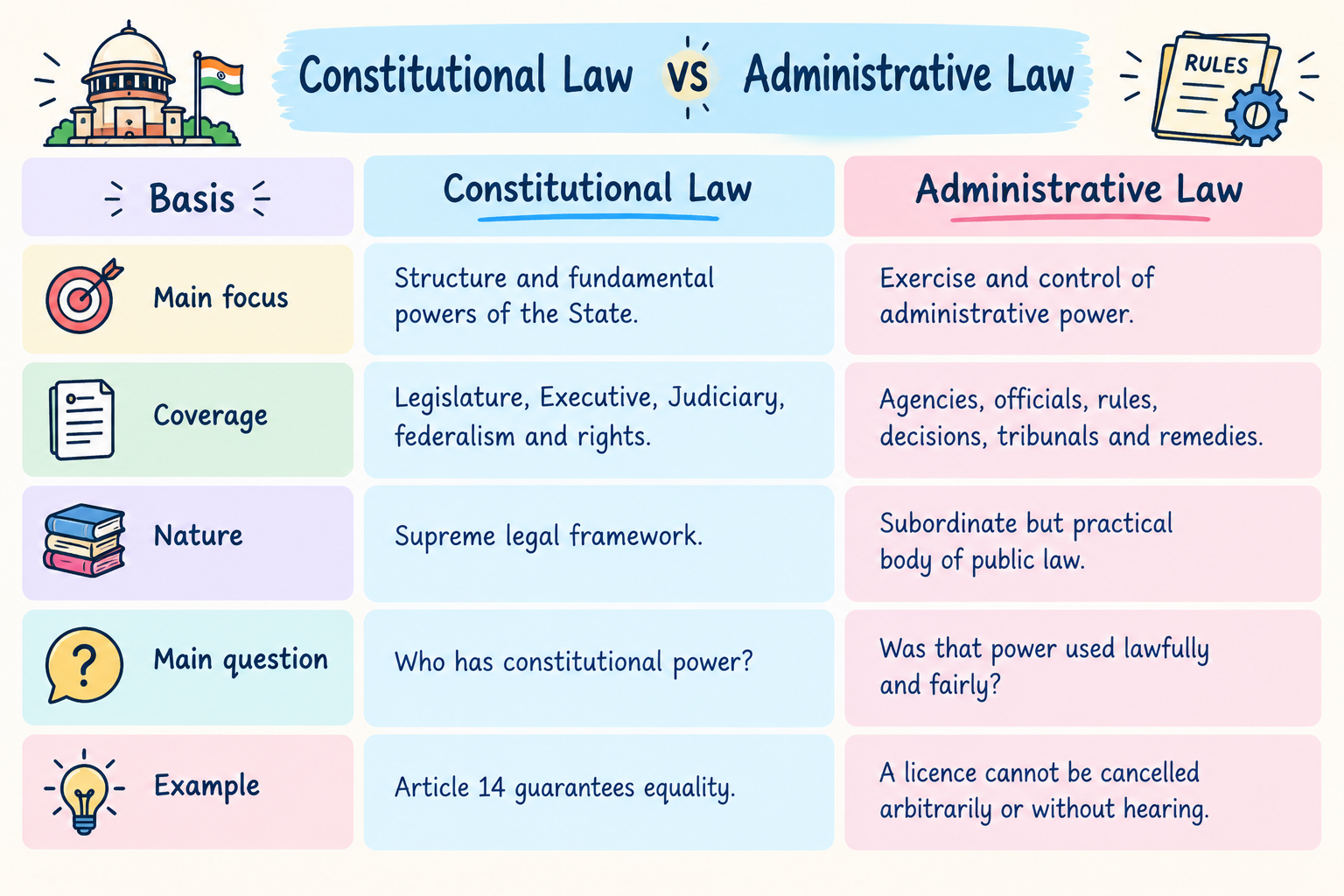
There is an overlap between the two. Administrative action is required to be in accordance with the Constitution; in the case of Ram Jawaya Kapur v. State of Punjab (1955) the Supreme Court stated that India does not adhere to a rigid separation of powers but that the functions of the government are clearly distinguished and that no one body can take on the fundamental functions of another.
Rule of Law
Dicey’s concept and its evaluation
The three components of A.V. Dicey’s classical rule of law were as follows-
- the supremacy of law, which means that no one can be punished save by means of law,
- equality before the law, which means that both officials and citizens are subject to the ordinary courts,
- and the predominance of the legal spirit, which means that rights are protected by means of judicial decisions.
Dicey’s model was valuable since it stood against arbitrary government, but it did have some limitations. It underestimated the role of delegated legislation, tribunals, and the particular requirements of a welfare state. It is not always possible to control modern administration merely through ordinary courts. However, the main point still remains strong i.e. public power must have legal authority and must be subject to review.
Modern Rule of Law and India
The modern concept involves legality, equality, fairness, transparency, reasonable decisions, access to justice and proportionality. In India, Articles 14, 19 and 21 discusses these principles. Article 14 guards against arbitrariness, Article 19 safeguards freedoms provided that reasonable restrictions are imposed and Article 21 calls for a fair procedure.
In the cases of E.P. Royappa v. State of Tamil Nadu (1974) and Maneka Gandhi v. Union of India (1978) the Supreme Court made it clear that arbitrariness is incompatible with the principle of equality and that any procedure which affects liberty must be fair. It is therefore the rule of law which serves as the fundamental check on administrative discretion.
Separation of Powers and checks and balances
The notion goes back to Aristotle but is in its present form linked with Montesquieu, who in ‘The Spirit of the Laws’ stated that legislative, executive and judicial powers should not all be held in the same hands since it serves to protect liberty.
In the United States there is a greater degree of separation of institutions. Congress is responsible for making laws, the President for carrying them out and the courts for interpreting them. The system of checks and balances is exercised through the President's power of veto, legislative oversight, the Senate's approval of appointments and judicial review.
The principle of parliamentary sovereignty holds in the United Kingdom. Since the Executive is generally made up of members of Parliament, separation of powers is not strict and accountability is primarily political and also enhanced by judicial review.
India follows a balanced method. The Union and the States are given executive power by Articles 53 and 154, legislatures are set up by Articles 79 and 168, and Articles 124 and 214 establish the Supreme Court and the High Courts. However, the Constitution does not set up completely separate sections. A certain degree of overlap is necessary, but the basic structure, judicial review and the limits of the institutions cannot be abolished. The case of Kesavananda Bharati v. State of Kerala (1973) acknowledged separation of powers and judicial review as important constitutional principles.
Parliamentary sovereignty and limited legislative power
The UK Parliament has traditionally been sovereign since it has the power to pass or repeal any law and courts usually cannot invalidate an Act of Parliament. Control is provided by political accountability and constitutional conventions.
The United States adheres to the principle of limited government. Congress is restricted by the written Constitution and the courts have the power to declare laws unconstitutional. Judicial review was introduced in the case of Marbury v. Madison in 1803.
India combines a parliamentary system of government with the principle of constitutional supremacy. Although Parliament has the authority to pass laws, its powers are restricted by the Fundamental Rights, the federal distribution of powers, the procedural requirements and the basic structure doctrine. In the case of Minerva Mills v. Union of India (1980) the Supreme Court ruled that both the limited power to amend the Constitution and judicial review form part of the Constitution’s basic structure.
Classification of administrative action
Executive or administrative functions
The powers involved in applying the law and carrying out public policy include issuing licences, collecting tax, making appointments, granting benefits or keeping public services running. In the case of a ministerial function there is little room for choice since the law specifies exactly what has to be done, whereas a discretionary function enables an authority to choose from among the lawful options. Discretion is not equivalent to personal freedom and must be exercised for the appropriate purpose, based on the relevant facts and without bias.
Legislative and quasi-legislative functions
A body is carrying out a legislative function whenever it establishes general rules, regulations, bye-laws or schemes under the power which has been delegated to it. Such rules apply to a group of people and not merely to one particular dispute. Administrative directions are instructions or guidelines given by departments, they may assist officials but cannot override the Constitution, any statute or binding rules unless the relevant law allows them to have legal effect.
Courts regulate delegated legislation by means of the principles of ultra vires and excessive delegation. Ultra Vires means 'beyond legal power', and where the parent Act requires it, the procedures of consultation, publication and legislative laying must also be followed.
Judicial and quasi-judicial functions
A body is said to have a judicial or quasi-judicial function when it establishes facts and rights after having examined the evidence and applied the relevant legal standards. This applies for example to disciplinary authorities, tax authorities and regulatory tribunals. Although a quasi-judicial body does not have to be a regular court it is necessary for it to act fairly.
The principles of natural justice include nemo judex in causa sua, which means that no one should act as a judge in a case where they have a personal interest, and audi alteram partem, which requires that the other side be heard. In the case of A.K. Kraipak v. Union of India (1969) the Supreme Court stated that the distinction between administrative and quasi-judicial action is very fine and that fairness may therefore be necessary even in the case of administrative decisions.
The case of L. Chandra Kumar v. Union of India (1997) ruled that tribunals may deal with specialised matters, but the powers of judicial review of the High Courts under Articles 226 and 227 and that of the Supreme Court under Article 32 cannot be entirely removed.
Tribunals and administrative justice
Tribunals are bodies which have been set up for the purpose of settling specific disputes, frequently employing technical knowledge and a simpler form of procedure. Although they can lessen the workload on the courts, it is essential that they are independent, that appointments to them are fair, that the procedures are open and that there is judicial oversight. Administrative justice has no meaning unless the tribunal is accessible, impartial and able to provide an effective remedy.
Conclusion
Administrative law acts as a link between the commitments set out in the constitution and the day-to-day activities of government. It enables the administration to operate efficiently at the same time as requiring that all powers must have a legal basis and that any person who is affected must be treated fairly.
Together, the Rule of Law, the separation of powers, natural justice, judicial review and constitutional rights stop the modern administrative state from becoming an arbitrary one.
Subscribe for updates
Join 10,000+ subscribers.
JU
Julie Nigam
Contributing author
Have a doubt about this?Ask Doubts
