
Landmark Cases on Hindu Law (PART 1): Marriage, Divorce & Maintenance
Family law remains a high-yield area for CLAT PG, and the Hindu Marriage Act draws examiners back to the same set of judgments every year. This piece walks through seven Landmark cases on Hindu Law that shaped marriage, divorce, and maintenance law in India. Each case carries its facts, the issues the Court framed, and the judgment with its underlying reasoning.
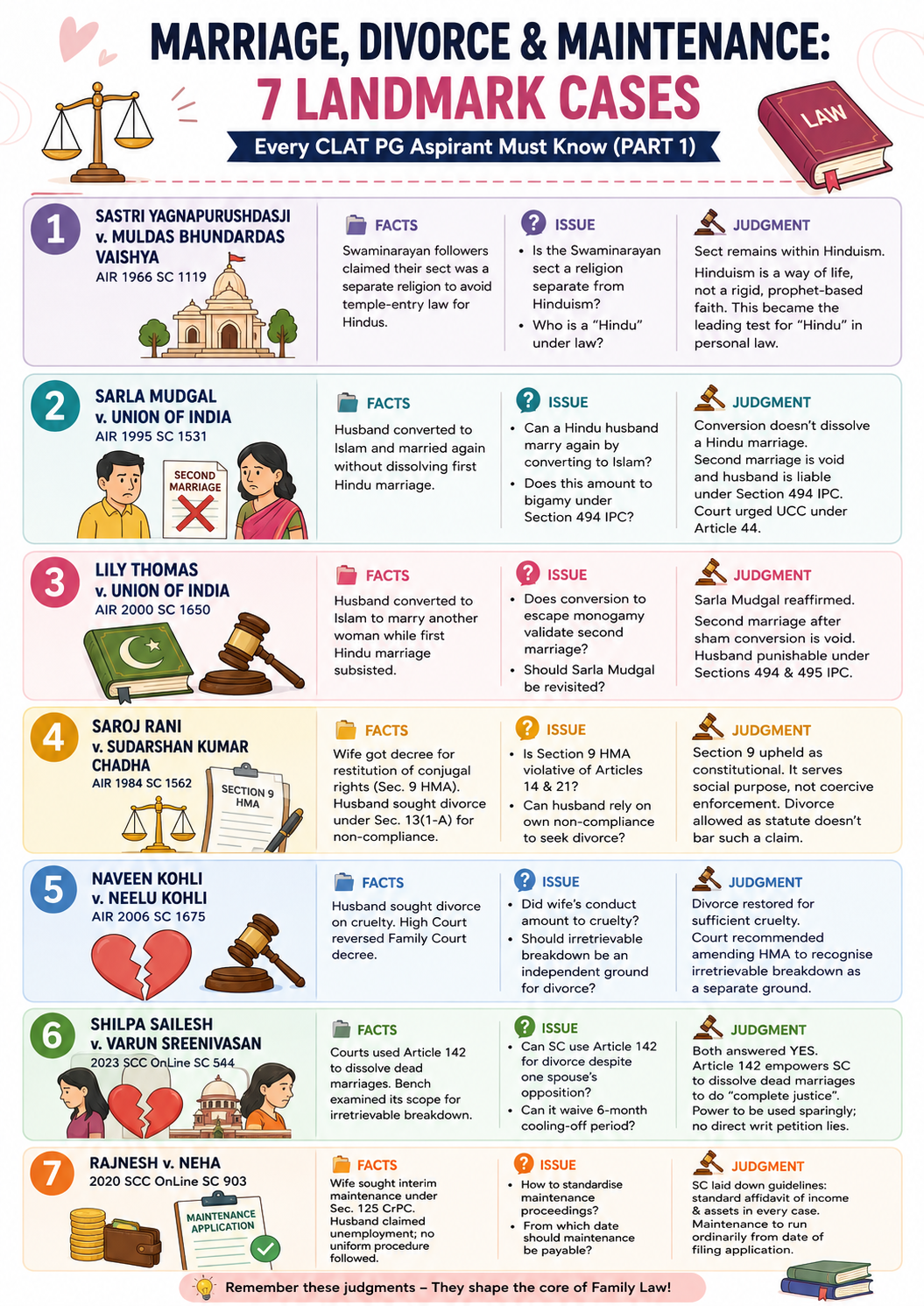
1. Sastri Yagnapurushdasji v. Muldas Bhundardas Vaishya AIR 1966 SC 1119
Facts: Followers of the Swaminarayan sect, calling themselves Satsangis, sued to keep their temples outside the Bombay Hindu Places of Public Worship (Entry Authorisation) Act, 1956. They argued that Swaminarayan worship formed a religion distinct from Hinduism, so the temple-entry law for Hindus should not apply to them.
Issues:
- Does the Swaminarayan sect qualify as a religion separate from Hinduism?
- Who counts as a "Hindu" under Hindu law and connected legislation?
Judgment: The Supreme Court held that Swaminarayan followers remain Hindus, since the sect shares Hindu philosophy, scriptures, and practices. Importantly, the Court described Hinduism as a way of life rather than a rigid, prophet-based faith, and this reasoning became the go-to test for defining "Hindu" in later personal law disputes.
2. Sarla Mudgal v. Union of India AIR 1995 SC 1531
Facts: Four petitions were clubbed together. In the lead case, Meena Mathur discovered that her husband, Jitender Mathur, had converted to Islam and married a second wife, Sunita Narula, without dissolving his first Hindu marriage. Other petitioners narrated similar patterns of conversion used to bypass monogamy under Hindu law.
Issues:
- Can a Hindu husband solemnise a valid second marriage merely by converting to Islam?
- Does such conversion, done without dissolving the first marriage, amount to bigamy under Section 494 IPC?
Judgment: The Court ruled that conversion alone does not dissolve a subsisting Hindu marriage. Therefore, the second marriage remains void, and the husband becomes liable under Section 494 IPC. The bench went further and urged the government to work toward a Uniform Civil Code under Article 44.
3. Lily Thomas v. Union of India AIR 2000 SC 1650
Facts: Sushmita Ghosh's husband converted to Islam to marry another woman while their Hindu marriage still subsisted. She challenged this conversion-driven second marriage, and the case tested whether the Sarla Mudgal principle needed reconsideration.
Issues:
- Does converting to Islam purely to escape the monogamy rule under Hindu law validate a second marriage?
- Should Sarla Mudgal be revisited or overruled?
Judgment: The Supreme Court reaffirmed Sarla Mudgal in full. It held that a second marriage contracted after a sham conversion, without real change in faith, stays void, and the husband remains punishable under Sections 494 and 495 IPC. This decision closed the door on using religious conversion as a bigamy loophole.
4. Saroj Rani v. Sudarshan Kumar Chadha AIR 1984 SC 1562
Facts: Saroj Rani obtained a consent decree for restitution of conjugal rights under Section 9 of the Hindu Marriage Act after her husband allegedly threw her out. When cohabitation did not resume within a year, the husband sought divorce under Section 13(1-A), citing non-compliance with that very decree.
Issues:
- Does Section 9 of the Hindu Marriage Act violate Articles 14 and 21 of the Constitution?
- Can a husband who consented to the restitution decree later rely on his own non-compliance to seek divorce?
Judgment: The Supreme Court upheld Section 9 as constitutional, overturning the Andhra Pradesh High Court's contrary view in T. Sareetha.
It reasoned that restitution serves the social purpose of preserving marriage and does not amount to coercive sexual enforcement. The Court also allowed the divorce, since the statute does not bar a consenting party from later invoking Section 13(1-A).
5. Naveen Kohli v. Neelu Kohli AIR 2006 SC 1675
Facts: Naveen Kohli sought divorce from Neelu Kohli, citing years of cruelty, including repeated criminal complaints and public humiliation. The Family Court granted divorce, but the Allahabad High Court reversed this on appeal, prompting Naveen to approach the Supreme Court.
Issues:
- Did the wife's conduct amount to cruelty under Section 13(1)(i-a) of the Hindu Marriage Act?
- Should irretrievable breakdown of marriage function as an independent ground for divorce?
Judgment: The Supreme Court restored the divorce decree, finding sufficient cruelty on record. Beyond that, it recommended that Parliament amend the Hindu Marriage Act to recognise irretrievable breakdown as a distinct statutory ground, since forcing estranged couples to remain legally married serves no purpose.
6. Shilpa Sailesh v. Varun Sreenivasan 2023 SCC OnLine SC 544
Facts: This matter began as a transfer petition and grew into a reference before a Constitution Bench, after courts repeatedly used Article 142 to dissolve dead marriages. The bench examined whether the Supreme Court could grant divorce on irretrievable breakdown even without both spouses consenting.
Issues:
- Can the Supreme Court invoke Article 142 to grant divorce on irretrievable breakdown despite one spouse's opposition?
- Can it also waive the six-month cooling-off period under Section 13-B(2) of the Hindu Marriage Act?
Judgment: The Constitution Bench answered both questions affirmatively.
It held that Article 142 empowers the Court to dissolve an emotionally dead marriage to do "complete justice," even where the Hindu Marriage Act provides no such ground, while cautioning that this power must be used sparingly and only after weighing the objecting spouse's interests.
It also clarified that litigants cannot approach the Supreme Court directly via a writ petition to claim this as a matter of right.
7. Rajnesh v. Neha 2020 SCC OnLine SC 903
Facts: Neha filed for interim maintenance for herself and her minor son under Section 125 CrPC. Rajnesh resisted payment, claiming unemployment, while the courts below relied on outdated income records to fix the amount, exposing the lack of a uniform maintenance procedure.
Issues:
- How should courts standardise maintenance proceedings across overlapping personal laws and statutes?
- From which date should maintenance become payable?
Judgment: The Supreme Court laid down comprehensive guidelines, directing parties to file a standard affidavit disclosing income and assets in every maintenance case. It further held that maintenance must ordinarily run from the date the application gets filed, not from the date of the final order, closing a long-standing gap in enforcement.
Get case-law updates weekly
Join 10,000+ subscribers.
HA
Hanspal Bakul
Contributing author
Have a doubt about this judgment?Ask Doubts
