
Top Judgments of January 2025
Introduction
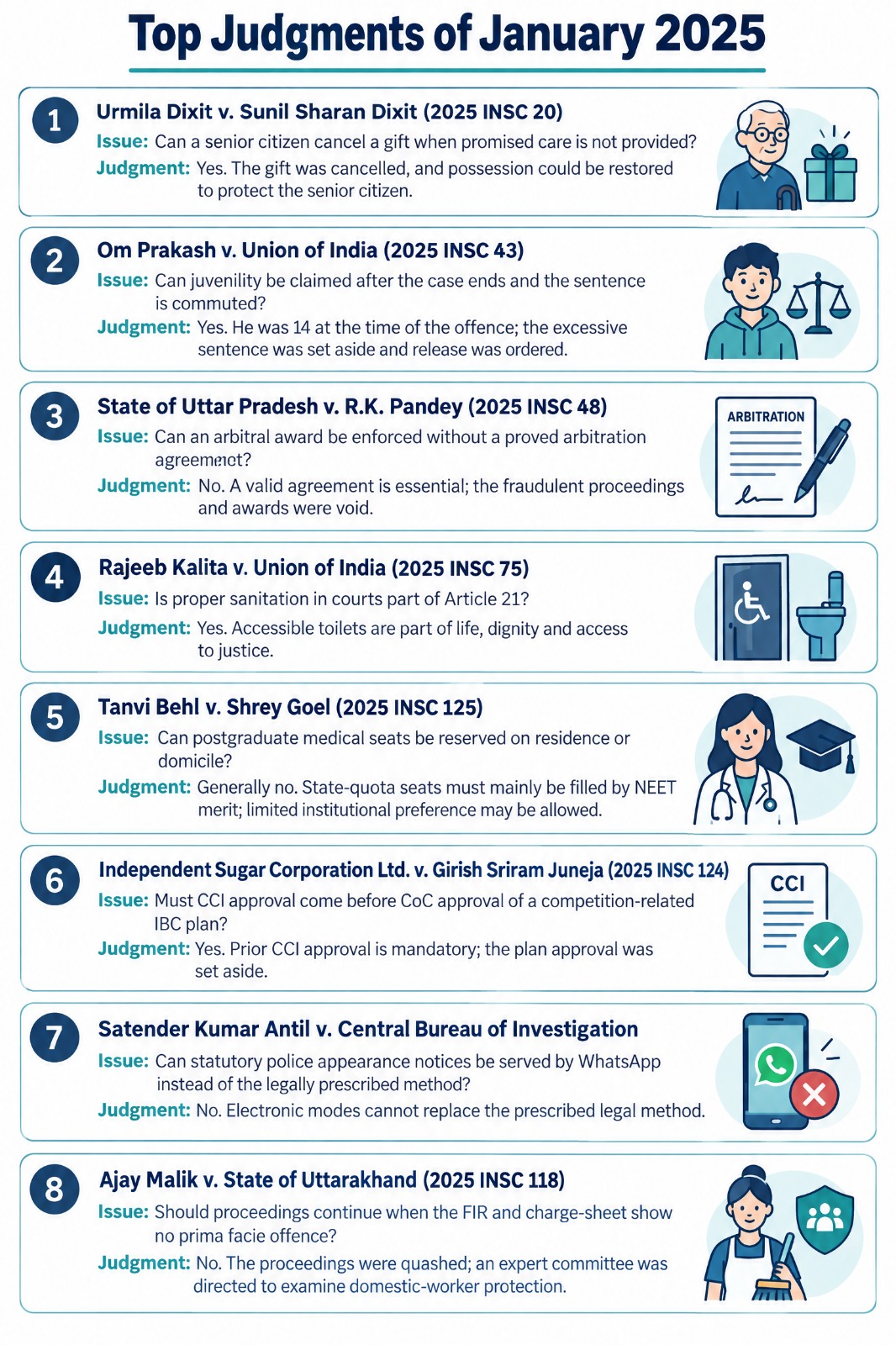
January 2025 brought important rulings on juvenile justice, senior-citizen rights, sanitation, arbitration, medical admissions, insolvency and domestic workers. They show how constitutional values work with statutory rules. This article includes the top judgments of the Supreme Court from the year 2025 of January month.
1. Urmila Dixit v. Sunil Sharan Dixit (2025 INSC 20)
Facts
- Urmila Dixit gifted her property to her son subject to his obligation to maintain her.
- The son allegedly failed to take care of her which led to the cancellation of gift deed under Section 23 of the Maintenance and Welfare of the Parents and Senior Citizens Act, 2007.
- SDM cancelled the gift deed and the Collector dismissed the son’s appeal.
- The single bench of the high court upheld these orders , but the High Court Division Bench reversed that order.
- Hence, Urmila appealed to the supreme court seeking the restoration of cancellation of the gift deed.
Issue
Could a gift made by a senior citizen be cancelled when the transferee failed to provide the promised care? Could the authority under Section 23 also restore possession to the senior citizen?
Judgment
The Supreme Court allowed the mother’s appeal and restored the cancellation of the gift deed. It applied the two conditions explained in Sudesh Chhikara v. Ramti Devi:
- the transfer must carry a condition of providing basic amenities and physical needs, and
- the transferee must fail or refuse to provide them.
The Court gave the Act a purposive interpretation and confirmed that the tribunal can order eviction or restore possession to protect a senior citizen.
2. Om Prakash v. Union of India (2025 INSC 43)
Facts
- Om Prakash was convicted for a 1994 offence and sentenced to death as at the time of trial his age was recorded 20 years though he was 14 years old.
- His appeals, curative petitions, review petitions were all dismissed but later his death sentence was commuted to life imprisonment following a mercy petition to the president.
- After spending nearly 25 years in custody, the school records stated that he was minor i.e. 14 years old at the time of commitment of offence.
Issue
Can a claim of juvenility be raised even after the criminal case has ended and a sentence has been commuted? What is the correct approach to determining the accused’s age?
Judgment
The Supreme Court held that the claim could be considered under Section 9(2) of the Juvenile Justice (Care and Protection of Children) Act, 2015, even after final disposal of the case. It found that Om Prakash was 14 years old when the offence was committed. His Section 313 Crpc, statement and the existence of a bank account could not be treated as reliable proof that he was an adult.
The Court maintained the conviction but set aside the sentence beyond the limit permitted under juvenile-justice law and ordered his release, unless required in another case. It also directed the State Legal Services Authority to assist with rehabilitation, livelihood and shelter. The ruling shows that juvenile law prioritises rehabilitation and correction of grave injustice.
3. State of Uttar Pradesh v. R.K. Pandey (2025 INSC 48)
Facts
- R.K. Pandey was a technician at a kanpur hospital transferred to state services, who retired in 1997 after 42 years of service. He claimed the retirement age of 60 and initiated litigation. Alongside the court proceedings, he unilaterally appointed arbitrators and invoked an unverified, non-existent 1957 arbitration agreement.
- He relied on an alleged arbitration agreement and obtained two ex parte awards of more than Rs. 46 lakh against the State. The State disputed the agreement, which was absent from official records, and challenged the unilateral appointment of arbitrators. Lower courts treated the objections as time-barred.
Issue
Can an arbitral award be enforced when the arbitration agreement itself is not proved? Can limitation rules protect an award that is a nullity because the proceedings lacked jurisdiction?
Judgment
The Supreme Court set aside both awards. It held that a valid arbitration agreement is the foundation of arbitration and a condition for enforcing an award. The alleged agreement was not properly authenticated, was not reflected in official records and was not signed by the person who relied upon it.
The Court found the proceedings sham and affected by fraud and lack of jurisdiction. The awards were null and unenforceable. The case is useful for party autonomy, fraud, natural justice and unilateral appointment of arbitrators.
4. Rajeeb Kalita v. Union of India (2025 INSC 75)
Facts
- The petitioner had complained that courts and tribunals premises did not have clean, accessible and maintained toilets. Even they lack the facilities for women, transgender persons and persons with disabilities.
- The majority of judicial complexes do not have accommodations for persons with disabilities (PwDs). They failed to follow statutory guidelines requiring wheelchair access, support bars, and ramps. He connected sanitation with dignity and access to justice.
Issue
Is access to proper sanitation in courts and tribunals part of the right to life and dignity under Article 21? What directions can the Court issue when such facilities are missing?
Judgment
The Court held that toilets are not merely a matter of convenience. Proper sanitation is a basic human-rights requirement and forms part of Article 21. The Court also referred to the State’s responsibilities under Articles 47 and 48A.
It directed High Courts and governments to provide separate, accessible facilities and prepare plans covering surveys, maintenance, ramps, sanitary facilities and grievance systems. The case illustrates structural PIL directions.
5. Tanvi Behl v. Shrey Goel (2025 INSC 125)
Fact
A dispute arose over Chandigarh’s reservation of postgraduate medical seats for candidates linked to the region by residence, schooling or parental property. The High Court invalidated the criteria and directed merit-based admissions.
Issue
Can a State or Union Territory reserve postgraduate medical seats on the basis of residence or domicile? How should State-quota seats be filled?
Judgment
The three-judge Bench held that residence-based reservation in postgraduate medical courses violates Article 14. It reaffirmed that postgraduate medical education requires a strong focus on merit and national access.
Institutional preference may be permitted in a limited form, but the remaining State-quota seats must be filled on the basis of merit in the NEET examination. The Court said India has one domicile i.e Indian domicile, not separate legal domiciles for States. Existing admissions were protected, but the residence rule was unconstitutional.
6. Independent Sugar Corporation Ltd. v. Girish Sriram Juneja (2025 INSC 124)
Facts
- Hindustan National Glass and Industries Ltd. (HNGIL), a major player in the glass packing sector, underwent the Corporate Insolvency Resolution Process (CIRP) under the Insolvency and Bankruptcy Code (IBC).
- AGI Greenpac Ltd. the second largest player in the same market and Independent Sugar Corporation Ltd. (INSCO) submitted competing resolution plans to acquire HNGIL.
- As AGI Greenpac proposed an acquisition requiring Competition Commission of India (CCI) approval.
- The Committee of Creditors (CoC) approved the plan before that approval. National Company Law Appellate Tribunal (NCLAT) treated the timing requirement as directory.
Issue
Under Section 31(4) of the Insolvency and Bankruptcy Code, must CCI approval be obtained before the Committee of Creditors approves a resolution plan involving a competition-law combination?
Judgment
By a 2:1 majority, the Supreme Court held that prior CCI approval is mandatory. It set aside the CoC approval of AGI’s plan and directed reconsideration of the eligible plans.
The Court stressed that one cannot avoid competition scrutiny by going into insolvency proceedings. This case is important for the issue of mandatory versus directory provisions and the relationship between the IBC and Competition Act.
7. Satender Kumar Antil v. Central Bureau of Investigation
Fact
- The case originated from the landmark 2022 Satender Kumar Antil judgment, where the supreme court issued comprehensive guidelines to prevent arbitrary arrests and streamline bail procedures across India. The court kept the matter active as a ‘continuous mandamus’ case to monitor whether police forces comply with the mandatory guidelines of arrest.
- The issue brought up before the court was about the growing practice of police forces serving Section 41-A CrPC and Section 35 BNSS arrest notices via WhatsApp, email, and other electronic media rather than physical delivery.
- The petitioner highlighted that electronic delivery lacked official verification and proper safeguards, creating a risk where individuals could be arrested for ‘non-compliance’ without ever properly receiving the notice.
Issue
Can statutory notices requiring a person to appear before the police be served through electronic modes when the CrPC or BNSS prescribes a particular method of service?
Judgment
The Court directed States and Union Territories not to treat WhatsApp or other electronic methods as substitutes for the modes prescribed by law. The same approach was applied to related notices under the CrPC and BNSS. The Court also required compliance committees and regular reports from High Courts.
The order is useful for personal liberty, statutory procedure, the CrPC–BNSS transition and continuing judicial monitoring.
8. Ajay Malik v. State of Uttarakhand (2025 INSC 118)
Facts
An appellant, named Ajay Malik is a DRDO scientist residing in Dehradun, hired a Scheduled Tribe woman as a domestic worker. She was brought to Uttarakhand through a Delhi-based placement agency.
An FIR was filed against Ajay Malik and alleged wrongful confinement, trafficking, forced labour and conspiracy. The employer argued that the record disclosed none of these offences. Malik approached the Uttrakhand high court to get the criminal proceedings quashed, but the high court rejected his petition. Hence he appealed to the supreme court.
Issue
Should the criminal proceedings be quashed under Section 482 of the CrPC when the FIR and chargesheet do not establish a prima facie offence? What legal protection is available to domestic workers?
Judgment
The Supreme Court quashed the proceedings against the employer. It found no prima facie case of wrongful confinement, trafficking or conspiracy. The Court clarified that although trafficking is a non-compoundable offence, proceedings can still be quashed when continuing them would amount to an abuse of process.
Separately, using Article 142, the Court directed the Union Government to constitute an expert committee to examine a legal framework for domestic workers. The case is important for Section 482, the prima facie standard and protection of vulnerable workers.
Conclusion
January 2025 judgments show the Supreme Court combining constitutional protection with close statutory interpretation. The Court protected a juvenile from an unlawful sentence, restored property to a neglected senior citizen and treated sanitation as part of dignity under Article 21. It also insisted on a valid arbitration agreement, merit in postgraduate medical admissions and prior competition approval in insolvency matters.
Get case-law updates weekly
Join 10,000+ subscribers.
JU
Julie Nigam
Contributing author
Have a doubt about this judgment?Ask Doubts
