
Top Supreme Court Judgments: October 2026 for CLAT PG
JU
Julie Nigam6 min readOctober 2026 Supreme Court judgments
What happens when a person spends six years in jail because of a weak investigation? Can children’s access to the internet be protected without shutting them out of the digital world? Can a court intervene during an election, and when does a tribunal exceed its review power? These questions were addressed by the supreme court in seven important judgments of October 2026. This article covers these October 2026 Supreme Court judgments. They cover criminal justice, constitutional rights, elections, digital rights, service law, electricity tariffs and income-tax law.
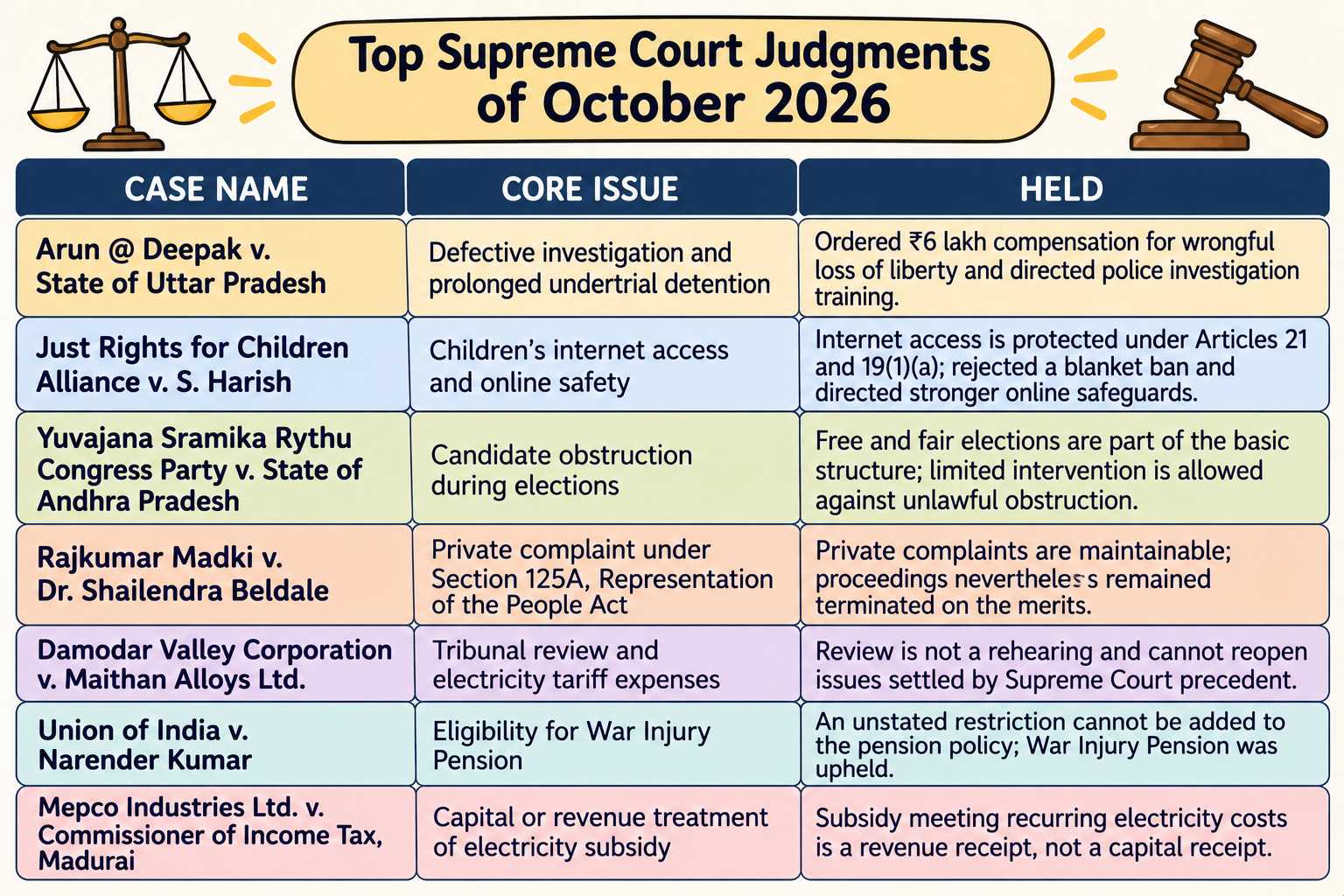
1. Arun @ Deepak v. State of Uttar Pradesh
Date: 26 October 2026
Citation: 2026 INSC 1150
Area: Criminal Law, Defective Investigation and Compensation for Loss of Liberty
Facts
- Arun was arrested in an Agra kidnapping and murder case on 14 November 2019 and remained an undertrial for around six years.
- His name did not appear in the FIR or in the relevant Section 161 statement.
- The prosecution relied on CCTV footage, an alleged confession by a co-accused and the recovery of charred bones.
Issue
Whether the Supreme Court should address the serious investigative and evidentiary failures that caused prolonged undertrial incarceration and whether the State should compensate the accused for the loss of liberty.
Judgment
The Bench of Justices J.B. Pardiwala and K. Vinod Chandran criticised the investigation as careless and the prosecution case as based on conjecture. It held that the electronic evidence was not properly proved, the recovery did not satisfy the requirements of the discovery rule and the prosecution failed to establish a reliable link between Arun and the alleged crime.
The Court directed Uttar Pradesh (state) to pay ₹6 lakh compensation within one month. If payment was delayed, interest at 18% per annum would apply. It also directed that the judgment be sent to the Director General of Police and the Home Secretary so that investigating officers could receive proper training.
2. Just Rights for Children Alliance v. S. Harish
Date: 15 October 2026
Citation: 2026 INSC 1149
Area: Fundamental rights, Children and Internet Access
Facts
- The case concerned the circulation of child sexual exploitation and abuse material through online platforms.
- The Court considered whether children should be kept away from the internet to protect them from online exploitation.
- It examined the responsibilities of intermediaries, including hash-matching, URL blocking, reporting and grievance redressal.
Issue
Whether protecting children from online exploitation justified a blanket restriction on their access to the internet, or whether a more targeted regulatory system was required.
Judgment
The Supreme Court held that access to and use of the internet is a fundamental right protected through Article 21 read with Article 19(1)(a). Children also enjoy this protection. The Court rejected a blanket internet ban because the internet is important for education, communication, information and expression.
At the same time, the Court did not ignore online harm. It directed stronger systems for identifying and removing harmful material, including perceptual hash-matching, verified URL lists, a National Hash and URL List Database, better reporting mechanisms and safeguards against wrongful removal. The Union was directed to frame suitable guidelines and consider amendments to the existing legal framework.
3. Yuvajana Sramika Rythu Congress Party v. State of Andhra Pradesh
Date: 21 October 2026
Area: Election law and Judicial Review
Facts
- YSRCP alleged that violence, intimidation and obstruction prevented its candidates from filing nomination papers for local-body elections in Andhra Pradesh.
- The party placed representations, supporting material and video evidence before the Court.
- Article 243ZA gives the State Election Commission control over municipal elections.
Issue
Whether constitutional courts must remain completely inactive once an election process has begun, even where violence or coercion may have denied candidates a fair opportunity to contest.
Judgment
The Bench of Justices Joymalya Bagchi and V. Mohana held that free and fair elections are part of the basic structure of the Constitution. The right to file nomination papers without unlawful obstruction is an important part of that process.
The Court recognised the need for judicial restraint because election authorities must be allowed to complete the process. However, this restraint does not prevent limited intervention where unconstitutional or illegal conduct may have polluted the election. Instead, it directed the State Election Commission to assess the complaints, give affected candidates an opportunity to file where justified and improve security and CCTV arrangements at nomination centres.
4. Rajkumar Madki v. Dr. Shailendra Beldale
Date: 16 October 2026
Citation: 2026 INSC 1138
Area: Representation of the People Act and Private Complaints
Facts
- The appellant challenged the Karnataka High Court’s quashing of his private complaint.
- The complaint alleged that an elected legislator had made a false residential-address disclosure in the affidavit filed with his nomination papers.
- The allegation was made under Section 125A of the Representation of the People Act, 1951.
Issue
Whether Section 195 CrPC (section 215 BNSS) barred a private complaint alleging an offence under Section 125A of the Representation of the People Act.
Judgment
The Supreme Court held that a private complaint was maintainable. Section 125A was not included in the list of offences covered by Section 195 CrPC. The Court treated this omission as deliberate and held that the law did not require the complaint to be filed only by a public servant.
However, the Court did not restore the prosecution. The documents on record effectively rebutted the allegation and the possibility of conviction was remote. The Court therefore upheld the termination of the proceedings on the merits, though not on the High Court’s reasoning about maintainability.
5. Damodar Valley Corporation v. Maithan Alloys Ltd.
Date: 30 October 2026
Citation: 2026 INSC 1178
Area: Electricity Tariff and Review Jurisdiction
Facts
- The dispute concerned DVC’s tariff for 2009–2014.
- The issue was whether contributions to a Sinking Fund for redemption of DVC bonds could be recovered through tariff in addition to depreciation.
- APTEL had earlier upheld the tariff treatment, relying partly on the Supreme Court’s decision in Bhaskar Shrachi Alloys Ltd. v. Damodar Valley Corporation.
Issue
Whether APTEL could reopen a concluded tariff question in review and disregard a binding Supreme Court precedent.
Judgment
The Supreme Court restored APTEL’s original order. It held that the DVC Act and applicable tariff regulations permitted depreciation and the Sinking Fund contribution to be treated as recoverable expenditure. The two items did not amount to impermissible duplication.
The Court emphasised that review jurisdiction cannot be used for a fresh argument or a re-hearing of the appeal. A tribunal also cannot reopen an issue settled by the Supreme Court. Article 141 requires courts and tribunals to follow the law declared by the Supreme Court. The Court imposed costs on the concerned parties.
6. Union of India v. Narender Kumar
Date: 28 October 2026
Citation: 2026 INSC 1166
Area: Military Pension and Beneficial Interpretation
Facts
- Narender Kumar was posted at Kargil during Operation Rakshak.
- He developed seropositive rheumatoid arthritis during the posting.
- He was granted disability pension but claimed War Injury Pension under the Ministry of Defence policy.
Issue
Whether the policy permitted War Injury Pension in these circumstances and whether the Union could rely on a restriction not clearly stated in the policy.
Judgment
The Supreme Court dismissed the Union’s appeal. It held that the policy language was not restrictive and that the Court could not insert an unstated exclusion. Once an operation was covered by the relevant category, the pensionary benefit could not be denied without a clear textual basis.
The Court upheld the grant of War Injury Pension and directed the Government to clarify the scope of future notifications.
7. Mepco Industries Ltd. v. Commissioner of Income Tax, Madurai
Date: 7 October 2026
Citation: 2026 INSC 1090
Area: Income-tax law and Subsidy Classification
Facts
- Mepco Industries received an electricity subsidy from the Government of Pondicherry.
- The subsidy was calculated as a percentage of the actual electricity charges paid by the existing manufacturing unit.
- The company treated the subsidy as a capital receipt.
Issue
Is electricity subsidy a capital receipt or a taxable revenue receipt under the Income-tax Act, 1961.
Judgment
On appeal, the Supreme Court observed that such subsidy was a receipt of revenue. The court noted that the subsidy was utilized for meeting the recurring cost of power of production with effect from the commencement of production and that it was not utilized for setting up a new capital asset or for any substantial expansion of capital.
The court further emphasized that a subsidy’s origin, timing, or structure is not determinative. Its nature and substance and effect depend on the basis on which treatment should be applied to it. Normally capital refers to support for increasing capital base or capital assets and revenue refers to financial support to improve the profitability of an existing enterprise.
Subscribe for updates
Join 10,000+ subscribers.
JU
Julie Nigam
Contributing author
Have a doubt about this?Ask Doubts