Quick Revision Notes (QRN): Hindu Law
JU
Julie Nigam13 min readIntroduction: What Should Students Revise in Hindu Law?
Hindu Law questions in CLAT PG usually test statutory provisions through short factual passages. Students should therefore revise not only definitions, but also the conditions, exceptions and legal consequences attached to each concept. These Quick revision notes cover the sources of Hindu Law, marriage, void and voidable marriages, divorce, maintenance, adoption, guardianship, succession and the coparcenary rights of daughters.
The focus is on the Hindu Marriage Act, 1955, the Hindu Adoptions and Maintenance Act, 1956, the Hindu Minority and Guardianship Act, 1956 and the Hindu Succession Act, 1956. Important Supreme Court decisions are included in one-line form so that students can connect the statutory rule with its judicial interpretation.
Hindu Law quick revision notes
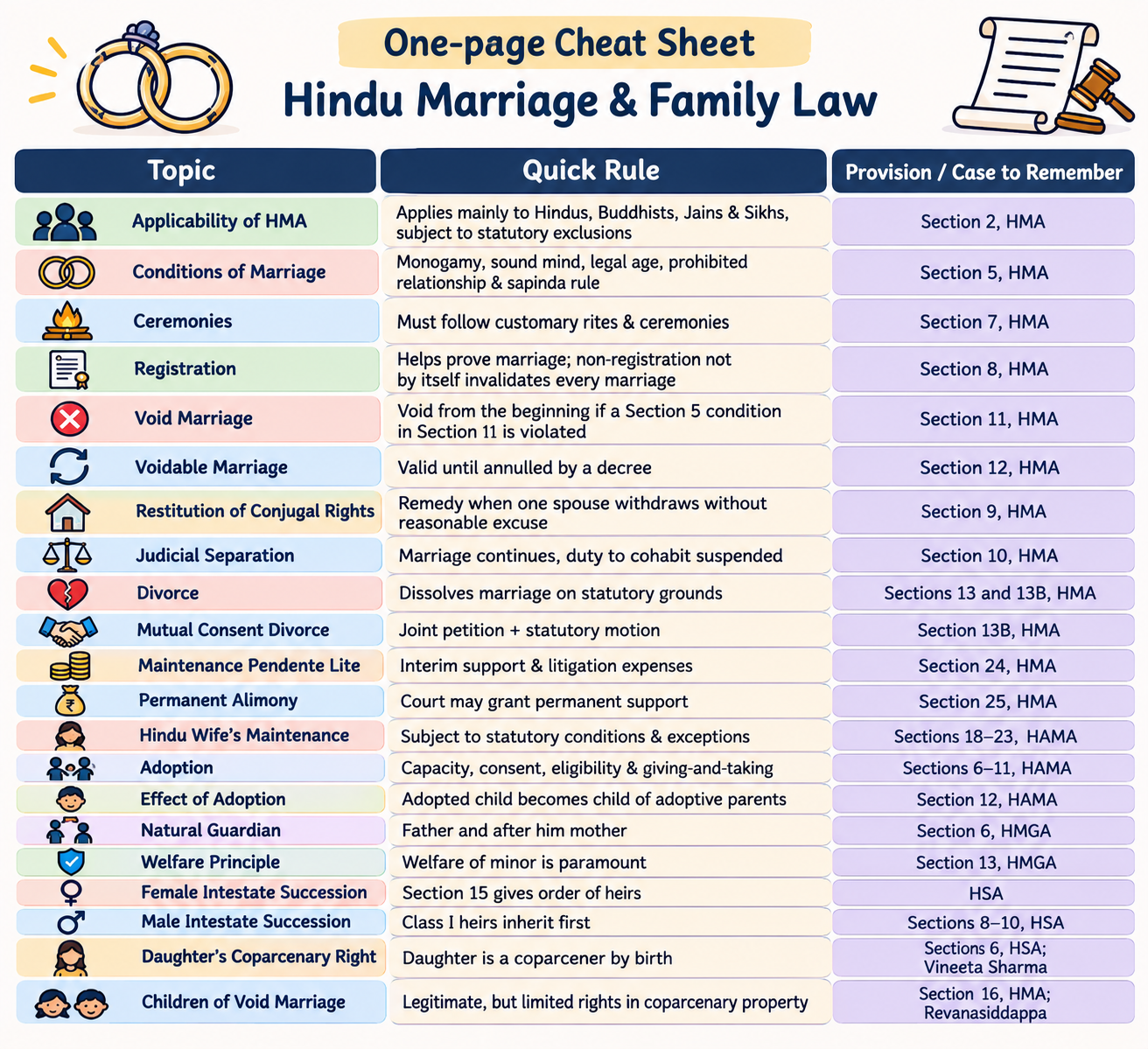
1. Sources of Hindu Law
Hindu Law comes from both ancient sources and modern legislation. For exams, divide the sources into ancient sources and modern sources.
Ancient Sources
- Shruti: the Vedas and texts regarded as revealed knowledge.
- Smriti: remembered texts such as the Manusmriti, Yajnavalkya Smriti and Narada Smriti.
- Commentaries: It consists of explanations and compilations of Smriti texts. The Mitakshara and Dayabhaga schools developed through these writings.
- Custom: a long, certain, continuous and reasonable practice accepted as binding by a community.
Modern Sources
Modern sources include judicial precedents, legislation, principles of equity and justice, and the Constitution. The main codifying statutes are:
- Hindu Marriage Act, 1955,
- Hindu Succession Act, 1956,
- Hindu Minority and Guardianship Act, 1956, and
- Hindu Adoptions and Maintenance Act, 1956.
The Constitution can invalidate a rule of personal law when it is ultra vires with a constitutional law. Where there is inconsistency as to the extent of custom statutory Hindu Law prevails over an inconsistent custom. Read the detailed Sources of Hindu Law revision note.
2. Hindu Marriage Act, 1955: Who is a Hindu?
The Hindu Marriage Act applies mainly to Hindus, Buddhists, Jains and Sikhs. It also applies to certain other persons who are not Muslim, Christian, Parsi or Jew unless the contrary is proved. The Act contains statutory rules on marriage, restitution, judicial separation, divorce and related relief.
A marriage under the Act is not only a personal or religious relationship but also it creates legal rights concerning status, maintenance, legitimacy, succession and matrimonial relief.
3. Conditions of a Valid Hindu Marriage
Section 5 of the Hindu Marriage Act lays down the main conditions:
- Neither party should have a spouse living at the time of marriage.
- The parties must be capable of giving valid consent and must not suffer from the statutory mental-condition disqualifications.
- The bridegroom must be 21 years old and the bride 18 years old.
- The parties must not be within a prohibited relationship unless a valid custom permits the marriage.
- The parties must not be sapindas of each other unless a valid custom permits the marriage.
Ceremonies under Section 7
A Hindu marriage must be solemnised according to the customary rites and ceremonies of either party. Where saptapadi is part of the ceremony, the marriage becomes complete when the seventh step is taken.
The ceremony requirement is important in cases where one party denies that a marriage took place. A photograph, social-media post or cohabitation may be evidence, but it does not always prove a legally solemnised Hindu marriage.
Registration under Section 8
Registration assists proof and helps prevent disputes about marital status. Non-registration does not automatically make every marriage void where the essential ceremony and conditions are otherwise proved. States may make registration rules, and courts have repeatedly encouraged registration.
Void and voidable marriage
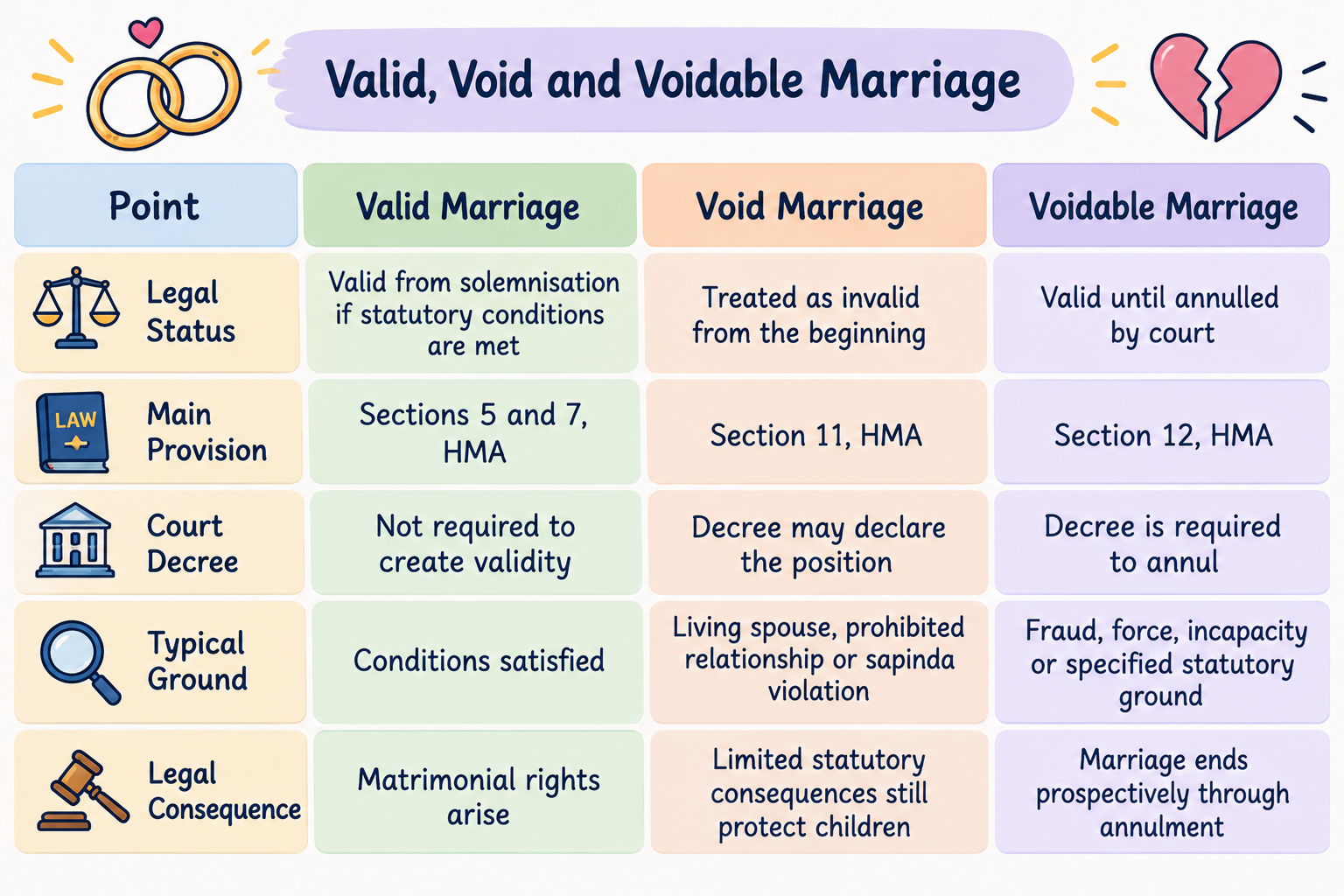
A void marriage is treated as legally invalid from the beginning. Section 11 covers marriages that breach specified conditions, including a living spouse, prohibited relationship or sapinda relationship.
A voidable marriage remains legally valid until a competent court issues a decree of annulment. Under Section 12, such a marriage can be set aside based on specific legal grounds, including -
- Lack of valid consent due to mental incapacity or unsoundness of mind.
- Consent obtained through force, coercion, or fraud.
- Non-consummation due to the impotence of the respondent.
- The respondent being pregnant by someone other than the husband at the time of marriage.
Important cases
- Bhaurao Shankar Lokhande v. State of Maharashtra: To establish the offense of bigamy, it must be legally proven that the second marriage was performed according to the vital rites and essential ceremonies required by custom or law.
- Kanwal Ram v. Himachal Pradesh Administration: In bigamy prosecutions, the prosecution must strictly prove that the subsequent marriage was validly and properly solemnized.
- Dolly Rani v. Manish Kumar Chanchal: A valid marriage under the HMA strictly requires compliance with the essentials under Section 7 such as saptapadi. A marriage certificate issued by an authority cannot validate or cure a marriage where these fundamental ceremonies were omitted.
- Seema v. Ashwani Kumar: the Supreme Court directed steps toward compulsory registration of marriages to protect spouses and children, while registration itself does not replace the essential requirements of a valid marriage.
For a full explanation, read Marriage under Hindu Law.
4. Restitution and Judicial Separation
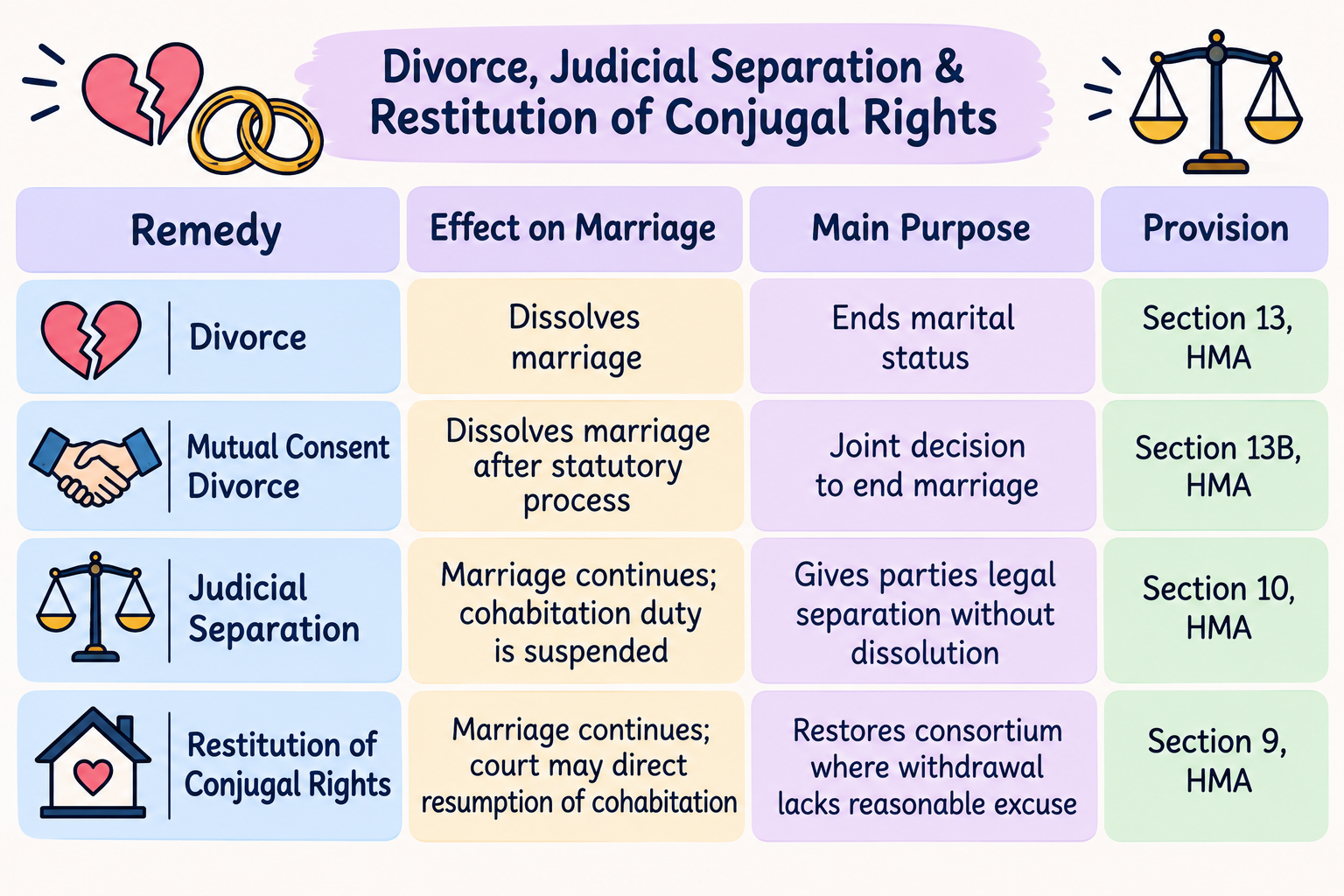
Restitution of Conjugal Rights: Section 9, HMA
When one spouse has withdrawn from the society of the other without reasonable excuse, the aggrieved spouse may seek restitution of conjugal rights. The burden is generally on the withdrawing spouse to show a reasonable excuse once withdrawal is established, subject to the court’s assessment.
The remedy has been debated because it affects privacy, dignity and personal autonomy. In T. Sareetha v. T. Venkata Subbaiah, the Andhra Pradesh High Court struck down section 9 of the Hindu marriage act, declaring it unconstitutional. Justice P.A. Choudary ruled that forcing an unwilling spouse to return to a marriage violates their fundamental rights to privacy, human dignity, and bodily autonomy. Conversely, the supreme court of India reversed this stance in Saroj Rani v. Sudarshan Kumar (1984) by upholding the constitutional validity of section 9. It held that the provision does not breach fundamental rights, instead it preserves the institution of marriage.
Judicial Separation: Section 10, HMA
Judicial separation does not dissolve the marriage. It suspends the obligation to live together. Either party may later seek divorce on the applicable statutory ground. The decree is therefore different from a divorce decree.
5. Divorce under Hindu Law
Section 13 of the HMA provides statutory grounds for divorce. Important grounds include:
- adultery,
- cruelty,
- desertion for the required period,
- conversion to another religion,
- incurable unsoundness of mind or certain mental disorders,
- communicable venereal disease in the statutory form,
- renunciation of the world by entering a religious order, and
A wife also has certain additional grounds under Section 13(2), including specified cases of the husband’s pre-existing marriage, rape, sodomy or bestiality, a maintenance decree followed by no resumption of cohabitation and repudiation of a marriage solemnised before the prescribed age.
Cruelty
Cruelty may be physical or mental. The court looks at the entire relationship, the seriousness of the conduct, its effect on the spouse and the surrounding circumstances. Ordinary wear and tear of married life is not automatically cruelty.
In Samar Ghosh v. Jaya Ghosh, the Supreme Court gave illustrative, not exhaustive, examples of mental cruelty. The decision emphasised that cruelty is fact-specific.
Desertion
Desertion requires both separation in fact and the intention to permanently abandon the marriage. A spouse may be physically absent without legally deserting the other, and a spouse living in the same house may still be guilty of constructive desertion in suitable facts.
Mutual Consent Divorce: Section 13B
The parties must jointly present a petition stating that they have lived separately for the statutory period, cannot live together and mutually agree to dissolve the marriage. The second motion and the court’s satisfaction are also relevant under the provision.
The six-month period is generally directory, not an absolute bar. In Amardeep Singh v. Harveen Kaur, the Supreme Court held that the waiting period may be waived where the statutory conditions and factors identified by the Court are satisfied.
Irretrievable Breakdown
Irretrievable breakdown is not an ordinary statutory ground available on demand before every court. The Supreme Court has used its constitutional power under Article 142 in appropriate cases to dissolve a marriage that has completely failed, while balancing the interests of both parties and the effect on children.
In the landmark case of Shilpa Sailesh v. Varun Sreenivasan (2023), a Constitution Bench ruled that the Supreme Court of India can dissolve a marriage on the ground of irretrievable breakdown by exercising its extraordinary powers under Article 142 of the constitution. The court clarified that it can grant a divorce even if one spouse does not consent, provided that the marriage has completely failed and the separation balances the interest of both parties and their children.
Read Divorce under Hindu Law for a detailed topic-wise explanation.
6. Maintenance under Hindu Law
Maintenance is intended to prevent destitution and secure a dignified standard of living. It is not a reward for good conduct or a punishment for marital failure.
Maintenance under HAMA
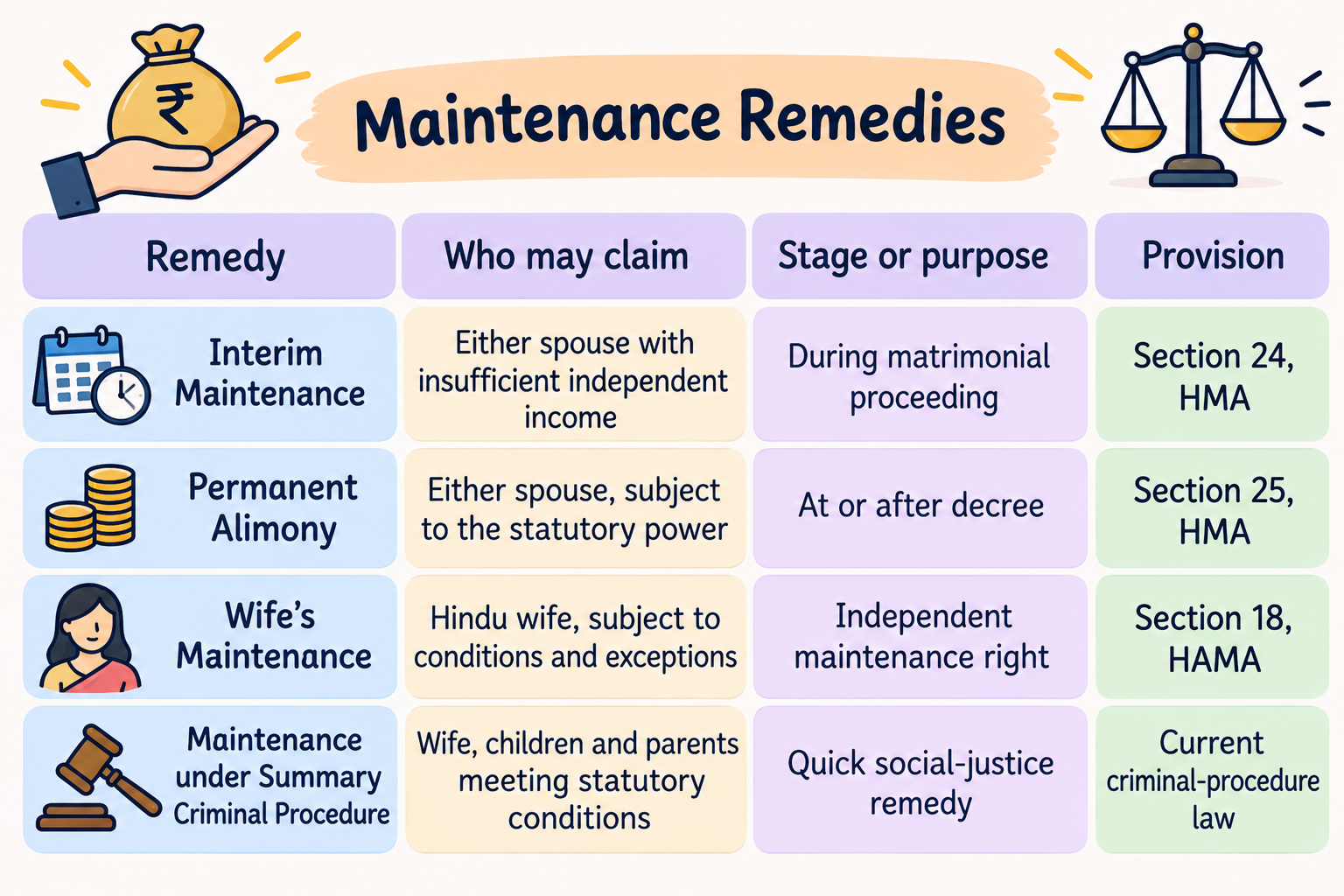
Sections 18 to 23 of the Hindu Adoptions and Maintenance Act deal with maintenance of a Hindu wife and other dependants.
A Hindu wife is entitled to maintenance during her lifetime from her husband, subject to the Act. She may live separately and still claim maintenance when statutory grounds exist, such as desertion, cruelty, another wife, conversion or another justifying circumstance. A wife may lose her right to maintenance under specific statutory conditions, such as unchastity or conversion to another religion. On the other hand a divorced wife remains eligible to claim financial support provided she does not remarry and fulfills the necessary statutory criteria.
Maintenance under HMA
It is divided under two primary sections under HMA:
- Section 24: provides interim maintenance and litigation expenses while the matrimonial case is pending in the court.
- Section 25: grants permanent alimony and maintenance at the time of the final decree or anytime thereafter.
When determining these amounts the courts must consider income, property, needs, conduct where relevant, the standard of living and other circumstances. Ultimately these maintenance provisions must be interpreted with the constitutional values of dignity and equality.
Important cases
- Vimla v. Veeraswamy: maintenance laws are social-justice measures and should receive a practical interpretation.
- Rajnesh v. Neha: laid down guidelines on disclosure of assets and liabilities, overlapping maintenance claims, the date from which maintenance may be awarded and enforcement.
- Chaturbhuj v. Sita Bai: the wife need not be completely without any income. The question is whether she can maintain herself in the manner contemplated by law.
- Bhagwan Dutt v. Kamla Devi: maintenance is designed to prevent destitution, but it is not an unlimited claim disconnected from the statutory conditions.
See Maintenance of a Hindu Wife for focused revision.
7. Adoption under HAMA, 1956
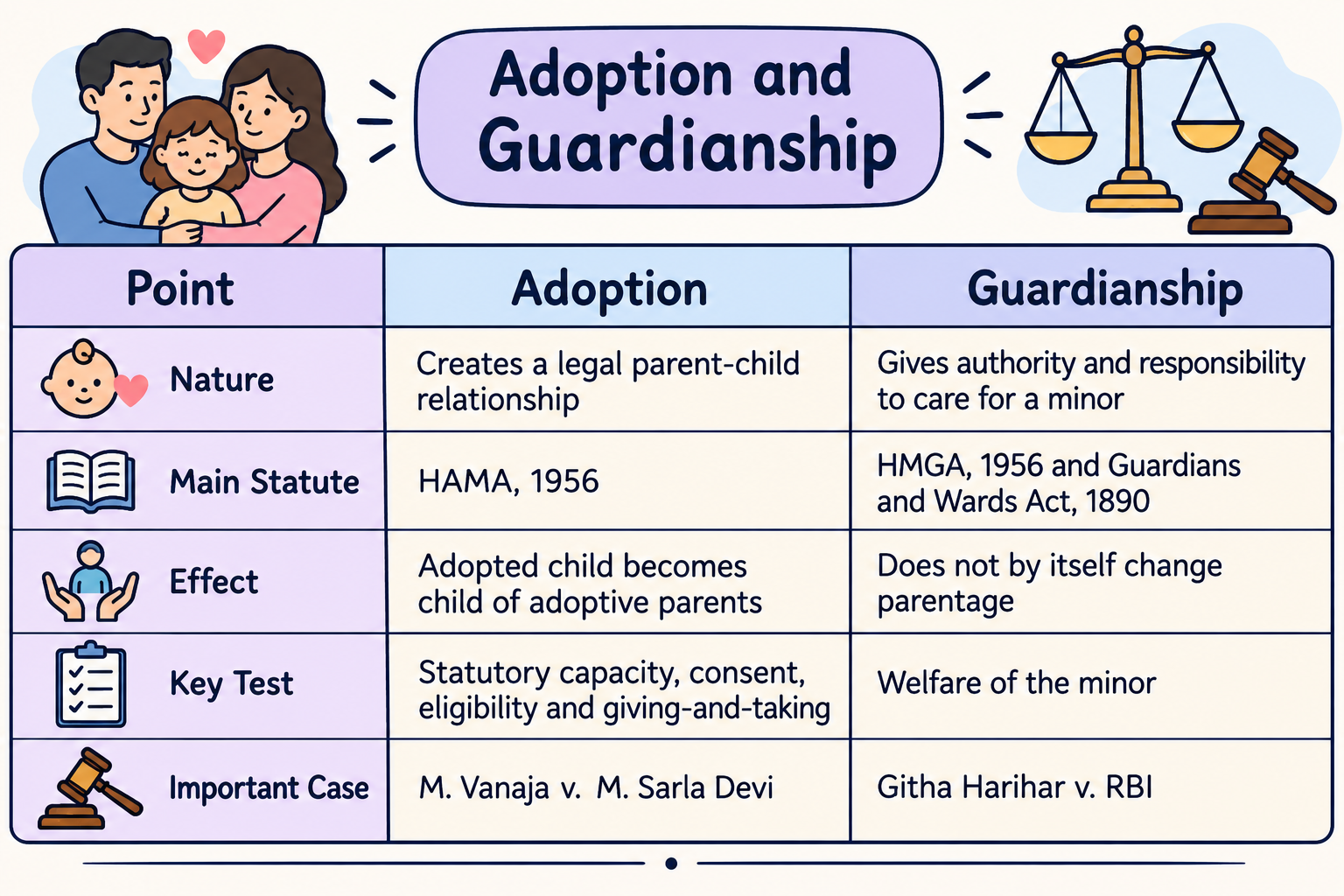
Adoption creates a legal parent-child relationship. The Hindu Adoptions and Maintenance Act applies to Hindus, Buddhists, Jains and Sikhs and to persons covered by Section 2.
Requisites of a Valid Adoption: Section 6
A valid adoption requires:
- the adopter has capacity and the right to adopt,
- the person giving the child has capacity to do so,
- the child is capable of being adopted, and
- the adoption satisfies the other statutory conditions.
Capacity to Adopt
Under Sections 7 and 8, a male or female Hindu of sound mind and not a minor may adopt, subject to the statutory conditions. A married person generally requires the consent of the spouse unless the spouse falls within the statutory exceptions.
Who may give a Child in Adoption?
The father or mother may give a child in adoption, and a guardian may do so with the court’s permission in the situations specified by the Act. The welfare of the child and the statutory consent requirements remain important.
Who may be Adopted?
Section 10 requires the child to be Hindu, not already adopted, unmarried unless custom permits otherwise and below the statutory age unless a valid custom permits adoption at an older age.
Other Conditions: Section 11
The child should not already have a living Hindu child of the same gender in the adoptive family, subject to the statutory wording. The age-gap rule applies where a male adopts a female child or a female adopts a male child. The child must be actually given and taken with the intention of transferring the child from the birth family to the adoptive family.
Section 12: Effect of Adoption
An adoption legally severs a child's ties from the biological family from the date of adoption. This fully integrates the child into the adoptive family as the natural child. However, this rule is subject to specific statutory exceptions. They are: the child cannot marry anyone they were barred from marrying within their biological family, and any property that vested in the child before the adoption remains their property.
Important Cases
- Kishori Lal v. Chaltibai: adoption must be proved through reliable evidence; the statutory requirements cannot be assumed.
- Ghisalal v. Dhapubai: consent and the other conditions of a valid adoption must be proved according to HAMA.
- M. Vanaja v. M. Sarla Devi: clarified that informal arrangements do not constitute a legal adoption, highlighting the mandatory nature of physical rituals like actual ‘giving and taking’ of the child.
- Sawan Ram v. Kala wanti & ors: reinforced these principles by explaining the overall legal effect of adoption and the relationship of an adopted child with the adoptive family.
For better understanding read Adoption under the Hindu Adoptions and Maintenance Act, 1956.
8. Guardianship and Custody
Guardianship concerns the legal authority to care for the person or property of a minor. The Hindu Minority and Guardianship Act, 1956 supplements the Guardians and Wards Act, 1890.
Natural Guardians
Section 6 recognises the natural guardians of a Hindu minor. For a legitimate boy or unmarried girl, the father and after him the mother are listed, subject to the statutory wording. For an illegitimate child, the mother and after her the father are listed. The mother is also the natural guardian of a child below five years, ordinarily.
For an adopted child, the adoptive father and after him the adoptive mother are recognised under the provision.
Welfare Principle: Section 13
The welfare of the minor is the paramount consideration. A person cannot claim guardianship as an absolute right if the arrangement harms the child. According to section 13 welfare includes physical safety, emotional well-being, education, stability and the child’s overall development.
Important cases
- Roxann Sharma v. Arun Sharma: the mother ordinarily has custody of a child below five years, subject to the welfare principle and the facts of the case.
- ABC v. State (NCT of Delhi): an unwed mother may seek guardianship without being compelled to disclose the identity of the child’s father in circumstances where that requirement would harm her privacy and the child’s welfare.
9. Hindu Succession Act: Basic Ideas
The Hindu Succession Act, 1956 governs intestate succession among Hindus and modifies several traditional rules. “Intestate” means a person dies without leaving a legally effective will for the property in question.
Coparcenary and Joint Family
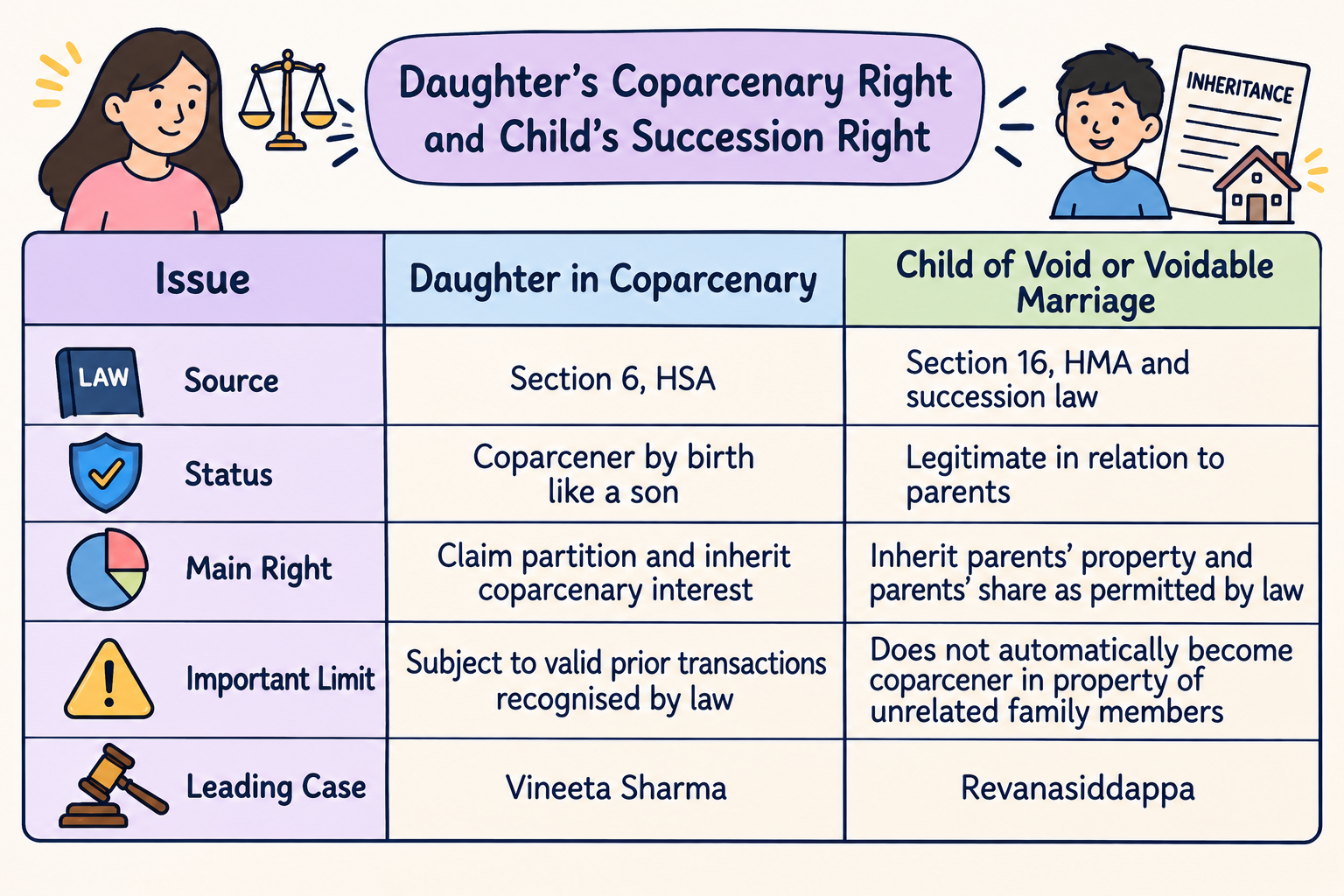
A coparcenary is a narrower body within a joint Hindu family. After the 2005 amendment, a daughter is a coparcener by birth in the same manner as a son. She has the same rights and liabilities in coparcenary property.
The amendment is not dependent on the father being alive on 9 September 2005. In Vineeta Sharma v. Rakesh Sharma, the Supreme Court clarified that the daughter’s right is by birth. The partition exception in the judgment concerns partitions legally effected before 20 December 2004 in the manner recognised by law.
Class I heirs
Class I heirs inherit first under the statutory scheme. They include the son, daughter, widow and mother, along with certain other heirs listed in the Schedule. A Class I heir excludes Class II heirs from inheriting in that succession.
Per capita and per stirpes
Class I heirs generally take simultaneously and per capita, subject to the statutory rules. When a pre-deceased son or daughter leaves children, the branch may inherit according to the scheme of representation.
Disqualifications
The Act contains statutory disqualifications, including the rule that a murderer cannot inherit the property of the person murdered or succeed to another inheritance connected with that killing. Conversion by itself does not automatically disqualify a person under the modern statutory scheme, though Section 26 addresses descendants of converts in specified circumstances.
10. Succession to a Hindu male
When a Hindu male dies intestate, Section 8 provides the order:
- Class I heirs,
- if none, Class II heirs,
- if none, agnates, and
- if none, cognates.
Class I first
The widow, son, daughter and mother are among the principal Class I heirs. A widow may include more than one widow, in which case all widows together take one share. Children of a predeceased child may represent that branch under the statutory scheme.
Class II
Class II heirs inherit only when there is no Class I heir. The Schedule lists the order of entry. An heir in an earlier entry excludes those in later entries.
Agnates and cognates
An agnate is related wholly through male links. A cognate is related but not wholly through male links. These categories matter only after Class I and Class II heirs and the statutory rules on agnates and cognates are considered.
11. Succession to a Hindu female
Section 15 provides the general order for the property of a Hindu female who dies intestate:
- sons, daughters, including children of a predeceased son or daughter, and the husband,
- heirs of the husband,
- mother and father,
- heirs of the father, and
- heirs of the mother.
Section 15(2) creates an important source-based exception. Property inherited by a female Hindu from her father or mother may return to the father’s heirs if she dies without children. Property inherited from her husband or father-in-law may go to the husband’s heirs in the statutory situation.
Section 14: Absolute Ownership
Property possessed by a female Hindu, whether acquired before or after the Act, is generally held by her as full owner and not as a limited owner. This is subject to the statutory exception for property acquired under a restricted grant or instrument.
In V. Tulasamma v. Sesha Reddy, the Supreme Court gave Section 14 a broad and remedial interpretation. A limited interest given to a woman in recognition of a pre-existing right can enlarge into absolute ownership.
Read Succession in the Case of Hindu Females for broader understanding.
12. Daughters’ Rights and Children of Void Marriages
Daughters as Coparceners
Section 6, after the 2005 amendment, places daughters on the same footing as sons in a Mitakshara coparcenary. The right in the property is acquired by birth. The daughter can claim partition and is subject to the same liabilities as a son.
In Vineeta Sharma v. Rakesh Sharma, the Supreme Court clarified that the father need not have been alive on 9 September 2005. The daughter’s right is not dependent on the father’s date of death.
Children of Void or Voidable Marriages
Section 16 of the Hindu Marriage Act protects the legitimacy of children born from void and voidable marriages. The child is treated as legitimate in relation to the parents.
The child’s right is not unlimited. Statutory scheme and judicial decisions distinguish property of the parents from property belonging to unrelated coparceners. In Revanasiddappa v. Mallikarjun, the Supreme Court held that children of void or voidable marriages are entitled to inherit the self-acquired property of their parents and their share in the parents’ interest in joint family property, but they do not automatically become coparceners in the property of other family members merely because of their legitimacy.
Important Hindu Law Judgments: One-Liners
| S. No. | Case Name | Legal Principle |
| 1. | Bhaurao Shankar Lokhande v. State of Maharashtra | Bigamy requires proof that the second marriage was validly solemnised through the essential ceremonies. |
| 2. |
For more practice, attempt CLATalogue’s Multiple Choice Questions on Hindu Law for CLAT PG and the Sectional Test on Family Law for CLAT PG. Use the CLAT PG Case Law Updates page for later Supreme Court decisions.
Subscribe for updates
Join 10,000+ subscribers.
JU
Julie Nigam
Contributing author
Have a doubt about this?Ask Doubts