Divorce under Hindu Law
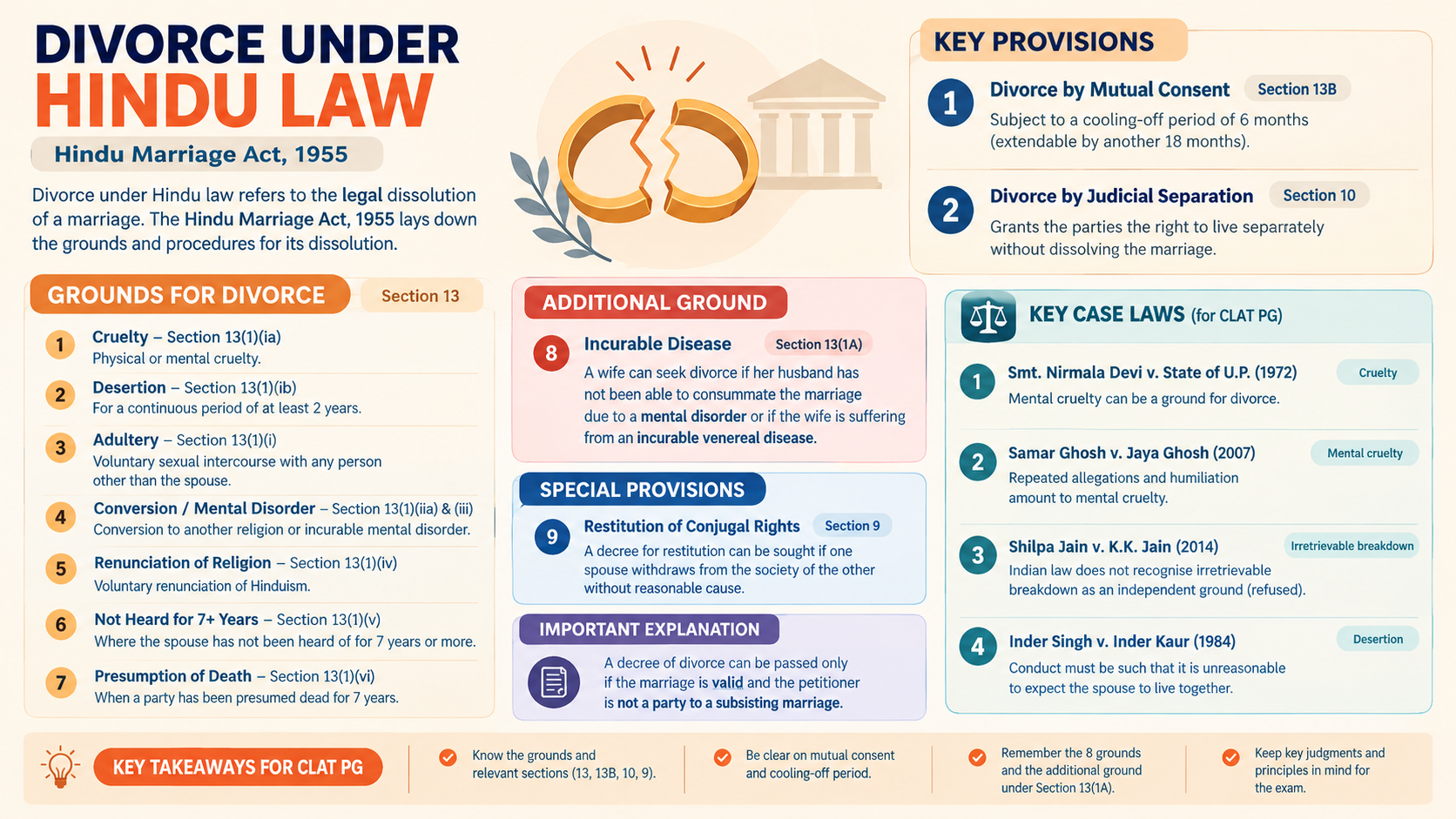
Divorce under Hindu law refers to the legal dissolution of a marriage. The Hindu Marriage Act, 1955 lays down the grounds and procedures through which a marriage may be dissolved.
Theories of Divorce
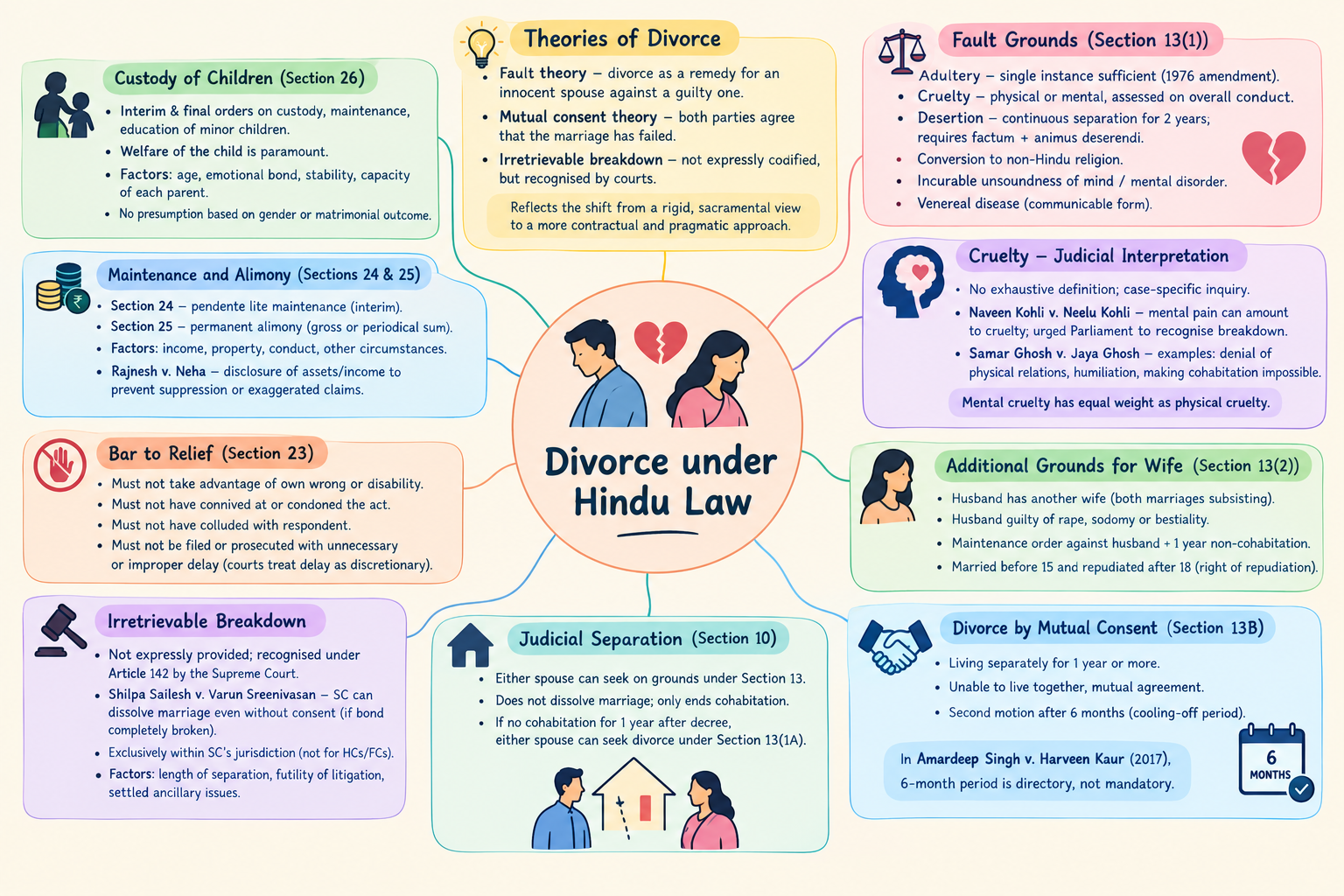
Matrimonial law recognises three principal theories governing the dissolution of marriage, and the Hindu Marriage Act, 1955 incorporates all three within its scheme.
The fault theory treats divorce as a remedy available to an innocent spouse against a guilty one who has committed a matrimonial offence such as adultery or cruelty.
The mutual consent theory treats marriage as a voluntary union that either party may equally choose to dissolve when both agree it has failed.
This layered approach reflects the gradual shift of Hindu marriage law from a rigid, sacramental conception toward a more contractual and pragmatic understanding of matrimonial breakdown.
Fault Grounds under Section 13(1)
Section 13(1) allows either husband or wife to petition for divorce on several fault-based grounds. Adultery permits divorce where the respondent has had voluntary sexual intercourse with a person other than their spouse, and the 1976 amendment removed the earlier requirement of proving repeated acts, making a single instance sufficient.
Cruelty, whether physical or mental, constitutes another ground, and courts assess it based on the cumulative conduct and its effect on the petitioner rather than any fixed catalogue of acts.
Desertion for a continuous period of not less than two years immediately preceding the petition entitles the deserted spouse to divorce, and courts examine both the factum of separation and the animus deserendi, meaning the intention to permanently abandon the matrimonial relationship.
Conversion to a non-Hindu religion, incurable unsoundness of mind or mental disorder rendering cohabitation unreasonable and venereal disease in a communicable form complete the remaining grounds under this provision.
Cruelty as a Ground: Judicial Interpretation
Courts have consistently declined to define cruelty exhaustively, preferring instead a case-specific inquiry into whether the cumulative conduct causes reasonable apprehension of harm or danger to the petitioner.
In Naveen Kohli v. Neelu Kohli, the Supreme Court held that persistent and unwarranted conduct causing mental pain and suffering can amount to cruelty even without physical violence, and it also urged Parliament to introduce irretrievable breakdown as a distinct statutory ground.
In Samar Ghosh v. Jaya Ghosh, the Supreme Court laid down illustrative, though not exhaustive, examples of mental cruelty, including sustained and unjustified denial of physical relations, persistent humiliation, and conduct that renders continued cohabitation impossible.
These rulings established that mental cruelty warrants the same weight as physical cruelty within matrimonial adjudication, and the standard remains fact-sensitive rather than formulaic.
Additional Grounds Available Only to the Wife: Section 13(2)
Section 13(2) grants certain grounds exclusively to a wife seeking divorce. She may seek divorce where her husband has another wife living at the time of the marriage, provided both marriages remain subsisting, or where the husband has been guilty of rape, sodomy, or bestiality since the marriage's solemnisation.
She may also seek divorce where a decree or order awarding maintenance has been passed against the husband despite continued non-cohabitation for one year or more, or where she was married before attaining the age of fifteen years and repudiated the marriage after attaining that age but before turning eighteen, an option known as the right of repudiation under the proviso to this section.
Divorce by Mutual Consent: Section 13B
Section 13B permits both spouses to jointly petition for divorce where they have lived separately for one year or more, are unable to live together, and mutually agree that the marriage should be dissolved.
The provision requires a second motion after a minimum interval of six months from the first motion, commonly called the cooling-off period, intended to allow the parties an opportunity for reconciliation before the divorce becomes final.
In Amardeep Singh v. Harveen Kaur, the Supreme Court held that this six-month waiting period is directory rather than mandatory, and courts may waive it where the parties have already been separated for a substantial period, all efforts at reconciliation and settlement have failed, and continuing the waiting period would only prolong their agony.
This ruling gave family courts meaningful discretion to expedite genuinely settled matters rather than mechanically enforcing the delay.
Judicial Separation: Section 10
Section 10 allows either spouse to seek judicial separation on any of the grounds available for divorce under Section 13, without immediately dissolving the marriage. A decree of judicial separation relieves the parties of the obligation to cohabit, though the marital tie itself continues to subsist, giving the parties an opportunity for reconciliation before deciding upon a final separation.
If the parties do not resume cohabitation for one year or more after such a decree, either spouse may rely on this fact as an independent ground for divorce under Section 13(1A).
Irretrievable Breakdown of Marriage
Although the Hindu Marriage Act does not expressly recognise irretrievable breakdown as a statutory ground, the Supreme Court has developed this principle through its extraordinary power under Article 142 of the Constitution to do complete justice between the parties.
In Shilpa Sailesh v. Varun Sreenivasan, a Constitution Bench held that the Supreme Court may dissolve a marriage on this ground, even absent mutual consent, where it finds the marital bond completely and irreparably broken, and where insisting on the ordinary statutory process would only cause further hardship.
The Court clarified that this power remains exclusive to the Supreme Court and does not extend to family courts or High Courts, which must continue applying the statutory grounds under Sections 13 and 13B.
The Court also laid down guiding factors for exercising this discretion, including the length of separation, the futility of continued litigation, and whether the parties have already settled ancillary issues like maintenance and custody.
Bar to Relief: Section 23
Section 23 imposes conditions that a petitioner must satisfy before a court grants any matrimonial relief, ensuring that a party cannot benefit from their own wrongdoing. The petitioner must not be taking advantage of their own wrong or disability, must not have connived at or condoned the alleged act, and must not have colluded with the respondent to obtain the decree.
The section also requires that the petition is not presented or prosecuted with unnecessary or improper delay, though courts largely treat delay as a matter of judicial discretion rather than an absolute bar.
Maintenance and Alimony: Sections 24 and 25
Section 24 empowers courts to grant maintenance pendente lite, meaning interim maintenance during the pendency of matrimonial proceedings, to a spouse who lacks independent income sufficient for support.
Section 25 provides for permanent alimony, allowing courts to order either spouse to pay a gross or periodical sum to the other, having regard to factors such as income, property, conduct, and other relevant circumstances, and this provision applies regardless of which spouse initiated the underlying petition.
The Supreme Court, in Rajnesh v. Neha, laid down comprehensive guidelines for maintenance proceedings across personal laws, directing parties to file affidavits of disclosure of assets and income to prevent both suppression of income by the paying spouse and exaggerated claims by the recipient spouse.
This judgment aimed to bring uniformity and transparency to maintenance determinations that had previously varied significantly across jurisdictions.
Custody of Children: Section 26
Section 26 empowers courts to pass interim orders regarding the custody, maintenance, and education of minor children during the pendency of matrimonial proceedings, and to make similar provisions even after passing the final decree.
Courts exercise this power guided primarily by the welfare of the child rather than the technical rights of either parent, examining factors such as the child's age, emotional bond with each parent, stability of environment, and the capacity of each parent to provide a nurturing upbringing.
This welfare principle overrides any presumption in favour of either parent based purely on gender or the outcome of the matrimonial dispute itself.
Subscribe for updates
Join 10,000+ subscribers.
HA
Hanspal Bakul
Contributing author
Have a doubt about this?Ask Doubts