Marriage under Hindu Law
Marriage under Hindu Law is a legally recognised union governed primarily by the Hindu Marriage Act, 1955, which lays down its essential conditions, ceremonies, rights, and dissolution.
Concept and Governing Law for Marriage under Hindu Law
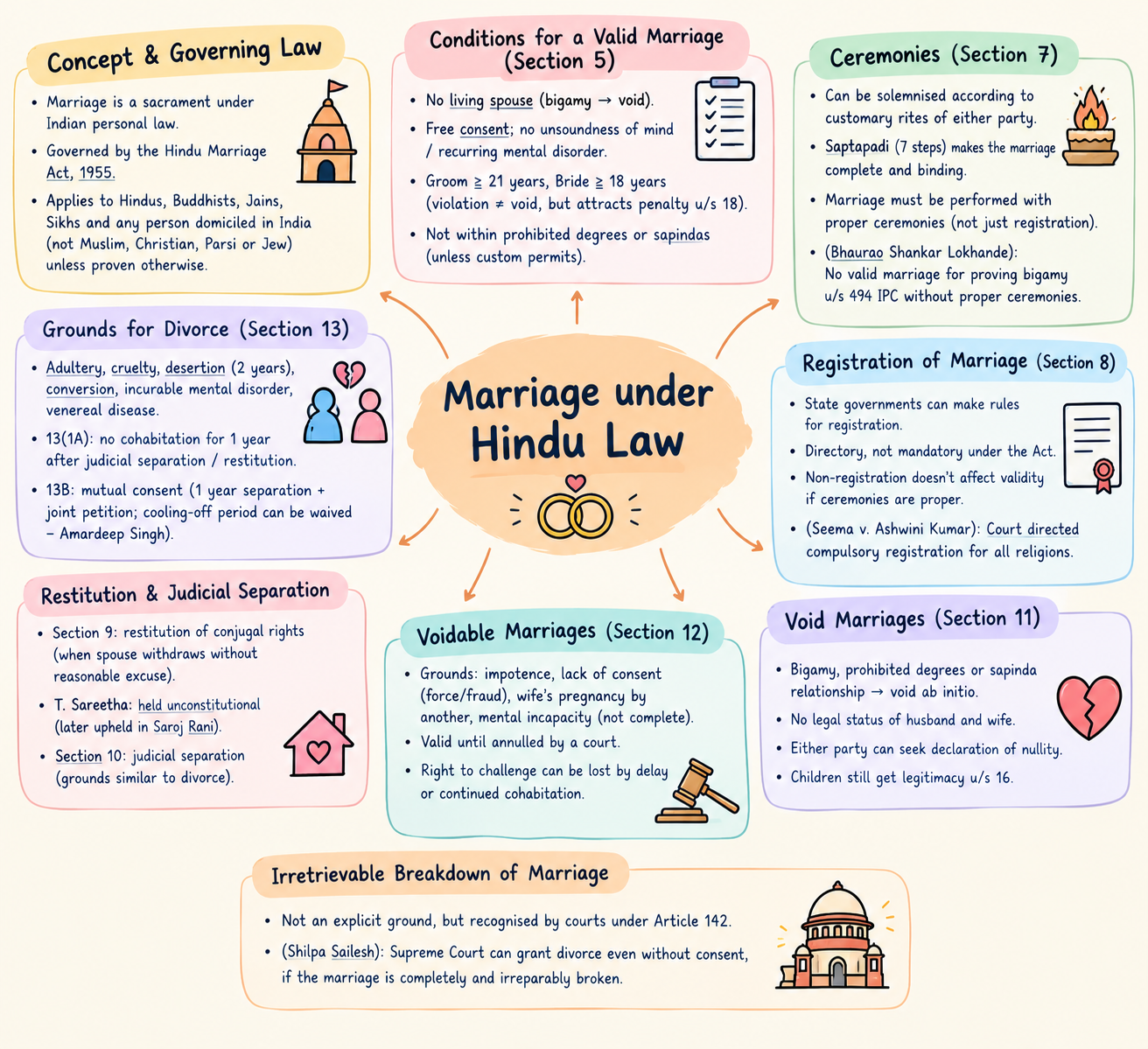
Hindu marriage functions as a sacrament under Indian personal law, and the Hindu Marriage Act, 1955 governs its essentials, ceremonies, and dissolution. The Act applies to Hindus, Buddhists, Jains, and Sikhs, and it also covers any person domiciled in India who is not a Muslim, Christian, Parsi, or Jew, unless proven otherwise.
This codified framework replaced most of the older customary and shastric rules, though certain customs continue to operate within its structure.
Conditions for a Valid Marriage: Section 5
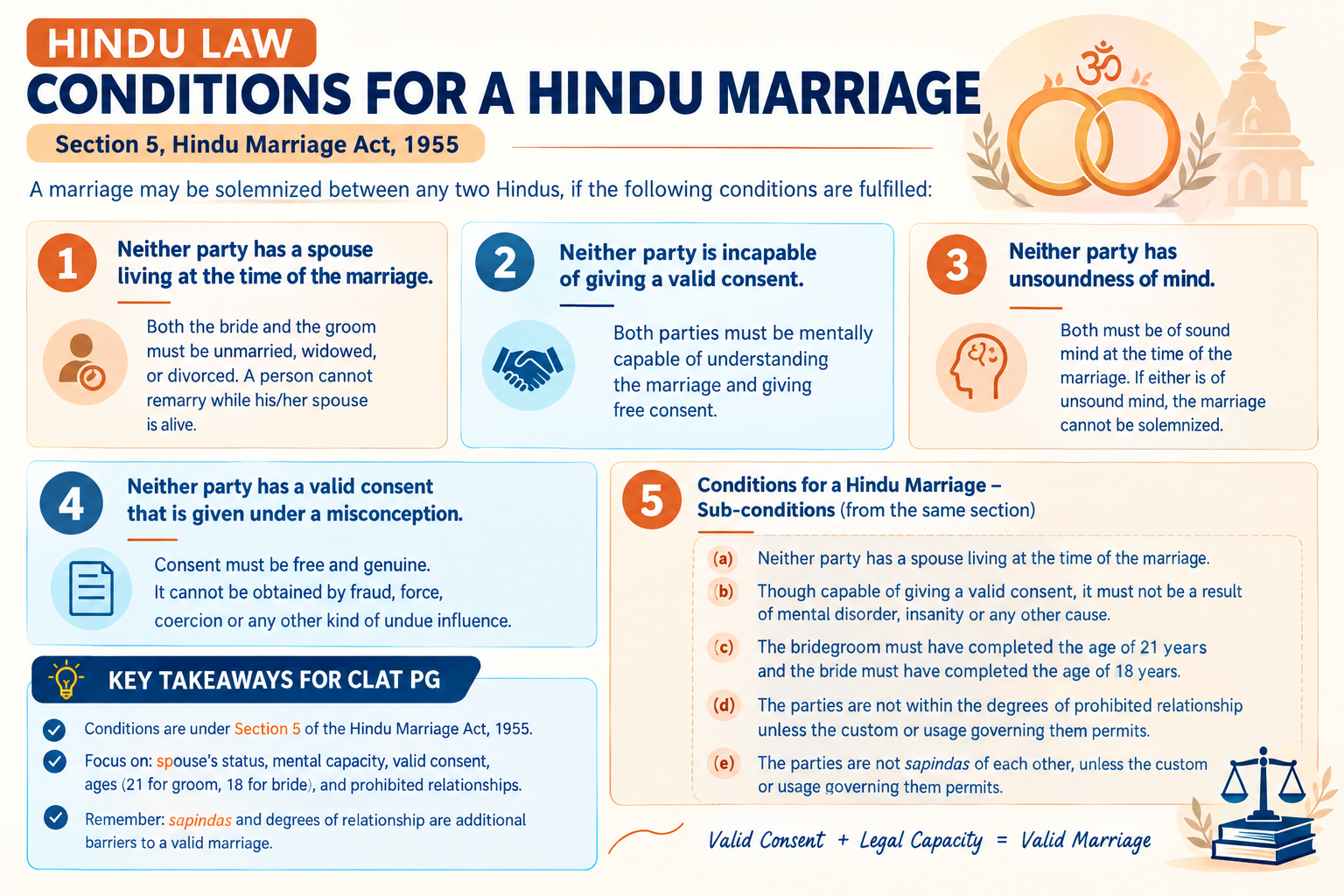
Section 5 lays down five essential conditions for a valid Hindu marriage. Neither party should have a living spouse at the time of marriage, since bigamy renders the marriage void under Section 11.
Both parties must be capable of giving valid consent, free from unsoundness of mind or recurring mental disorder that would render them unfit for marriage and procreation.
The bridegroom must have completed twenty-one years of age, and the bride must have completed eighteen years, though violation of this condition does not automatically void the marriage.
The parties must also not fall within the degrees of prohibited relationship or be sapindas of each other, unless a custom or usage governing each of them permits such a marriage.
Courts have consistently held that a marriage in violation of the age condition remains valid, though it attracts penal consequences under Section 18.
Ceremonies: Section 7
Section 7 recognises that a Hindu marriage may be solemnised according to the customary rites and ceremonies of either party, giving primacy to community and family custom over any uniform ritual.
Where the parties follow Saptapadi, meaning the taking of seven steps by the bride and groom jointly before the sacred fire, the marriage becomes complete and binding upon completion of the seventh step.
In Bhaurao Shankar Lokhande v. State of Maharashtra, the Supreme Court held that a marriage not performed with proper ceremonies, as required by the personal law or custom applicable to the parties, does not amount to a valid marriage for the purposes of proving bigamy under Section 494 IPC.
Parties seeking to prove a valid marriage must establish that the applicable ceremonies were actually performed, since mere registration or a claimed relationship does not substitute for ceremonial solemnisation.
Registration of Marriage: Section 8
Section 8 empowers state governments to make rules for registering Hindu marriages, primarily to provide documentary proof of the marriage having taken place. Registration remains directory rather than mandatory under the Act itself, and non-registration does not affect the validity of a marriage otherwise solemnised according to proper ceremonies.
However, in Seema v. Ashwini Kumar, the Supreme Court directed all state governments to make registration of marriages compulsory for all religions, recognising its evidentiary value in preventing issues like child marriage, bigamy, and desertion.
Void Marriages: Section 11
Section 11 declares a marriage void ab initio if it violates the conditions relating to bigamy, prohibited degrees of relationship, or sapinda relationship under Section 5. A void marriage confers no legal status of husband and wife, and either party may seek a declaration of nullity, though such a decree merely confirms an already non-existent marriage.
Children born from a void marriage nonetheless receive legitimacy under Section 16.
Voidable Marriages: Section 12
Section 12 lists grounds on which a marriage remains valid until a competent court annuls it at the instance of one party.
These grounds include incapacity to consummate the marriage due to impotence, lack of valid consent obtained through force or fraud, pregnancy of the wife by another person at the time of marriage, and mental incapacity falling short of complete unsoundness.
Unlike a void marriage, a voidable marriage produces full legal effect unless and until a party successfully challenges it, and the right to challenge can also become barred by delay or continued cohabitation with knowledge of the grounds.
Restitution of Conjugal Rights and Judicial Separation
Section 9 allows a spouse to seek restitution of conjugal rights when the other spouse withdraws from their society without reasonable excuse, and the court may pass a decree directing resumption of cohabitation.
In T. Sareetha v. T. Venkata Subbaiah, the Andhra Pradesh High Court held this provision unconstitutional for violating personal liberty and privacy, though the Supreme Court later upheld its validity in Saroj Rani v. Sudarshan Kumar Chadha, treating it as a legitimate remedy rather than coercive state interference.
Section 10 separately allows either spouse to seek judicial separation on grounds similar to those available for divorce, without immediately dissolving the marriage.
Grounds for Divorce: Section 13
Section 13 lists grounds available to either spouse for divorce, including adultery, cruelty, desertion for a continuous period of two years, conversion to another religion, incurable mental disorder and venereal disease in a communicable form.
Section 13(1A) further permits either party to seek divorce where no resumption of cohabitation has taken place for one year or more after a decree of judicial separation or restitution of conjugal rights.
Section 13B additionally provides for divorce by mutual consent, requiring the parties to live separately for one year and to file a joint petition confirming their inability to live together, subject to a cooling-off period that the Supreme Court, in Amardeep Singh v. Harveen Kaur, held could be waived in appropriate cases.
Irretrievable Breakdown of Marriage
Though not an explicit statutory ground, courts have increasingly invoked irretrievable breakdown of marriage while exercising powers under Article 142 of the Constitution to grant divorce where a marriage has become practically unworkable.
In Shilpa Sailesh v. Varun Sreenivasan, a Constitution Bench held that the Supreme Court can dissolve a marriage on this ground even without the consent of both parties, provided it finds the marriage completely and irreparably broken.
This development addresses cases where prolonged separation makes continuation of the marital bond meaningless, though it remains a power exercised only by the Supreme Court rather than lower matrimonial courts.
Subscribe for updates
Join 10,000+ subscribers.
HA
Hanspal Bakul
Contributing author
Have a doubt about this?Ask Doubts