Succession in case of Hindu Males
Intestate Succession in case of Hindu Males: Section 8
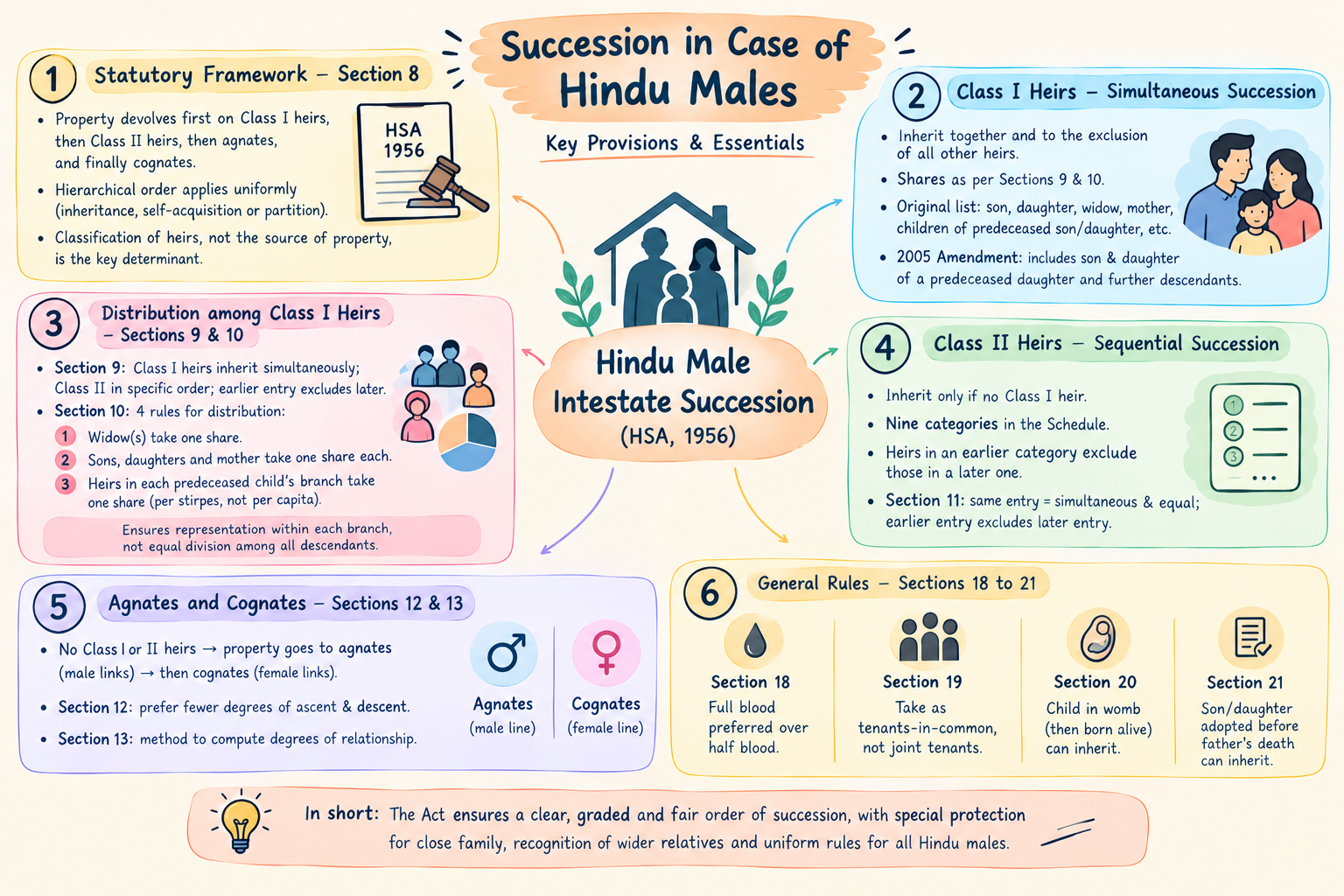
Section 8 of the Hindu Succession Act, 1956 lays down the general scheme governing intestate succession in case of Hindu males, establishing a graded order of heirs entitled to inherit in the absence of a will.
The property devolves first upon heirs specified in Class I of the Schedule to the Act, and in their absence, upon heirs specified in Class II, followed by agnates of the deceased, and finally by cognates, with each category exhausted before succession moves to the next.
This hierarchical structure, unlike the source-based rules governing female succession under Section 15, applies uniformly regardless of how the deceased male acquired the property, whether through inheritance, self-acquisition, or partition, making the classification of heirs rather than the source of property the central determinant of devolution.
Class I Heirs: Simultaneous Succession
Class I heirs, listed in the Schedule to the Act, inherit simultaneously and to the exclusion of all other heirs, taking their shares per the rules laid down in Sections 9 and 10 rather than in any further hierarchical order among themselves.
The original Class I category included the son, daughter, widow, mother, and children of a predeceased son or daughter, along with the widow and children of a predeceased son of a predeceased son, reflecting a scheme designed to protect the deceased's immediate family and lineal descendants.
The Hindu Succession (Amendment) Act, 2005 significantly expanded Class I to include additional heirs such as the son and daughter of a predeceased daughter, and further descendants, reflecting the broader legislative shift toward gender-neutral inheritance that the same amendment achieved through the coparcenary reforms under Section 6.
Distribution among Class I Heirs: Sections 9 and 10
Section 9 establishes the order of succession among heirs specified in the Schedule, confirming that those in Class I inherit simultaneously in preference to those in Class II, and that Class II heirs inherit in the specific order set out within that class, with heirs in an earlier entry excluding those in a later entry.
Section 10 lays down four specific rules governing distribution among Class I heirs: the intestate's widow, or if there are more widows than one, all the widows together, take one share; the surviving sons and daughters and the mother each take one share; and the heirs in the branch of each predeceased son or predeceased daughter take between them one share, distributed per stirpes within that branch rather than per capita across the whole class.
This per stirpes distribution within a predeceased child's branch ensures that grandchildren collectively receive only the share their deceased parent would have received, rather than dividing the estate equally among every individual descendant regardless of generation, thereby preserving the principle of representation within Hindu succession law.
Class II Heirs: Sequential Succession
Class II heirs inherit only in the absence of any Class I heir, and unlike Class I, they do not take simultaneously but succeed according to a specific sequential order set out in nine categories within the Schedule, with heirs in an earlier category wholly excluding those in a later category.
The order begins with the father, followed by the son's daughter's son and daughter, brother and sister, then further descendants and collateral relatives arranged in a specific and carefully structured hierarchy extending to great-grandchildren of siblings and specified categories of uncles and their children.
Section 11 governs distribution among Class II heirs, providing that heirs falling within the same entry take simultaneously and equally among themselves, while heirs in an earlier entry exclude those in any subsequent entry entirely, reinforcing the general principle of sequential exhaustion that governs the overall scheme of succession to a Hindu male's property.
Agnates and Cognates: Sections 12 and 13
Where a Hindu male dies leaving no Class I or Class II heirs, the property devolves upon his agnates, meaning relatives connected wholly through male links, whether by blood or adoption, and in the absence of any agnate, upon his cognates, meaning relatives connected through one or more female links.
Section 12 lays down the order of succession among agnates and cognates, generally preferring an heir related to the deceased through fewer degrees of ascent and descent over one related through a greater number of such degrees, applying the same principle independently to agnates and to cognates.
Section 13 supplements this by prescribing the specific method for computing degrees of relationship for determining the order among agnates and cognates, requiring computation of degrees of ascent from the deceased to the common ancestor and degrees of descent from the common ancestor to the heir, with the total number of degrees determining priority among competing claimants within the same category.
General Rules of Succession: Sections 18 to 21
Section 18 provides that heirs related to an intestate by full blood are preferred to heirs related by half blood, where the nature of the relationship is otherwise the same, reflecting a preference for closer biological connection where competing claims arise.
Section 19 addresses the mode of succession where two or more heirs succeed together to the property of an intestate, providing that they take the property as tenants-in-common and not as joint tenants, meaning each heir holds a defined and heritable share rather than a right of survivorship among themselves.
Section 20 clarifies that a child in the womb at the time of the intestate's death, who is subsequently born alive, has the same right to inherit as if they had been born before the intestate's death, with the inheritance deemed to vest from the date of death itself.
Section 21 establishes a presumption of survivorship based on age, rather than simultaneous death. It explicitly states that when the order of death is uncertain, the younger individual is presumed to have survived the elder until the contrary is proved.
Preferential Right to Acquire Property: Section 22
Section 22 grants heirs specified in Class I of the Schedule a preferential right to acquire the interest of another Class I heir proposing to transfer their share in immovable property or a business belonging to the deceased, requiring the transferring heir to first offer their interest to the other heirs before transferring it to an outsider.
This provision aims to prevent fragmentation of ancestral property or family businesses by ensuring that ownership stays within the family unit wherever a co-heir wishes to exit their share, and disputes regarding the valuation of such interest are to be determined by the court on application by any interested party.
Disqualifications from Inheritance: Sections 24 to 28
Sections 25 through 28 lay down grounds on which certain persons stand disqualified from inheriting under the Act, notwithstanding their otherwise valid claim as heirs.
Section 25 disqualifies a murderer, or a person who abets the murder, from inheriting the property of the person murdered, or any property in furtherance of that succession, embodying the principle that no person should profit from their own wrongdoing.
Section 26 provides that descendants of a convert to another religion are disqualified from inheriting the property of any Hindu relative unless such descendants are themselves Hindus at the time succession opens.
Section 28 clarifies that no person is disqualified from succeeding to property merely on the ground of any disease, defect, or deformity, or, save as provided in the Act, on any other ground whatsoever, reflecting a deliberate legislative rejection of older customary disqualifications based on physical or mental disability.
Section 24, which previously disqualified certain widows who had remarried from inheriting as the widow of a predeceased son, predeceased grandson, or deceased brother, was repealed by the Hindu Succession (Amendment) Act, 2005, removing this specific gender-based bar to inheritance.
Coparcenary Property and Succession: Section 6
Section 6, as amended in 2005, provides that a daughter of a coparcener becomes a coparcener by birth in her own right in the same manner as a son, and is subject to the same rights and liabilities in respect of coparcenary property as a son.
Where a male Hindu dies after the commencement of the 2005 amendment, having an interest in coparcenary property, that interest devolves by testamentary or intestate succession under the Act, rather than by survivorship, thereby extending the ordinary succession scheme under Sections 8 to 13 to interests in coparcenary property as well, subject to the proviso requiring a notional partition to ascertain the deceased's precise share.
Comparative Note: Distinction from Female Succession
The scheme governing a Hindu male's succession differs fundamentally from that governing a Hindu female's succession under Sections 15 and 16, since the male scheme applies uniformly regardless of property source, whereas the female scheme incorporates source-based exceptions under Section 15(2) for property inherited from parents or from a husband or father-in-law.
This distinction remains a frequently tested comparative point for CLAT PG aspirants, since examiners often construct fact patterns testing whether candidates can correctly identify which succession scheme, and which specific provision within that scheme, governs a given set of facts.
Subscribe for updates
Join 10,000+ subscribers.
HA
Hanspal Bakul
Contributing author
Have a doubt about this?Ask Doubts