Strict Liability in Tort: Rylands v. Fletcher, Exceptions & Cases for CLAT PG
SH
Shruti chauhan11 min readWhat is the Meaning of Strict Liability?
Strict liability in tort is liability without fault. A person who keeps a dangerous thing on their land is liable for the damage it causes if it escapes, even if they took every reasonable care to prevent the escape.
Strict Liability: liability without fault
Strict liability means a defendant is held liable for harm without the plaintiff having to prove intention or negligence. The plaintiff needs to show only three things: a dangerous thing, its escape, and a non-natural use of land. The rule comes from the English case Rylands v. Fletcher (1868), and the defendant can escape liability only by proving one of five recognised exceptions.
Most torts are fault-based. In negligence, for example, the plaintiff must prove that the defendant owed a duty of care, breached it, and caused damage. Strict liability removes the second step. The question is not "was the defendant careless?" but "did the defendant bring something dangerous onto the land, and did it escape?"
The reason is risk. Someone who brings an unusual hazard onto their land for their own purposes creates a risk that neighbours did not choose. The law makes the person who created and profits from that risk bear the loss when it materialises, rather than the innocent neighbour.
The word "strict" does not mean "absolute". Strict liability allows exceptions, such as an act of God or the plaintiff's own default. Absolute liability, which Indian law developed in 1987, allows none. The difference is explained later in this article.
Rylands v. Fletcher (1868): Facts and Rule
Rylands v Fletcher is the case that created strict liability in tort. The House of Lords held a mill owner liable for flooding his neighbour's mine, even though the owner had not been negligent.
Facts
The defendants, Rylands, owned a mill and hired independent contractors to build a reservoir on their land to supply it with water. Beneath the site were old, disused mine shafts. The contractors found them but did not seal them properly. When the reservoir was filled, water burst through the shafts and flooded the plaintiff Fletcher's working coal mine next door.
The defendants had not been negligent themselves and did not know about the shafts. The contractors' negligence could not be attributed to them under the ordinary rules. Even so, they were held liable.
The rule
Blackburn J, in the Court of Exchequer Chamber (1866), laid down the rule:
"The person who for his own purposes brings on his lands and collects and keeps there anything likely to do mischief if it escapes, must keep it in at his peril, and, if he does not do so, is prima facie answerable for all the damage which is the natural consequence of its escape."
The House of Lords affirmed the decision in 1868. Lord Cairns added that the rule applies only to a non-natural use of land. Together, these two judgments give the three essentials of strict liability.
Why it matters
"Prima facie answerable" is the key phrase. Liability arises without proof of fault, but it is not unconditional. Blackburn J himself said the defendant could excuse himself by showing the escape was due to the plaintiff's default, or an act of God. Later cases added three more exceptions.
Elements of Strict Liability
A plaintiff must prove three essentials to succeed under the rule in Rylands v Fletcher:
- Dangerous thing: the defendant brought onto the land something likely to do mischief if it escapes.
- Escape: the thing escaped from the defendant's land to a place outside it.
- Non-natural use: the defendant's use of the land was special and brought increased danger.
If any one of these is missing, the rule does not apply, and the plaintiff must prove negligence or another tort instead.
Dangerous thing
The thing need not be dangerous in itself. It must only be likely to cause harm if it escapes. Courts have treated water stored in bulk, gas, electricity, explosives, fire, sewage, chemicals, noxious fumes and poisonous vegetation as dangerous things. In Rylands v Fletcher itself, the dangerous thing was the large quantity of water collected in the reservoir.
Escape
The dangerous thing must escape from land the defendant occupies or controls to a place outside it. In Read v J. Lyons & Co (1947), an inspector was injured by a shell that exploded inside the defendants' munitions factory. The House of Lords held there was no escape, since the harm happened on the defendants' own premises, so Rylands v Fletcher did not apply.
Compare Crowhurst v Amersham Burial Board (1878). The defendants planted a poisonous yew tree whose branches grew over the boundary onto the plaintiff's land. The plaintiff's horse ate the leaves and died. The branches growing over the boundary counted as an escape, and the defendants were held liable.
Non-natural use of land
The use must be a special use that brings increased danger to others, not the ordinary use of land or a use for the general benefit of the community. In Rickards v Lothian (1913), someone blocked a washbasin on the top floor of a building and left the tap running, flooding the plaintiff's premises below. The Privy Council held that an ordinary domestic water supply is a natural use of land, so the owner was not strictly liable.
Essentials of strict liability
| Essential | Meaning | Case |
| Dangerous thing | Something likely to do mischief if it escapes (water, gas, electricity, explosives) | Rylands v Fletcher (1868) |
| Escape |
Exceptions to Strict Liability
A defendant who meets all three essentials can still avoid liability by proving one of five exceptions: act of God, the plaintiff's own default, act of a third party, consent of the plaintiff, or statutory authority. These apply alongside the general defences in tort law, but are specific to the rule in Rylands v Fletcher.
Act of God
An act of God is an event caused by natural forces, without human intervention, which no human foresight could have guarded against. In Nichols v Marland (1876), the defendant had created artificial lakes on his land by damming a natural stream. An extraordinarily heavy rainfall, heavier than anyone could remember, burst the embankments and the water washed away the plaintiff's bridges. The court held this was an act of God, and the defendant was not liable.
Plaintiff's own default (Ponting v Noakes)
If the damage is caused by the plaintiff's own act or default, the plaintiff cannot recover. In Ponting v Noakes (1894), the plaintiff's horse reached over the boundary onto the defendant's land and ate the leaves of a poisonous yew tree growing there, and died. The tree had not grown over the boundary, so there was no escape. The harm was caused by the horse's own intrusion onto the defendant's land, so the defendant was not liable.
Ponting v Noakes is the mirror image of Crowhurst v Amersham Burial Board. In Crowhurst the yew grew over onto the plaintiff's land, so there was an escape and liability. In Ponting the horse reached over onto the defendant's land, so there was neither escape nor liability.
Act of a third party
The defendant is not liable if the escape was caused by the wrongful act of a stranger over whom they had no control. In Box v Jubb (1879), the defendant's reservoir overflowed because a third party emptied its own reservoir upstream into the stream that fed it. The defendant was not liable. The exception does not cover the defendant's servants or independent contractors, which is why Rylands was still liable for its contractors in Rylands v Fletcher.
Consent of the plaintiff
If the plaintiff consented, expressly or impliedly, to the presence of the dangerous thing, often because it was kept for their common benefit, they cannot complain when it escapes without negligence. In Peters v Prince of Wales Theatre (1943), the plaintiff leased a shop in the defendant's theatre building. The sprinkler system, installed for the benefit of the whole building, burst and flooded the shop. The defendant was not liable. This exception works like the maxim volenti non fit injuria.
Statutory authority
An act done under the authority of a statute is a defence, provided it was done without negligence. In Green v Chelsea Waterworks Co (1894), a water main laid by a company under a statutory duty to supply water burst and flooded the plaintiff's premises. Since there was no negligence, the company was not liable.
Exceptions to the rule in Rylands v Fletcher
| Exception | Meaning | Case |
| Act of God | Natural forces no human foresight could guard against | Nichols v Marland (1876): extraordinary rainfall burst artificial lakes |
| Plaintiff's own default |
Strict vs Absolute Liability
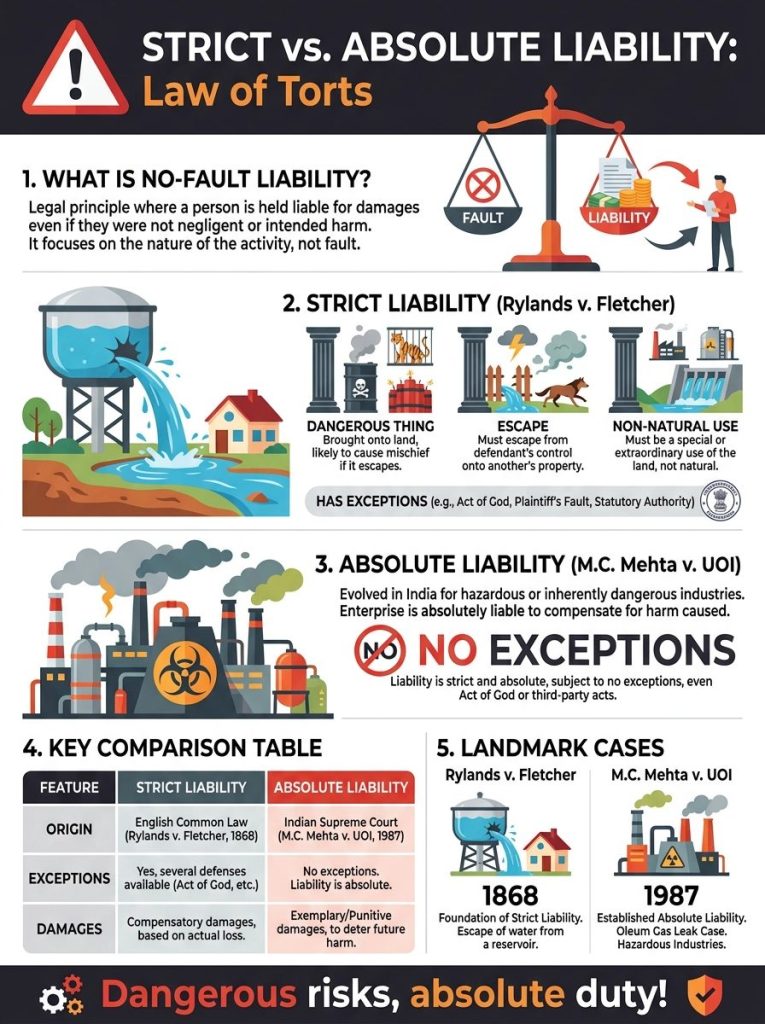
Strict liability allows five exceptions and requires an escape. Absolute liability allows no exceptions and requires no escape. Both are no-fault rules, but absolute liability is the stricter one, designed for hazardous industry.
| Basis | Strict liability | Absolute liability |
| Origin | Rylands v Fletcher (1868), England | M.C. Mehta v Union of India (1987), India |
| Applies to |
The Supreme Court gave three reasons for going beyond Rylands v Fletcher. First, the 19th-century rule was built for a farming and early industrial economy, not for chemical plants handling lethal gases. Second, an enterprise that profits from a hazardous activity is best placed to absorb the loss, through insurance or pricing. Third, only the enterprise knows the risks inside its plant, so the victim should not have to prove an escape or rebut defences like act of a third party.
The compensation rule matters as much as the removal of exceptions. Under strict liability, damages put the plaintiff back where they were. Under absolute liability, the larger and more prosperous the enterprise, the greater the compensation it must pay, so the rule also deters.
Strict Liability in India after MC Mehta
Strict liability still applies in India, but since 1987 it sits below absolute liability. Indian courts apply absolute liability to hazardous and inherently dangerous enterprises, and the rule in Rylands v Fletcher to other cases where a dangerous thing escapes.
M.C. Mehta v Union of India (1987)
In December 1985, oleum gas leaked from a unit of Shriram Foods and Fertilisers in Delhi, a year after the Bhopal gas disaster. In M.C. Mehta v Union of India, a Constitution Bench led by Chief Justice P.N. Bhagwati held that an enterprise engaged in a hazardous or inherently dangerous activity owes an absolute and non-delegable duty to the community. If anyone is harmed by an accident in that activity, the enterprise is absolutely liable, and none of the Rylands v Fletcher exceptions applies.
After MC Mehta
- Indian Council for Enviro-Legal Action v Union of India (1996): the Supreme Court reaffirmed absolute liability and applied the polluter pays principle against chemical industries in Bichhri, Rajasthan.
- Public Liability Insurance Act, 1991: passed after Bhopal, it makes owners handling hazardous substances pay fixed relief to victims on a no-fault basis, and requires them to insure.
- National Green Tribunal Act, 2010: Section 17(3) directs the Tribunal to apply the no-fault principle in accident cases. The NGT relied on absolute liability after the LG Polymers styrene gas leak in Visakhapatnam in 2020.
- M.P. Electricity Board v Shail Kumar (2002): the Supreme Court applied strict liability to an electricity board whose live wire fell on a road and electrocuted a cyclist, so ordinary strict liability is still applied.
Where strict liability is applied today
- Water stored in bulk: reservoirs, dams, tanks and water mains
- Electricity transmission and live wires
- Gas, fire, explosives and fireworks
- Chemicals, toxic waste and industrial effluents
- Poisonous vegetation and noxious fumes escaping onto neighbouring land
- Defective products, under the product liability chapter of the Consumer Protection Act, 2019 (sections 82 to 87), where a manufacturer is liable even without proof of negligence
Strict Liability in Criminal Law
Strict liability in criminal law is a different idea from strict liability in tort. In criminal law it means an offence that can be committed without mens rea (a guilty mind). The prosecution must prove the act, but not intention or knowledge.
These offences are usually regulatory or "public welfare" offences, such as food adulteration, pollution, and customs and foreign exchange violations. In State of Maharashtra v M.H. George (1965), the Supreme Court upheld the conviction of a passenger carrying gold through India in breach of foreign exchange rules, even though he did not know of the rule.
In short, criminal strict liability is about dropping mens rea for an offence, while tort strict liability is about compensating a victim for an escape of something dangerous. This article deals with the tort rule.
FAQs
What is strict liability in tort?
Strict liability in tort is liability without fault. Under the rule in Rylands v Fletcher (1868), a person who brings a dangerous thing onto their land for a non-natural use is liable if it escapes and causes damage, even without negligence.
What are the exceptions to Rylands v Fletcher?
There are five: act of God (Nichols v Marland), the plaintiff's own default (Ponting v Noakes), act of a third party (Box v Jubb), consent of the plaintiff (Peters v Prince of Wales Theatre), and statutory authority (Green v Chelsea Waterworks).
What is the difference between strict and absolute liability?
Strict liability needs an escape and allows five exceptions. Absolute liability, laid down in M.C. Mehta v Union of India (1987), applies to hazardous enterprises, needs no escape, allows no exceptions, and links compensation to the size and capacity of the enterprise.
Is strict liability applied in India?
Yes. Indian courts still apply the rule in Rylands v Fletcher, for example to electrocution from live wires in M.P. Electricity Board v Shail Kumar (2002). For hazardous and inherently dangerous industries, they apply absolute liability instead.
What happened in Ponting v Noakes?
In Ponting v Noakes (1894), the plaintiff's horse reached over the boundary onto the defendant's land, ate leaves from a poisonous yew tree and died. The defendant was not liable, because the tree did not escape and the harm came from the plaintiff's own horse intruding.
Conclusion
Strict liability makes a person answerable for the escape of a dangerous thing from a non-natural use of their land, whether or not they were careless. Rylands v Fletcher set the rule in 1868, and five exceptions limit it: act of God, the plaintiff's default, act of a third party, consent and statutory authority. India went further in 1987 with absolute liability for hazardous industry, but the older rule still governs ordinary cases.
For exams, learn the three essentials, the five exceptions with one case each, and the Crowhurst and Ponting contrast. Then test yourself with these practice questions on strict and absolute liability.
Subscribe for updates
Join 10,000+ subscribers.
SH
Shruti chauhan
Contributing author
Have a doubt about this?Ask Doubts