
Landmark Cases on Hindu Law (PART 2): Property, Succession & the Hindu Joint Family
Family law remains a high-yield area for CLAT PG, and the Hindu Marriage Act draws examiners back to the same set of judgments every year. This piece walks through seven landmark cases on Hindu law that shaped property, succession and Hindu joint family law in India. Each case carries its facts, the issues the Court framed, and the judgment with its underlying reasoning.
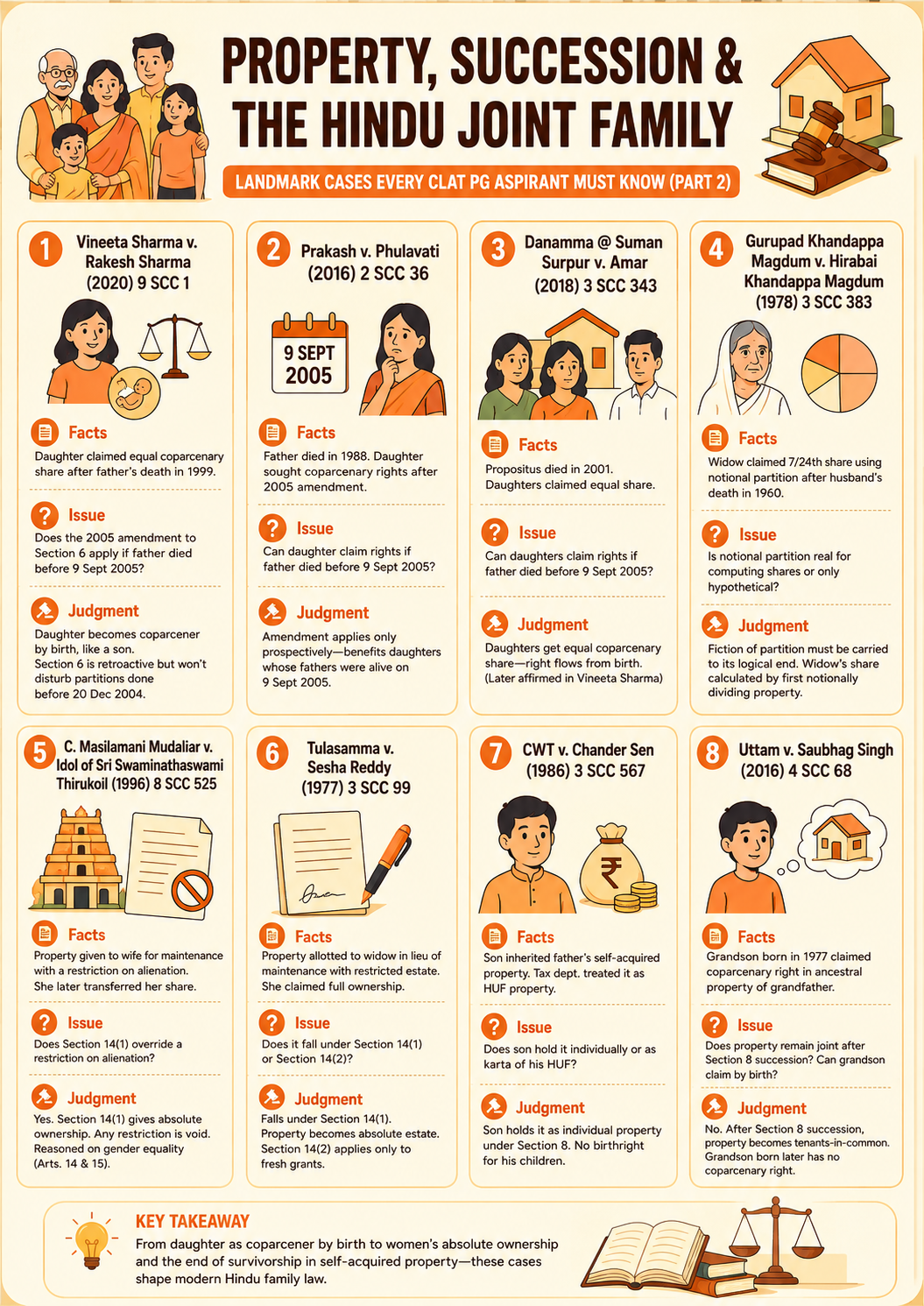
1. Vineeta Sharma v. Rakesh Sharma (2020) 9 SCC 1
Facts
Dev Dutt Sharma dies in 1999, survived by his widow, one daughter (Vineeta), and three sons; one son later dies unmarried in 2001. Vineeta files a suit claiming an equal coparcenary share, but her brothers resist on the ground that their father died before the 2005 amendment took effect.
Dev Dutt Sharma dies in 1999, survived by his widow, one daughter (Vineeta), and three sons; one son later dies unmarried in 2001. Vineeta files a suit claiming an equal coparcenary share, but her brothers resist on the ground that their father died before the 2005 amendment took effect.
Conflicting High Court and Supreme Court rulings on this exact point forced a reference to a larger bench.
- Issues
Does the 2005 amendment to Section 6 apply only when the father-coparcener is alive on 9 September 2005? - Does it operate prospectively, retrospectively, or retroactively?
Judgement
A three-judge bench holds that a daughter becomes a coparcener by birth, just like a son, and this status doesn't depend on her father's survival on the amendment date. The Court treats Section 6 as retroactive: it operates on a factual situation existing before the amendment but doesn't reopen closed or registered partitions completed before 20 December 2004. This ratio finally overrules Phulavati's "living coparcener" test and settles the law.
A three-judge bench holds that a daughter becomes a coparcener by birth, just like a son, and this status doesn't depend on her father's survival on the amendment date. The Court treats Section 6 as retroactive: it operates on a factual situation existing before the amendment but doesn't reopen closed or registered partitions completed before 20 December 2004. This ratio finally overrules Phulavati's "living coparcener" test and settles the law.
2. Prakash v. Phulavati (2016) 2 SCC 36
Facts
The plaintiff's father dies in 1988, and she files a partition suit in 1992, which the trial court dismisses in 2007. She appeals after the 2005 amendment comes into force, seeking an enhanced share as a coparcener under the amended Section 6.
The plaintiff's father dies in 1988, and she files a partition suit in 1992, which the trial court dismisses in 2007. She appeals after the 2005 amendment comes into force, seeking an enhanced share as a coparcener under the amended Section 6.
Issues
Can a daughter claim coparcenary rights under the 2005 amendment if her father died before the amendment took effect?
Can a daughter claim coparcenary rights under the 2005 amendment if her father died before the amendment took effect?
Judgement
The Supreme Court holds that the amendment applies only prospectively, benefiting daughters whose fathers were alive as coparceners on 9 September 2005. Since the plaintiff's father died well before that date, she cannot claim enhanced coparcenary rights. This "living coparcener" ratio dominated lower-court practice for four years until Vineeta Sharma expressly overrules it.
The Supreme Court holds that the amendment applies only prospectively, benefiting daughters whose fathers were alive as coparceners on 9 September 2005. Since the plaintiff's father died well before that date, she cannot claim enhanced coparcenary rights. This "living coparcener" ratio dominated lower-court practice for four years until Vineeta Sharma expressly overrules it.
3. Danamma @ Suman Surpur v. Amar (2018) 3 SCC 343
Facts
Gurulingappa Savadi, the propositus, dies in 2001, before the 2005 amendment comes into force, leaving behind sons and daughters. His grandson later files a partition suit, and the daughters claim an equal coparcenary share despite their father's pre-amendment death.
Gurulingappa Savadi, the propositus, dies in 2001, before the 2005 amendment comes into force, leaving behind sons and daughters. His grandson later files a partition suit, and the daughters claim an equal coparcenary share despite their father's pre-amendment death.
Issues
Can daughters claim coparcenary rights when the father-coparcener died before 9 September 2005, and does the pendency of a partition suit affect that claim?
Can daughters claim coparcenary rights when the father-coparcener died before 9 September 2005, and does the pendency of a partition suit affect that claim?
Judgement
The Court grants the daughters an equal coparcenary share, reasoning that their right flows from birth rather than from the father's survival. However, the judgment doesn't fully reconcile this outcome with Phulavati's contrary logic, and it leaves a doctrinal contradiction on record. Vineeta Sharma later resolves this tension in the daughters' favour and confirms Danamma's outcome, if not its full reasoning.
The Court grants the daughters an equal coparcenary share, reasoning that their right flows from birth rather than from the father's survival. However, the judgment doesn't fully reconcile this outcome with Phulavati's contrary logic, and it leaves a doctrinal contradiction on record. Vineeta Sharma later resolves this tension in the daughters' favour and confirms Danamma's outcome, if not its full reasoning.
4. Gurupad Khandappa Magdum v. Hirabai Khandappa Magdum (1978) 3 SCC 383
Facts
Khandappa dies in 1960, leaving behind his widow Hirabai, two sons, and three daughters as members of a Mitakshara joint family. Hirabai sues for a 7/24th share, calculated by adding her 1/4th notional share (had partition happened during Khandappa's lifetime) to her 1/24th share in his coparcenary interest. Her son Gurupad contests this, arguing that no partition actually occurred and that the widow can't claim a share as though one had.
Khandappa dies in 1960, leaving behind his widow Hirabai, two sons, and three daughters as members of a Mitakshara joint family. Hirabai sues for a 7/24th share, calculated by adding her 1/4th notional share (had partition happened during Khandappa's lifetime) to her 1/24th share in his coparcenary interest. Her son Gurupad contests this, arguing that no partition actually occurred and that the widow can't claim a share as though one had.
Issues
Must courts treat the notional partition under Explanation 1 to Section 6 as a real, factual partition for computing shares, or merely as a hypothetical exercise limited to quantifying the deceased's interest?
Must courts treat the notional partition under Explanation 1 to Section 6 as a real, factual partition for computing shares, or merely as a hypothetical exercise limited to quantifying the deceased's interest?
Judgement
The Supreme Court holds that the fiction of partition must be carried to its logical conclusion. Once the law assumes a partition happened, all its natural consequences, including the allotment of a definite share to each heir, follow automatically.
The Supreme Court holds that the fiction of partition must be carried to its logical conclusion. Once the law assumes a partition happened, all its natural consequences, including the allotment of a definite share to each heir, follow automatically.
Consequently, Hirabai's share must be computed by first notionally dividing the property among all coparceners and then adding her share in her husband's interest. This ratio becomes the foundation for calculating shares in every subsequent notional-partition case, including Uttam v. Saubhag Singh.
5. C. Masilamani Mudaliar v. Idol of Sri Swaminathaswami Thirukoil (1996) 8 SCC 525
Facts
Somasundaram Pillai executes a will in 1950, bequeathing property to his wife Sellathachi and his cousin's widow Janakathachi, but restricts their power to alienate it and directs the property toward temple charity after their lifetime. Sellathachi later transfers her share to the appellants, and the temple idol challenges this alienation as invalid under the will's restrictive condition.
Somasundaram Pillai executes a will in 1950, bequeathing property to his wife Sellathachi and his cousin's widow Janakathachi, but restricts their power to alienate it and directs the property toward temple charity after their lifetime. Sellathachi later transfers her share to the appellants, and the temple idol challenges this alienation as invalid under the will's restrictive condition.
Issues
Does Section 14(1) of the Hindu Succession Act override a testamentary condition restricting a Hindu woman's power to alienate property given to her in lieu of a pre-existing right like maintenance?
Does Section 14(1) of the Hindu Succession Act override a testamentary condition restricting a Hindu woman's power to alienate property given to her in lieu of a pre-existing right like maintenance?
Judgement
The Court holds that property given to a Hindu woman in satisfaction of a pre-existing right, such as maintenance, falls squarely under Section 14(1), which converts her interest into absolute ownership regardless of any contrary condition in the instrument.
The Court holds that property given to a Hindu woman in satisfaction of a pre-existing right, such as maintenance, falls squarely under Section 14(1), which converts her interest into absolute ownership regardless of any contrary condition in the instrument.
Consequently, any restraint on alienation attached to such property becomes void and unenforceable. The Court further roots this reasoning in the constitutional guarantee of gender equality under Articles 14 and 15, treating restrictive conditions as a tool of subordination that Section 14(1) is designed to remove.
6. Tulasamma v. Sesha Reddy (1977) 3 SCC 99
Facts
Tulasamma's husband dies in 1931 while jointly held with his stepbrother, leaving her with a maintenance right against the joint family properties. A compromise decree later allots her certain properties in lieu of maintenance, but the decree expressly restricts her interest to a limited estate. After the 1956 Act comes into force, she claims absolute ownership over these properties under Section 14(1).
Tulasamma's husband dies in 1931 while jointly held with his stepbrother, leaving her with a maintenance right against the joint family properties. A compromise decree later allots her certain properties in lieu of maintenance, but the decree expressly restricts her interest to a limited estate. After the 1956 Act comes into force, she claims absolute ownership over these properties under Section 14(1).
Issues
Does property allotted to a Hindu woman in lieu of a pre-existing maintenance right fall under Section 14(1), which grants full ownership, or under Section 14(2), which preserves the restricted estate created by the instrument?
Does property allotted to a Hindu woman in lieu of a pre-existing maintenance right fall under Section 14(1), which grants full ownership, or under Section 14(2), which preserves the restricted estate created by the instrument?
Judgement
The Supreme Court holds that Section 14(1) is wide enough to cover any property a Hindu woman acquires in satisfaction of a pre-existing right, including maintenance, and that such property becomes her absolute estate the moment the Act applies.
The Supreme Court holds that Section 14(1) is wide enough to cover any property a Hindu woman acquires in satisfaction of a pre-existing right, including maintenance, and that such property becomes her absolute estate the moment the Act applies.
The Court clarifies that Section 14(2) applies only to a fresh, independent grant that creates a restricted estate for the first time, with no pre-existing right behind it. Since Tulasamma's claim traces back to her maintenance right, the compromise decree's limiting language cannot prevent her from becoming full owner.
7. Commissioner of Wealth Tax v. Chander Sen (1986) 3 SCC 567
Facts
Chander Sen and his father, Rangi Lal, run a joint business, which they formally partition, though they continue operating the business together afterward. On Rangi Lal's death, he leaves behind a sum of money in his account, which Chander Sen inherits as his sole surviving son. The tax authorities treat this inherited amount as HUF property in Chander Sen's hands and assess it accordingly.
Chander Sen and his father, Rangi Lal, run a joint business, which they formally partition, though they continue operating the business together afterward. On Rangi Lal's death, he leaves behind a sum of money in his account, which Chander Sen inherits as his sole surviving son. The tax authorities treat this inherited amount as HUF property in Chander Sen's hands and assess it accordingly.
Issues
When a son inherits his father's self-acquired property under Section 8 of the Hindu Succession Act, does he hold it as his individual property or as karta of his own HUF?
When a son inherits his father's self-acquired property under Section 8 of the Hindu Succession Act, does he hold it as his individual property or as karta of his own HUF?
Judgement
The Supreme Court holds that Section 8 lays down an independent scheme of succession that doesn't preserve the old Mitakshara notion of survivorship. Consequently, once a son inherits self-acquired property from his father under Section 8, he takes it purely in his individual capacity, and his own children acquire no birthright claim over it.
The Supreme Court holds that Section 8 lays down an independent scheme of succession that doesn't preserve the old Mitakshara notion of survivorship. Consequently, once a son inherits self-acquired property from his father under Section 8, he takes it purely in his individual capacity, and his own children acquire no birthright claim over it.
This ratio effectively subordinates traditional coparcenary principles to the codified succession scheme wherever Section 8 applies.
8. Uttam v. Saubhag Singh (2016) 4 SCC 68
Facts
Jagannath Singh dies in 1973, leaving behind ancestral property along with his widow and sons; his grandson Uttam is born only in 1977, after Jagannath's death. Uttam later files a partition suit, claiming a coparcenary interest by birth in the ancestral property. The lower appellate court rejects his claim, holding that Section 8 succession had already converted the property into individual shares before his birth.
Jagannath Singh dies in 1973, leaving behind ancestral property along with his widow and sons; his grandson Uttam is born only in 1977, after Jagannath's death. Uttam later files a partition suit, claiming a coparcenary interest by birth in the ancestral property. The lower appellate court rejects his claim, holding that Section 8 succession had already converted the property into individual shares before his birth.
- Issues
Does ancestral property continue as joint family property after a coparcener's death triggers succession under Section 8, or does it convert into individual shares held as tenants-in-common? - Can a grandson born after such succession claim a coparcenary interest by birth?
Judgement
The Supreme Court, relying on CWT v. Chander Sen and applying the notional-partition technique from Gurupad Khandappa Magdum, held that once Section 8 succession is triggered - which occurred here because the deceased left behind a Class I female heir (his widow) under the unamended Section 6 proviso - the property permanently ceases to be joint family property.
The Supreme Court, relying on CWT v. Chander Sen and applying the notional-partition technique from Gurupad Khandappa Magdum, held that once Section 8 succession is triggered - which occurred here because the deceased left behind a Class I female heir (his widow) under the unamended Section 6 proviso - the property permanently ceases to be joint family property.
The heirs hold their shares as tenants-in-common, not as coparceners. Since Uttam was born in 1977, after this legal conversion had already occurred in 1973, he could not claim a birthright coparcenary interest in property that had stopped being joint family property prior to his birth.
Get case-law updates weekly
Join 10,000+ subscribers.
HA
Hanspal Bakul
Contributing author
Have a doubt about this judgment?Ask Doubts
