
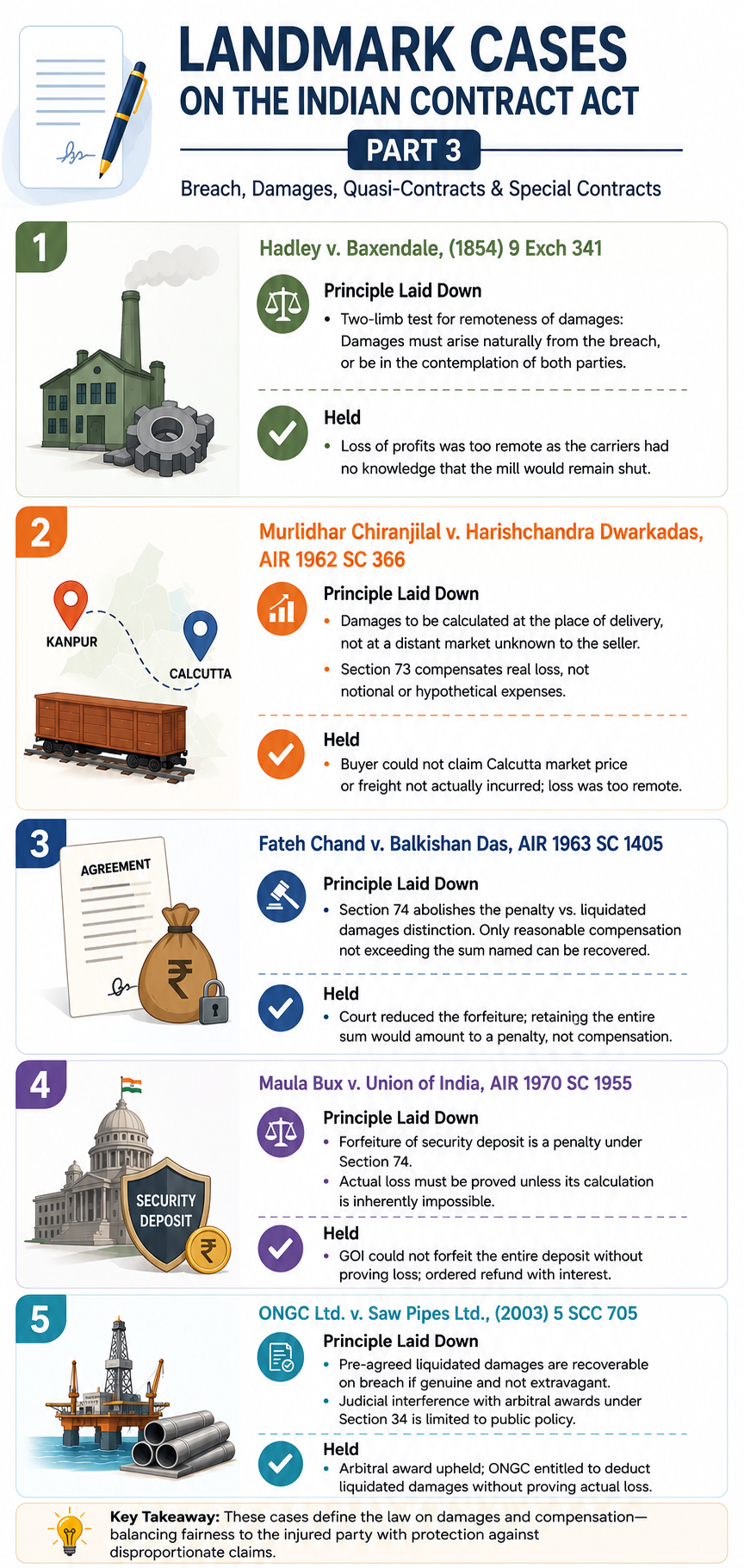
Landmark Cases on the Indian Contract Act (PART 3) : Breach, Damages, Quasi-Contracts and Special Contracts
1. Hadley v. Baxendale, (1854) 9 Exch 341
Facts
The plaintiffs ran a mill in Gloucester, and the crankshaft of their steam engine broke down. They engaged the defendants, common carriers, to transport the broken shaft to Greenwich so that a new one could be manufactured using it as a model. The carriers delayed delivery, and the mill remained shut for several extra days as a result.
Issues
- Whether the plaintiffs could recover loss of profits suffered during the period the mill stood idle due to the delay
- What standard governs the recoverability of damages arising from a breach of contract.
Judgment
The court denied the claim for lost profits and laid down the two-limb test for remoteness of damages. Damages recoverable must arise naturally from the breach in the usual course of things, or must have been in the contemplation of both parties as a probable result at the time of contracting.
Since the carriers had no knowledge that the mill would remain shut without the shaft, the loss of profits fell outside both limbs and could not be claimed.
2. Murlidhar Chiranjilal v. Harishchandra Dwarkadas, AIR 1962 SC 366
Facts
The seller agreed to deliver goods to the buyer at a railway station in Kanpur but failed to do so within the stipulated period. The buyer sued for damages, calculating the loss based on the market price at Calcutta, a destination to which the buyer intended to resell the goods, along with freight charges that the buyer had never actually paid.
Issues
- Whether damages should be calculated with reference to the market price at the place of resale rather than the place of delivery.
- Whether a buyer could claim freight expenses that were never incurred.
Judgment
The Court held that damages must be assessed based on the price prevailing at the place where delivery was due, not at a distant market the seller never contemplated. It also disallowed the freight claim, since Section 73 of the Contract Act compensates real loss and not notional or hypothetical expenditure.
The buyer failed to prove that the seller had knowledge of the intended resale at Calcutta, so that special loss remained too remote to recover.
3. Fateh Chand v. Balkishan Das, AIR 1963 SC 1405
Facts
The plaintiff agreed to sell immovable property to the defendant, who paid earnest money and a further sum towards the price. The contract stipulated that on default by the buyer, the seller could forfeit the amount paid. The buyer failed to complete the sale within the agreed time, and the seller sought to retain the entire sum received.
Issues
- Whether a seller could retain the full amount stipulated as forfeiture without proving actual loss.
- Whether the common law distinction between a penalty and liquidated damages survives under Indian law.
Judgment
The Court held that Section 74 dispenses with the common law distinction between penalty and liquidated damages, and a party can recover only reasonable compensation not exceeding the sum named in the contract.
Courts retain discretion to scale down amounts that appear unconscionable or punitive, even where a contract labels the sum as agreed compensation. Applying this principle, the Court reduced the forfeiture, holding that retaining the entire sum would amount to a penalty rather than genuine compensation for loss.
4. Maula Bux v. Union of India, AIR 1970 SC 1955
Facts
The appellant entered into a contract with the government to supply certain goods and deposited a security amount to guarantee due performance. The appellant failed to supply the goods as agreed, and the government forfeited the security deposit under the terms of the contract.
Issues
Whether the government could forfeit the entire security deposit without proving actual loss suffered due to the breach.
Judgment
The Supreme Court set aside the forfeiture of the security deposit and ordered the government to refund the amount with interest. The Court held that a forfeiture clause for a security deposit falls under Section 74 of the Indian Contract Act as a penalty.
The Court clarified that a party cannot automatically pocket a security deposit upon a breach unless they prove actual loss, or unless the nature of the contract makes calculating the loss inherently impossible. Since the goods in question (supplies like potatoes and eggs) had measurable market prices, the government was legally required to prove its actual damages. Having failed to prove any loss, the government's forfeiture was illegal.
5. ONGC Ltd. v. Saw Pipes Ltd., (2003) 5 SCC 705
Facts
ONGC contracted with Saw Pipes for the supply of equipment meant for offshore drilling, with a clause providing for liquidated damages in case of delayed delivery. Saw Pipes delivered the goods late, and ONGC deducted the pre-agreed sum from the payment due, relying on the liquidated damages clause.
Issues
- Whether a party claiming liquidated damages under a contract must prove actual loss, or whether the pre-estimated sum becomes recoverable merely upon breach.
- What is the scope of judicial interference with arbitral awards under the public policy ground in Section 34 of the Arbitration and Conciliation Act, 1996.
Judgment
The Supreme Court set aside the arbitral award that had required ONGC to prove actual loss, holding that where parties genuinely pre-estimate damages at the time of contracting and the sum is neither extravagant nor unconscionable, courts need not insist on strict proof of loss.
The Court also expanded the meaning of public policy to include patent illegality, allowing wider judicial scrutiny of arbitral awards. The ruling reaffirmed that a liquidated damages clause, once reasonable, is enforceable on the occurrence of breach itself.
6. State of West Bengal v. B.K. Mondal & Sons, AIR 1962 SC 779
Facts
The respondent constructed a building for use by a government department at the request of an officer who lacked proper authority to enter into a binding contract on the state's behalf. The department accepted and used the building, but the state later refused to pay, arguing that no valid contract existed due to non-compliance with constitutional formalities under Article 299 and Section 175(3) of the Government of India Act, 1935.
Issues
Whether the state could be held liable to pay for the benefit received in the absence of a formally valid contract.
Judgment
The Court held that Section 70 creates a quasi-contractual obligation independent of a formal contract, arising when a person lawfully does something for another without intending to act gratuitously, and the other party enjoys the benefit of that act.
Since the state knowingly accepted and used the building constructed for it, it could not escape payment merely because the underlying arrangement lacked contractual validity. This judgment established that quasi-contractual liability under Section 70 applies squarely against government bodies as well.
7. Bank of Bihar Ltd. v. Damodar Prasad, AIR 1969 SC 297
Facts
The bank advanced a loan to the principal debtor on the strength of a guarantee furnished by the surety. The debtor defaulted in repayment, and the bank sued both the debtor and the surety. The surety argued that the bank must first exhaust its remedies against the principal debtor before proceeding against him.
Issues
Whether a creditor must first sue and exhaust remedies against the principal debtor before enforcing the guarantee against the surety.
(It also considered the true nature of the surety's liability under Section 128 of the Contract Act.)
Judgment
The Court rejected the surety's argument and held that the liability of a surety is coextensive with that of the principal debtor unless the contract states otherwise. A creditor becomes entitled to proceed against the surety immediately upon default, without any obligation to exhaust remedies against the debtor first.
The Court reasoned that delaying enforcement against the surety would defeat the very commercial purpose of a guarantee, which exists to give the creditor prompt recourse in case of default.
8. Lallan Prasad v. Rahmat Ali, AIR 1967 SC 1322
Facts
The creditor advanced ₹20,000 to the debtor against a promissory note and a pledge of 147 tons of aeroscraps. The creditor later sued the debtor for the full loan amount, falsely claiming that the pledged goods were never delivered to him.
Evidence showed that the creditor had received the goods but could no longer account for or return them.
Issues
Whether a pawnee (creditor) can maintain a suit for the recovery of a debt if he has put himself in a position where he is unable to redeliver the pledged goods to the pawnor (debtor) upon payment.
Judgment
The Supreme Court held that under Section 176 of the Contract Act, a creditor's right to recover a loan is dependent on his readiness to return the pledged security. If a creditor denies possession or cannot return the goods, he cannot claim a decree for the debt. The Court dismissed the creditor's suit entirely.
9. Pannalal Jankidas v. Mohanlal, AIR 1951 SC 144
Facts
The plaintiffs acted as commission agents for the defendants to purchase and store goods in a Bombay godown. The principal expressly instructed the agents to insure the goods, and the agents even charged the principal for the insurance premium. However, the agents neglected to actually take out the policy.
A catastrophic explosion in the Bombay Harbour subsequently destroyed the goods. Under a subsequent government ordinance, insured goods received 100% compensation, while uninsured goods only received 50%.
Issues
- Whether an agent is liable for a financial loss under Section 211 and 212 of the Contract Act if they fail to follow the principal's express instructions.
- Whether the lack of full compensation under a subsequent government ordinance was a direct consequence of the agent's negligence or too remote.
Judgment
The Supreme Court held the agent liable to pay the remaining 50% shortfall to the principal. The Court ruled that under Section 211, an agent must strictly follow instructions. Failing to insure the goods was a direct breach.
The ultimate loss of 50% compensation flowed directly from the agent’s omission, meaning the doctrine of remoteness of damages did not protect the agent.
Get case-law updates weekly
Join 10,000+ subscribers.
HA
Hanspal Bakul
Contributing author
Have a doubt about this judgment?Ask Doubts
