
Landmark Judgments of October 2025
Introduction
For CLAT PG aspirants, important Supreme Court judgments are not merely current-affairs topics, they are also useful for understanding constitutional principles, statutory interpretation, and the practical application of law.
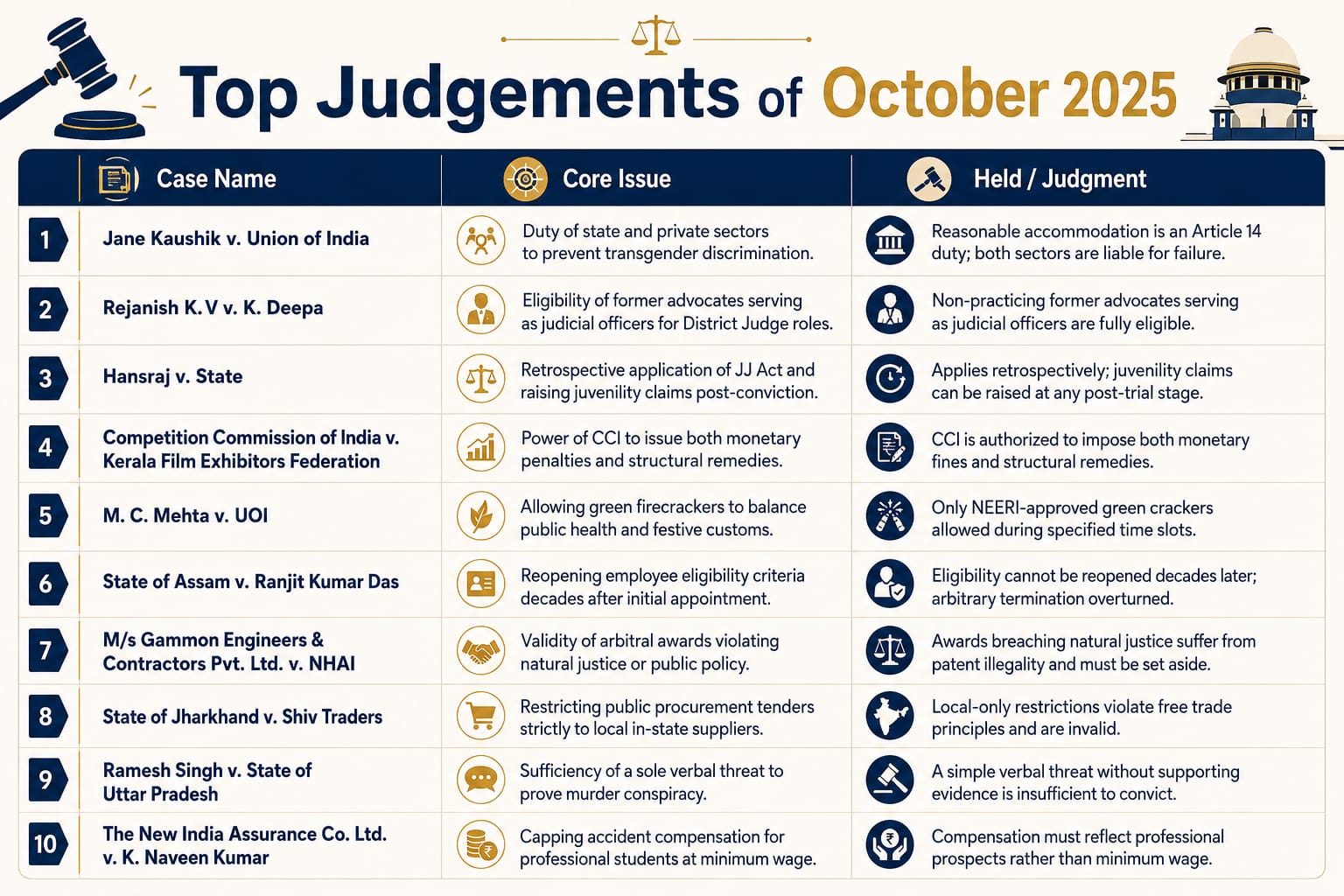
This article discusses the top judgments of October 2025 which covers a wide range of areas, including transgender rights, judicial appointments, juvenile justice, competition law, environmental protection, arbitration, public procurement, criminal conspiracy, and motor accident compensation.
Jane Kaushik v. Union of India ( 2025 INSC 1248)
Facts
A transgender woman who was a qualified teacher was treated unfairly by two private schools. At one of them she was made to resign after having worked for eight days, and at the other the job offer which had been made to her was withdrawn when it was discovered that she was a transgender person. Neither of the schools had the grievance redressal procedures that are required by the Transgender Persons (Protection of Rights) Act, 2019.
Issue
Whether the state and private organisations have a positive duty to prevent discrimination against transgender people, and whether the state's failure to implement the 2019 Act amounts to 'omissive discrimination’.
Judgment
The Supreme Court stated that ‘reasonable accommodation’ constitutes an implied duty under Article 14 and decided that private employers cannot use the distinction between the public and private sectors as a means of avoiding their responsibilities. It found both the schools and the Union/State governments liable for discrimination, the latter being liable for failure to prevent discrimination, and ordered compensation of ₹50,000 from each of them while also setting up an advisory committee to enforce the Act.
Rejanish K.V v. K. Deepa (2025 INSC 1208)
Facts
The criteria governing the appointment of District Judges under the ‘bar quota’ were brought into question, with a particular challenge being made to the precedent established in Dheeraj Mor v. High Court of Delhi (2020), which limited eligibility to advocates who were practicing at the time of appointment.
Issue
Is it permissible for judicial officers who have previously been advocates but are not at that moment engaged in practice to be appointed as District Judges under article 233 of the Constitution?
Judgment
The Constitution Bench, consisting of five judges, stated that Dheeraj Mor had not stated the correct legal principle. The Court decided that limiting appointments to advocates who are currently practicing is exclusionary and that former advocates who are serving as judicial officers are eligible, thus promoting competition and inclusivity in the higher judicial services.
Hansraj v. State (2025 INSC 1211)
Facts
A man who was 56 years old at the time of his conviction, for an incident that took place in 1981, brought a claim based on his youth many years after his trial.
Issue
Whether the Juvenile Justice (Care and Protection of Children) Act, 2000, applies retrospectively and whether a claim of juvenility can be made at any stage, even after a final conviction.
Judgment
The Supreme Court agreed that the Juvenile Justice Act should be applied retrospectively. It ruled that an assertion of juvenility may be made at any stage of the trial or even after the trial has been concluded, which results in the petitioner's release since the beneficial object of the Act applies in all such cases.
Supreme Court clarified the section 27 of Competition Act : Competition Commission of India v. Kerala Film Exhibitors Federation (2025 INSC 1161)
Facts
The Federation's members were fined and disqualified by the Competition Commission of India (CCI) for having entered into anti-competitive agreements, but the appellate tribunal cancelled these decisions and thus restricted the CCI's powers of remedial action.
Issue
Whether the CCI has the authority to impose both monetary fines and behavioural or structural remedies under section 27 of the Competition Act in order to end anti-competitive behaviour.
Judgment
The Supreme Court ruled that the CCI is indeed entitled to impose both monetary penalties and behavioural structural remedies and it reinstated the CCI’s orders, noting that effective remedies must provide for deterrence and strict adherence to competition law.
Green Firecrackers Case (Delhi-NCR) : M. C. Mehta v. UOI (2025 INSC 1233)
Facts
The Delhi-NCR area suffered from serious winter air pollution and as a result a total prohibition of firecrackers was imposed. Both manufacturers and citizens applied for permission to use low-emission alternatives in order to reconcile cultural customs with environmental worries.
Issue
Whether low-emission ‘green’ firecrackers can be permitted to balance public health concerns with regulated festive practices .
Judgment
The Supreme Court has decided that only green firecrackers which have been approved by the National Environmental Engineering Research Institute (NEERI) may be used, on the basis of scientific advice from NEERI and pollution data; however, their use is subject to strict time limits and strict enforcement conditions in order to protect public health.
The permitted time slots includes two durations of the day -
- 6 to 7 in the morning
- 8 to 10 in the evening
Reinstatement of lecturer terminated after 18 years : State of Assam v. Ranjit Kumar Das (2025)
Facts
A lecturer from Assam was made to leave his post after having served for 18 years because of alleged age irregularities, even though his records had been carefully checked at the time of his original appointment.
Issue
Whether the state can reopen the eligibility criteria and dismiss an employee many years after they were appointed when the records had already been verified and accepted.
Judgment
The Supreme Court required that the lecturer should be reemployed with his services continuing. It stated that the State cannot, decades later, re-open questions of eligibility, since such a move would be arbitrary, disruptive of the rights accrued through settled service, and a breach of natural justice.
Supreme Court held that Natural justice cannot be compromised in arbitral awards : M/s Gammon Engineers & Contractors Pvt. Ltd. v. NHAI (October 2025)
Facts
The arbitral award was contested on the grounds that it breached the principles of natural justice and public policy since it ignored substantial evidence and failed to give one of the parties a fair hearing.
Issue
It is questionable whether an arbitral award which violates natural justice or public policy can be regarded as unsustainable under section 34 of the Arbitration and Conciliation Act, 1996.
Judgment
The Supreme Court stated that awards which breach the principles of natural justice or public policy are not Sustainable, and it ruled that failing to hold a hearing or ignoring relevant evidence constitutes patent illegality, which means the award must be set aside.
State of Jharkhand v. Shiv Traders (October 2025)
Facts
The state of Jharkhand introduced a policy which limited public procurement tenders to suppliers who were based within the state.
Issue
The question is whether a state has the right to limit public procurement tenders to local suppliers, and if such a policy breaches the principles of free trade and non-discrimination as provided in Articles 301 and 304 of the Constitution.
Judgment
The Supreme Court invalidated the policy on the grounds that it breached the principles of free trade and non-discrimination; it decided that competitive bidding must be open to all eligible participants in India unless a restriction is clearly supported by law.
Ramesh Singh v. State of Uttar Pradesh (October 2025)
Facts
The man accused was found guilty of murdering on the basis of a verbal threat, with no overt act or any supporting evidence to back up the charge.
Issue
Is it enough, under Sections 120A and 302 of the IPC, for there to be only a verbal threat, with no overt acts or supporting evidence?
Judgment
The Supreme Court ruled that a simple verbal threat is not sufficient to establish a murder conspiracy; intention can only be shown by conduct which proves that the parties have met their minds. The conviction was overturned because there was a lack of corroborative evidence.
SC enhanced the compensation to the disabled CA student : The New India Assurance Co. Ltd. v. K. Naveen Kumar (October 2025)
Facts
A CA student became 100% disabled as a result of a motor accident, and the motor accidents tribunal granted him compensation based merely on the minimum wage, without taking into account his potential for higher future earnings.
Issue
Can accident compensation be limited to the minimum wage when it is shown that someone's future earnings could be higher given their professional qualifications and prospects?
Judgment
The Supreme Court decided that it cannot limit compensation to the minimum wage and that the tribunals should evaluate future income in a realistic way, taking into account the individual's prospects and qualifications, and thus increased the award beyond ₹60 lakhs to make the compensation just and fair.
Conclusion
These judgments are important for CLAT PG because they demonstrate how the Supreme Court applies constitutional values and statutory provisions to real-life disputes. The common thing between all the judgments is protection of fairness.
These judgments show how efficiently the court decided fairness in employment, judicial appointments, criminal trials, arbitration, public acquisition, and compensation claims.
Get case-law updates weekly
Join 10,000+ subscribers.
JU
Julie Nigam
Contributing author
Have a doubt about this judgment?Ask Doubts
