
Landmark Supreme Court Judgments of June 2025
Introduction
Although June 2025 was a short month for court sessions due to the Court observing partial working days, it still considered a number of significant issues involving personal liberty, bail, preventive detention, free speech, criminal law, family support and the independence of lawyers. A single theme emerges from the Court's judgments i.e. legal power must be exercised fairly and should not be used in a way that undermines fundamental rights.
The article looks at seven significant Supreme Court cases from June 2025. Five of the cases are reported judgments or substantive decisions, and the other two are important interim or procedural orders. It is useful to make this distinction since the major developments in June consisted of both final rulings and important orders.
Amlesh Kumar v. State of Bihar (2025 INSC 810) : Concerning narco-analysis and personal liberty
Facts
- An FIR was filed against Amlesh Kumar and his family following the disappearance of his wife, with the charges comprising dowry-related cruelty, kidnapping, assault and other offences.
- Amlesh provided an alternative version of the circumstances surrounding the disappearance.
- His application for bail was submitted to the Patna High Court, and during the hearing the investigating officer said that narco-analysis tests would be carried out on all the accused persons and possibly on the witnesses.
- The High Court agreed with this suggestion and postponed the proceedings.
Issue
Can a court allow the police to carry out narco-analysis when considering bail? And, Does an accused person have an absolute right to ask for a voluntary narco-analysis test?
Judgment
The Supreme Court cancelled the decision of the High Court. It stated that compulsory narco-analysis breaches both Article 20(3) and Article 21 of the Constitution. Citing the case of Selvi v. State of Karnataka, the Court affirmed the right against self-incrimination, the right to mental privacy and the right to personal liberty. A bail hearing does not give permission for a wandering investigation.
Although an accused can ask for a voluntary test at an appropriate stage in the trial, there is no automatic right to require such a test. The report on its own cannot establish either guilt or innocence.
Rakhi Sadhukhan v. Raja Sadhukhan : Fair permanent alimony
Facts
The appellant was divorced, had never married again and was living on her own. The Calcutta High Court had set the amount of permanent alimony at ₹20,000 a month. She contended that this sum did not properly take into account her financial needs and the standard of living that had existed during the marriage.
Issue
How should the court determine the amount of alimony in a case where a divorced woman is still financially dependent and the cost of living has gone up?
Judgment
The Supreme Court raised the amount to ₹50,000 a month, taking into account the woman’s ongoing financial dependence, the effects of inflation, her standard of living and the need for some reasonable future security. The ruling serves as a reminder to the courts that maintenance should be realistic and not just symbolic.
Aftab v. State of Uttar Pradesh : Liberty cannot be taken away on the grounds of paperwork.
Facts
Although Aftab had obtained bail from the Supreme Court, he still stayed in prison for an extra 28 days because the jail authorities depended on the fact that a specific subsection of the statute was omitted from the release documents, even though the order did contain enough information to identify both the case and the prisoner.
Issue
Can the prison authorities refuse to set a person free who has been granted bail because of a small technical error in the release order?
Order
The Court described the situation as a “travesty of justice” and stated that technical objections cannot override a clear decision aimed at restoring liberty. It ordered a judicial inquiry and instructed Uttar Pradesh to pay ₹5 lakh as provisional compensation.
The Court also emphasized the importance of sensitising prison officers. The ruling gives practical application to Article 21 and to the principle that liberty cannot be placed on the alter of unnecessary technicalities.
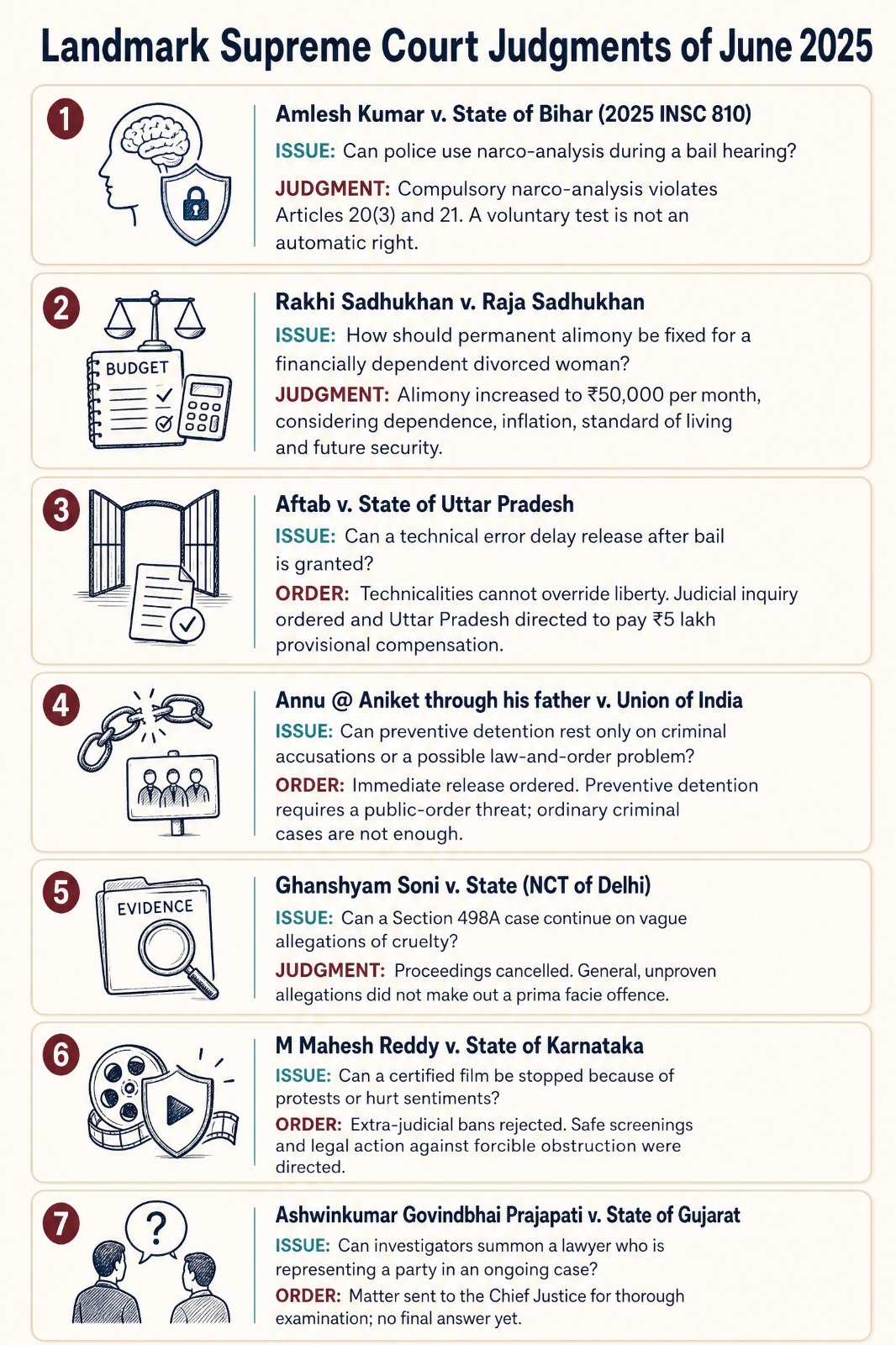
Annu @ Aniket through his father v. Union of India : The limits on preventive detention
Facts
A young law student from Madhya Pradesh had been held in custody on the grounds of Section 3(2) of the National Security Act, 1980. He had previously been the subject of a number of criminal cases, having been acquitted in certain ones and granted bail in others.
In this particular case, he was already in judicial custody in relation to an alleged assault on a professor. Even though bail had become available to him, he still remained in detention under the NSA.
Issue
Could preventive detention be given on the grounds that a person had been accused in criminal cases or might cause a law-and-order problem?
Order
The Supreme Court ordered that he should be released immediately and separated ‘law and order’ from ‘public order'. Since preventive detention is an exceptional power it may only be exercised in cases where there is a threat to public order as required by statute. Ordinary criminal charges are not sufficient.
The Court also criticised the fact that a person who was already in judicial custody had been detained and pointed out the flaws in the way his representation had been handled.
Ghanshyam Soni v. State (NCT of Delhi) : A safeguard against cases based on vague notions of cruelty
Facts
A complaint was filed under Section 498A of the Indian Penal Code against a husband and his family members. The allegations of cruelty were general and did not include any specific supporting facts. The case continued even though the trial court had acquitted the accused, since the higher court had intervened in that decision.
Issue
Can a criminal case based on Section 498A go on when the allegations are unclear and do not establish a prima facie case of cruelty?
Judgment
- The Supreme Court cancelled the proceedings, stating that general and unproven allegations are not sufficient in themselves to establish a prima facie offence.
- The Court also examined the issue of limitation and, using the power granted to it under Article 142, achieved a complete justice.
- The decision does not diminish the protection against real domestic cruelty, rather, it stops the criminal law from being applied in cases where the essential elements of the offence are missing.
M Mahesh Reddy v. State of Karnataka : Film release and the rule of law
Facts
The film Thug Life had obtained certification from the Central Board of Film Certification, but its show in Karnataka was halted following remarks made by actor Kamal Haasan on the relationship between Kannada and Tamil. This led to protests and calls for an apology, with a petition being submitted to request that the film be screened safely.
Issue
Can a state or a private organization halt a certified film since some people say that their feelings have been hurt or because they threaten to stage protests?
Order
The Supreme Court criticized the extra-judicial ban and stated that it is not for mobs to take the law into their own hands. On 19 June the Court noted the Government’s promise to ensure safe screenings and ordered that suitable legal action should be taken against anyone who tried to forcibly prevent the release.
This safeguarded the freedom of speech and expression provided for in Article 19(1)(a) while at the same time reminding the State that it had to control violence and not yield to it.
Ashwinkumar Govindbhai Prajapati v. State of Gujarat : Can investigating agencies summon lawyers?
Facts
The case did raise a serious issue concerning investigating authorities calling in a lawyer who was acting for one of the parties in a case which was still ongoing. The question was, that such a move could disrupt the lawyer’s professional obligations and compromise the fairness of the judicial process.
Issue
Can an investigating body call in a lawyer who is acting for one of the parties in a case that is currently underway?
Order
The Supreme Court regarded the matter as one of public importance and sent it, together with other related questions, over to the Chief Justice for thorough examination. The issue concerned the appropriate balance between investigation, the relationship between a lawyer and his client, and the ability of the legal profession to function independently. This was an important procedural ruling and not a final answer to all the questions.
Conclusion
The decisions of the Supreme Court in June 2025 demonstrate that constitutional rights should be significant in ordinary legal proceedings. These cases also illustrate the importance of case law in that a constitutional principle is easier to understand when one can see how it impacts a real person.
When preparing for the CLAT PG, you should remember the constitutional topics such as Articles 19, 20(3), 21, 22 and 142, the distinction between law and order and public order, and the Court’s ongoing attempt to strike a balance between individual liberty and legitimate state action.
Get case-law updates weekly
Join 10,000+ subscribers.
JU
Julie Nigam
Contributing author
Have a doubt about this judgment?Ask Doubts
