
Top 5 Supreme Court Judgments: August 2026
August 2026 gave law students something rare. A nine judge bench settled a five decade old labour law debate. A two judge bench refused to change how India carries out the death penalty. Another bench rewrote the rules on black money in elections.
This month deserves a proper read for CLAT PG 2027 aspirants, not a quick scroll. Below are five judgments picked for their relevance to Constitutional, Labour, Criminal, Election, and Company Law. Each comes with its citation, the provision involved hyperlinked to its bare text, and a clear statement of what the Court finally held.
State of Uttar Pradesh v. Jai Bir Singh (2026 INSC 897)
This case asked a question that has troubled Indian labour law since 1978. What exactly is an industry under Section 2(j) of the Industrial Disputes Act, 1947?
The dispute began over whether the Social Forestry Department of Uttar Pradesh could be treated as an industry. If yes, its workers would get protections under the Industrial Disputes Act. If not, they would not.
In 1978, a seven judge bench in Bangalore Water Supply and Sewerage Board v. A. Rajappa answered this broadly. It laid down a Triple Test. Any systematic activity, carried out with employer employee cooperation, for producing or distributing goods or services, would count as an industry. Profit motive did not matter.
Many judges later felt this test was too wide. A reference was eventually sent to a nine judge bench, the largest in Indian legal history on a single statutory question.
Held
On 20 August 2026, the bench held that the Triple Test will continue to govern all disputes still pending under the old Industrial Disputes Act, 1947, which now stands repealed.
It clarified something important. The Industrial Relations Code, 2020, has its own definition of industry under Section 2(p), which must be read on its own terms, not tied to Bangalore Water Supply.
For CLAT PG, remember this simply. Old disputes follow the old test, new disputes follow the new Code.
Rishi Malhotra v. Union of India (2026 INSC 873)
This case challenged something most people never question. Why does India execute prisoners by hanging?
Senior Advocate Rishi Malhotra filed this PIL in 2017. He argued execution by hanging under Section 354(5) of the Code of Criminal Procedure, 1973 was cruel and violated Articles 21 and 14. He sought alternatives such as lethal injection, shooting, or electrocution.
This provision now continues as Section 393(5) of the Bharatiya Nagarik Suraksha Sanhita, 2023, since the CrPC has been replaced.
The precedent standing in the way was Deena v. Union of India, a 1983 Constitution Bench ruling upholding hanging as constitutional. A smaller bench cannot overturn a larger bench's ruling. It can only refer the question onward if there is compelling reason to doubt the earlier view.
Held
On 18 August 2026, Justices Vikram Nath and Sandeep Mehta dismissed the petition. The Court found no scientific or empirical material showing that lethal injection or any other method is genuinely less painful than hanging. It refused to refer Deena to a larger bench.
Importantly, the Court left the door open. It said the Union Government remains free to set up an expert committee to review the method of execution if future scientific evidence justifies a change.
For your exam notes, this case is a clean example of stare decisis, the principle that a smaller bench must respect a larger bench's binding precedent absent compelling new material.
State of Karnataka v. Prathik Parasrampuria (2026 INSC 868)
This case traces back to the 2014 Lok Sabha bye election from the Bellary constituency in Karnataka.
An Election Commission flying squad raided the respondent's premises on a tip off. They seized a laptop, cheque books, a pen drive, and over Rs 20 lakh in cash, allegedly meant to bribe voters. An FIR was registered under Sections 171E and 188 of the Indian Penal Code, 1860.
The Karnataka High Court quashed this FIR in 2015, holding that the complaint failed to specify whom the accused intended to bribe or how.
The State appealed to the Supreme Court, which went further than the individual case and called for nationwide data on election related FIRs and their outcomes.
Held
On 17 August 2026, a bench of Justices Sanjay Karol and N. Kotiswar Singh issued a seven point directive covering search and seizure procedures during elections. Seizures above Rs 10 lakh must now be reported to Income Tax authorities. Withdrawal of any criminal case against a candidate now requires mandatory High Court approval. Trial courts must dispose of pending election offence cases with real urgency.
The Court observed that once external factors like cash or gifts influence a voter's choice, that choice is no longer truly the voter's own.
This case connects two areas at once, the Representation of the People Act, 1951, and criminal law on bribery.
M/s Tata Steel Limited v. Union of India (2026 INSC 920)
This case is a useful entry point into GST law for CLAT PG aspirants who find tax topics intimidating.
The GST Department issued a show cause notice to Tata Steel for financial years 2018 19 to 2020 21, following an audit objection about mismatched input tax credit. It invoked Section 74 of the Central Goods and Services Tax Act, 2017, allowing a five year limitation instead of the usual three years under Section 73.
Section 74 can only be invoked where there is fraud, wilful misstatement, or suppression of facts to evade tax. Tata Steel argued the notice used these words without stating any facts to support them.
Held
On 25 August 2026, Justices J.B. Pardiwala and K. Vinod Chandran agreed. The Court set aside the notice, holding that merely reciting the words fraud or suppression cannot justify extended limitation. The notice must disclose facts supporting the allegation, though the Department may issue a fresh notice with genuine grounds.
For your revision, remember the difference cleanly. Section 73 applies to ordinary short payment of tax. Section 74 applies only where the Department can show real evidence of culpable conduct, not just the label.
Securities and Exchange Board of India v. Rajeev Vasant Sheth (2026 INSC 826)
This case is about insider trading, and it is a strong pick if your exam touches company or securities law.
Rajeev Vasant Sheth was Chairman and Managing Director of Tara Jewels Limited, a listed company. In 2017, while its financials were deteriorating sharply, Sheth and his daughters sold a large chunk of their shareholding while holding unpublished price sensitive information, avoiding losses of roughly Rs 1.38 crore.
SEBI's Whole Time Member held this to be insider trading under the SEBI Prohibition of Insider Trading Regulations, 2015 and imposed penalties. The Securities Appellate Tribunal reversed this, accepting that the sale served a genuine corporate purpose, relying on an older defence from Rakesh Agrawal v. SEBI under the 1992 regulations.
Held
On 11 August 2026, Justices Sanjay Karol and N. Kotiswar Singh restored SEBI's order. Under Regulation 4(1) of the 2015 Regulations, once a person holding unpublished price sensitive information trades, insider trading is presumed. Neither intention nor the later use of proceeds makes any difference.
The Court held the legitimate corporate purpose defence does not survive under the stricter 2015 Regulations. It reduced one penalty from Rs 25 lakh to Rs 10 lakh but kept liability intact.
This case is a good reminder that older case law does not automatically survive when the underlying regulation changes.
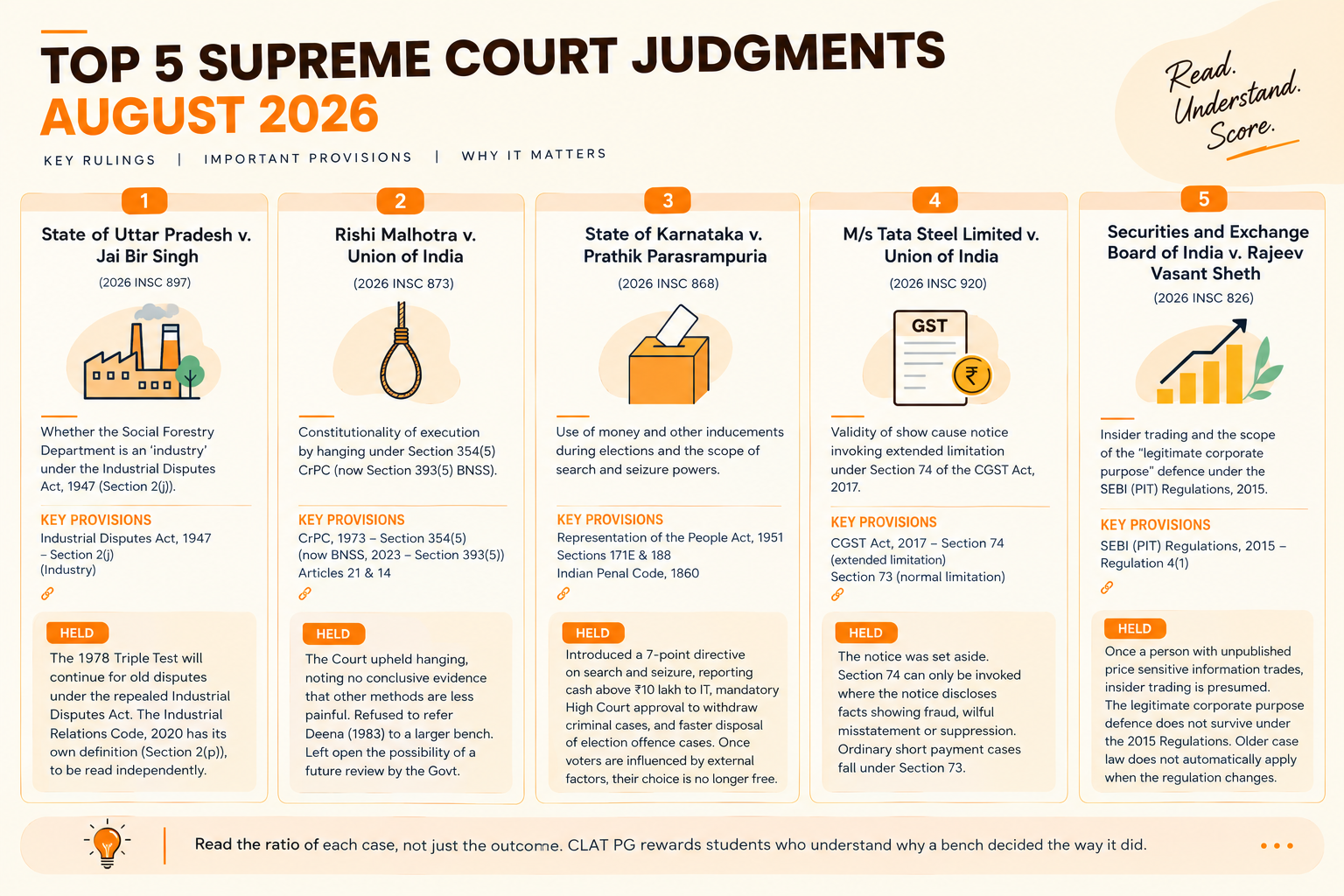
Read the ratio of each case, not just the outcome. CLAT PG rewards students who understand why a bench decided the way it did, and these five judgments give you real practice at exactly that.
Get case-law updates weekly
Join 10,000+ subscribers.
SH
Shruti chauhan
Contributing author
Have a doubt about this judgment?Ask Doubts
