
Landmark Cases on Right to Die Under Article 21 of the Constitution of India
Can the right to life also mean the right to end that life? This question has puzzled Indian courts for nearly four decades, producing one of the most fascinating and evolving lines of judgments in constitutional law on Right to Die under Article 21.
Article 21 of the Constitution simply says that no person shall be deprived of life or personal liberty except according to procedure established by law. From this single sentence, courts have had to work out whether a person can choose to die, and if so, under what circumstances.
This article walks you through every major judgment on this journey, from the earliest High Court rulings to the most recent Supreme Court decision in 2026.
Where the Debate Began: Maruti Sripati Dubal
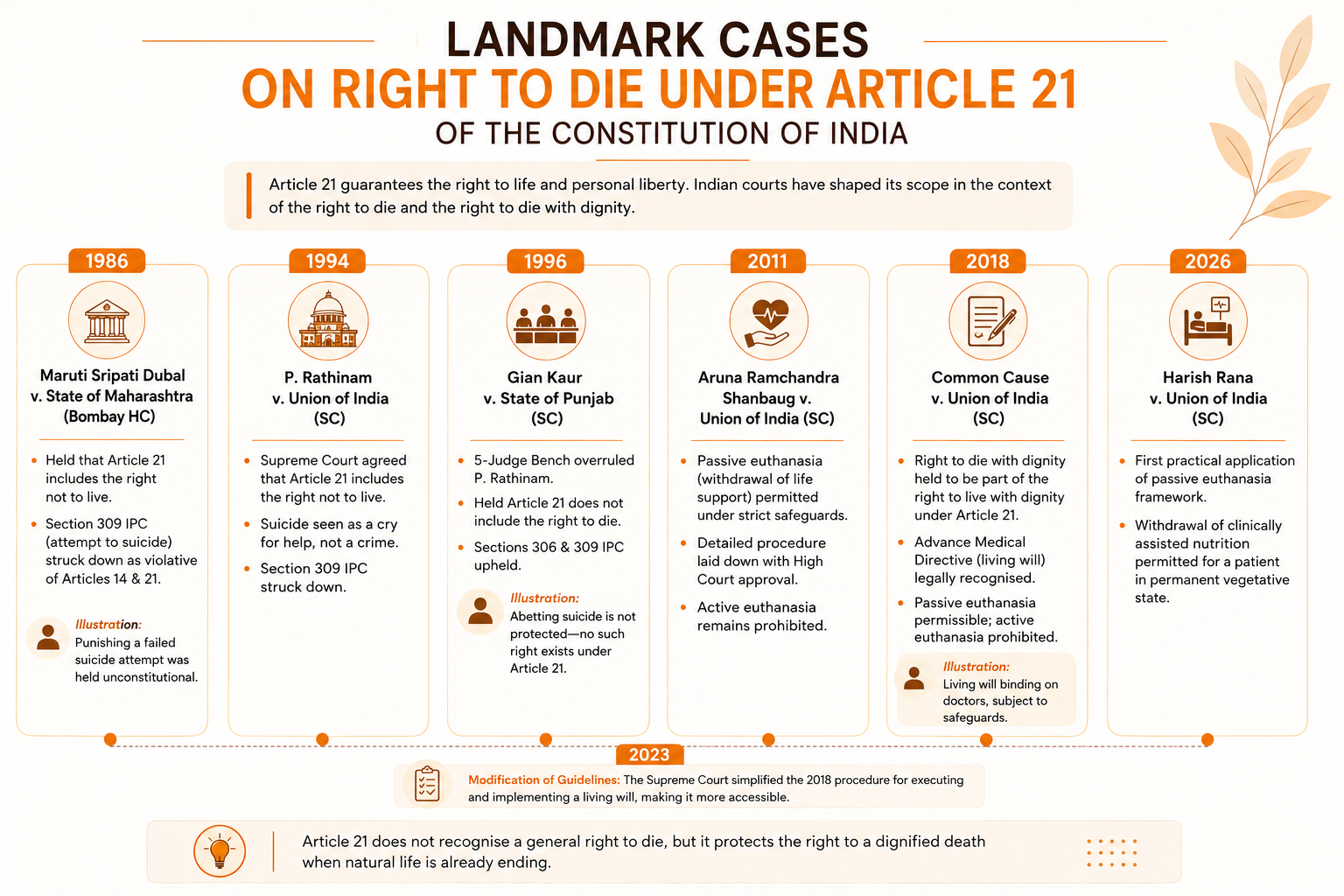
The story starts with Maruti Shripati Dubal v State of Maharashtra (1986), decided by the Bombay High Court. A police constable facing prosecution under Section 309 of the Indian Penal Code, for attempting suicide, challenged the constitutionality of that provision.
The Bombay High Court held that the right to life under Article 21 logically includes the right not to live. Justice Sawant reasoned that just as a person has the freedom to do or not do a lawful act, life should include the freedom to end it. Section 309 IPC was struck down as violative of Articles 14 and 21.
Illustration: A person suffering from unbearable circumstances attempts to end their life but survives. Under this ruling, prosecuting that person for the attempt itself was held to be unconstitutional, since punishing a failed suicide attempt was seen as adding cruelty to an already tragic situation.
The Supreme Court Agrees: P. Rathinam v Union of India
In P. Rathinam v Union of India (1994), two petitioners who had faced prosecution under Section 309 IPC challenged its validity before the Supreme Court itself.
A two judge bench, agreeing with the Bombay High Court's reasoning in Maruti Sripati Dubal, held that the right to life under Article 21 includes the right not to live. The Court described suicide as a cry for help rather than a crime, and struck down Section 309 IPC as unconstitutional.
This was a significant moment. For the first time, the Supreme Court itself had recognised that Article 21 could be read to include a right to die, at least in the specific context of attempted suicide.
The Reversal: Gian Kaur v State of Punjab
Just two years later, a much larger bench overturned this position. In Gian Kaur v State of Punjab (1996), the appellants had been convicted under Section 306 IPC for abetting the suicide of their daughter in law.
They argued that if the right to die was part of Article 21, as held in P. Rathinam, then helping someone exercise that right could not be a crime either, making Section 306 IPC unconstitutional as well.
A five judge Constitution Bench firmly rejected this reasoning. The Court held that the right to life is a natural right, while suicide is an unnatural termination of that life, and the two cannot be treated as extensions of each other. The Court overruled P. Rathinam, holding that Article 21 does not include the right to die, and upheld both Sections 306 and 309 IPC as constitutionally valid.
Illustration: Under this ruling, a person who abets another's suicide, for instance by supplying poison with full knowledge of the intent, cannot claim protection by arguing that they were merely helping the victim exercise a constitutional right, because no such right exists under Article 21.
However, the Gian Kaur bench added an important nuance. It observed that the right to live with dignity may extend to a right to die with dignity, particularly where death is already imminent due to terminal illness. This single observation planted the seed for everything that followed in the euthanasia debate.
From Suicide to Euthanasia: Aruna Shanbaug's Case
The next major development came through a very different and deeply moving set of facts. In Aruna Ramchandra Shanbaug v Union of India (2011), a nurse at Mumbai's KEM Hospital had remained in a persistent vegetative state for over three decades following a brutal assault in 1973.
Journalist Pinki Virani, acting as her next friend, filed a petition seeking permission to withdraw Aruna's life support, arguing this would allow her to die with dignity rather than continue in a state with no hope of recovery.
The Supreme Court declined to permit euthanasia in Aruna's specific case, largely because the hospital staff who had cared for her for decades opposed the withdrawal of support. However, the Court made a much larger and more lasting ruling on the law itself.
It held that passive euthanasia, meaning the withdrawal of life sustaining treatment to allow a natural death, could be permitted in India under strict judicial safeguards. The Court laid down a detailed procedure requiring approval from the jurisdictional High Court, acting under its parens patriae power, based on the opinion of a medical board and consultation with the patient's relatives.
Importantly, the Court read the earlier Gian Kaur observation about dignified death as approval for this approach, even though that reading was later questioned. This judgment marked the first formal legal recognition of passive euthanasia in India, though active euthanasia, meaning the deliberate administration of a lethal substance, remained firmly prohibited.
The Turning Point: Common Cause v Union of India
The framework from Aruna Shanbaug still required court approval on a case by case basis, which was slow and impractical for families facing such situations. This gap led to Common Cause v Union of India (2018).
A registered society filed a public interest petition asking the Supreme Court to recognise the right to die with dignity as a fundamental right, and to legally validate the concept of a living will, also called an advance medical directive.
A five judge Constitution Bench, led by then Chief Justice Dipak Misra, unanimously held that the right to die with dignity is an intrinsic part of the right to live with dignity under Article 21. The Court clarified that a life prolonged by artificial means, against the patient's wishes, in a state with no chance of recovery, does not amount to the dignified life the Constitution protects.
The Court legally recognised the advance medical directive for the first time, allowing a mentally competent adult to specify in advance the circumstances under which they would want life support withdrawn if they later became incapable of making that decision themselves.
Illustration: A person diagnosed with a progressive illness can now execute a living will, stating that if they later enter an irreversible vegetative state, doctors should not use extraordinary artificial means to keep them alive. This directive is now legally binding on treating physicians, subject to the safeguards the Court prescribed.
The Court also drew a clear line. Passive euthanasia was declared legally permissible, while active euthanasia remained a criminal act under Indian law.
Simplifying the Procedure: The 2023 Modification
The original 2018 guidelines for executing and implementing a living will were criticised for being too cumbersome, involving multiple layers of medical boards and magisterial witnessing. In January 2023, the Supreme Court, acting on an application by the Indian Society for Critical Care Medicine, modified its own 2018 guidelines to simplify this procedure.
The revised process reduced the number of witnesses required, streamlined the medical board approval process, and removed the earlier requirement of District Court involvement for authenticating the directive, making the entire mechanism more accessible for ordinary patients and families.
The First Real Application: Harish Rana v Union of India
For years, the passive euthanasia framework existed largely on paper. That changed with Harish Rana v Union of India, decided by the Supreme Court on March 11, 2026.
Harish Rana had remained in a permanent vegetative state for over thirteen years following a traumatic brain injury sustained in 2013. The Supreme Court permitted the withdrawal of clinically assisted nutrition and hydration being administered through a surgically installed feeding tube, applying the very framework laid down in Common Cause.
This case is widely regarded as the first practical implementation of India's passive euthanasia framework in an individual case, showing that the legal principles developed since Gian Kaur have moved from theory into real, compassionate practice.
Conclusion
The journey from Maruti Sripati Dubal to Harish Rana shows how Indian constitutional law can evolve carefully over decades, balancing the sanctity of life with genuine human compassion. Article 21 still does not recognise a general right to die, but it firmly protects the right to a dignified death when natural life is already ending.
Understanding this progression, case by case, gives you far more than a list of citations. It gives you a clear picture of how Indian courts think through some of the most sensitive questions a legal system can face.
Get case-law updates weekly
Join 10,000+ subscribers.
SH
Shruti chauhan
Contributing author
Have a doubt about this judgment?Ask Doubts
