
Online Certificate Course on Technology Laws by Lawctopus Law School [REVISED & UPDATED; May 5 – July 5]: Register by May 5!
About Lawctopus Law School
Since March 2020, Lawctopus Law School has taught a wide range of skills to over 14,000+ law students, young lawyers, professionals, academicians, and business people in the last 3 years.
Over 1000 students have given our courses an average rating of 91/100. Not only are they well-rated (we are open to independent review), our courses come with a ‘warm’ learning experience!
About Technology Law Course [Revised & Updated]
What is Technology Law?
The Technology Law landscape has witnessed tremendous growth over the years, with the advent of new-age technologies and social media. These new systems have changed how we communicate!
While innovation in this sector has introduced several new products and services, it has also given rise to new challenges across different media – be it television, print, mobile devices, or the Internet.
Technology laws govern the movement of communications across these different platforms.
Why is it important?
The importance of Technology Law in modern society has recently grown exponentially. We all know how valuable technology is, and how it has shaped our lives, in every manner possible.
Further, with the development of the mobile phone and broadband internet, governments, institutions, and companies are now investing in technology, more than ever. Its share in the economy is rapidly growing, and innovation is happening every day.
Hence, laws regulating technology are also catching up. Naturally, with everything being reliant on technology, this is definitely an exciting area of law to be associated with!
Why should you be a Technology Lawyer?
Lately, work has been flowing in from all sectors – be it online aggregators, e-commerce, digital payments, cross-border trading, data privacy, blockchain and cryptocurrency, the export of tech services, drone regulations, regulations of automated vehicles and other robots, cybersecurity – and legal issues pertaining to many such key technological developments.
If you get excited by such new technology and the changing world around us, then Tehnology Law could offer you great opportunities!
It goes without saying that Technology Law is constantly evolving, keeping everyone – from lawyers to entrepreneurs, to politicians – on their toes. Hence, it is extremely valuable to develop legal expertise in this domain, as digital disruption continues.
Accordingly, career prospects in Technology law have increased astronomically, and there exist limitless requirements for legal advice on these issues by all kinds of industries, start-ups, law firms, policy houses, and even governments!
Sounds interesting? Want to know more about this area of law?
Click here to register.
Our online certificate course on ‘Technology Laws’ will teach you the basic, as well as the advanced concepts of Technology law.
Not only will you get a grip of the fundamentals, you will also be taught the nuances of the subject, from an extremely practical perspective.
This course is a good mix of rigorously researched reading modules, engaging weekly live lectures, and useful assignments (with individual, personalized feedback).
Most importantly, our course will be delivered with utmost warmth and care!
Designed for law students and young lawyers, this intensive 2-month course will ensure that you know everything there is to know about this emerging, exciting, and futuristic area of law.
At the end of this course, our aim is that law students perform well in their Technology law internships and young lawyers to become well-versed in this fast-growing subject area to secure further career opportunities.
We have revised and updated the course with the recent technological and legal developments!
Course Structure
This course holistically covers all essential aspects of this subject area – be it an introduction to Technology Laws, fintech regulations, cryptocurrencies, privacy and data protection, e-commerce, telecom regulations, the liability of intermediaries and content moderation, media and entertainment laws, as well as emerging technologies.
A brief overview of the course structure is given as follows:
Module 1: Introduction to Technology Law
This module covers what Technology laws are, the role of Technology lawyers, and the various practice areas in this field. It also covers practical aspects, such as research methodologies for Technology law practitioners, sources of research, as well as essential know-how for budding lawyers in this field.
Module 2: Fintech
This module introduces the concept of fintech, as well as delves into the regulatory framework for digital products and services. It also discusses prepaid payment instruments, payment gateways and aggregators, payment banks, UPIs, digital and P2P lending, and other such regulatory components.
Module 3: Fintech (Cryptocurrencies)
This module briefly discusses the concept of cryptocurrencies, their legality, as well as Indian case laws on this issue.
Module 4: Privacy and Data Protection
This module traces the evolution of the Right to Privacy in India by analysing various case laws, legislations, and general jurisprudence. It also covers the recently introduced Digital Personal Data Protection Act, 2023. It also discusses the position adopted by various foreign jurisdictions, specifically in the EU and USA. The module also covers a discussion on EU GDPR.
Module 5: E-Commerce, Intermediary Liability, and Content Moderation
This module discusses the liability of intermediaries, as well as take-down mechanisms. It delves into the Information Technology Act 2000, the Information Technology (Intermediary Guidelines and Digital Media Ethics Code) Rules, 2021, and blocking rules under the same. This module also touches upon e-commerce and over-the-top or ‘OTT’ services.
Module 6: Telecom Regulations
This module discusses the regulation of telecommunications in India by exploring key laws, as well as government ministries. It also deliberates upon the licensing regime, interesting case laws, the network neutrality debate in India, as well as the Other Service Provider regime.
Module 7: Media and Entertainment Laws
This module discusses regulations governing print media, cable television and radio, media transactions. It also probes into broadcast, advertising, and new media regulations.
Module 8: Emerging Technologies
This module touches upon fascinating, upcoming, disruptive technologies, such as 5G, artificial intelligence and machine learning, blockchain, drones, Internet of Things, Augmented, Virtual, and Mixed Reality, and many other emerging technologies. It discusses the applicable regulations and the need for upcoming laws in this regard.
Sounds exciting?
Click here to register.
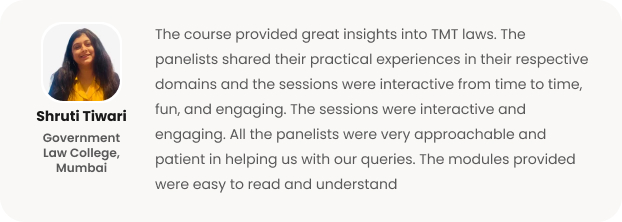
What our Learners say


Course Details
Duration: 8 weeks.
Course fee: Rs. 4900 (inclusive of GST).
Mode of learning:
- Completely online and self-paced. (Except for the weekly live sessions. The recordings of the live sessions are also available)
- Detailed reading modules and resources have been revised and updated to keep pace with the recent developments in technology and law
- Weekly live lectures that build on the reading modules, clear your doubts, explain assignments, etc.
- An online forum for doubt clarification
- Regular communication over WhatsApp and Email so that you do not miss any live class or assignment deadlines. We deeply ‘care’ for your learning.
We go out of our way to support our students!
- Live orientation session which tells you about our platform and how to make full use of the course.
- A broadcast-only WhatsApp group to check updates easily and fast.
- Access to recorded versions of the live lectures in case you miss attending them live!
Add-on benefits:
- Get a certificate issued by Lawctopus Law School after the successful completion of the course. (Don’t worry, if you put in a sincere effort in this course, you’ll get a certificate. We are liberal in our markings and give you a second chance. We do want sincere efforts from our learners).
- Free career counselling, CV, and career guidance webinars for everyone.
- Get preferable internship slots (for the top-performing 2-4 students in each batch).
Click here to register.
Need help to decide? Feel free to reach out to us on these channels.
Phone calls/WhatsApp Number: 935 968 4056 (Ishani Patankar, Counsellor, Lawctopus Law School)
Email: courses@lawctopus.com
Subscribe for updates
Join 10,000+ subscribers.
AD
Adtiya Aryan
Contributing author
Have a doubt about this?Ask Doubts
