For many law graduates, NALSAR, Hyderabad is one of the most attractive choices for postgraduate legal study. But getting there requires more than knowing that NALSAR is a leading law school. A candidate must understand the correct entrance paper, eligibility rules, counselling process, expected rank, fee structure and the academic nature of the programme. This guide focuses mainly on one year NALSAR LL.M. through CLAT PG. It also explains the university’s ranking, course structure, specialisation options, recent General-category rank trend and the separate two-year LL.M. in Insolvency and Bankruptcy Laws.
NALSAR University of Law was established on 5 July 1998 under the National Academy of Legal Studies and Research University Act, 1998, also known as Act 34 of 1998. Its permanent campus is at Justice City, Shamirpet, Hyderabad. The university was created with an emphasis on constitutionalism, the rule of law, legal education and social justice.
NALSAR is recognised under Sections 2(f) and 12(B) of the University Grants Commission Act. The university has also received NAAC A++ accreditation with a score of 3.52 out of 4.00. Its postgraduate law programme is therefore not merely a professional qualification course; it is designed around advanced study, research and academic engagement.
NALSAR’s National Ranking
NALSAR University of Law was ranked third in India in the NIRF 2025 Law category, with a score of 79.50. This is the university’s institutional ranking. It should not be confused with a CLAT PG admission rank.
The NIRF rank tells us how the institution is placed nationally on factors such as teaching, learning resources, research, graduation outcomes, outreach and perception. The CLAT PG rank, usually expressed as an All India Rank or AIR, determines whether a candidate may receive a seat through the CLAT counselling process.
Why choose NALSAR for an LL.M.?
NALSAR is a strong choice for students who want postgraduate legal education with a research and academic focus. Its reputation, NIRF position and residential campus provide a useful base for students considering teaching, judicial service preparation, policy work, doctoral research or specialised legal practice. The one-year programme also allows students to study advanced subjects without committing to a two-year degree.
The course is particularly suitable for students who enjoy reading judgments, working with legal theory and writing a dissertation. Its elective-based structure allows a student to build depth in areas such as public law, corporate and commercial law, criminal law, intellectual property or international trade. The programme is academically oriented and should not be viewed simply as a guaranteed law-firm placement route. It is a better option for students seeking admission at NALSAR LL.M. through CLAT PG.
Which exam is required for the NALSAR one-year LL.M.?
Candidates seeking admission at NALSAR LL.M. through CLAT PG must appear for and qualify in CLAT PG examination. There is no separate NALSAR entrance paper for this programme. After the CLAT PG result, candidates participate in the Consortium of NLUs counselling and allotment process, where they submit their preferences and complete the required admission steps if NALSAR is allotted.
Candidates should always check the notification for the relevant admission year because dates, fee deadlines and seat matrices can change.
CLAT PG paper pattern for NALSAR aspirants
The CLAT PG paper contains 120 objective questions for 120 marks and must be completed in two hours. Each incorrect answer attracts a negative marking of 0.25 marks. The paper is not limited to constitutional law.
The current CLAT PG eligibility framework requires a candidate to have an LL.B. degree or an equivalent law qualification with at least 50% marks. The minimum is 45% for candidates belonging to SC, ST and PwD categories. There is no upper age limit.
Candidates appearing in the final year of their LL.B. may also apply, but they must produce proof of passing the qualifying examination within the deadline prescribed by the Consortium and NALSAR. A candidate should read the admission notification carefully rather than rely only on the previous year’s rules.
NALSAR’s one-year LL.M. has 66 seats. Seventy-five per cent of the seats are earmarked for All India candidates and 25% for Resident Students of Telangana. The applicable category reservations and horizontal reservations, including women and PwD reservations where provided in the official seat matrix, also affect the final cut-off.
How long is the NALSAR LL.M. through CLAT PG?
The main NALSAR LL.M. through CLAT PG is a one-year programme, full-time LL.M. It is not a two-year CLAT PG course. Its academic design combines taught courses with a dissertation, making it particularly suitable for students interested in advanced legal research, teaching, policy work, judicial service preparation or further academic study.
The programme structure described by NALSAR carries 36 credits:
Component
Requirement
Credits
Mandatory courses
3 courses
12
Optional courses
LL.M. Specialisations Offered by NALSAR
Students considering NALSAR LL.M. through CLAT PG can explore different areas of legal specialisation depending on their academic interests and career objectives. The principal areas mentioned by NALSAR include:
Corporate and Commercial Laws
Criminal Law
Intellectual Property Rights
International Trade and Business Laws
Public Law and Legal Theory
General LL.M.
NALSAR LL.M. through CLAT PG fees
For the 2026–27 academic year, the official fee document lists the total one-year LL.M. fee as follows:
Category
Total fee
General candidates
₹2,15,000
SC/ST candidates
₹2,09,000
The total includes tuition, academic charges, user charges, one-time payments, mess advance and refundable deposits. The General-category structure includes tuition of ₹65,000, other academic charges of ₹13,000, user charges of ₹67,000, one-time payments of ₹10,000, mess advance of ₹40,000 and refundable deposits of ₹20,000.
The amount paid during CLAT counselling or seat confirmation may be adjusted against the university fee. Candidates should verify the payable balance, refund conditions and payment deadlines in the fee notice for their admission year. The fee may also be revised in a later cycle.
NALSAR CLAT PG cut-off: What rank is safe?
There is no permanently safe rank for NALSAR. The closing rank changes according to the number of candidates, paper difficulty, seat preferences, category, Telangana resident allocation, counselling round, withdrawals and the number of candidates who accept other offers. A competitive CLAT PG rank is essential for securing NALSAR LL.M. through CLAT PG, although the final admission outcome depends on category, seat availability and counselling movement.
For a General-category All India candidate, AIR under 100 should be treated as a strong target and a useful safety buffer, not as a guarantee. AIR 100–150 can remain highly competitive, particularly if the candidate participates in all applicable counselling rounds. AIR 150–250 may still have a chance in a year when the list moves, but it should not be treated as a secure NALSAR outcome.
A candidate should also distinguish between an opening rank and a closing rank. An opening rank shows the position of the first candidate admitted or allotted in a category while a closing rank shows the last reported rank at a particular stage. Neither number predicts the result for every candidate.
Four-year NALSAR CLAT PG rank trend
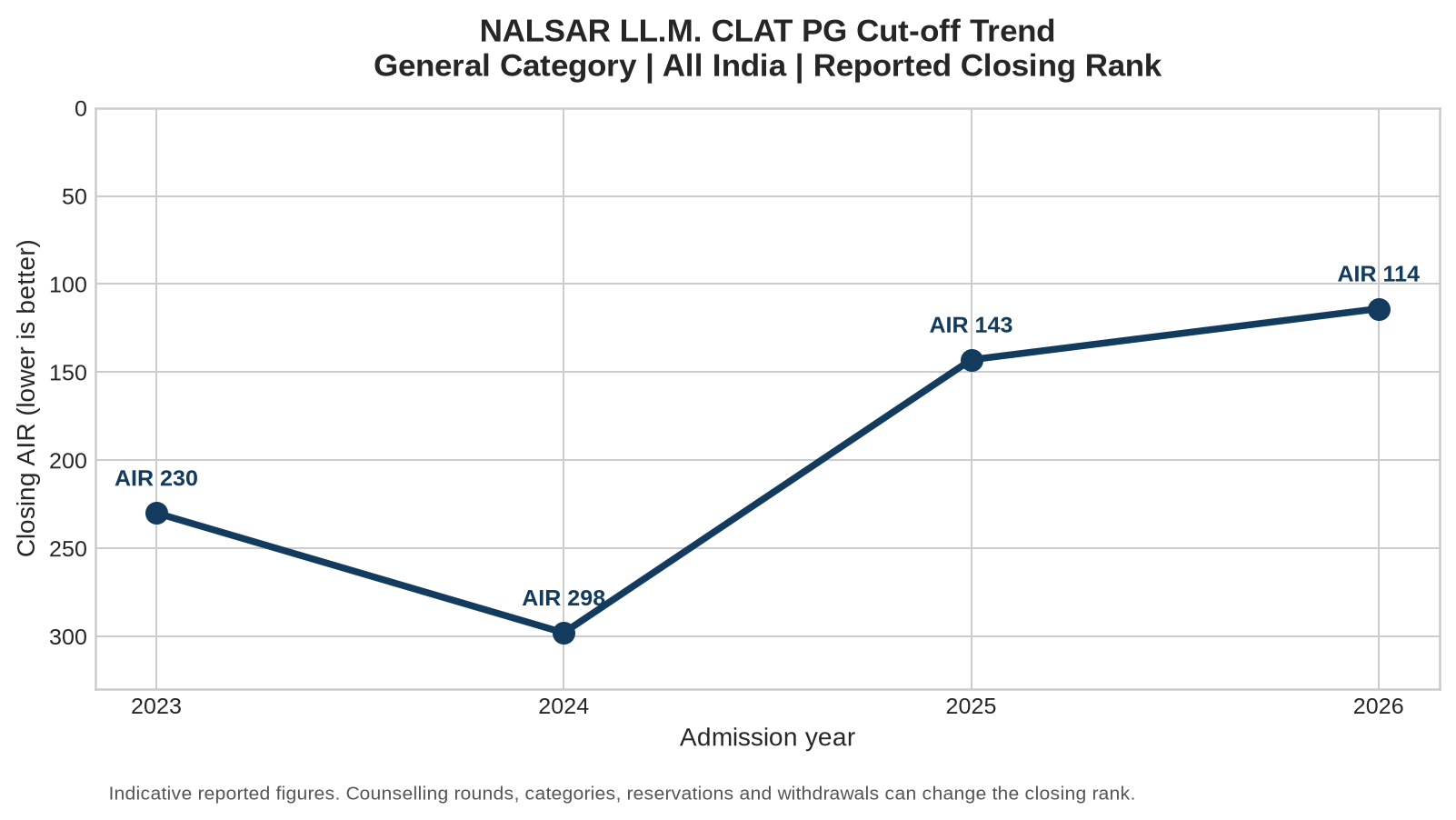
The following graph uses reported General-category All India closing ranks for 2023–2026. The available graph do not always describe every year using precisely the same counselling round, and later rounds can move substantially after withdrawals.
Admission year
Reported General-category closing AIR
2023
230
2024
298
2025
How to get admission to NALSAR LL.M. through CLAT PG
The process can be understood in six steps:
Complete an LL.B. or appear in the final year, while satisfying the applicable marks requirement.
Register for the relevant CLAT PG examination.
Prepare the CLAT PG syllabus, appear for the 120-question paper and secure a competitive AIR.
Register for Consortium counselling and place NALSAR high in the preference list.
Check the allotment lists and then exercise freeze, float or exit options, at last pay the prescribed confirmation or counselling amount on time.
Complete NALSAR’s document verification, balance-fee payment and registration requirements.
A good rank alone is not enough if a candidate misses a counselling deadline or fails to upload the required documents.
Other LL.M. programme at NALSAR: Insolvency and Bankruptcy Laws
NALSAR also offers a separate two-year LL.M. in Insolvency and Bankruptcy Laws in collaboration with the Indian Institute of Corporate Affairs (IICA). This is different from the one-year LL.M. through CLAT PG.
The two-year programme is conducted across NALSAR, Hyderabad and IICA, New Delhi, according to the programme structure. Admission is through a separate online entrance examination followed by a personal interview. It is not obtained through the ordinary CLAT PG allotment route.
The programme is aimed at students who specifically want to study insolvency, bankruptcy, restructuring and related corporate-regulatory law. Candidates should check the individual notification at NALSAR’s website for eligibility, dates, fee, test pattern and seat details before applying.
Frequently asked questions
Is NALSAR LL.M. admission through CLAT PG one year or two years?
The candidates admitted at NALSAR LL.M. through CLAT PG are considered to be the part of one-year full-time programme. NALSAR separately offers a two-year LL.M. in Insolvency and Bankruptcy Laws through its own entrance examination and interview process.
Can a final-year LL.B. student apply?
Yes, subject to CLAT and NALSAR rules. The candidate must produce proof of passing the qualifying law degree within the prescribed timeline.
Is NALSAR’s NIRF rank the same as its CLAT cut-off rank?
No. NALSAR was ranked third in the NIRF 2025 Law category. The CLAT cut-off is an AIR used for admission and changes from year to year.
Is AIR 100 guaranteed to secure NALSAR?
No. AIR 100 is a strong target for a General-category All India candidate, but it is not a guarantee. Category, seat allocation, counselling preferences and the year’s movement affect the result.