
National Honour (Amendment) Bill, 2026: National Song, Vande Matram Gets Equal Protection
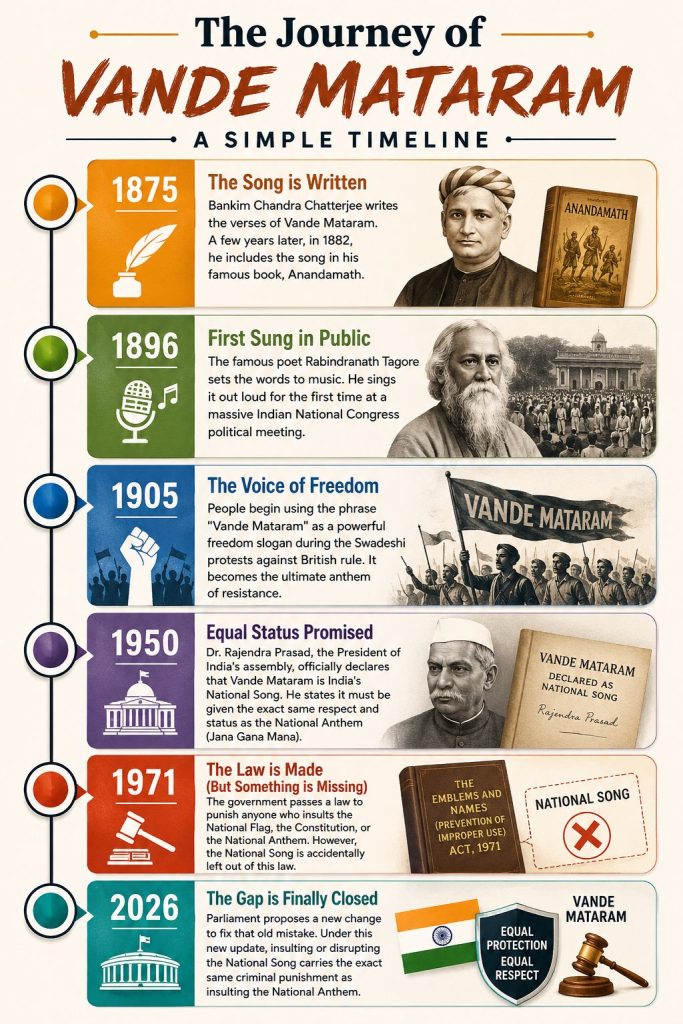
Recently on 24th July, 2026 our home minister Amit Shah introduced the Prevention of Insults to National Honour (Amendment) Bill, 2026 in the Rajya Sabha. The bill aims to protect the national song ‘Vande Matram’ in the same manner as the national anthem is given protection under the Prevention of Insults to National Honour Act, 1971. The bill had been passed by the rajya sabha on 29th july, 2026, and by lok sabha on 30th july, 2026.
Statutory provisions of 1971 Act.
To understand the new changes, it is necessary to look at the original framework of 1971 act –
- Section 2 of the act penalises the burning, trampling, defacing, mutilating, or destroying of the national flag or constitution of India. However, constructive criticism of the same is protected.
- Section 3 penalises the act of ‘intentionally’ disturbing or preventing anyone from singing the National Anthem.
- Section 3A provides for enhanced penalties on second and subsequent convictions for offences mentioned above of minimum one year. Prevention of Insults to National Honour (Amendment) Act, 2003 added this section.
Key features of the bill
- Purpose – It gives the national song ‘Vande Matram’ the same legal protection as of the national anthem.
- Offence – Criminalizes the act of intentionally insulting Vande Mataram, or causing or disturbing anyone from reciting it as a crime.
- Punishment – Offenders face up to the 3 years of imprisonment with fine or both. On second or subsequent offence, one year minimum punishment is mandatory.
Need for the Amendment
The bill aimed at amending the parent act ‘Prevention of Insults to National Honour Act, 1971’. The original act safeguards the national anthem ‘Jana Gan Mana’ the only patriotic song, by criminalizing any act which insults or intentionally disturbs the assembly reciting it. The 2026 bill aims to safeguard the national song ‘Vande Matram’ by criminalizing insult or disruption in the same manner.
The change honour’s the will of Dr. Rajendra Prasad who gave the statement on 24th January 2026, that the national song ‘vande matram’ played a historical role in the freedom struggle for India thus it shall hold an equal status and honour as national anthem. Apart from honoring Dr. Prasad’s constitutional vision, the government planned the bill to align with the ongoing 150th anniversary commemorations of Vande Matram.
Comparative analysis of 1971 Act & 2026 Amendment Bill
| Statutory feature | 1971 Act | 2026 Amendment bill |
| Section 3 | Only protected National Anthem (Jana Gana Mann). | Includes both National Anthem (Jana Gana Mann) & National Song (Vande Matram). |
| Prohibition on conduct |
Political & legal criticism on the Bill
Legal experts questioned that, since the bill explicitly uses the word ‘intentional’, whether the simple act of a person choosing not to sing or remaining silent will create the criminal liability. They question whether the courts ruling in ‘Bijoe Emmanuel’, which protected standing respectfully without reciting the national anthem under Article 19(1)(a) and Article 25 would similarly protect the person’s right to remain silent during national song.
The opposition strongly opposed the bill stating that the national song contains several stanzas, which contains hindu deity names such as durga and lakshmi. So, if the government instructs to recite all the stanzas, it will directly conflict with religious beliefs of minorities. Therefore, this won’t unite, rather divide the people.
While both the houses have successfully passed the bill, it now awaits presidential assent. The supreme court will soon review the legality and challenges to this bill and will provide the balance between the bill and personal freedom soon.
Subscribe for updates
Join 10,000+ subscribers.
JU
Julie Nigam
Contributing author
Have a doubt about this?Ask Doubts
