
Nuisance under the Law of Torts: Meaning, Essentials, Types, Defences, Landmark Cases & Remedies!
Introduction
The law of torts protects not only a person’s body and property but also their right to enjoy life and property without unreasonable interference. In a civilized society, individuals must tolerate ordinary inconveniences arising from the lawful activities of others. However, when such interference becomes substantial and unreasonable, the law treats it as a nuisance and grants relief to the affected person.
Unlike trespass, which involves direct and immediate interference, nuisance generally arises from indirect interference such as excessive noise, smoke, vibrations, foul odours, pollution, water leakage, or hazardous activities. The tort of nuisance seeks to balance competing rights by ensuring that one person’s lawful use of property does not unreasonably interfere with another’s peaceful enjoyment of life or land.
Meaning and Definition of Nuisance
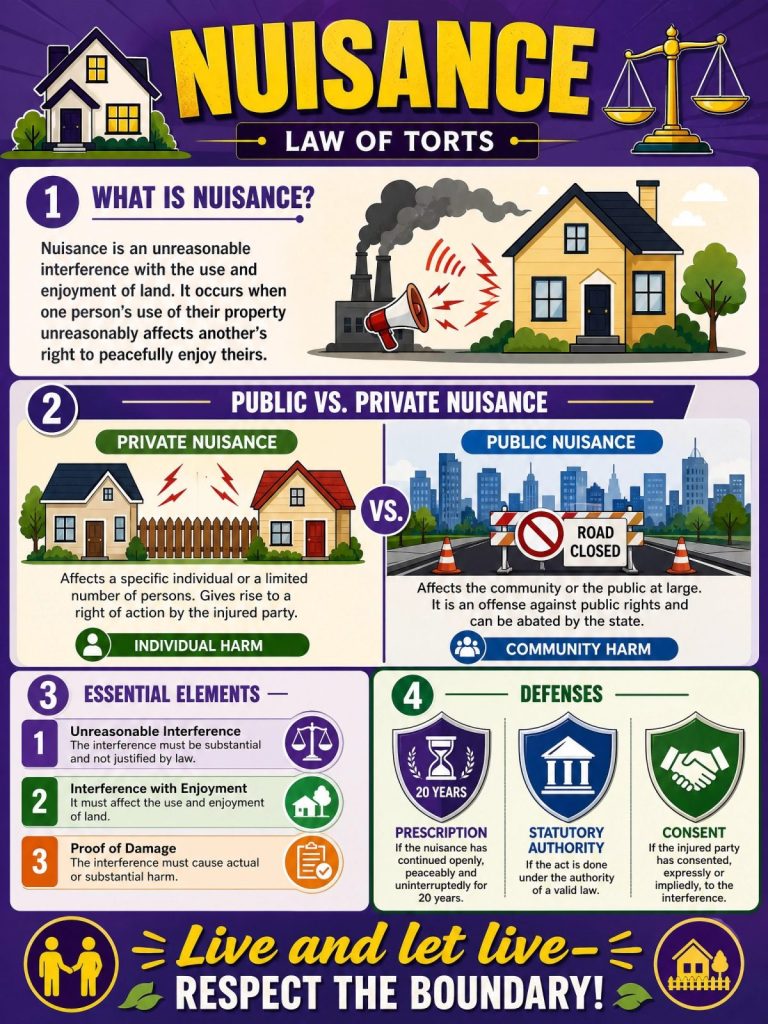
The term nuisance refers to an unlawful interference with a person’s use or enjoyment of land or with a right enjoyed by the public.
According to Winfield, nuisance is “an unlawful interference with a person’s use or enjoyment of land, or of some right over or in connection with it.”
Similarly, Salmond defines nuisance as “the wrong done to a person by unlawfully interfering with his use or enjoyment of land or some right connected with it.”
Therefore, nuisance does not arise merely because an act causes inconvenience. The interference must be substantial, unreasonable, and recognised by law as actionable.
Essentials of Nuisance
To establish liability for nuisance, the plaintiff must prove certain essential elements.
1. There Must Be an Unreasonable Interference
The interference must exceed the level of inconvenience that an ordinary person is expected to tolerate in society. Courts determine reasonableness by considering factors such as the nature of the locality, duration, frequency, and intensity of the interference.
Illustration: A factory operating loud machinery throughout the night in a residential colony may constitute nuisance because the continuous noise substantially interferes with the neighbours’ peaceful enjoyment of their homes.
2. The Interference Must Affect the Use or Enjoyment of Land or a Public Right
The wrongful act must interfere either with the plaintiff’s enjoyment of land or with a public right shared by the community.
The interference may arise from smoke, dust, foul odours, vibrations, excessive noise, polluted water, dangerous trees, or any activity that materially affects normal use of property.
Illustration: Continuous discharge of toxic fumes from a nearby factory that makes neighbouring houses unfit for comfortable living may amount to nuisance.
3. The Damage Must Be Real and Substantial
The law does not recognise trivial annoyance or minor inconvenience. The plaintiff must establish that the interference caused material discomfort, inconvenience, physical injury, or damage to property.
The standard applied is objective. Courts examine the effect on an ordinary reasonable person rather than someone with exceptional sensitivity.
Illustration: Minor construction noise during daytime may not amount to nuisance, but continuous drilling late at night for several weeks is likely to be actionable.
Types of Nuisance
The law broadly classifies nuisance into Public Nuisance and Private Nuisance.
1. Public Nuisance
Public nuisance is an unreasonable interference with rights enjoyed by the public at large. It affects an entire community or a considerable section of society rather than an individual alone.
Common examples include obstructing public roads, polluting rivers, causing hazardous emissions, or creating excessive public noise.
Landmark Case: In Rose v. Miles (1815), the defendant obstructed a public navigable waterway, forcing the plaintiff to transport goods by land at additional expense. The Court held that although public nuisance primarily affects the community, a private action is maintainable where the plaintiff suffers special damage beyond that suffered by the general public.
Illustration: Blocking the entrance to a public hospital or erecting an illegal structure on a public road amounts to public nuisance because it interferes with public rights.
2. Private Nuisance
Private nuisance involves an unlawful interference with an individual’s use or enjoyment of land. It generally affects a particular person or a limited number of individuals rather than the public as a whole.
Private nuisance may result from smoke, dust, vibrations, overflowing water, offensive smells, excessive noise, or dangerous conditions on neighbouring property.
Landmark Case: In St. Helen’s Smelting Co. v. Tipping (1865), fumes emitted from the defendant’s factory damaged the plaintiff’s trees and crops. The House of Lords held that where nuisance causes physical damage to property, liability cannot be avoided merely because the locality is industrial.
The decision established that actual damage to property is always actionable, irrespective of the character of the locality.
Illustration: A restaurant continuously emitting smoke and strong cooking odours that make neighbouring flats uncomfortable to live in may be liable for private nuisance.
Factors Considered by Courts
Whether an act amounts to nuisance depends on the facts and circumstances of each case. Courts generally consider the following factors:
1. Nature of the Locality
The character of the locality significantly influences the determination of nuisance. Activities acceptable in an industrial area may be unreasonable in a residential neighbourhood.
2. Duration of the Interference
A temporary inconvenience rarely amounts to nuisance. Continuous or recurring interference is more likely to attract liability.
3. Intensity of the Harm
Courts assess the seriousness and frequency of the interference. The greater the impact on ordinary life, the stronger the claim.
4. Sensitivity of the Plaintiff
The law protects ordinary use of property, not extraordinary sensitivity.
Landmark Case: In Robinson v. Kilvert (1889), the plaintiff stored unusually delicate paper that was damaged by heat generated from the defendant’s ordinary business operations. The Court held that the defendant was not liable because the activity would not have affected ordinary property.
Defences to Nuisance
Although nuisance protects private and public rights, the defendant may avoid liability by proving a recognised defence.
1. Statutory Authority
An act expressly or impliedly authorised by a statute is generally not actionable as a nuisance, provided it is carried out without negligence.
Illustration: A municipal authority excavating roads to repair underground pipelines under statutory powers is generally protected from liability if reasonable precautions are taken.
2. Prescription
A person may acquire the legal right to continue an activity amounting to nuisance if it has been openly, peacefully, and continuously carried on for the statutory period without interruption.
3. Consent
If the plaintiff has voluntarily agreed to the activity causing the interference, they cannot subsequently claim that it amounts to nuisance.
However, the consent must be free and informed.
4. Act of God
Where the nuisance results solely from extraordinary natural events that no human foresight or reasonable care could prevent, the defendant may rely on the defence of Act of God.
What Is Not a Defence?
Coming to the Nuisance
A defendant cannot escape liability merely because the plaintiff moved near the defendant’s existing activity.
Landmark Case: In Sturges v. Bridgman (1879), the defendant had operated noisy machinery for several years before the plaintiff built a consulting room nearby. The defendant argued that the plaintiff had “come to the nuisance.”
The Court rejected this argument and held that every occupier has the right to reasonable enjoyment of their property. The fact that the plaintiff arrived later did not deprive them of legal protection.
This decision firmly established that coming to the nuisance is not a valid defence.
Remedies for Nuisance
A successful plaintiff may seek one or more of the following remedies.
1. Damages
The court may award compensation for physical injury, property damage, financial loss, or loss of enjoyment resulting from the nuisance.
2. Injunction
An injunction restrains the defendant from continuing or repeating the nuisance. It is particularly useful where the interference is continuous or likely to recur.
3. Abatement
In limited circumstances, the injured person may remove the nuisance without approaching the court, provided they act reasonably and do not cause unnecessary damage.
Illustration: A property owner may trim branches of a neighbour’s tree that extend onto their land, subject to the applicable legal limitations.
Public Nuisance vs. Private Nuisance under Law of Torts in India
| Basis | Public Nuisance | Private Nuisance |
| Nature | Affects the public or a large section of society. | Affects an individual or a limited group of persons. |
| Right Violated |
The tort of nuisance plays a crucial role in maintaining a balance between individual rights and community interests. While every person is free to use their property, they must exercise this right responsibly and without causing unreasonable interference to others. Courts determine nuisance by considering the nature, extent, and reasonableness of the interference rather than merely the existence of inconvenience.
Subscribe for updates
Join 10,000+ subscribers.
SH
Shruti chauhan
Contributing author
Have a doubt about this?Ask Doubts
