
Polluter Pays Principle Under Environmental Law: Meaning, Origin, and Landmark Judgments
Introduction
Every year, industries dump untreated waste into rivers, factories release toxic gases into the air, and companies extract natural resources without repairing the damage they leave behind. For a long time, the cost of this destruction was quietly passed on to society, to the farmer whose land turned barren, to the fisherman whose river ran dry, and to the taxpayer who funded the cleanup. The Polluter Pays Principle changed this equation. It places the financial burden of pollution back where it belongs, on the polluter.
This article explains what the Polluter Pays Principle means, where it came from, how Indian courts have applied it, and why it remains one of the most important tools in environmental law today.
What Is the Polluter Pays Principle
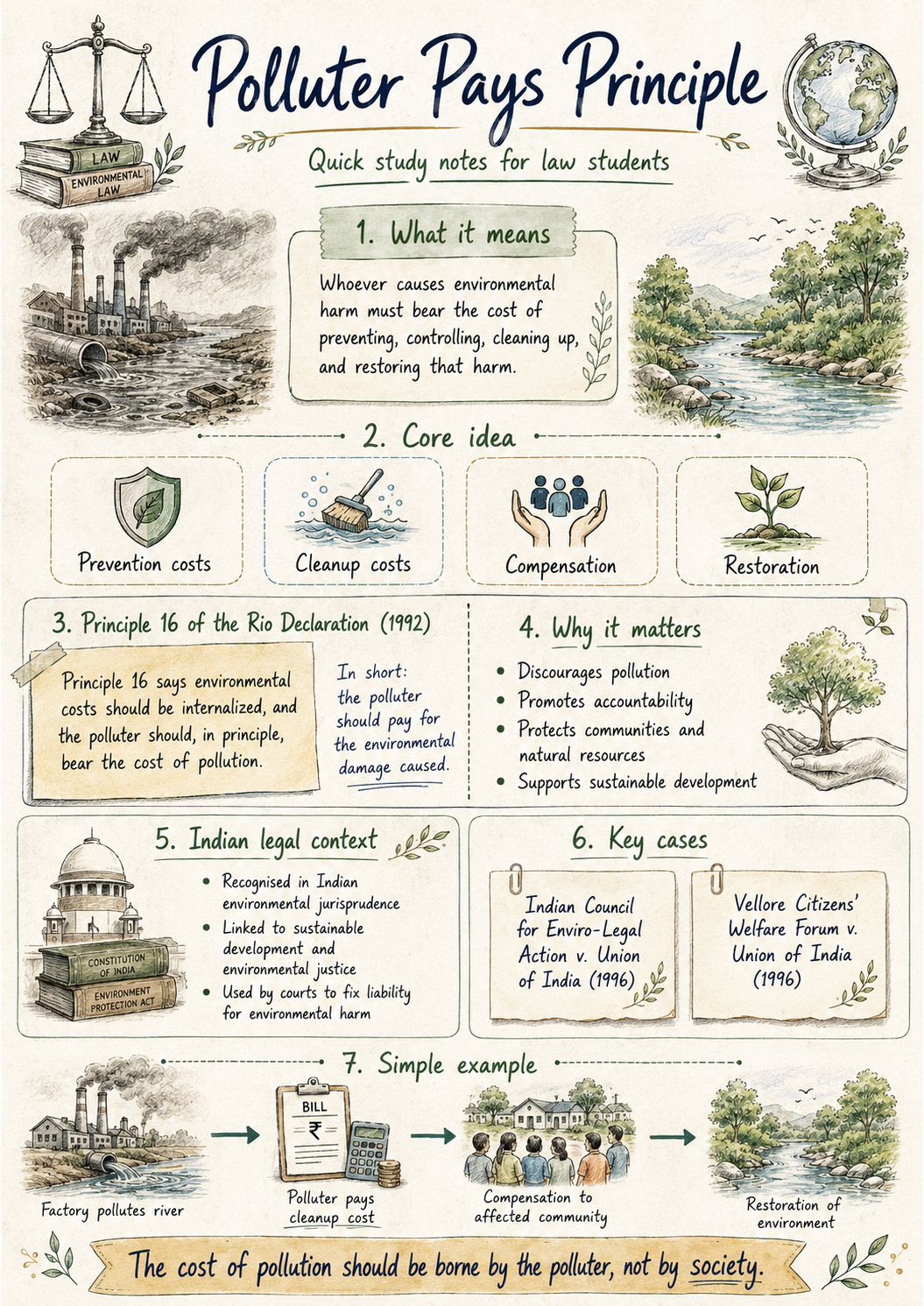
The Polluter Pays Principle states that a person, company, or entity that causes environmental pollution must bear the cost of preventing, controlling, and remedying that pollution. It is a simple idea rooted in fairness. If an industry profits from an activity that harms the environment, the same industry should pay for the harm caused rather than shifting that burden onto the public or the government.
The principle covers two broad responsibilities. First, the polluter must pay to prevent pollution from occurring in the first place, for example by installing treatment plants or pollution control equipment.
Second, if pollution has already occurred, the polluter must pay for cleanup, restoration of the damaged environment, and compensation to the victims affected by it.
Origin of the Polluter Pays Principle
The concept did not originate in India. It first appeared in international environmental policy discussions in the 1970s.
In 1972, the Organisation for Economic Co-operation and Development, commonly known as the OECD, formally recommended that the cost of pollution control should be borne by the polluter rather than by governments through subsidies.
The idea was primarily economic at that stage. It aimed to prevent distortions in international trade that would occur if some countries subsidised polluting industries while others did not.
The principle gained wider global recognition through the Rio Declaration on Environment and Development, adopted at the United Nations Conference on Environment and Development held in Rio de Janeiro in 1992.
Principle 16 of the Rio Declaration stated that national authorities should promote the internalisation of environmental costs, with the polluter bearing the cost of pollution, taking into account the public interest, without distorting international trade and investment.
From this point, the Polluter Pays Principle evolved from a purely economic tool into a recognised principle of environmental justice, adopted by countries around the world, including India.
Legal Basis of the Polluter Pays Principle in India
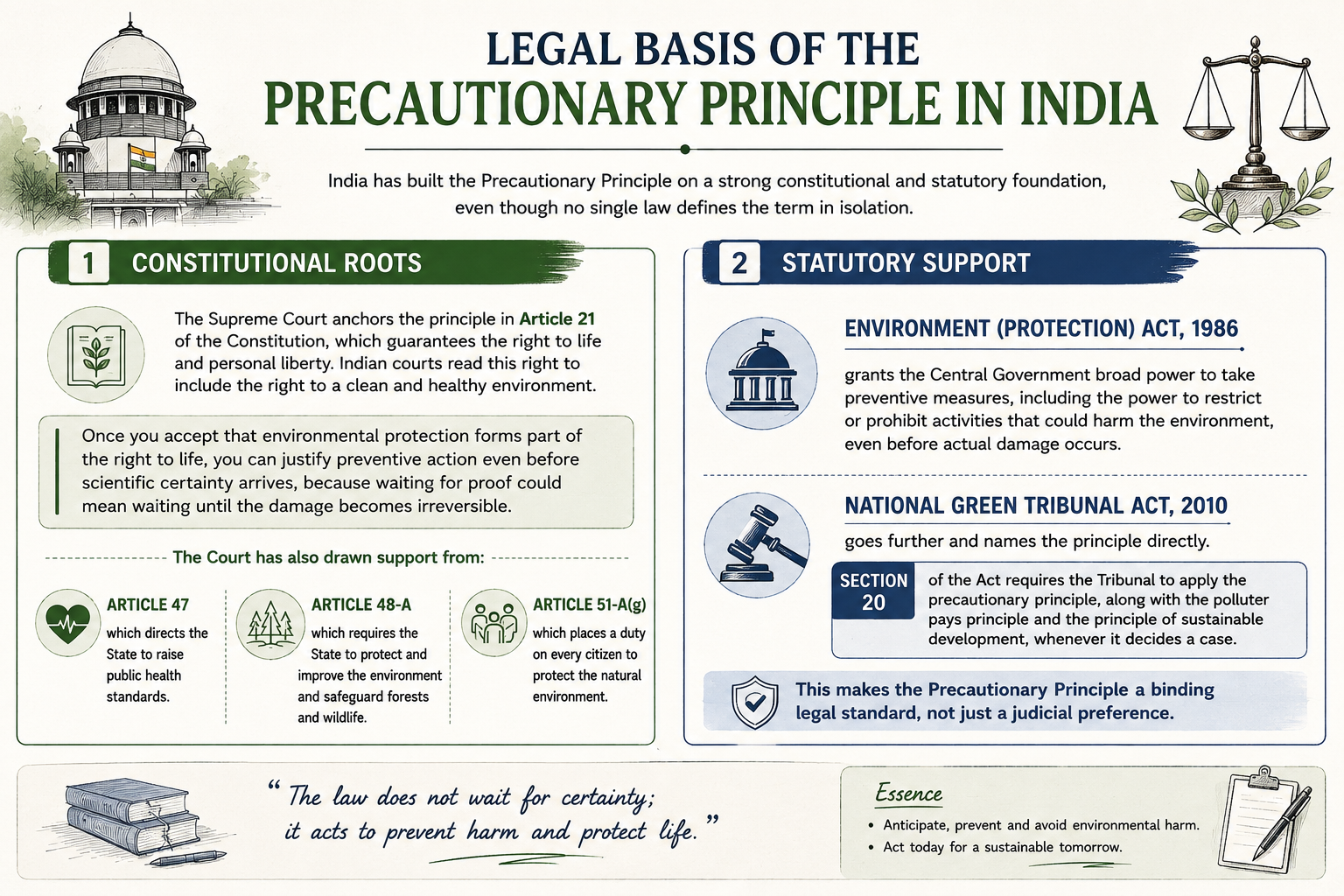
India does not have one single statute that defines or codifies the Polluter Pays Principle in explicit terms. Instead, the principle has developed largely through judicial interpretation, supported by constitutional provisions and environmental legislation.
Landmark Judgments on the Polluter Pays Principle
Indian courts have played the leading role in developing and applying the Polluter Pays Principle. Some of the most significant judgments are discussed below.
Indian Council for Enviro-Legal Action v. Union of India (1996)
Also known as the Bichhri Village case, this matter involved chemical industries in Bichhri, Rajasthan, that discharged highly toxic sludge and effluents, causing severe damage to soil, groundwater, and the health of local residents.
The Supreme Court held that once an industry engages in a hazardous or inherently dangerous activity, it owes an absolute and non-delegable duty to the community to ensure that no harm results, and that if harm does result, the industry is strictly liable to compensate for it.
The Court made clear that this liability extends beyond compensating individual victims and also includes the cost of restoring the damaged environment. This case is widely regarded as the point at which the Polluter Pays Principle was firmly established as part of Indian environmental jurisprudence.
Vellore Citizens' Welfare Forum v. Union of India (1996)
This case dealt with large scale pollution caused by tanneries and other industries in Tamil Nadu, which discharged untreated effluents that contaminated the Palar river and rendered groundwater in the region unfit for drinking and agriculture.
The Supreme Court held that the Precautionary Principle and the Polluter Pays Principle are essential features of sustainable development, and that both principles form part of the environmental law of the country. The Court directed the polluting tanneries to compensate affected villagers and to pay for restoring the ecology of the affected area.
This judgment is particularly important because it formally recognised sustainable development as a balancing concept between economic growth and environmental protection, with the Polluter Pays Principle serving as one of its core components.
M.C. Mehta v. Union of India, the Taj Trapezium Case (1997)
This case addressed the damage caused to the Taj Mahal by pollution from industries operating in the surrounding area, known as the Taj Trapezium Zone. Emissions from these industries were causing discolouration and corrosion of the monument's marble surface.
The Supreme Court directed industries in the zone to either switch to cleaner fuel sources such as natural gas or relocate away from the area. The judgment reinforced the idea that industries causing environmental harm bear the responsibility of taking corrective action, reflecting the practical application of the Polluter Pays Principle even where the harm was to a cultural monument rather than to public health directly.
Sterlite Industries and Subsequent NGT Rulings
In more recent years, the National Green Tribunal has actively enforced the Polluter Pays Principle in line with its statutory mandate under Section 20 of the NGT Act.
Industries and even government bodies have been held liable and directed to pay substantial sums as environmental compensation for violations ranging from industrial pollution to unchecked dumping of waste on riverbanks.
These rulings confirm that the principle applies not only to private industry but also to public authorities that fail in their duty to prevent environmental harm.
How the Polluter Pays Principle Works in Practice
The application of the principle generally follows a few consistent steps in Indian environmental adjudication.
First, courts or tribunals determine whether an activity is hazardous or has caused environmental degradation. Where the activity is inherently dangerous, courts have applied the principle of strict and even absolute liability, meaning the polluter is held responsible regardless of whether they took precautions or acted without negligence.
Second, once liability is established, the polluter is directed to compensate the victims who suffered harm, whether through loss of health, livelihood, or property.
Third, the polluter is also directed to bear the cost of restoring the environment to its original condition as far as possible. This may include remediation of contaminated soil, restoration of water bodies, or reforestation.
Fourth, in many cases, courts and tribunals also impose the cost of running the litigation or the cost of authorities that had to intervene to detect and stop the pollution.
Modern Applications: Extended Producer Responsibility
A contemporary extension of the Polluter Pays Principle is Extended Producer Responsibility, often referred to as EPR. Under this concept, manufacturers are made responsible for the entire life cycle of their products, including collection and disposal after the product is used.
India has applied this concept through rules covering plastic packaging, electronic waste, and battery waste, requiring producers to fund and organise the collection and recycling of these materials rather than leaving the burden on municipal authorities and taxpayers.
Subscribe for updates
Join 10,000+ subscribers.
SH
Shruti chauhan
Contributing author
Have a doubt about this?Ask Doubts
