
Preamble of the The Constitution of India
The Preamble of the Constitution of India reads as follows:
WE, THE PEOPLE OF INDIA, having solemnly resolved to constitute India into a SOVEREIGN SOCIALIST SECULAR DEMOCRATIC REPUBLIC and to secure to all its citizens
JUSTICE, social, economic and political;
LIBERTY of thought, expression, belief, faith and worship;
EQUALITY of status and of opportunity;
and to promote among them all FRATERNITY
assuring the dignity of the individual and the unity and integrity of the Nation;
IN OUR CONSTITUENT ASSEMBLY this 26th day of November 1949, do HEREBY ADOPT, ENACT AND GIVE TO OURSELVES THIS CONSTITUTION.
The preamble to the Constitution of India is a brief introductory statement that sets out the guiding purpose, principles and philosophy of the constitution. The Preamble to the Indian Constitution is based on the ‘Objectives Resolution’, drafted and moved by Pandit Nehru, and adopted by the Constituent Assembly. It has been amended by the 42nd Constitutional Amendment Act (1976), which added three new words —socialist, secular and integrity.
In Golak Nath v. State of Punjab Justice Subba Rao said that the objective sought to be achieved by the Constitution is declared in sonorous terms in its preamble. It contains, in a nutshell, its ideals and its aspirations. The preamble is not a platitude. The mode of its realization is worked out in detail in the Constitution.
The Preamble reveals four ingredients or components:
- Source of the authority of the Constitution: The Preamble states that the Constitution derives its authority from the people of India.
- Nature of Indian State: It declares India to be of a sovereign, socialist, secular democratic and republican polity.
- Objectives of the Constitution: It specifies justice, liberty, equality and fraternity as the objectives.
- Date of adoption of the Constitution: It stipulates November 26, 1949 as the date
The preamble can be viewed in two parts. In the first part is speaks of values of sovereignty, socialism, secularism, democracy and republic as the nature of Indian polity. In the second part, it guarantees values of justice JUSTICE- social, economic and political. LIBERTY of thought, expression, belief, faith and worship. EQUALITY of status and of opportunity and to promote among them all FRATERNITY
Features of the Preamble
Sovereign– Implies that India is neither a dependency nor a dominion of any other nation, but an independent state.
Socialism-Indian brand of socialism is a ‘democratic socialism’ which involves the nationalization of all means of production and distribution and the abolition of private property.
Secular-All religions in our country (irrespective of their strength) have the same status and support from the state
Democratic– This polity is based on the doctrine of popular sovereignty, that is, possession of supreme power by the people.
Republic-The head of the state is always elected directly or indirectly for a fixed period.
Justice-In the Preamble embraces three distinct forms—social, economic and political, secured through various provisions of Fundamental Rights and Directive Principles.
Liberty– Means the absence of restraints on the activities of Individuals and providing opportunities for the development of individual personalities.
Equality-Means the absence of special privileges to any section of the society, and the provision of adequate opportunities for all individuals without any discrimination.
Fraternity-Means a sense of brotherhood.
One of the controversies about the Preamble is as to whether it is a part of the Constitution or not. In the Berubari Union case (1960), the Supreme Court specifically opined that Preamble is not a part of the Constitution. In the Kesavananda Bharati v. State of Kerala (1973), the Supreme Court rejected the earlier opinion and held that Preamble is a part of the Constitution.
The question as to whether the Preamble can be amended under Article 368 of the Constitution arose for the first time in the historic case Kesavananda Bharati v. State of Kerala (1973), the Court held that the basic elements or the fundamental features of the Constitution as contained in the Preamble cannot be altered by an amendment under Article 368.
Importance of Preamble
- It states the source of authority. The source of authority is the people of India.
- The preamble of the Indian Constitution reflects the basic philosophy of the framers of the Constitution.
- Preamble states when the constitution was adopted and enacted
- It also states the nature of the state and also makes commitments towards social, economic and political justice to all citizens.
- The preamble of the Constitution states its objectives
Sources of Constitution
The main sources may be identified as-
Government of India Act, 1935: Federal Scheme, Office of Governor, Judiciary, Public Service Commissions, Emergency provisions, Administrative details.
British Constitution: Parliamentary government, Rule of Law, Legislative procedure, Single citizenship, Cabinet System, Prerogative Writs.
US Constitution: Fundamental Rights, Independence of Judiciary, Judicial Review, Impeachment of the President, Removal of Supreme Court and High Court judges and post of Vice-President.
Irish Constitution: Directive Principles of State Policy, the nomination of members to Rajya Sabha and method of election of President, Federation with a strong centre, Vesting of residuary powers in the Center, the appointment of State Governors by the Center and advisory jurisdiction of the Supreme Court.
Canadian Constitution: Federation with a strong centre, residuary powers with the centre, appointment of state governors by the centre and advisory jurisdiction of the Supreme Court.
Australian Constitution: Concurrent List, Freedom of trade, commerce and intercourse joint sitting of the two Houses of Parliament.
Weimar Constitution: Suspension of Fundamental Rights during Emergency.
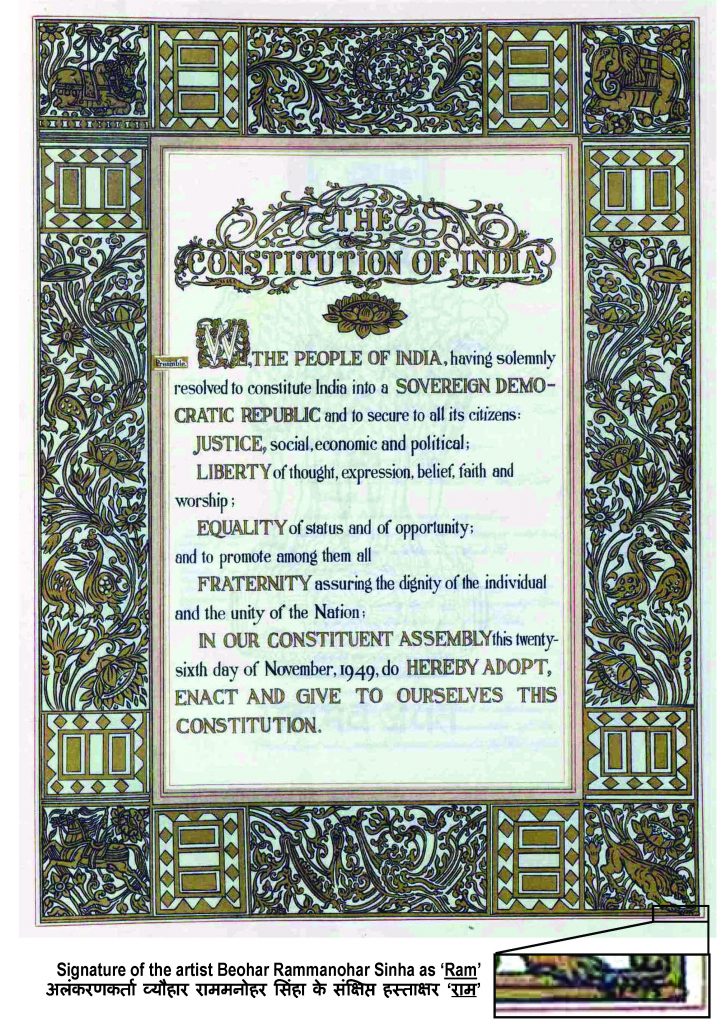
The preamble of the Indian Constitution
Soviet Constitution: Fundamental duties, the idea of justice (social, economic and political) in the Preamble.
French Constitution: Republic and the ideals of liberty equality and fraternity in the Preamble.
South African Constitution: Procedure for amendment, the Constitution and election of the members of Rajya Sabha.
Japanese Constitution: Procedure established by law. The drafted Constitution was finally adopted on November 26, 1949.
Many of the features can be said to have sourced/influenced/borrowed from multiple sources. For example, India has a federal scheme with a strong centre. Each of these concepts is intertwined with the social and political history of civilization, the battle of ideas and system of Governance. The American Revolution, The French Revolution, The Russian Revolution and India’s own freedom struggle contributed to these concepts.
Subscribe for updates
Join 10,000+ subscribers.
HA
Harshita Gulati
Contributing author
Have a doubt about this?Ask Doubts
