Nature, Scope and Sources: Public International Law
Meaning of Public International Law
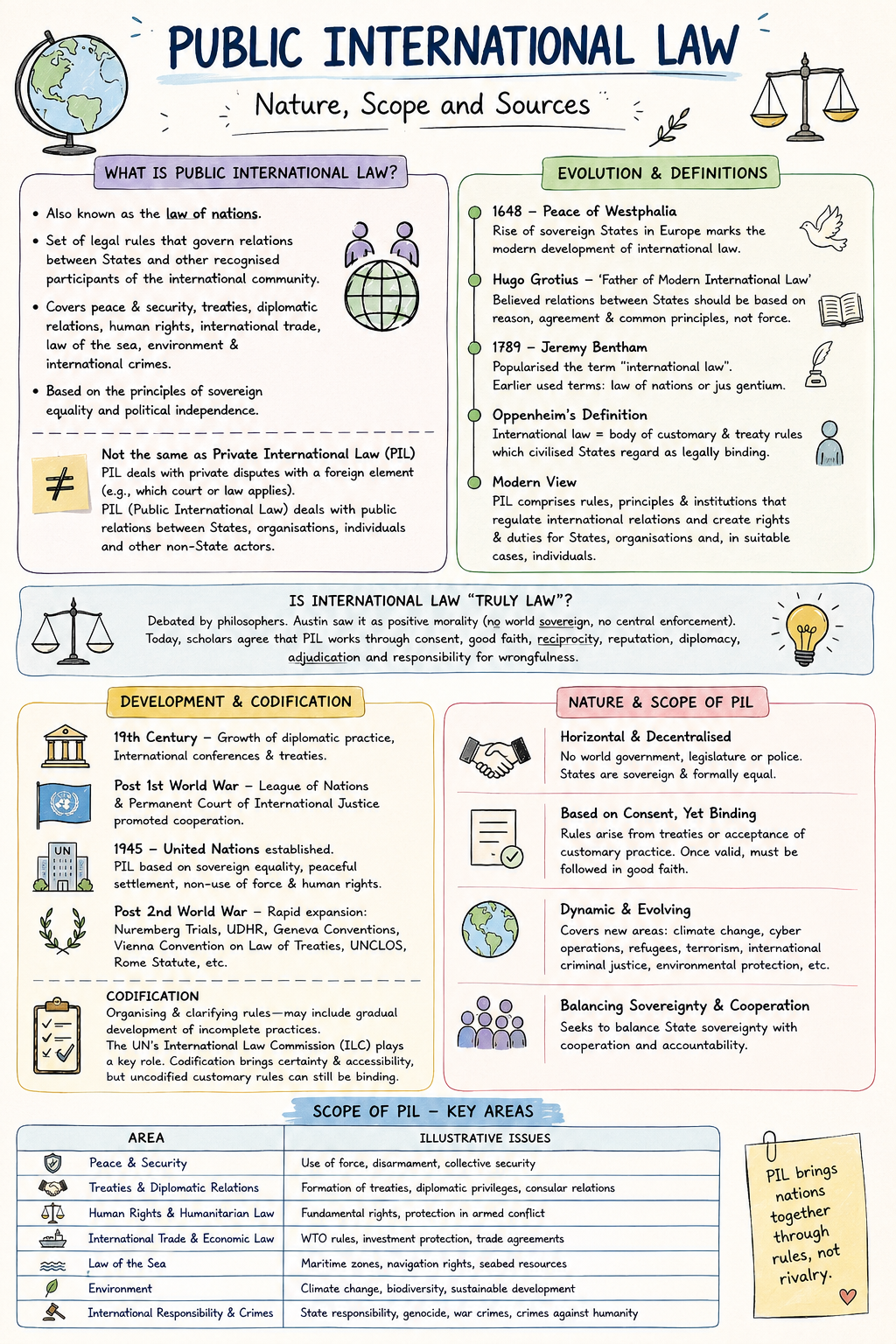
Public International Law (PIL), which is also known as the law of nations, consists of the set of legal rules that regulate the relationships between States and other participants in the international community that are recognized. It covers issues such as peace and security, treaties, diplomatic relations, human rights, international trade, the law of the sea, environmental protection and international crimes. It establishes common rules for politically independent and legally equal countries.
It is necessary to distinguish between PIL and Private International Law. Private international law deals with private disputes which have a foreign element. Like, deciding which country’s court should hear a case or which law should apply to an international contract. Whereas PIL mainly involves public relations between States, international organisations, individuals and other non-State actors.
Evolution and definitions
The development of international law in modern times is closely linked to the emergence of sovereign States in Europe and the Peace of Westphalia in 1648. People like Hugo Grotius, who is frequently referred to as the ‘father of modern international law’, maintained that relations between States could be based on reason, agreement and common principles rather than on force alone.
The term “international law” was promoted by Jeremy Bentham in 1789. Earlier authors generally employed phrases like the law of nations or jus gentium. The terminology introduced by Bentham emphasized the fact that the law governs relations between nations, even though modern PIL extends beyond relations between governments alone.
There is no single definition which is generally accepted. According to Oppenheim, international law may be described as the collection of customary and treaty rules which civilised States regard as legally binding when acting towards one another. This definition illustrates the traditional approach which is centred on the State.
At present, however, a wider definition is favoured i.e. Public International Law comprises the rules, principles and institutions which regulate international relations and establish rights and duties for States, organisations and, in suitable cases, individuals.
The question of ‘whether international law is truly law?’ has been discussed by various philosophers. Austin considered it to be positive morality since there was no world sovereign legislature and no central enforcement bodies. Nowadays, scholars argue that law does not have to rely on a single authority and that PIL functions via consent, good faith, reciprocity, reputation, diplomacy, adjudication and responsibility for wrongfulness.
Development and codification
In the 19th century diplomatic practice, international conferences and treaties all developed. Following the 1st World War the League of Nations and the Permanent Court of International Justice were set up to promote cooperation. When the United Nations was founded in 1945, PIL gained a more solid basis. It focused on sovereign equality, the peaceful settlement of disputes, the non-use of force and human rights.
Following the 2nd World War, PIL experienced rapid expansion. Individual responsibility for international crimes was brought about by the Nuremberg trials. Examples of this expansion include the Universal Declaration of Human Rights, the Geneva Conventions, the Vienna Convention on the Law of Treaties, the UN Convention on the Law of the Sea and the Rome Statute.
Codification involves organizing, clarifying and setting down in a formal manner rules which might have previously existed as part of customs and practices. It does not simply consist in copying the existing law. It also includes the step-by-step development of rules when the practice in question is incomplete.
The International Law Commission (ILC), which was set up by the UN General Assembly, plays a major role in this process. Codification enhances certainty and ease of access, although a customary rule that has not been codified can still be binding on States in the absence of a treaty.
Nature and scope of PIL
The PIL has a distinctive feature in that it is horizontal and decentralised. Unlike a national system, it does not have a worldwide government, a legislature or a police force. The states are sovereign and officially equal, which is why many rules result from their consent by means of treaties or by way of acceptance of customary practice.
However, the fact that consent has taken place does not mean that international law is optional. Once a treaty is valid it must be carried out in good faith, and customary rules may apply even in the absence of a written agreement.
PIL is also dynamic and constantly growing. It now covers climate change, cyber operations, refugees, terrorism, international criminal justice and environmental protection. It achieves a balance between sovereignty and cooperation as well as accountability.
Its scope can be understood through the following broad areas-
| Area | Illustrative Issues |
| Peace and security | Use of force, self-defence, collective security and peaceful settlement |
| State relations | Recognition, jurisdiction, immunities, diplomatic relations and State responsibility |
| Human welfare |
Subjects of international law
An entity is considered to be a subject of international law if it is able to hold international rights and obligations and, to some extent, can bring or defend an international claim. It has traditionally been believed that the only complete subjects are States, since they have a territory, a population, a government and international independence.
However, the sovereignty of States is restricted by obligations which they have voluntarily accepted and by the generally binding rules of international law.
Organisations on an international level, like the United Nations, are also considered to be subjects since the instruments which establish them confer upon them legal personality and powers.
People are not any longer seen simply as objects of PIL. Under human-rights law, individuals have international rights, whereas international criminal law can place direct duties and criminal responsibility on them. People who are seeking self-determination, national liberation movements, the Holy See and, in some limited cases, organisations such as the International Committee of the Red Cross may have a special or disputed status. The status of corporations and NGOs is determined by the applicable rule or treaty.
Sources of international law
The standard statement of sources is found in paragraph 1 of Article 38 of the Statute of the International Court of Justice and says that the Court shall apply the following:
- International conventions or treaties are written agreements which impose binding obligations on the parties. To them, they can be bilateral or multilateral.
- A treaty binds a State to the extent that it has given its consent to be bound, under the terms of the treaty and subject to any reservations it may have.
- International custom means a general practice that is regarded as law. Two points are significant- consistent State practice, and opinio juris.
- Opinio juris refers to the belief that the practice is followed because it is required by law. Custom becomes especially important in the absence of a treaty.
- The fundamental principles of law include those widely acknowledged in different legal systems, such as acting in good faith, showing equity where appropriate, taking responsibility for wrongful conduct and respecting the finality of judgments. These principles serve to avoid gaps in the legal system.
Article 38 also regards judicial decisions and the writings of highly qualified jurists for the determination of legal rules. International judgments generally do not establish a rule binding on all States, but they assist in interpreting treaties, custom and general principles.
Resolutions of the United Nations, unilateral declarations and ‘soft law’ may have an influence on the law, although the extent of their legal force differs. Peremptory norms (jus cogens), for instance the prohibitions of genocide and slavery, hold a higher status and cannot be overridden by a ordinary treaty.
Relationship between international law and municipal law
Municipal law is the internal or domestic law of a state. There are two main theories concerning its relationship with PIL. The monist theory considers international and domestic law as belonging to a single legal system. In this view, an international rule may be directly applicable within a state on the basis of the Constitution.
The dualist theory, on the other hand, sees them as distinct systems and holds that an international obligation usually needs to be incorporated or transformed by means of domestic legislation before it can be enforced in a national court.
India adopts a practical and generally dualistic method when it comes to treaties. While the Union executive has the authority to conclude treaties. It may be necessary for Parliament to pass legislation in order to put an agreement into effect, as provided for in Article 253 of the Constitution. Although Article 51(c) promotes the respect of international law and treaty obligations, it is a Directive Principle and not directly enforceable.
Indian courts can apply international conventions in interpreting fundamental rights and statutory provisions so long as there is no conflict with domestic law, the Constitution, or existing legislation. It therefore follows that a treaty can have international binding effect even if further domestic actions are required before it can be applied directly in Indian courts.
Conclusion
Public international law constitutes the legal framework for a world that is interdependent. It started out with rules applicable to sovereign states but has since come to offer protection to individuals, regulate international organisations and deal with common global problems.
Even though enforcement is decentralised, public international law is still considered real law since states, institutions and individuals make use of it in order to organise their behaviour, to settle disputes and to assign responsibility.
Students should remember the connection between sovereignty and cooperation, Article 38 of the ICJ Statute, the difference between monism and dualism, and the ongoing expansion of international legal personality.
Subscribe for updates
Join 10,000+ subscribers.
JU
Julie Nigam
Contributing author
Have a doubt about this?Ask Doubts